
We argued recently that official support for renminbi internationalisation has increased over the past few years. But top-level rhetoric does not tell us much about what has motivated the shift. It might also be a lagging reflection of the emerging onshore debate, to which we turn in this note.
Here we zoom in on how onshore commentators conceptualise RMB internationalisation by reviewing 43 Chinese-language articles published since 2024. We find that intellectuals in China remain in the process of defining what ‘RMB internationalisation’ means in practice, and that multiple interpretations coexist. The pattern resembles the early Belt and Road debate: top-level slogans came first, while the operational details were decided in a more decentralized manner over time. Four themes emerge from the discourse, however.
First, broader global use of the RMB is not seen as requiring full capital account liberalisation; the preferred model is “controlled opening” and “conditional convertibility”, contrary to the common view that meaningful RMB internationalisation requires full capital-account liberalisation. Relatedly, discussions of China’s exchange rate system, or how managed the currency is, do not feature prominently and therefore suggest that a fully floating currency isn’t broadly viewed as a requirement for RMB internationalisation, either.
Second, China should first expand renminbi usage in areas where China has a dominant role: goods trade, selected commodities, and receptive partner countries. One implication is that adoption that looks small in global aggregate data could still matter materially for the RMB’s political importance: adoption in major non-Western economies could weigh on the effectiveness of US and EU financial coercion in a non-linear manner.
Third, geopolitical risk and de-dollarisation matter, but appear less central to the discourse locally than internationally. Where discussed, dollar weaponisation is seen as strengthening the case for RMB internationalisation.
Fourth, the bottleneck is no longer just getting RMB offshore. The recycling of renminbi offshore has become a constraint as offshore liquidity has grown faster than the channels available for investing RMB offshore. This means that offshore RMB may “leak” back onshore in search of investment returns.
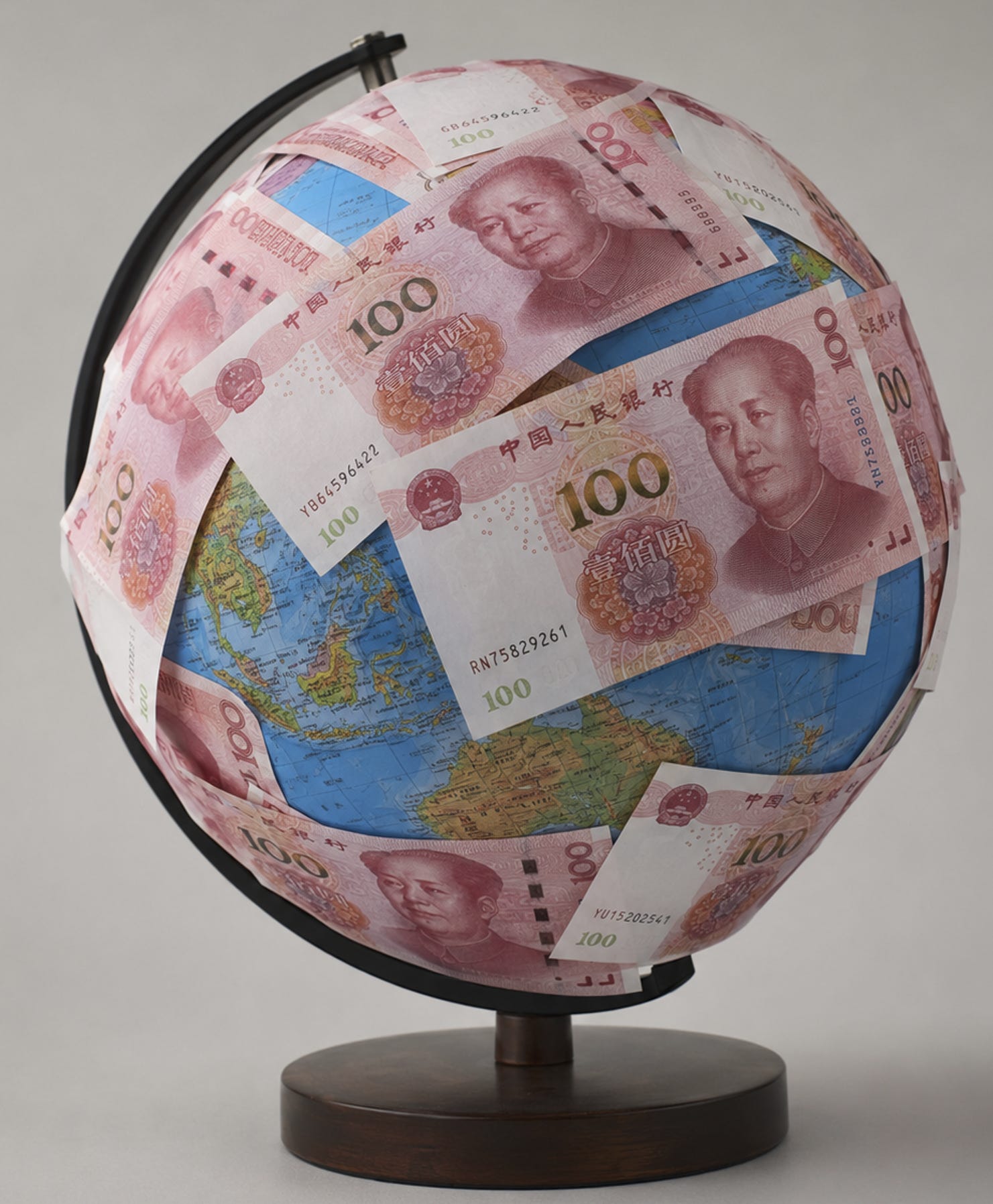
To develop a more granular understanding of how local actors conceptualise RMB internationalisation, we have identified and examined 43 onshore, Chinese-language articles published since 2024 on the topic.
A major takeaway from our analysis is that there doesn’t seem to be a single big plan, and that onshore analysts are also trying to make sense of what RMB internationalisation “is”. Another interpretation is that onshore policy commentators are helping translate broad political guidance into operational policy debate. If true, better understanding the arguments highlighted by onshore intellectuals might provide a guide to the future development for RMB internationalisation.
There are two pieces of context on this front.
The first is that while the lack of a detailed, top-level plan makes outcomes less predictable, it is likely a deliberate choice made in order to give the companies, ministries, and local governments that will execute the plan more leeway in implementing the strategy in line with local realities. Chinese policy documents frequently call for policies to be “adapted to local conditions” (因地制宜) to prevent one-size-fits-all policies that might not work well across the country, given how much variation there is between regions.
A second but related perspective is that Chinese policymakers have a history of “crossing the river by feeling the stones”, or an incremental, cautious approach to reform, emphasising testing, experimentation, and learning from experience before taking the next step. This could well apply to this project, too.
Despite the lack of a comprehensive and detailed top-level plan, there are certain themes that emerge from the 43 articles. These themes are not equally prominent across the sample: some are present across many articles, others less so. We therefore treat the sample less as a survey of decisive consensus than as a map of the arguments currently available within the onshore debate. The most interesting themes are the following:
Controlled internationalisation. Western analysts often argue that capital account liberalisation is a precondition for internationalising the renminbi and that the control over the capital account will be a constraining factor. The Chinese onshore debate is more nuanced, however, though it has coalesced around a more conservative approach that stands at odds with the mainstream Western view.
One group of analysts points out that capital account liberalisation is an important component of RMB internationalisation, with few reservations in terms of the intended end-state. Miao Yanliang, chief FX strategist of CICC, a major Chinese investment bank, for example, argues that “capital-account opening should advance steadily” (link, November 2025). Jia Kang, a senior think tank researcher, has said that “In the past, the lack of free convertibility under the capital account served as a “firewall” against the Asian financial crisis, but in the future, it is necessary to steadily dismantle this “firewall” and gradually achieve free convertibility of the RMB” (January 2024, link).
This group also calls for the renminbi to be more market-driven (or “flexible”). Miao Yanliang also states that the renminbi’s exchange rate should become “more flexible”, though “at an appropriate time”. Liu Shangxi, previously President of the Chinese Academy of Fiscal Sciences, also argues that “the form of exchange rate control would need to become more flexible” (May 2025, link). But across the broader set of articles, the authors do not tend to link (or even mention) China’s exchange rate system to renminbi internationalisation.
Another group of analysts argue that opening must be balanced with control. One example of how this view is framed comes from Qu Manxue, a professor, who argues that China should “continue to promote RMB internationalization in terms of “quantity,” and also, in terms of “quality,” ... [that China should be] finding prudent approaches amid the balance between expanding opening-up and preventing systemic risks; seeking equilibrium between RMB exchange-rate stability and conditional free convertibility of the RMB” (link, February 2024). Wu Xiaoqiu, another professor, argues that there might be a “third way distinct from both the traditional planned path and the fully American model. … If we were to follow the traditional capital account liberalisation path entirely, it could severely impact China’s foreign exchange reserves and national security. That path is not feasible. ... RMB liberalisation must be gradual” (link, August 2025).
Top-level messaging has since narrowed the acceptable range of the debate toward controlled opening rather than wholesale liberalisation. In January 2026, Chinese state media published a speech that Xi Jinping made in 2024, in which he endorsed the more conditional approach to opening. He wrote that “Opening must ensure national financial and economic security, guarding against risks from openness itself and from adversaries’ deliberate actions. We must manage the pace and intensity of opening, strengthen regulatory capacity, and ensure higher-level openness with stronger risk prevention” (January 2026, link).
Following that, Zhou Xiaochuan, former PBOC governor, “suggested seizing this favorable moment to steadily advance reform and opening, enhance RMB’s usability and convertibility, optimize capital flow management, distinguish between legitimate cross-border investment and abnormal capital flight, and avoid excessive controls that stifle financial vitality” (April 2026, link). This view, arguably, leans a bit more towards liberalisation than that communicated by Xi Jinping, though it still signals that wholesale liberalisation isn’t on the cards.
One proposed way to resolve the tension between opening and control is to let the offshore renminbi market remain separate from the onshore one. Liu Shangxi, previously President of the Chinese Academy of Fiscal Sciences, for example, argues that “Without full capital account liberalisation, promoting RMB internationalization requires building on cross-border RMB trade settlement, creating conditions for RMB to circulate abroad, expanding its usage scope, activating offshore RMB pools, and providing markets for transactions, investment, and risk management. Offshore RMB should enjoy treatment comparable to freely convertible currencies—usable for deposits, loans, settlement, asset management, arbitrage, and hedging—forming a certain market scale. This constitutes a solid foundation for internationalization” (May 2025, link)
Internationalise where China has an advantage, in terms of both BoP categories, goods types, and regions. Another cluster of arguments is that China should first focus on expanding the role of the renminbi in goods trade at large, commodities trade, and in countries where China is welcome.
Goods trade might serve as a springboard for RMB internationalisation by first focusing on trade invoicing and settlement before moving on to, for example, the renminbi’s role as a reserve currency. Li Liuyang, head of FX research at CICC, a major Chinese investment bank, argues that China should follow the model of the Deutsche Mark (”trade-led, supported by manufacturing strength, capital controls”), rather than the yen’s path (”finance-led, but less successful”) and “leverage trade competitiveness, start with settlement and pricing” (April 2024, link). Huang Qifan, the former mayor of megacity Chongqing, argues that China should “continue promoting the use of RMB pricing and RMB settlement in China’s cross-border trade” (September 2024, link).
Some authors also argue that China should focus on commodity trade. Lian Ping, chairman of the China Chief Economists Forum, has argued that China should “deepen RMB application in commodity trade. Use China’s huge commodity import demand to anchor RMB pricing and settlement. Expand RMB use in oil, iron ore, copper, and agricultural products, and build a “RMB commodity pricing ecosystem” (December 2025, link). Zhong Yi, Guo Kai, and Zhu He make a similar argument, saying that China should “Cultivate RMB pricing functions: Develop commodity markets, enhance RMB-denominated contracts, leverage China’s trade scale, and build international benchmarks in areas like energy, metals, and new industries” (April 2025, link).
Finally, expand where China is welcome. Yang Panpan, a senior researcher at the Chinese Academy of Social Sciences, suggests that China should “continue improving the currency and financial cooperation mechanisms between China and ASEAN, facilitate trade and investment, and expand the use of local currencies within the region” (March 2024, link).
Yu Yongding, an influential economist, has argued that “As the world’s second-largest economy, largest trading nation, and third-largest creditor country, China can make corresponding requirements depending on transaction nature. For example: Direct investment in Belt and Road countries should be denominated and settled in RMB. These countries should hold some RMB-denominated short-term government bonds or deposits. Financing from China could require issuing Panda bonds” (July 2025, link). Lian Ping, chairman of the China Chief Economists Forum, argues that expansion strategies should vary by region, e.g. “expand RMB use in Europe (settlement, reserves, offshore centers), ASEAN (goods trade), and the Middle East (energy trade, RMB asset investment)” (December 2025, link).
One important implication is that averages are misleading when assessing the CNY’s potential global impact. Even if the RMB usage in the “global West” doesn’t pick up much in the coming decade, its usage might increase substantially in “geopolitical swing states” such as the BRICS and the broader “global south”. If the RMB becomes more important in these economies, it would likely reduce the ability of, for example, the US and the EU to use economic tools to solve political conflicts. Russia since 2022 is the clearest case showing how concentrated RMB adoption can have outsized geopolitical significance even if global aggregate shares remain modest.
Another implicit take-away is that the there is much less emphasis on expanding the renminbi’s role as a store of value, or in global financial markets more broadly, as compared to its role in trade. One speculative hypothesis is that analysts recognize that the ‘cost’ of following a “controlled and conditional” path is that progress on this front will remain limited for now.
Geopolitical risk and de-dollarization also feature in a range of articles, though it isn’t the dominant theme across the 43 articles we have examined. There is disagreement about whether the RMB needs to replace the dollar or not. One state media article, for example, writes that “RMB internationalization is not about replacing the dollar. It is not a zero-sum game; both currencies can coexist as strong global currencies” (March 2024, link; also February 2024, link).
Yu Yongding, an influential economist, however, argues that “dollar weaponization provides new momentum for RMB internationalization” (April 2025, link). A summary of a closed-door discussion session in October 2024 argues that “China must prepare for monetary independence. RMB internationalization has only one way forward: building a new system outside the dollar. The sooner China abandons the illusion of being accepted by the dollar system, the more fully it can use the near-term “window period” it can secure” (October 2024, link).
It is surprising that the geopolitical dimensions of RMB internationalisation doesn’t take up more space in the discourse. One explanation is that it is such an obvious driver that the author’s might not feel the need to spell it out. Another could be that the sensitivity of the topic means that it’s a topic viewed as best reserved for closed-door conversations. What is clear, however, is that renminbi internationalisation is a strategic project whose aims goes far beyond geopolitics.
Expanding channels for recycling of offshore RMB. Some authors argue that offshore RMB products need to be further developed to enable the recycling of offshore RMB. More specifically, whereas authorities have found out how to increase offshore RMB liquidity, there are few ways to recycle (or invest) offshore renminbi, and as a result, investors often tend to move their RMB back onshore. There are few disagreements on this topic, and below we simply summarise some key points made by a number of authors.
Most recently, former PBOC governor Zhou Xiaochuan said (April 2026, link) that the supply of safe assets is essential for RMB internationalisation, and that while “China’s government bond market has gradually opened, but the scale and convenience of safe asset supply must improve.”
Jiang Yile, an academic, suggests accelerating “the issuance and trading of offshore RMB government bonds to meet global demand for diversified safe assets” (October 2024, link).
Liu Shangxi, previously President of the Chinese Academy of Fiscal Sciences, argues that “As RMB asset scale expands, matching financial products and derivatives are needed to activate offshore liquidity pools. However, RMB international bond issuance, offshore RMB equities, cross-border RMB funds, and RMB currency exchange markets remain underdeveloped” (May 2025, link), while also noting that “offshore RMB products have gradually diversified” and pointing out some examples of this.
Ba Shusong, formerly a professor at Peking University, echoes this and argues that “relying solely on trade settlement to advance RMB internationalization is insufficient. Without follow-up RMB-denominated financial products, markets, and financial infrastructure capable of absorbing RMB generated from trade settlements, such RMB will quickly be converted into other international currencies and will fail to become a sustained driver of internationalization” (August 2025, link).
Wu Xiaoqiu, a professor at Renmin University, similarly argues that “we must carefully consider how to build a comprehensive product system and asset market around offshore RMB” (August 2025, link).
Lian Ping, chairman of the China Chief Economists Forum, argues that “China should also innovate RMB-denominated derivative instruments, such as interest rate swaps, currency options, and credit default swaps (CDS), so as to provide overseas capital with sound risk-hedging channels and better satisfy and facilitate offshore RMB investment needs.” (December 2025, link).
Caixin, a leading economic magazine, wrote that “insufficient market depth still constrains development [of offshore RMB bond issuance] —particularly the lack of adequate risk-hedging tools—indicating that financial infrastructure needs further improvement” (February 2026, link).
Sheng Songcheng, President of the China Chief Economists Forum, recommends that China should “Expand the supply of safe RMB assets in offshore markets by normalizing the issuance of RMB-denominated government bonds and central bank bills abroad, thereby improving the offshore RMB yield curve” (April 2026, link, link).
The PBOC’s deputy governor Zou Lan implicitly echoed this point in January, when he said that China will increase the scale and appeal of offshore RMB bond market. He made the following comments at the Asian Financial Forum in Hong Kong (January 2026, link):
To expand the supply of offshore yuan government bonds to enhance market liquidity
To establish and improve mechanisms for offshore yuan market operations, invigorate market trading, and strengthen the yuan’s pricing power
To boost appeal of offshore yuan market
To boost liquidity for Hong Kong’s yuan market
Conclusion: a new type of global currency?
If the renminbi’s international footprint expands without meaningful capital-account opening, it would represent an unusual form of currency internationalisation. Historically, global currencies have been issued by countries with a high degree of capital mobility. This means that the impact of a more global RMB on the international financial system would likely be different from what historical parallels imply.
More specifically, the value and liquidity of the renminbi wouldn’t be determined by monetary policy and market forces alone, but would also be contingent on Chinese authorities’ views on the currency and capital account. If the global usage of the renminbi increases further over time, that would therefore also make global markets more exposed to Chinese policy discretion.
In addition, global currencies have historically internationalised across both goods trade and financial assets. Chinese authorities and policy thinkers appear comfortable expanding RMB use through trade invoicing and settlement. But the conservative approach to opening the capital account might, among other reasons, hold back adoption of the renminbi as a store of value. As such, renminbi internationalisation might be more selective in this dimension, too.
The above article is an excerpt of a longer note sent to clients of Exante Data in April. If you are interested in learning more about how Exante Data help institutional investors generate alpha, get in touch with us at sales@vanda.com.
The content in this piece is partly based on proprietary analysis that Exante Data does for institutional clients as part of its full macro strategy and flow analytics services. The content offered here differs significantly from Exante Data’s full service and is less technical as it aims to provide a more medium-term policy relevant perspective. The opinions and analytics expressed in this piece are those of the author alone and may not be those of Exante Data Inc. or Exante Advisors LLC. The content of this piece and the opinions expressed herein are independent of any work Exante Data Inc. or Exante Advisors LLC does and communicates to its clients.
Exante Advisors, LLC & Exante Data, Inc. Disclaimer
Exante Data delivers proprietary data and innovative analytics to investors globally. The vision of exante data is to improve markets strategy via new technologies. We provide reasoned answers to the most difficult markets questions, before the consensus.
This communication is provided for your informational purposes only. In making any investment decision, you must rely on your own examination of the securities and the terms of the offering. The contents of this communication does not constitute legal, tax, investment or other advice, or a recommendation to purchase or sell any particular security. Exante Advisors, LLC, Exante Data, Inc. and their affiliates (together, “Exante”) do not warrant that information provided herein is correct, accurate, timely, error-free, or otherwise reliable. EXANTE HEREBY DISCLAIMS ANY WARRANTIES, EXPRESS OR IMPLIED.
Exante Data is a trading name of Vanda Research Limited which is an appointed representative of Messels Limited which is authorised and regulated by the Financial Conduct Authority.
No posts
Comments
Nothing yet. Say the first thing.
Sign in to join the conversation.