
There was a time in my life, not even that long ago, when I did not read. Like everyone, I read in school, sure, but sometime in my mid-twenties, after graduate school, I stopped. I guess I’d come to associate reading with schoolwork. I hadn’t had the time or inclination to read for pleasure in years. I was so thoroughly not in the habit of reading that I didn’t even notice I didn’t read.
It was my friend Sam, a terrific reader, who noticed for me. Sam is the most well-read person I know, a position he’s held without contest since we first met twenty whole years ago this summer. To his credit, Sam never shamed me for not reading, though I was already a writer at that point. I didn’t yet understand that writers are supposed to read — that a solid half of the work of writing is, in fact, reading. Sam just casually suggested, la di da, that maybe I should read more. “Try fifteen minutes a day,” he said. “Just try it.” I do think I felt a little admonished, though it wasn’t his fault; I mean, how had I become someone who didn’t read??? I can’t remember if I acted on his challenge right away — it was twenty whole years ago, as I said — but eventually, when I found myself reading again, I attributed it to him.
Reading now feels so obvious to me, so necessary, that it’s hard to remember a time when it wasn’t. I imagine this is how some people feel about running or meditation, any activity that becomes a self-sustaining habit. I read some interview online once — I tried to find it just now and can’t — with a stylish older woman, a retired teacher I think, who said that on a typical day she spends the mornings writing and the afternoons reading, and nearly teared up at the thought, my first glimpse of Paradise. I instantly forwarded it to Ash, with the caption MY FUTURE. I will claw my way there eventually.
While I bide my time here on Earth, I read every night before bed. This is non-negotiable. It must be a book, a physical book, and it must be fiction. Sometimes I only last for fifteen minutes, but it’s how I lure my mind away from the day. I know it’s time to turn out the light when I repeatedly lose consciousness mid-page — a troubling event in other circumstances, but a great sign in this one! Sometimes I also get to read over breakfast, if no one else in the house is up yet. When that happens, WHAT a day it is. Last Friday, for instance. I made myself a cortado, by which I mean espresso with a glug of poorly steamed milk, the only steamed milk I can make; spread two slices of toast thickly with peanut butter; and read the last fifteen pages of Sarah Waters’s The Little Stranger.
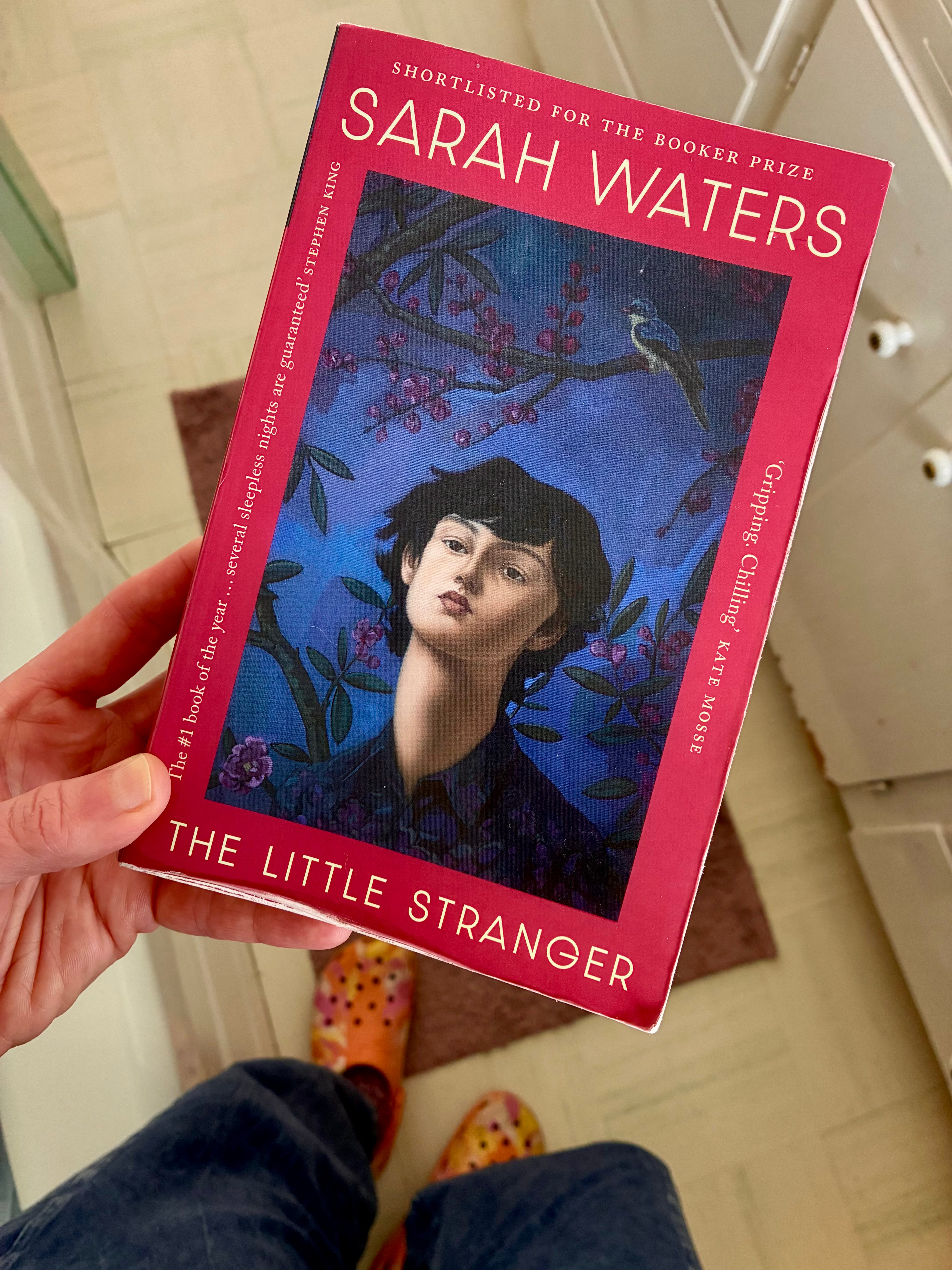
God, what a story. Sarah Waters! Fuck, man! I will throw caution to the wind and call this novel a Gothic masterpiece. It starts out quietly, taking its time establishing the story, orienting its reader to the social and economic contours of post-World War II England, and then, around page 100, it takes off like a rocket. None other than Hilary Mantel, reviewing The Little Stranger for The Guardian, calls it “gripping, confident, unnerving and supremely entertaining.” Mantel even compares Waters to Margaret Atwood:
[Waters] has the same narrative ease and expansiveness, and the same knack of twisting the tension tighter and tighter within an individual scene. . . . The Little Stranger operates in the queasy borderlands between the supernatural and the psychopathological, and it is territory in which Waters moves with an air of supreme ease.
The Little Stranger is the third Sarah Waters novel I’ve read in the past 18 months. That’s a lot of time spent with a single author, especially given that I only finish about 35 books a year. (Emphasis here on ‘finish’; I’ve been learning to quit books that aren’t working for me! Freedom! I DNF’d more than a dozen books in 2025.)
Admittedly, before 18 months ago, I’d never heard of Sarah Waters. Then I read a recommendation somewhere for The Paying Guests, Waters’ 2014 novel about a genteel widow and her adult daughter who, after World War I, take in lodgers to make ends meet. The recommendation must have been a strong one, because it stuck with me, and when I stumbled upon The Paying Guests in a bookstore, I snatched it up. I hadn’t remembered from the recommendation, or maybe it wasn’t mentioned, that the story is very gay, but: EVEN BETTER. I tore through it, and after that, I started to look for Sarah Waters everywhere.
Turns out I live in the wrong country. Sarah Waters is a Welsh novelist, best known for her artful, well-crafted historical novels with lesbian protagonists. For some reason — maybe because she writes artful, well-crafted historical novels with lesbian protagonists — it’s difficult to find her work in the US, in brick-and-mortar bookstores at least. It’s very convenient for my reading habits that I’ve been teaching in Europe somewhat regularly(?!). Last fall I found a copy of Tipping the Velvet at Shakespeare and Company, the famous English-language bookstore in Paris. Apparently Tipping the Velvet is a lesbian classic, but as with everything else Sarah Waters, I went into it semi-clueless. And it was a THRILL. Hot. Hot! Those who know her novels tend to be rabid for them. Sarah Waters writes page-turners that are deeply researched, richly atmospheric, and keenly attuned to the contours of human thought. This sounds like a real reach, but for me, her novels somehow sit at the center of a Venn diagram uniting Lauren Groff (Matrix, The Vaster Wilds), the movie Portrait of a Lady on Fire, and Shirley Jackson (The Haunting of Hill House).
This said, I am sorry to report that there is nothing (openly) queer about The Little Stranger. But the story makes up in psychological intrigue and good solid scares what it lacks in sapphic sex. From the first pages, it reminded me of The Haunting of Hill House, actually: not only do both stories orbit a haunted house, but they tap the same kind of cerebral horror. It fits, then, that as I was writing this, I found a wonderful interview with Waters in which she cites Hill House as an influence on The Little Stranger — and Patricia Highsmith’s The Talented Mr. Ripley. Have you read it? Of course you’ve seen the movie, with Jude Law and Matt Damon and Gwyneth, but the book is something else. I thought about it for weeks afterward. It was astonishing. I hadn’t thought of the movie as scary, but the book is pure horror, this quiet methodical horror.
Speaking of which, I am … a horror person now?
Comments
Nothing yet. Say the first thing.
Sign in to join the conversation.