
I hereby present to you what may(?) be my favorite(!) of all(!) the interviews I’ve shared to date. It should come as no surprise that it’s with Rachel Khong, bestselling author of the novels Real Americans and Goodbye, Vitamin and the brand-new story collection My Dear You.
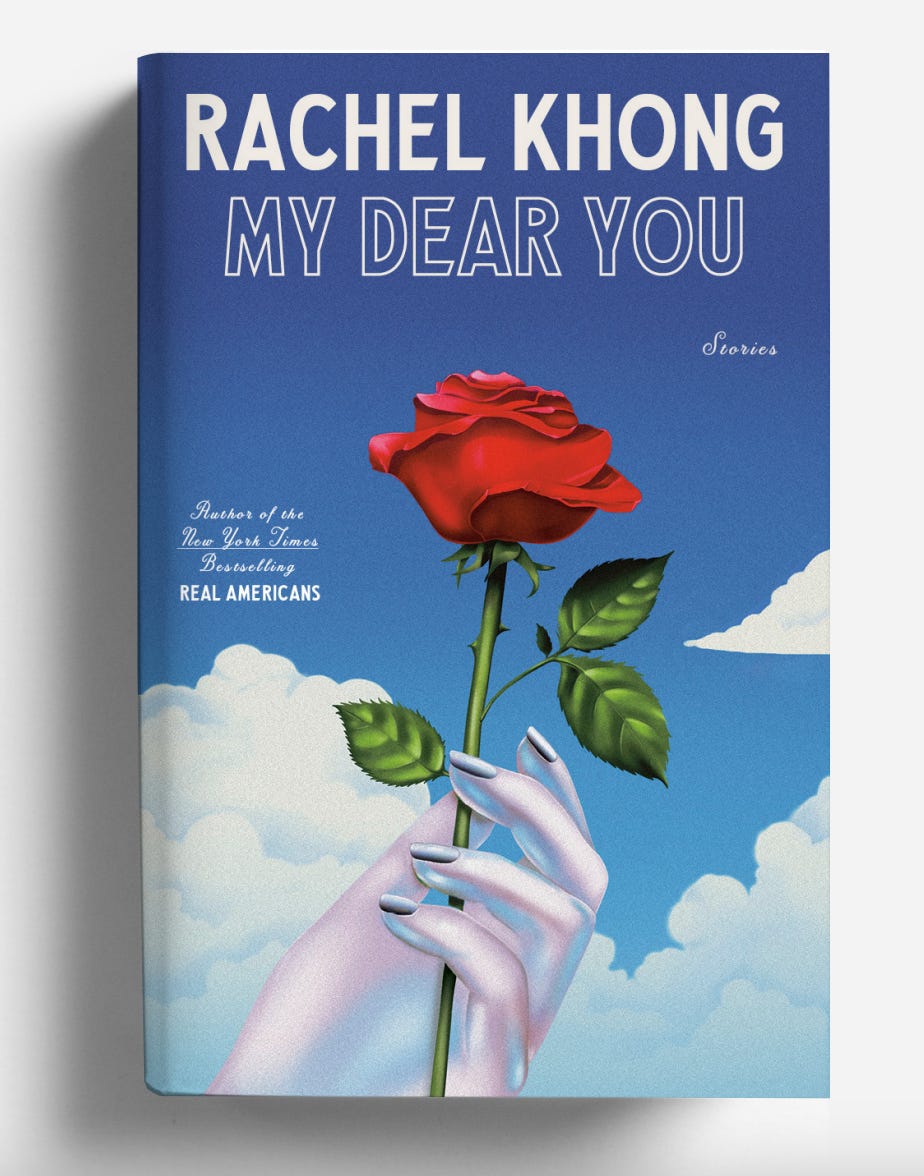
I find fandom cringy and awkward, but I am a HUUUUUUGE Rachel Khong fan. I imagine many of you are too, especially if you’ve read Real Americans, her 2024 novel that took the literary world by storm. If you haven’t read it, I hope you will — and also Goodbye, Vitamin, her 2017 debut, a tender and sparkling little sneak attack of a novel.
If any of this background sounds familiar, it may be because I interviewed Rachel for this newsletter when Real Americans came out. I loved our chat then so much that I couldn’t whittle it down to a single post and instead ran it in two parts.
1:
and 2:
In addition to writing novels, Rachel is a brilliant writer of short fiction. That’s abundantly clear in My Dear You, a collection of ten stories that are playful, strange, and razor-sharp in their emotional precision. In one story, the US government injects all citizens with a drug that makes them see everyone else as members of their own race and gender. In another, a woman adopts a cat who conjures the ghosts of her ex-loves. A factory worker decides to liberate a sex doll she’s tasked with selling. Beneath all their bizarre premises, each story is so human, too; it’s like ten brief exploratory missions into the grief, pleasure, and limitations of the human experience.
I read the first pages of the first story, the titular “My Dear You,” while we were visiting friends on Lopez Island over Valentine’s Day weekend. The opening paragraphs were so weird and made me laugh so hard, I had to pass the book around so everyone could see. I read the first four stories right there in our friends’ living room, with two families’ worth of humanity bustling around me, talking and cooking and carrying on — I was that enthralled. Nobody else sees the world, all its loss and longing and beauty and fucked-upedness, like Rachel Khong.
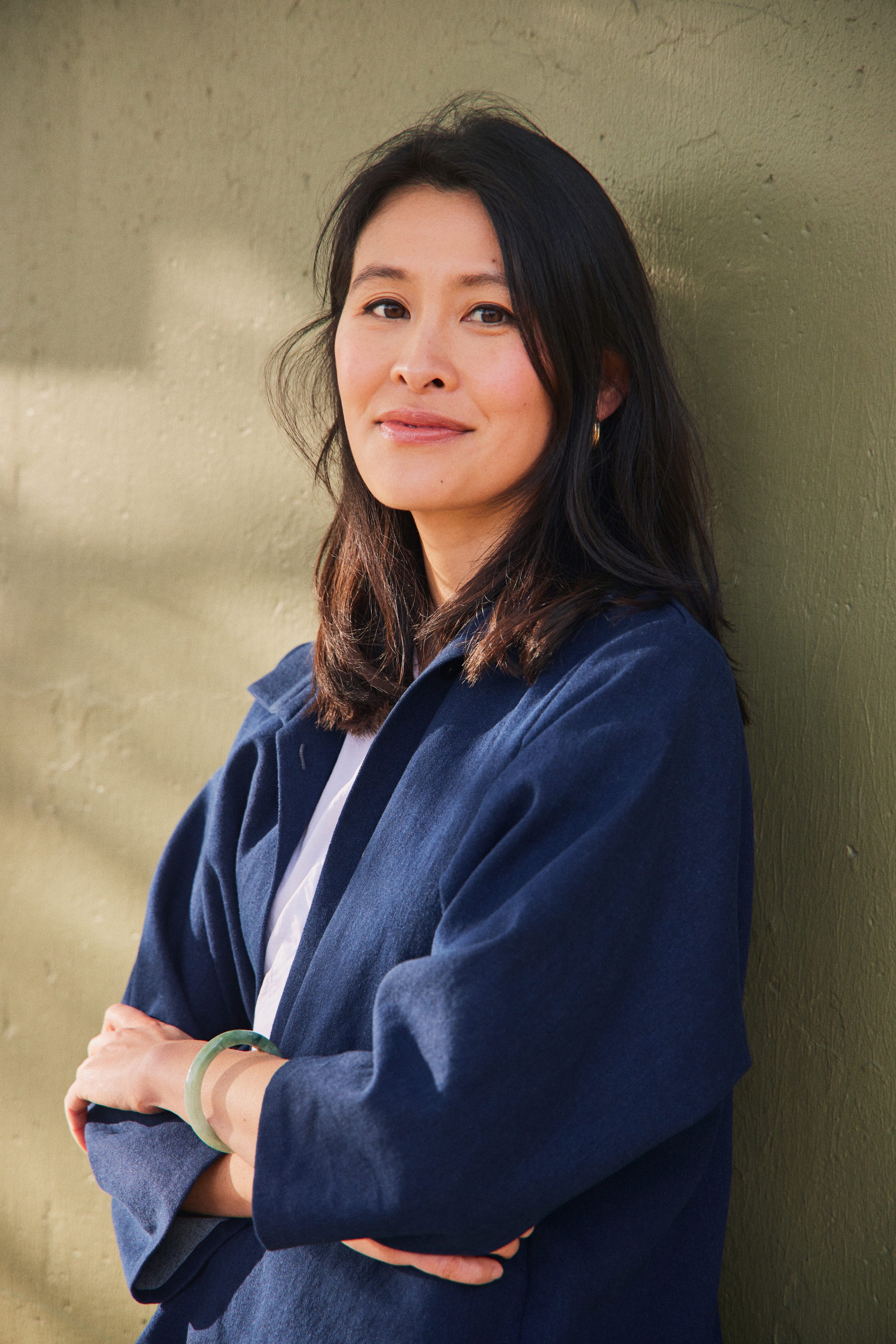
Rachel also teaches writing as part of a collective called The Dream Side. I can say from experience that she’s a gifted teacher. You can get a sense of that, I think, in her newsletter Short Story Short, where each month she shares her thoughts on one short story. As of this writing, Rachel is currently on tour for My Dear You, so check to see if she’s coming to your city.
The conversation that follows took place on Zoom on March 4, 2026. I’ve edited it for clarity and brevity, and though it’s still on the long side, I decided to run it as a single newsletter. Please enjoy —

Molly Wizenberg
Rachel, I tore through this book. Thematically, it has a lot in common with Real Americans, so I wanted to start by asking about the relationship between that book and this one. Did any of the stories in My Dear You predate Real Americans?
Rachel Khong
These stories were written over the course of nine years, so almost a decade. The title story “My Dear You” came first, and I wrote it, I think, a little bit before Goodbye, Vitamin came out. There’s always a lull before a book comes out, when you’re casting about for things to do. The story just sort of came to me. Goodbye, Vitamin had also come from a short story that I realized I wanted to expand, to stay with the voice of that story. Anyway, then “My Dear You” kind of led to Real Americans, even though they’re very different. In “My Dear You” — I don’t think it’s a spoiler to say this — the protagonist is in heaven. She’s been eaten by a crocodile, her face is completely messed up —
MW
Oh my god, that sentence on page 4, “The tearing and the rocks left my face entirely fucked”! I laughed so hard.
RK
[Laughs.] Yeah, so the protagonist gets to choose a new face in heaven. That idea actually came to me first, the concept of choosing a new face. If you were to choose a new face, a new body, whatever, would you choose? Would you choose what you were [in life]? When she has to decide what race she wants to be, she doesn’t know. That feels weird to get to choose, right? So she lets a computer decide. But then there’s this little moment of disappointment when she’s Asian again. And I was really interested in that moment. What do we get to choose for ourselves? What should we choose for ourselves? Through writing that story, just that little part of the story, I realized that there was so much more to it.
Writing a story is how I figure out what I’m thinking about, what I’m obsessed with. Through writing “My Dear You,” I realized, Oh, I’m interested in this question of choice.
And then I kept going like that, writing into the questions that arose. The next story [in the book, and chronologically,] is “The Freshening,” which is also about race and how we treat people differently. What would it be like if everybody looked just like you, your same demographic? Through those two stories, I started chewing on the topics that led to Real Americans. They share a lineage, though they’re different creatures in the end.
MW
It sounds like stories serve a foundational role in all your work.
RK
I started out writing stories because, you know, they’re shorter. They’re what you can handle in writing workshops. Now I think of myself more as a novelist. But stories are more manageable. Even if they’re hard, they’re not as hard as a novel. A novel is more than you can hold in your head. A story, I can sort of hold it in my hand. Stories remind me that I can finish something. I don’t force myself to write stories, but when I’m working on a novel, what usually happens is I go somewhere different — into nature, or on a train, traveling somewhere — and I’ll have a spark of something that I want to put somewhere. Sometimes the novel can contain it. But other times I just have to start a story.
MW
You’ve said that you don’t make outlines, that you write to find out what’s happening. You started writing Real Americans without knowing how to finish it. Is it different with a short story? To what degree can you see the beginning and the end?
RK
I’ve been thinking lately about how a novel is like a sea turtle going on a long migration. They kind of don’t know where they’re going. They’re not thinking, I will swim THERE. I read this paper about sea turtles that described their movement as “drifting and homing.” Drifting and homing. They wind up on the beach where they were born, but before that, they’re making all sorts of weird journeys, for thousands and thousands of miles. They’re often swimming in circles. Writing a novel is like that. It’s a kind of bodily process of drifting and seeing what feels good.
While I was writing Real Americans, I collected all these quotes about not knowing — being in the dark, traveling these long distances, not knowing the destination, not knowing if you’re going the right way. That’s how a novel feels to me. That dark place is so interesting, and it’s so generative. That’s where things grow. That’s where you can surprise yourself. It’s fundamental to writing a novel.
With stories, it’s similar, but the journey is shorter. It starts with a character, or a premise, or a question, and then I do that dark voyage a little bit. I find stories really fun to write! There’s so much that surprises me in the process of writing them.
MW
This is all really heartening. As I was preparing to talk with you today, I was battling this feeling of incompetence, this feeling that I don’t really get short stories. I know that feeling is common, especially among non-writers. It’s funny — George Saunders does such a brilliant job of teaching short stories, making stories legible. I’ve learned a ton from reading Story Club over the years. But the more I read from him, the higher the stakes seem to be. Like, you’ve only got a tiny bit of space in a short story, and you’ve got to accomplish ALL THIS? I don’t know, maybe that’s just —
RK
I don’t really think there are rules. I mean, stories are so different. And George likes to look at a particular kind of story, the Russian masters. It kind of intimidates me too! I don’t read that way, and I definitely don’t write that way. I think what he’s doing [might be best applied to] reading, not necessarily writing. I don’t think writing comes from thinking really hard or planning — like, I’m going to hit on X themes, do this and this, and wrap it all up by page 15. Writing is intuitive. It has to be done loosely. You can’t hold onto it.
MW
That’s my experience too. I feel so resistant to the style of teaching that gives you a punch list — like, you need these elements, your narrative should take this shape, A + B = C. I find it… constipating. It constipates my writing, rather than freeing it.
RK
I think more and more that writing doesn’t come from just your brain. Sometimes I can tell when a writer is writing from just their brain. It’s trying too hard. I’m interested in the writing that’s coming from your whole body, your whole set of emotions, the organism of you. And we’re not talking about a shining gemstone here. You’re a messy weird thing with all these scars.
MW
When we talked a couple of years ago, you were thinking about the difference between a novelist and an AI writing a novel. It’s so important that we’ve got these human bodies that enforce limits on us! We’re not machines. We’ve got these memories that are not perfectly organized file cabinets. Writing is a process of making meaning from a starting point of imperfection.
RK
I love that you connected that!
You know, when I was writing these stories, I didn’t know that they would go together. I didn’t know that this would be a book. Each of these stories was written individually and meant to stand on its own. But I’ve always loved story collections, and I love it when collections feel cohesive, like they’re orbiting a set of ideas or themes. When I began to put these stories together, I didn’t know if they had something to orbit. But the process of putting showed me that they did. Like, Oh, there they are!
To return to your very first question, My Dear You has overlapping themes with Real Americans, though the books are very different tonally. For instance, the fact that we don’t get to live every life possible — that choosing one thing means you don’t get to choose another, and that the things we choose determine who we are and the lives we live. That fact is at odds with my American upbringing, the idea that you can do anything you want to, you’re infinite, you’re somehow not even mortal. There’s this sense of invincibility. But during the pandemic, getting into my thirties, I really came up against that. And putting these stories together, I saw that that was the theme they’re orbiting, however unglamorously: one day, we’re going to die. We’re getting older. You make choices, and that means you can’t make other choices.
But I also think there’s something interesting and really beautiful in that, in the fact that we don’t get to choose. Everything is more meaningful once we accept that, right?
MW
In the story “Tapetum Lucidum,” the protagonist is visited by ghosts, by versions of what could have been, had she made other choices. In an interview, you said — talking about that story — that “there’s no precise word to describe the grief of not getting to live a different reality, but ‘haunting’ strikes me as coming very close.” That really resonates. Do you think this particular grief is an American thing? Or a human thing?
RK
It must be a human thing. Though it might be a little bit American-flavored, the way that I’m writing about it. The character in “Tapetum Lucidum” sees ghosts of former boyfriends, even possible children that were never born, and I do think that’s a bit cultural. As an American, I grew up with such a sense of abundance in everything: groceries, life paths, career choices — even if the reality was, like, I’m not actually good at that thing. And that sort of greed for lots of different kinds of lives is exacerbated by the times we’re living through. We see so much of other people’s lives on social media, and really intimately too. Other lives are so accessible to us, so available. That triggers something in us — like, Should I be living that kind of life instead?
MW
Ash wanted to show me something on social media the other night, and I was tired and cranky and didn’t want to look. Like, “I don’t want to see something from someone else’s life that I wouldn’t see if there were no social media! I don’t want that information!”
I guess I’m interested in the way that writing these stories — many of which are not bound by the constraints of reality — maybe helped you survive what we’re living through?
RK
It’s funny, I don’t think I ever start a story planning to put it in an alternate reality. I might think I’m going to change things, or I’m going to make things extra weird. But really I just start writing. And then often it just goes there, because the world that we live in is so weird already! It feels very surreal, what we’re living through. How is this happening? Writing is how I’ve metabolized both what happens to me and also what is happening in the world. I don’t know what to do with it. All I can do is metabolize it into my art.
Molly Wizenberg 35:43
Yes! And then that art — I don’t know how to say this exactly, but it gave me a kind of relief, reading these stories. You present us again and again with forms of discomfort, and even when a story is terribly sad or unnerving, we’re sort of… appalled into laughter.
RK
It is often funny, so I wanted to capture that a little bit. There’s much serious writing that exists about race, for instance, and so much that needs to be done about racism, and I don’t think this is unserious, but I was interested in the things that are just funny — like, where did that come from? Why are you being racist? That’s so silly.
MW
That doesn’t sound unserious to me. In fact, it’s very sly, how serious these stories really are. I found myself thinking about them for days after reading. I would read a story each night before bed, ten nights —
RK
I do that too. I read a short story before bed.
MW
Sometimes I would turn off the light thinking, I’m not sure I get it yet. I’m going to have to think on that. I could tell it needed time to digest. And then — this was so cool — I would wake up the next morning, and in those bleary moments between the alarm going off and my getting out of bed, my brain would spontaneously return to the story. Without any conscious effort, I’d sort of arrive, gently, at new understanding. It’s like the story was a math problem that my brain needed time to solve. I loved that. I feel grateful that your stories gave me that experience.
RK
Thank you for saying that. It’s like when you’re writing and get stuck, and then you go to bed with it in your mind, and you wake up in the morning to find that your subconscious mind has completed the puzzle. It was sort of given to you.
MW
As a reader, what were some of the first short stories that lit you up? Did you read them in school?
RK
I discovered stories in high school, but not because we read them in school. It was because I went to Costco with my parents almost every weekend, and I would go to the books table, and that’s where I discovered The Best American Short Stories series.
MW
Rachel Khong discovered short stories at Costco.
RK
I really did! The one I remember the most — and that I still have, actually — is the 2001 one with the yellow cover, edited by Barbara Kingsolver. She has great taste in stories. I read all of them, and I loved that they were so different from each other. I think that was my introduction to the idea that writers live among us, that they aren’t all dead, like Chaucer or Virginia Woolf. If all the writers were dead, I could never be one, you know? Those stories showed me that you could write about stuff happening right now, and that writing can be a way of metabolizing life. Yeah, Costco is where it all started, I guess.
MW
It does seem meaningful that you stumbled upon a contemporary anthology. If you’d picked up a collection of short stories from some dead guy, it might have taken you a lot longer to become a writer.
RK
And it was crucial that the stories were from the year that I was actually living in! That really mattered to me. It opened something up. I can still see that actually, in this collection. Even though [the stories in My Dear You] were written over many years, there’s a nowness to them. They’re about actual years that I lived through.
MW
And you read a short story every day? Always at bedtime?
RK
Yeah, I mostly do it at night, before bed. I’ll usually be reading a couple things at once, maybe a story collection and something else. That was a practice I started during the pandemic. I was reading one short story and one poem every day. I had to get out of my head, and I was dissatisfied with social media, the way it feels both intimate and impersonal at the same time. Stories were an antidote. They’re distilled pieces of someone else’s perspective. Instead of feeling obsessed with what was going on in my life, I could see other people living life in their own ways. I could be inside someone else’s voice. I loved it so much, I kept going.
MW
What a profound and pleasurable practice. Almost like a spiritual practice, maybe?
RK
It is a spiritual practice. I grew up in the Christian church, and there’s a little booklet called Our Daily Bread that would have some kind of prompt — I don’t quite remember, but prayer prompts or something like that. I love having a daily thing. We’ve talked about the five-year diary, right?
MW
I don’t know if we’ve talked about it, but I have one! You write like one sentence about your day, every day? I did it for a while. But it’s not really my thing…
RK
For some reason, it really is mine! I’m just the sort of person who wants to write something down every day.
MW
I love the idea of it. I want to have done it. But it always felt too hard to narrow the day down to such a small space. I’m not a very concise person.
RK
Okay, well, my five-year diary is not beautiful. It’s often three sentences crammed into a very very small space. And it’s really random, too. Sometimes it’s what I did. Sometimes it’s a memorable meal, or a funny thing someone said. I definitely don’t put pressure on myself to make it a work of art, or even interesting. I’m on my third one now. You should try again. You could do it before bed, along with your reading.
MW
Okay, okay, I want to go back to it. [Update: I did! I’ve written in it every night since March 4! I LOVE IT!]
What’s your writing practice right now, aside from that?
RK
I’m years into my next novel, but I’m not — I don’t feel like I’m quite in the middle yet, though I do have a really messy draft.
MW
I don’t think I’ve ever asked you if you have a favorite pen or notebook.
RK
Unfortunately, I have so many. Like this one [holds up a notebook] — the Maruman Mnemosyne, ruled. Very smooth and nice paper. This is my ‘woo’ journal. My tarot, journaling, phases-of-the-moon journaling, it all goes in here. But my real workhorse notebook is this [holds up a different notebook] — the National brand steno notebook, with the spiral along the top.
MW
No frills! A classic.
Well, Rachel… thank you. I just love this book. I hope it finds its way into lots of hands, especially the hands of readers who don’t think they’re ‘short story people.’ It’ll prove them wrong. I’m going to do my part to make that happen.
RK
Thank you. Thank you for having me on again. It’s so fun to get to talk about this book with a friend. And you’re such a good reader. You shouldn’t let George Saunders intimidate you.
MW
[Laughs.] Thank you.
Comments
Nothing yet. Say the first thing.
Sign in to join the conversation.