
Welcome to the third issue of the Knightian Uncertainty Dispatch—a monthly curated reading list for anyone thinking about macroeconomics, finance, and forecasting in a world where the future is not just risky, but sometimes genuinely unforeseeable because it may differ from the past.
Each month, I recommend four new papers + one “essential” that help grapple with structural change and uncertainty beyond probabilistic risk—and what those realities imply for economic modeling, forecasting, and policymaking.
The goal is to curate papers that:
Deepen our understanding of structural change and Knightian uncertainty.
Are useful for how we actually reason and forecast in unstable environments.
Connect to one another—so the pieces speak to each other rather than living in isolated silos.
This month’s theme is central banks in uncharted territory: how major monetary policy institutions are rethinking their frameworks when the future may not look like the past.
Something notable is happening across the world’s central banks. After the forecasting failures of 2021–23, institutions are not just patching their models—they are asking harder questions about the kind of uncertainty they face. Is it uncertainty within a known probability distribution, where wider confidence bands suffice? Or is it something deeper—uncertainty about the structure itself, where the distribution may have changed in ways that cannot be quantified from past data?
The four pieces this month map this institutional reckoning:
Bauer, Berge, Fiori, Loria, and Zhong lay out the Federal Reserve’s new taxonomy of uncertainty for the 2025 framework review—distinguishing state, structural, and expectations uncertainty—and document that several central banks have abandoned fan charts because they fail during structural breaks.
Cateau, Coletti, and Portelance describe how the Bank of Canada is shifting from precision engineering to risk management, explicitly invoking “Knightian or radical uncertainty” and proposing “thick-line macro”—one of the few central bank publications to use that language.
Amaral, Ehlers, Shim, and Tombini survey 12 central banks on how they actually handle uncertainty in practice—and reveal a striking gap: most focus on “known unknowns” with quantifiable likelihoods, rarely addressing the possibility that the future may be genuinely unforeseeable.
Bailey, the Bank of England Governor, provides the structural backdrop: five qualitative headwinds—from supply shocks to deglobalization to AI—that are reshaping the economic landscape in ways that existing macroeconomic frameworks are, in his words, “less well equipped” to handle.
Together, these pieces tell a story about an institutional conversation that is further along than many academics realize—and yet still hasn’t fully confronted the implications of taking structural change seriously.
Paper: “Accounting for Uncertainty and Risks in Monetary Policy” by Michael D. Bauer, Travis J. Berge, Giuseppe Fiori, Francesca Loria, and Molin Zhong. FEDS 2025-073 / SF Fed Working Paper 2025-19. Published 2025.
This paper was prepared for the Federal Reserve’s 2025 monetary policy framework review. Apart from the Bank of England staff paper by Haberis et al. (2025), discussed in the December Dispatch, it offers the most systematic treatment I’ve seen of the different kinds of uncertainty that central bankers face—and it does not shy away from acknowledging the limits of quantification.
At the heart of the paper is a three-part taxonomy: state uncertainty (where are we now?), structural uncertainty (have the relationships changed?), and expectations uncertainty (are agents forming expectations about a stable or shifting world?). The first can, in principle, be resolved with more data. The second and third cannot—not fully—because they involve the possibility that the economy’s structure has changed in ways that historical data alone cannot reveal.
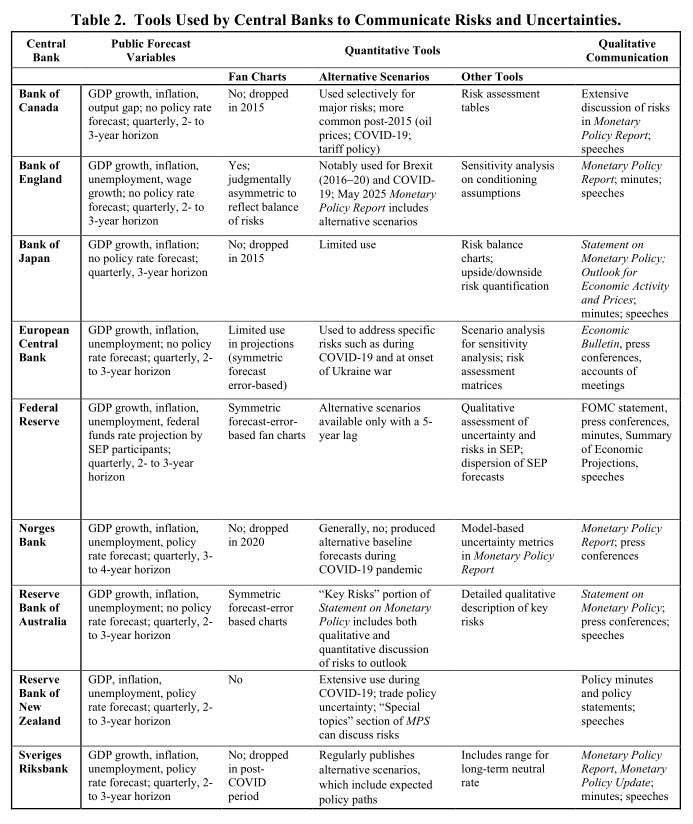
That distinction matters. A footnote early in the paper explicitly acknowledges Knightian uncertainty as “unknown unknowns”—a rare concession in a Federal Reserve publication. And the paper documents a practical consequence: fan charts, which assume a known probability distribution around the central forecast, fail during structural breaks. Several central banks have abandoned them.
A comment. The deeper problem with fan charts is not just that they fail during structural breaks—it is what they are taken to represent. A fan chart is typically interpreted as illustrating the uncertainty around a central forecast. But it only captures the probabilistic uncertainty: the part that can be quantified, conditional on the model. Once we recognize that the economy undergoes structural change, there is an additional layer of uncertainty—Knightian uncertainty—about the future structure, about the model itself. That uncertainty cannot be quantified ex ante; it is ultimately subjective, even when informed by careful analysis of past data. Fan charts are silent about it. They show the uncertainty we can measure and say nothing about the uncertainty we cannot.
The three-part taxonomy—state, structural, expectations—maps directly onto the concerns that motivate this Dispatch. It gives practitioners a shared vocabulary for distinguishing “we need more data” from “the world has changed.”
It was written for the FOMC as part of the 2025 framework review. This is not an academic exercise—it is an attempt to shape how the Federal Reserve thinks about uncertainty in its own policymaking.
The finding that fan charts fail during structural breaks is important. Fan charts embed the assumption that the future is drawn from a known distribution estimated from the past. When that assumption breaks down, they don’t just become imprecise—they become actively misleading, because the actual uncertainty around a forecast has more layers than probabilistic risk alone.
Table 2 provides a rare cross-country overview of how major central banks communicate uncertainty. The most striking column is “Fan Charts”: five of the eight central banks listed have either dropped them or never adopted them. Only the Bank of England, the ECB (with limited use), and the Federal Reserve still publish them—and even the Fed’s version is a symmetric, forecast-error-based confidence band with a five-year lag before scenarios become available.
The paper’s most important contribution is not the taxonomy itself but what it implies: different kinds of uncertainty require different policy responses. State uncertainty calls for patience, data gathering, and careful statistical analysis. Structural uncertainty calls for robustness, model diversity, and scenario analysis. Expectations uncertainty calls for clear communication—but also humility about what communication can achieve when agents themselves face Knightian uncertainty.
The paper also documents that the profession’s standard tool for communicating uncertainty—the fan chart—fails precisely when it is needed most. That is a significant institutional admission.
Read the Introduction and Section 2.1 for the taxonomy, then go to Table 2 for the cross-country comparison of how central banks communicate uncertainty. If you have more time, Section 3 discusses how policymakers can account for uncertainty in their decisions.
Paper: “From models to communications: strengthening risk management in monetary policy at the Bank of Canada” by Gino Cateau, Don Coletti, and Annie Portelance. Chapter in BIS Papers No. 163, pp. 51–58. Published 2025.
This short chapter—only eight pages—may be the most direct engagement with Knightian uncertainty I have seen from inside a major central bank. The Bank of Canada describes how it is shifting from “precision engineering” to “risk management” in monetary policy, and it uses the phrase “Knightian or radical uncertainty” by name to explain why.
Their diagnosis is sharp. The base case forecast creates a “false sense of precision.” Models should be treated as “only one perspective among many.” Risk analysis should extend beyond what the baseline model suggests. These are not cautious hedges in an academic paper—they are operational principles that the Bank of Canada is implementing.
The concrete proposals follow from the diagnosis: “thick-line macro” (communicating forecasts as wide bands rather than precise paths), model suites with different structural assumptions, and shifting from mean to mode for the baseline forecast. Each of these acknowledges that the single-model, single-baseline paradigm is inadequate when the economy undergoes structural change.
A comment. What strikes me about this paper is the explicit language. Many central banks practice some version of model humility—running multiple scenarios, widening confidence intervals, hedging their forecasts. But most of this is framed as dealing with “higher uncertainty”—meaning more risk within a known framework. The Bank of Canada goes further: they invoke Knightian uncertainty by name, acknowledging that the kind of uncertainty may be different, not just its magnitude. That is a meaningful distinction, and it is rare in institutional publications.
It is one of the very few central bank publications to explicitly invoke “Knightian or radical uncertainty.” That language matters—it signals a conceptual shift, not just a recalibration.
The three reform priorities—challenging the false precision of the base case, practicing model humility, broadening risk analysis—read like a practical checklist for any institution grappling with unforeseeable change.
“Thick-line macro” is a memorable and implementable idea: present forecasts as ranges rather than point estimates, making uncertainty visible rather than hidden behind a single number.
The Bank of Canada is making a bet: that acknowledging the limits of what models can tell us—openly and institutionally—leads to better policy than pretending those limits don’t exist. “Thick-line macro” is not about being less rigorous. It is about being honest that a single number with a symmetric fan chart may be the wrong way to communicate a future that is genuinely uncertain.
At eight pages, read the whole thing. It is concise and clearly written. If you must prioritize, focus on the section describing the three reform priorities and the discussion of “thick-line macro.”
Paper: “Monetary policy decision-making and communication under high uncertainty: insights from a survey of central banks in the Americas and beyond” by Eduardo Amaral, Torsten Ehlers, Ilhyock Shim, and Alexandre Tombini. Chapter in BIS Papers No. 163, pp. 7–30. Published 2025.
If the Bauer et al. paper gives us a taxonomy of uncertainty and the Cateau et al. paper shows one bank’s response, this BIS survey provides the field-level view: what do central banks actually do when uncertainty is high?
The answer, based on a survey of 12 central banks across the Americas and beyond, is revealing. Most institutions responded to the post-2020 period by reducing forward guidance, moving toward gradualism, and expanding scenario analysis. These are sensible adaptations. But the survey also reveals a striking gap: central banks overwhelmingly focus on “known unknowns”—risks that can be assigned probabilities and bounded by historical experience—and rarely address the possibility that the future may involve “unknown unknowns” that fall outside any probability distribution estimated from past data.
In other words, most central banks are becoming more sophisticated about probabilistic uncertainty without fully engaging with the deeper challenge that the Dispatch is built around: what do you do when the economy may undergo structural changes that you cannot foresee or quantify?
It provides rare cross-country survey evidence on how 12 central banks handle uncertainty in practice—not in theory, but in their actual decision-making and communication.
It documents concrete institutional adaptations: reduced forward guidance, more gradualist policy moves, expanded scenario analysis, alternative communication tools. These are useful benchmarks for practitioners.
Most importantly, it exposes the gap between institutional practice and the conceptual challenge: institutions disagree on the right approach—fan charts, scenarios, qualitative assessments all coexist—yet most are getting better at quantifying “known unknowns” while still largely avoiding the harder question of what to do about “unknown unknowns.”
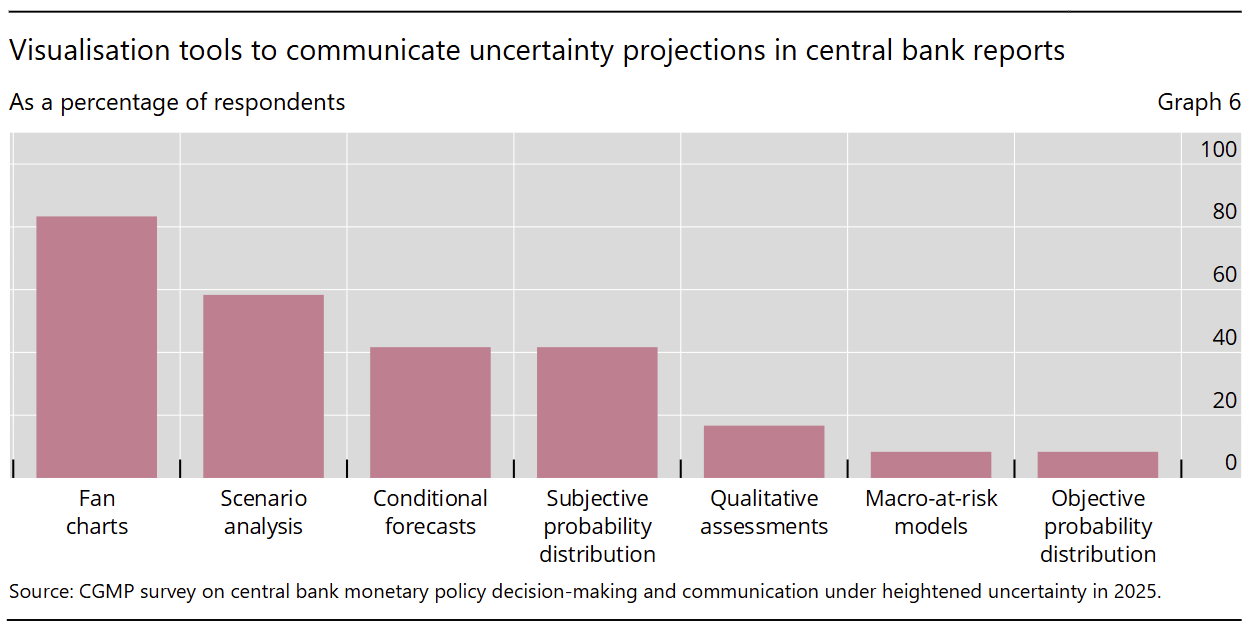
Graph 6 shows what tools central banks actually use to communicate uncertainty in their reports. Fan charts lead, followed by scenario analysis and conditional forecasts. Qualitative assessments, macro-at-risk models, and objective probability distributions trail behind. The pattern is clear: the most widely used tools are those that quantify probabilistic uncertainty—precisely the “known unknowns.” Tools that might help communicate deeper uncertainty remain on the periphery.
This paper is published in the same BIS volume (No. 163) as the Cateau et al. chapter and provides its institutional backdrop. Reading them together is instructive: Cateau et al. represents the frontier of how far a central bank has gone in acknowledging Knightian uncertainty, while Amaral et al. shows that most central banks have not gone nearly as far. The gap between the Bank of Canada’s explicit invocation of radical uncertainty and the field’s focus on quantifiable risk is one of the most interesting tensions in this issue.
Central banks have made real progress in dealing with uncertainty since 2020. They communicate more cautiously, move more gradually, and rely more on scenarios. But most of these adaptations assume that uncertainty can be quantified—wider confidence bands, alternative scenarios with assigned probabilities, data-dependent forward guidance. The harder question—what to do when the probability distribution itself may have changed—remains largely unanswered at the institutional level.
Read the Introduction for the survey design, then skip to the sections on scenario analysis and communication tools for the most actionable institutional comparisons. Graph 6 shows at a glance what visualisation tools central banks use to communicate uncertainty.
Speech: “The World Today” by Andrew Bailey, Governor of the Bank of England and Chair of the Financial Stability Board. Delivered at the AlUla Conference for Emerging Market Economies, IMF/Saudi Ministry of Finance, 8 February 2026.
This is not a research paper—it is a speech. But it is a speech by the Governor of the Bank of England that frames the current economic moment as one of qualitative structural change, and it provides the backdrop that makes the other three papers in this Dispatch urgent.
Bailey organizes his remarks around five structural headwinds that are reshaping the global economy:
Shocks: The nature and frequency of supply-side shocks have changed.
Growth potential: Potential output growth is declining in advanced economies.
Demographics: Aging populations are altering labor markets and savings patterns.
Trade: Deglobalization and trade fragmentation are reversing decades of integration.
Finance: The financial system is undergoing structural shifts.
What makes the speech notable is Bailey’s framing. He draws on Schumpeter’s concept of “discrete rushes” of innovation—the idea that technological change does not arrive smoothly but in bursts that create qualitatively new economic configurations. Applied to AI and robotics, this means the current moment is not just “more uncertainty” but a different kind of economic landscape than the one our models were built for.
The admission is direct: “our macroeconomic frameworks are less well equipped” for supply-side shocks of this kind.
A comment. Bailey’s speech is useful not for any single analytical insight—the five headwinds are well known individually—but for what it represents: a senior policymaker organizing the current moment around qualitative structural change, not cyclical fluctuation. The Schumpeterian framing is particularly apt. Schumpeter’s “creative destruction” is precisely the kind of non-repetitive structural change that Knightian uncertainty is about—change that creates genuinely new configurations rather than drawing from a known distribution of past states. When the Governor of the Bank of England frames the world this way, it validates the premise that forecasting and policymaking need to be built around structural change, not just wider error bands.
Bailey structures the entire speech around qualitative structural shifts—not cyclical fluctuation, not just “bigger shocks”—which is exactly the distinction this Dispatch insists on.
The direct admission that existing macroeconomic frameworks are “less well equipped” for the current environment is significant coming from a sitting central bank Governor and FSB Chair.
The Schumpeterian “discrete rushes” framing provides accessible language for discussing structural change that is qualitatively different across periods—useful for the Dispatch audience.
The structural changes Bailey describes—deglobalization, aging, AI, supply shocks, financial system transformation—are not temporary disruptions that will revert to a familiar baseline. They are qualitative shifts that create a different economic landscape. If that is right, then the institutional adaptations described in the other three papers are not optional upgrades. They are necessary responses to a world where the past is a less reliable guide to the future.
Read the opening framing on the five structural headwinds and the section on AI and Schumpeter’s “discrete rushes.” Then read the concluding passages on what these headwinds imply for monetary policy and international financial architecture.
Paper: “Uncertainty and the Effectiveness of Policy” by William C. Brainard. American Economic Review, 57(2), pp. 411–425. Published 1967.
and
Chapter: “Making Policy in a Changing World” by William C. Brainard and George L. Perry. In Economic Events, Ideas, and Policies: The 1960s and After, edited by George Perry and James Tobin, pp. 43–69. Brookings Institution Press, 2000.
Most economists working on monetary policy know the Brainard principle. The 1967 paper asks a deceptively simple question: how should a policymaker act when uncertain about the effects of their own instruments? Brainard’s answer—the attenuation principle—is that when the policymaker faces multiplicative uncertainty (uncertainty about the transmission mechanism itself, not just additive noise), they should respond less aggressively than they would under certainty. Move in the right direction, but hedge against the possibility that the instrument does not work as expected.
The result is elegant, and it has shaped central bank practice for decades. The gradualism documented in the Amaral et al. survey (Paper #3) is, in substantial part, Brainard’s legacy. When central bankers say they prefer to move in measured steps because they are uncertain about the economy’s response, they are channeling—explicitly or implicitly—the 1967 paper.
But the Brainard principle rests on a crucial assumption: the policymaker knows the model. The structure of the economy is given; only the parameters are uncertain. The policy problem is to choose the right instrument setting given that you don’t know the exact coefficient. This is uncertainty within a known framework—risk, in Knight’s terminology, not genuine uncertainty about the framework itself.
Thirty-three years later, Brainard returned to the question—and the ground had shifted. In “Making Policy in a Changing World,” Brainard and Perry set out to do something that conventional econometric analysis rarely does: allow for the possibility that the key macroeconomic relationships have changed over time, and examine what policymakers knew—and didn’t know—as those changes unfolded.
Their starting point is a sharp observation about the mismatch between statistical practice and the policymaker’s problem. Standard econometrics treats parameters as constant until a structural break test rejects stability—typically requiring a t-statistic of two, or odds of twenty to one against. But as Brainard and Perry note, “twenty to one are long odds for a policymaker, for whom the costs of following the model when it is wrong can be significant.” The profession’s default—assume stability until proven otherwise—is exactly backwards from the perspective of someone who has to act under the possibility that the world has changed.
To address this, they estimate wage and price equations using Kalman filters that allow all coefficients to vary over time as random walks—not as discrete breaks at specific points, but as gradual stochastic drifts. This choice is deliberate: they argue that it is “quite implausible” that changes in wage and price processes “shift in such a discontinuous and infrequent way,” and that changes are “more likely to be spread over time.”
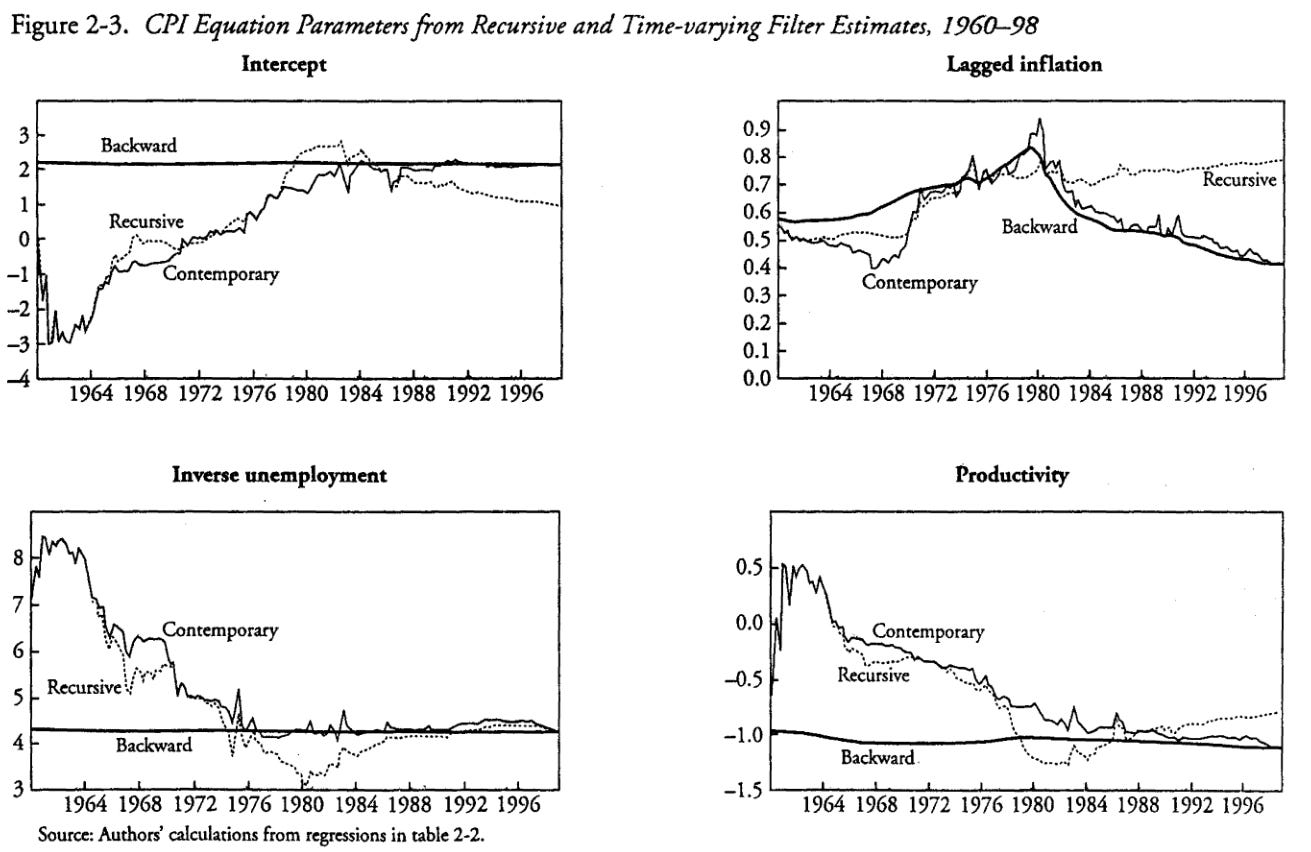
The results are striking. Most parameters of the inflation-unemployment relationship—the intercept, the coefficient on unemployment, the coefficient on productivity—are remarkably stable across four decades. But one crucial coefficient is not: the sum of coefficients on lagged inflation, the conventional proxy for expected inflation. This parameter—which determines whether the Phillips curve is accelerationist—was moderate in the early 1960s, rose to near 1.0 during the high-inflation OPEC shock years, and then declined back to its lowest levels by the late 1990s. The accelerationist Phillips curve, and with it the NAIRU framework, is approximately correct during high-inflation periods—but not at low or moderate inflation.
Figure 2-3 is the paper’s key exhibit. Four panels show the time-varying coefficients of a CPI equation estimated with Kalman filters from 1960 to 1998. Three of the four parameters—the intercept, inverse unemployment, and productivity—are remarkably stable across four decades. But the fourth, the sum of coefficients on lagged inflation (the conventional proxy for expected inflation), tells a different story: it rises from moderate levels in the early 1960s toward 1.0 during the high-inflation OPEC shock years, then declines steadily back to its lowest levels by the late 1990s. This single figure captures the chapter’s central finding: while most of the inflation process held steady, the one parameter that determines whether the Phillips curve is accelerationist changed dramatically—and a policymaker relying on time-invariant estimates would have been systematically misled.
The implications for policy are direct, and Brainard and Perry draw them out in their concluding section with an explicit callback to the 1967 paper. They write: “we know that uncertainty about the response to policy actions calls for deviation from certainty-equivalent behavior”—citing Brainard (1967) directly. But now the uncertainty is deeper than what the 1967 framework assumed. If parameters drift over time, then “conventional estimation procedures can be misleading” and “sticking with prior estimates, unless recent observations fall outside of conventional confidence intervals, will be a mistake.” Policymaking that is alert to parameter drift “will respond less to the prescription from conventional econometric estimates and more to recent shocks.”
The chapter closes with a sentence that could serve as an epigraph for this entire Dispatch: “policymakers need to be constantly alert to unexpected developments, both shocks and changes to the economic structure.”
The arc from 1967 to 2000 traces the same journey that central banks are making today—from parameter uncertainty to structural change. Brainard’s 1967 paper gives us the canonical framework: attenuate when uncertain. Brainard and Perry’s 2000 chapter reveals that attenuation within a known model is not enough when the model itself is shifting. The first paper asks: “What if I don’t know the coefficient?” The second asks: “What if the coefficient has changed—and I don’t know when, or to what?”
That second question is the one the four papers in this Dispatch are wrestling with. The Fed’s taxonomy distinguishes structural uncertainty from state uncertainty (Bauer et al.). The Bank of Canada invokes Knightian uncertainty by name (Cateau et al.). The BIS survey reveals that most institutions haven’t yet fully engaged with uncertainty beyond quantifiable risk (Amaral et al.). And Bailey frames the current moment as one of qualitative structural change (Bailey). Each of these is, in its own way, grappling with the problem that Brainard and Perry identified a quarter-century ago: the world changes in ways that a time-invariant model cannot capture.
Reading Brainard (1967) and Brainard and Perry (2000) together provides the intellectual foundation for this month’s theme—and a measure of how far we’ve come, and how far we still have to go.
For the 1967 paper, read the setup and the derivation of the attenuation result—the core insight fits in a few pages. For the 2000 chapter, read the “Data and Decisionmaking” section (p. 46) for the twenty-to-one odds argument, then look at Figure 2-3 for the time-varying CPI equation parameters, and finish with “Some Lessons for the Conduct of Policy” (pp. 68–69) for the explicit link back to Brainard (1967) and the conclusions about structural change.
That’s it for the February issue of the Knightian Uncertainty Dispatch.
What emerges from reading these four pieces together is a picture of central banking at an inflection point. The taxonomy exists (Bauer et al.). At least one institution is acting on it with explicit reference to Knightian uncertainty (Cateau et al.). But the broader field remains focused on quantifiable risk (Amaral et al.)—even as the structural landscape becomes harder to map from historical data alone (Bailey).
The gap between the conceptual frontier and institutional practice is where the interesting work lies. And it is narrowing—but slowly.
If you have suggestions for papers that I should cover in future issues—especially work that connects structural change, Knightian uncertainty, and real-world forecasting and policymaking—please send them my way.
And if you found this Dispatch useful and want the next issue in your inbox, consider subscribing. It helps the Dispatch reach the people who are interested in developing economic theory and practical forecasting tools for a changing world characterized by Knightian uncertainty.
No posts
Comments
Nothing yet. Say the first thing.
Sign in to join the conversation.