
Welcome to the fifth issue of the Knightian Uncertainty Dispatch — a monthly curated reading list for anyone thinking about macroeconomics, finance, and forecasting in a world where the future is not just risky, but sometimes genuinely unforeseeable because it may differ from the past.
Each month, I recommend four new papers + one “essential” that help grapple with structural change and uncertainty beyond probabilistic risk — and what those realities imply for economic modeling, forecasting, and policymaking.
The goal is to curate papers that:
Deepen our understanding of market outcomes and policy in a world with unforeseeable structural change and Knightian uncertainty.
Are useful for how we actually reason and forecast in unstable environments.
Connect to one another — so the pieces speak to each other rather than living in isolated silos.
This month’s theme picks up where the March Dispatch and my post “The Quiet Revolution in Central Bank Forecasting” left off. Together, the two pieces documented a remarkable institutional shift unfolding in real time. As the surging oil prices caused by the war in Iran put central banks under pressure, seven major institutions responded with strikingly different uncertainty-communication approaches — and three that had previously published probabilistic forecasts moved to scenario-based communication within six weeks of each other. The Quiet Revolution post traced the cross-bank picture; the March Dispatch curated the primary speeches and policy documents behind it.
This issue asks the deeper question: what does it mean for monetary policy when the economy may be undergoing structural change?
When we acknowledge that the economy may be changing to a new regime that we have not yet observed, three implications follow for monetary policy. They are not new ideas. They are simply what it means to take structural change seriously.
First, neither the central bank nor market participants can know which scenario will unfold. The future regime is, in a real sense, not yet written. We can’t know exactly what it will look like. Even rational and well-informed individuals and institutions will base decisions on expectations that may not align with what will actually happen. This gives rise to large and systematic forecast errors at exactly the moments when forecasts matter most — the moments at which the regime is shifting.
Second, policymakers and market participants need not share a common scenario. Under unforeseeable structural change, there is no single correct model that both parties will converge to. The central bank may be reading the future regime differently than the market; the market may itself be heterogeneous. This is the coordination problem: monetary policy may not have its desired effect, not because the central bank lacks credibility, but because the policymaker’s view of the transmission mechanism differs from the market’s view.
Third, central banks need to consider robustness across multiple scenarios rather than optimization given a single scenario. When neither alignment nor coordination of expectations can be assumed, the right policy is the one that performs reasonably well across the range of plausible regimes — not the one that performs best inside any single scenario. The cost of being wrong about which regime is operative can dominate the cost of being slightly suboptimal under the realized regime.
The four papers in this issue show that senior central bankers are explicitly recognizing each of these implications. A G7 central bank governor names the structural change and the identification problem (Macklem). A chief economist at a major central bank names the coordination problem and makes the case for robustness over optimization (Pill). A Macro Technical Paper from the Bank of England documents how scenarios are now constructed in operational practice based on their flagship DSGE model (Albuquerque et al.). And the April 30 Bank of England Monetary Policy Report — the central document of this issue — published three illustrative scenarios with no designated central projection. The institutional shift the March Dispatch documented has now reached the headline projection vehicle of another major central bank.
What emerges from reading the four papers together is that the policy implications of structural change are visible to senior policymakers and have begun to reshape institutional practice. What is still missing is the formal apparatus that derives these implications from first principles. The constant-parameter REH-DSGE framework that has been the workhorse of monetary economics since the 1970s implicitly assumes both coordination (the central bank and the market share the model) and alignment (their shared expectations correspond to what will actually happen) — assumptions that become visibly untenable under structural change. The essential — Lucas (1976) — is the founding statement of that framework. Reading Lucas alongside the four papers makes the gap between operational practice and theoretical foundations particularly clear.
A note on format. As with the March issue, this Dispatch features primarily central-bank documents rather than research papers. The deliberate institutional shift toward scenario-based communication is moving faster than the academic literature, and the most articulate statements of the policy implications are now coming from inside major central banks. The essential returns to the academic tradition — and to its founding moment.
Speech: “Structural Change — Canada at a Crossroads” by Tiff Macklem, Governor of the Bank of Canada. Delivered at the Empire Club of Canada, Toronto, 5 February 2026; reproduced as SUERF Policy Note No. 402 in April 2026. Link.
This speech is the cleanest articulation in 2026 of structural change as the operating environment for monetary policy. Macklem opens by defining structural change explicitly as “the transition between one steady state and the next” — not a deviation around a stable trend, not a larger-than-usual shock, but a change in the underlying economic environment. He identifies a convergence of three structural forces affecting Canada in 2026: a permanent shift in US trade policy, the diffusion of artificial intelligence through the economy, and the slowing of population growth from accelerated immigration in the early 2020s to its slowest pace in decades. None of these is a temporary disturbance. Each is a transition to a new regime, and they are all happening at once. As Macklem put it:
“The impact of these forces on the Canadian economy will not be a temporary cyclical fluctuation. These are deep structural changes that are transforming the economic landscape.”
The most analytically important section is what Macklem calls the cyclical/structural identification problem. He states the problem cleanly: it is hard to know whether a drop in GDP growth is part of a structural trend or a temporary downturn, and getting the call wrong has costs. If the central bank misdiagnoses a structural slowdown as cyclical, it will overstimulate — adding inflationary pressure to an economy that cannot grow faster without it. If it misdiagnoses a cyclical downturn as structural, it will tolerate avoidable slack, leaving people unemployed who could be working. The two errors are symmetric in form but very different in consequence, and the data alone do not tell the central bank which is happening in real time.
This is the first of the three implications stated from inside the policy machinery. The central bank cannot know ex ante which scenario will unfold, and the cost of being wrong shapes the policy choice. Macklem’s response is methodological rather than tactical: the Bank will rely more on scenario analysis to “explore alternative interpretations and reduce the risk of policy errors,” develop richer multi-sector models, and use more granular and regional data to detect structural shifts as they unfold. The framework — the 2 percent inflation target — does not change. How the framework is implemented does.
A comment. The speech is unusually clear about the operational consequences of taking structural change seriously — scenarios, multi-sector models, granular data, the identification problem itself. What it does not do, and could not be expected to do in a policy speech, is ask what theoretical framework would formalize those commitments.
“It is hard to know whether a drop in GDP growth is part of a structural trend or a temporary downturn. Getting the call wrong has costs.”
A sitting G7 central bank governor explicitly defines structural change as the transition between one steady state and the next, and names the convergence of US protectionism, AI, and demographics as the current rapid-change moment. Read alongside Senior Deputy Governor Rogers’s March 26 remarks, Macklem’s speech gives the Bank of Canada the most coordinated public articulation of any major central bank that the post-pandemic environment is structurally different and that scenarios are the institutional response.
Macklem names the cyclical/structural identification problem cleanly as the central forecasting and policy challenge.
Macklem codifies a methodological response in a senior speech — scenario analysis, multi-sector models, granular data — joining the move toward scenarios documented across multiple institutions in the March Dispatch. The framework does not change; how it is implemented does.
Macklem provides the policymaker articulation of the first implication: under structural change, the central bank cannot know which scenario will unfold, and the cost of being wrong shapes the policy choice. The methodological commitment to scenarios follows.
Read the “What is structural change?” section for the explicit definition and the “Monetary policy implications” section for the identification problem.
Speech: “Uncertainty, Structural Change and Monetary Policy Strategy” by Huw Pill, Chief Economist of the Bank of England. Maxwell Fry Annual Lecture, Money Macro and Finance Society, University of Birmingham, 8 October 2025. Link.
The Maxwell Fry Lecture is one of the most explicit statements to date by a senior major-bank policymaker that monetary policy must operate under genuine uncertainty about the structure of the economy — not just the realization of shocks within a known structure. The title alone is a Dispatch tagline: three core themes — uncertainty, structural change, and monetary policy strategy — in one phrase, by a sitting MPC member of a major central bank.
Pill’s main message is that “in a world of radical uncertainty and deep structural economic change, more weight should be given to robust eternal verities in running monetary policy, at the expense of pursuing fragile optimising approaches specific to a given set of often ephemeral circumstances.” The argument has two parts. First, when the deep parameters governing the economy — Pill names price-setting behavior, wage-setting behavior, and possibly the formation of expectations themselves — may have shifted, fitted models specific to the previous regime are unreliable guides to policy. Second, when the central bank cannot pin down the natural rate of interest (R*), potential output (y*), or the natural rate of unemployment (u*) with any precision, it must eliminate any uncertainty about its own inflation target (π*) and follow a systematic data-to-decisions mapping that disciplines both private expectations and internal MPC discussions.
This is a generalization of the case for inflation targeting that goes beyond the standard credibility argument. Standard inflation targeting argues that a clear target anchors expectations and reduces inflation volatility. Pill’s argument is that the only thing the central bank can credibly commit to is the target itself, because everything else — the natural rate of interest, the natural rate of unemployment, the slope of the Phillips curve, the response of inflation to energy shocks — is itself uncertain. Conservative central banking, in Rogoff’s 1985 sense and Waller’s 1992 extension, is the right institutional response.
The coordination point. The most analytically distinctive contribution of the speech is Pill’s recognition that under structural change, the central bank and the market need not share a view of the economy. This is where the speech departs most clearly from the standard New Keynesian apparatus. In the standard model with the rational expectations hypothesis (REH), the economist represents both the central bank’s and the market’s expectations by the model’s conditional expectation; any apparent disagreement is a transient information friction. Pill’s setup is different. When the deep parameters of the economy may have shifted, neither party knows the structure for certain, and there is no model to which both could converge. This is the second of the three implications stated from inside the policy machinery. Markets and policymakers need not coordinate on a common scenario, and policy may not have its desired effect because the policymaker’s view of the transmission mechanism differs from the market’s view.
A comment. Pill is unusual among senior central bankers in invoking the term “radical uncertainty” — the term associated with Kay and King (2020), though not formally cited in the speech — and in framing the policy problem in those terms. But the speech operates inside the formal frame of optimal-control monetary policy: the eternal verities Pill anchors on — a clear inflation target, a systematic data-to-decisions mapping, conservative central banking — are themselves derivable inside the standard model under specific assumptions. The speech identifies the question, but the formal apparatus available to it cannot represent the rational response to genuinely structural uncertainty as different from the rational response to risk.
“In a world of radical uncertainty and deep structural economic change, more weight should be given to robust eternal verities in running monetary policy, at the expense of pursuing fragile optimising approaches specific to a given set of often ephemeral circumstances.”
Pill makes the most explicit statement to date by a senior major-bank policymaker that monetary policy must operate under genuine uncertainty about the structure of the economy — not just the realization of shocks within a known structure.
Pill articulates the coordination point cleanly: markets and policymakers need not share a view of the economy under structural change. He thereby voices the second of the three implications from inside the Monetary Policy Committee.
Pill makes the case for robustness over optimization — the third implication. His framework — anchor on the target, systematic data-to-decisions mapping, conservative central banking — chooses robust policy over policy optimized for any single scenario.
Pill provides the policymaker articulation of the second and third implications: under structural change, markets and the central bank need not coordinate on a common scenario, and the right policy is the one that is robust across plausible scenarios rather than optimized for any single one. The eternal verities — most centrally a clear inflation target — are what remain when little else can be known with precision.
Read the main message paragraph for the eternal verities framing and the three-bullet diagnostic of structural features of the UK economy for the substantive content. Footnote 4 on Rogoff (1985) and Waller (1992) gives the conservative-central-banking citation chain.
Paper: “Decompositions, Forecasts and Scenarios from an Estimated DSGE Model for the UK Economy” by Daniel Albuquerque, Jenny Chan, Derrick Kanngiesser, David Latto, Simon Lloyd, Sumer Singh, and Jan Žáček. Bank of England Macro Technical Paper No. 1, June 2025. Link.
This paper is the canonical 2025 reference for how scenarios are constructed at a major central bank. The Dispatch includes it because anyone who wants to understand what scenario-based central-bank communication is doing analytically has to understand the machinery — and Albuquerque et al. document that machinery in unusual operational detail, including a distinction between two types of scenarios that is not always made explicit elsewhere.
The model is a two-agent New Keynesian DSGE — the successor to COMPASS — with optimizing and rule-of-thumb households, an imported-energy sector, time-varying trends, an expanded shock set, and real adjustment costs. Standard fare for a 2025 central-bank model.
The two scenario classes. Section 6 distinguishes two operationally distinct ways of constructing a scenario.
Alternate-shock or conditioning-path scenarios hold the model fixed and impose specific shock or path realizations — for example, a world-trade shock that reduces world-trade growth by one percentage point through 2025. The standard DSGE conditional-forecasting machinery is then applied.
Structural scenarios change the model parameters or specification — for example, doubling backward indexation in the price-setting Phillips curve and tripling it in the wage-setting Phillips curve relative to baseline — and re-solve and re-simulate the model.
The May 2025 Monetary Policy Report used both. The “weaker-demand” scenario was built from imposed risk-premium and investment-cost shocks (alternate-shock type). The “higher-persistence” scenario perturbed the Calvo stickiness and indexation parameters of the price- and wage-setting Phillips curves to mimic steeper transmission of cost pressures (structural type), calibrated against the Bernanke and Blanchard (2025) decomposition of post-pandemic inflation.
The paradox. The structural-scenario approach explains how structural change is treated in mainstream central-bank DSGE models — and it shows where the limits of the framework become hardest to ignore. Importantly, these models assume that the parameters are constant. Structural change is represented by shifting a constant parameter of an internally stationary model to a new value. Each scenario is itself a fully specified, constant-parameter alternative model, and policy is computed as the equilibrium inside each. After the Lucas critique, this is the conventional way of doing policy analysis applied to scenario construction.
It has three limitations. The first is internal: shifting the parameters of a constant-parameter model is, strictly speaking, inconsistent with the model itself. Inside each scenario, agents are forward-looking and form expectations as if the parameters were going to remain at their current values forever. The very thing the structural scenario is meant to capture — that the parameters might shift — is not visible to the agents inside the scenario. They never entertain the possibility that a shift might occur in the future.
The second is the more important from a policy perspective. By representing structural change as a fixed alternative model in each scenario, the framework presupposes that the central bank’s and market participants’ expectations correspond to the scenario and that the scenario actually unfolds. The two assumptions the rest of this issue is built around, coordination and alignment, are baked into the construction. Within any single scenario, neither implication #1 (forecast errors due to misalignment) nor implication #2 (the coordination problem between central bank and market) can arise: agents and the policymaker are operating in the same internally consistent world. Robustness across scenarios — implication #3 — is the framework’s attempt to handle the limitation externally, by comparing policy across analyst-chosen scenarios. The limitation, however, is structural rather than external. It is built into the assumption that each scenario is an internally stationary model.
The third is methodological. The model’s parameters are estimated or calibrated on historical data under the assumption that they have been constant over the sample — yet the structural-scenario approach assumes those same parameters may shift in the future. If parameters can shift now, they may also have shifted across the historical sample. In that case, the estimates are weighted averages over distinct regimes rather than estimates of stable structural relationships. This would explain the well-known poor forecasting performance of this class of models. (See “Fixed Models in a Changing World”.)
All three limitations are inherited from applying Lucas’s policy-analysis framework to scenario analysis. The essential for this issue takes the connection up at length.
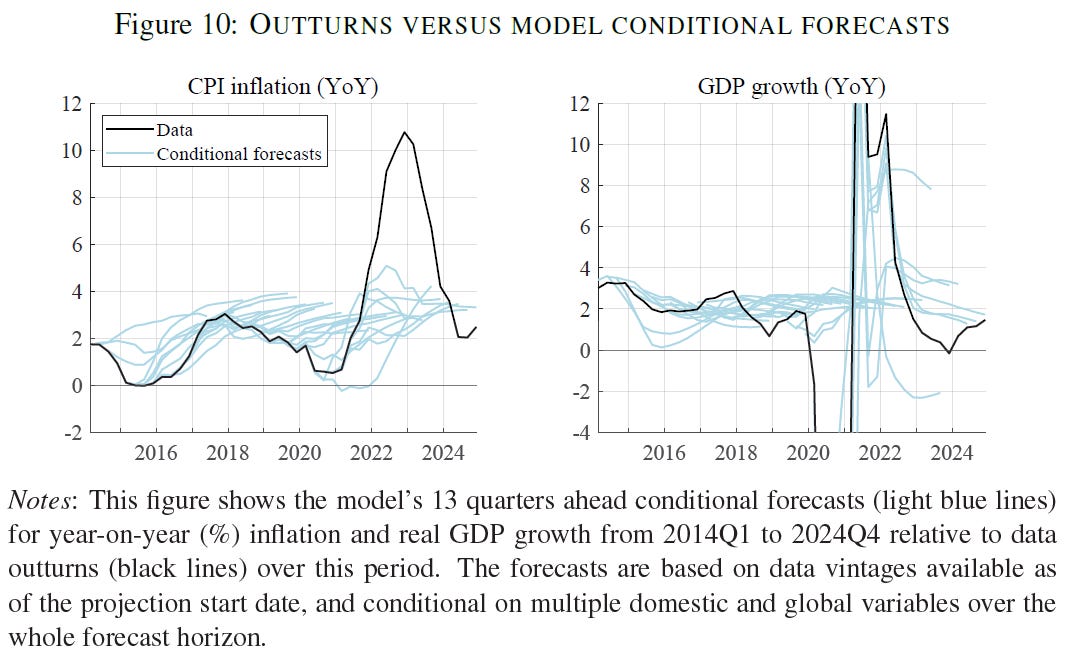
The paper is unusually candid about the limits of this apparatus. Figure 10 makes the alignment failure visible: the model’s inflation forecasts and the realized data part company through the 2021–2024 surge, with inflation under-predicted in real time and errors well beyond the model’s credibility bands. This is implication #1 in concrete form — the kind of episode in which a constant-parameter model cannot capture what actually happens, and which motivated the structural-scenario approach the paper documents.
It provides the canonical reference document for what state-of-the-art central-bank DSGE looks like in 2025, and for how scenarios are constructed in operational practice. The paper rewards any reader who has heard senior policymakers talk about scenarios and wants to see the machinery.
It draws the distinction between alternate-shock scenarios and structural scenarios as the key methodological move. Structural scenarios capture mainstream DSGE’s quiet operational concession to structural change: the analysts perturb parameters that the model treats as constant because internal empirical analysis suggests they may have shifted.
It acknowledges the limits of the apparatus with unusual candor. Figure 10 shows the model “struggles most to predict abrupt changes.” Figure 12 shows that even with perfect foresight of conditioning paths, observed inflation sits at the upper edge of the 90 percent credibility band.
Albuquerque et al. show that mainstream DSGE has incorporated structural change operationally — through analyst-chosen perturbations of parameters that the model treats as constant.
Read Section 5.1 on forecast performance against data outturns (Figure 10 is the key visual); Section 5.2 on counterfactual perfect-foresight forecasts (Figure 12); Section 6.1 on the distinction between alternate-shock and structural scenarios; Section 6.2 on the May 2025 MPR scenarios; and the Conclusion for the planned extensions.
Document: “Monetary Policy Report — April 2026”, Bank of England, 30 April 2026. Accompanied by the Monetary Policy Summary and Minutes of the meeting ending 29 April 2026. Link.
Published the day before this Dispatch went out, the April 2026 Monetary Policy Report is the most significant change to Bank of England forecast communication since fan charts were introduced in 1996. What is new is structural rather than the appearance of scenarios per se: the Bank has published alternative scenarios alongside its central projection in many previous Reports — most recently the “weaker-demand” and “higher-persistence” scenarios in May 2025, and going back to the smooth-Brexit and no-deal Brexit scenarios in 2018–2019. The novelty in April 2026 is that the Report publishes three illustrative scenarios — labeled A, B, and C — as the projection, with no designated central case. The Bernanke Review is explicitly cited as motivation. The central projection with a fan chart approach, which the Bank pioneered three decades ago and which became the global standard for probabilistic forecast communication, has effectively been replaced for this Report as the principal projection vehicle. The scenarios are explicitly illustrative rather than exhaustive, and no probabilities are assigned to them — individual MPC members express their own weights, but no Committee-level probability distribution stands behind the projection.
The Bank is yet another major Western central bank to take this step in response to the surging oil prices caused by the war in Iran. “The Quiet Revolution in Central Bank Forecasting” traced the cross-bank picture in detail; the Bernanke Review’s 2024 recommendation is being implemented globally, fast.
The scenarios. The three scenarios in the Report differ in how they handle two sources of uncertainty: the path of global energy prices, and the strength of any second-round effects on domestic inflation. Scenarios A and B keep the price- and wage-setting structure unchanged and vary the energy-price path and the size of second-round effects. Scenario C goes further — it adjusts COMPASS so that households’ and firms’ “recent experience of high inflation play a greater role in shaping inflation dynamics.” This is exactly the structural-scenario move Albuquerque et al. document in Paper #3: deep parameters that the model treats as constants are perturbed to represent a regime in which the inflation-generating process may have shifted.
State-contingent policy. Box G of the Report develops the analytical framework for setting policy across the three scenarios. Citing Söderström (2002), the Box states that “when there is uncertainty about the strength of inflation persistence, it may be better to err on the side of setting policy as if inflation persistence will be significant.” This is the third of the three implications — robustness across scenarios — stated explicitly as the Bank’s analytical framework in the Report itself. The Minutes go further: paragraph 11 records that “the appropriate monetary policy response would be state-contingent.” Robustness across scenarios is no longer an individual member preference; it has become Committee language.
A comment. The Committee voted 8 to 1 in favor of holding Bank Rate at 3.75 percent. The dissent is analytically illuminating. Huw Pill voted for a 25-basis-point hike, and in his statement he ties the dissent directly to the staff scenarios:
“Structural change in price and wage-setting, and the impact on inflation expectations of greater attentiveness to, and salience of, energy and food prices, may strengthen second-round effects beyond what is captured in those scenarios.”
Pill is saying the scenarios understate the upside risk because structural change in price- and wage-setting reaches further than the staff calibration captures. The dissent rests on a claim about the inflation-generating process, not a different read of the data inside a fixed model. As the same author who delivered the Maxwell Fry Lecture six months earlier (Paper #2), Pill’s vote is the same diagnosis applied at a real policy decision. It is also implication #2 — the coordination problem — made visible inside the Committee: a senior member of the same body that produced the scenarios reads the structural change underneath them differently. The new format makes that disagreement visible rather than averaging it away.
Chart 3.2 of the Report shows the projected paths of CPI inflation and the output gap under each of the three scenarios. The visual makes the institutional move concrete: three distinct trajectories, none privileged as a central case, with policy to be set robust across the range.
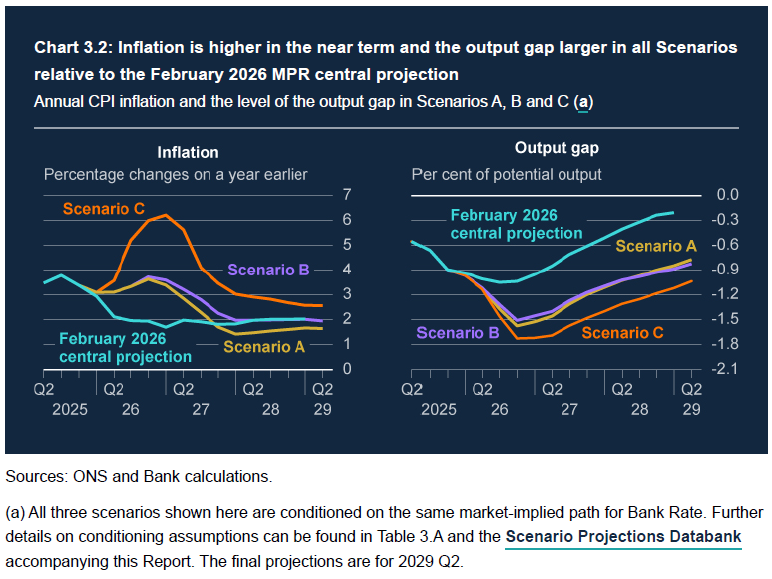
In Scenario A, CPI inflation peaks at 3.6 percent in late 2026 and falls below the 2 percent target by the end of 2027. In Scenario B, inflation peaks marginally higher at 3.7 percent and returns to target by 2028. In Scenario C, inflation peaks at 6.2 percent in 2027 Q1 and remains above target throughout the forecast horizon, with wage growth peaking at 4.6 percent. The output gap widens to between –1.5 and –1.7 percent of potential by end-2026 across all three. As the introduction to Section 3.1 puts it, the chart presents “three scenarios, A, B and C, which help illustrate a range of potential outcomes for the UK economy, without any one being designated as a central projection.”
The Report delivers the most significant change to Bank of England forecast communication since fan charts were introduced in 1996. Three illustrative scenarios. No designated central projection. No probabilities assigned. The Bank has restructured its principal projection vehicle.
Box G and Minutes paragraph 11 state robustness across scenarios as the Bank’s analytical framework and as Committee language. Implication #3 has migrated from speeches into the operational decision rule of a major central bank.
Pill’s dissent locates the disagreement explicitly in the staff scenarios, making implication #2 — the coordination problem — visible inside the Committee, where the new format reveals regime-change disagreement that fan charts would have averaged away.
The April Bank of England Monetary Policy Report is the live institutional implementation of all three implications. Three scenarios with no central projection acknowledges that the central bank cannot identify which scenario will unfold (implication 1). Pill’s dissent makes regime-change disagreement visible inside the Committee (implication 2). State-contingent and robust policy is now the collective decision rule (implication 3). The institutions have done the operational work.
Read Section 3.1 for the scenario framework and the rationale for dropping the central projection; Box G for the analytical framework on robust policy under inflation persistence uncertainty; Minutes paragraph 11 for the line that puts state-contingent policy in collective MPC language; and Pill’s dissent in the Minutes for the structural-change diagnosis at a real policy decision.
Paper: “Econometric Policy Evaluation: A Critique” by Robert E. Lucas, Jr. Carnegie-Rochester Conference Series on Public Policy, vol. 1, pp. 19–46, 1976. Link.
Lucas (1976) is the founding statement of the methodological apparatus that the four papers above are working with — sometimes explicitly, sometimes implicitly. Reading the four papers alongside Lucas is the cleanest way to see what scenario-based central-bank communication is doing, why it is the right operational response to the current moment, and where the gap lies between current institutional practice and the theoretical foundations available to support it.
The diagnosis and the solution. Pre-Lucas policy analysis used reduced-form econometric models estimated on past data. Lucas argued that the estimated coefficients are not deep parameters but reduced-form summaries that depend on agents’ expectations of the prevailing policy regime — if policy changes, expectations change, and the coefficients shift with them. The constructive proposal that emerged from the critique was to treat preferences and technology as deep parameters, model expectations explicitly via the rational expectations hypothesis, derive aggregate behavior from optimizing primitives, and compute equilibria under alternative policy rules. This combination is the foundation of mainstream macroeconomics in 2026. Every central-bank DSGE model, including the Bank of England’s COMPASS suite documented in Paper #3, is descended from it.
From Lucas to scenarios. Lucas asked a specific question: how does a shift in a policy parameter affect economic outcomes? He answered by shifting the parameter and computing the new equilibrium. This is an equilibrium concept — it characterizes the new steady state, not the transition. Within a constant-parameter model with the rational expectations hypothesis, the answer is internally consistent and analytically powerful. By construction, the central bank’s and the market’s expectations coincide, and those expectations align with what the model says will happen in the new equilibrium with the new policy rule.
The same machinery is now used to compute scenarios. One or more parameters of a constant-parameter model are shifted, the new equilibrium is computed, and the resulting paths are presented as the scenario. Inside any single scenario, the coordination of central-bank and market expectations and their alignment with outcomes hold by the same construction as in Lucas’s policy-shift exercise.
But there is an important difference between Lucas’s question and the scenario question. Lucas’s policy shift can be announced — and once announced, the question of whether it propagates as the model implies turns into a question of central-bank credibility. A scenario for a shift in deep or structural parameters cannot be announced. Neither the central bank nor the market can know which scenario will unfold, what the future parameter values will be, or whether their expectations will align with what happens. This is the argument the central bankers in the four papers above make from inside the institution. Macklem names the cyclical/structural identification problem. Pill names the coordination problem explicitly. Albuquerque et al. document the operational workaround — perturbing parameters the underlying model treats as constant. The April Bank of England Monetary Policy Report drops the central projection entirely and makes robustness across scenarios the collective decision rule.
The implication. The constant-parameter REH machinery — which works for Lucas’s question of an announceable policy shift — cannot be relied on alone for policy analysis and scenario computation when the economy’s structure may itself change in ways neither the central bank nor the market can foresee. What is missing is the formal apparatus that derives the institutional responses documented in this issue from first principles, applying the spirit of the Lucas critique one layer deeper than Lucas himself did. Closing that gap is the next step of our research program.
“Any change in policy will systematically alter the structure of econometric models.”
It provides the founding statement of the constant-parameter REH approach to policy analysis — the apparatus behind every central-bank DSGE in 2026.
At 28 pages including discussion, the original paper is short, dense, and rewards direct reading. The diagnosis, the constructive proposal, and three worked examples are all in compact form. Most economists today inherit Lucas’s argument through textbooks and DSGE practice rather than from the source.
Reading Lucas alongside the four papers in this issue is the cleanest way to see why scenario-based central-bank communication is the right operational response to the current moment — and where its theoretical foundations stop short.
The constant-parameter REH apparatus is the field’s solution to the problem Lucas posed, and it works for the question Lucas asked. Applied to scenarios for unforeseeable structural change, where neither central bank nor market can know what is coming, it runs into limits that the institutions are now actively confronting.
The original paper is short — 28 pages including discussion. The opening two sections state the diagnosis; Section 3 sets out the constructive proposal; Section 5 (”Some Examples”) works through three concrete cases. Read with the question in mind: what does Lucas’s argument imply when applied not to changes in the policy rule, but to changes in the structural parameters the policy rule presupposes?
That’s it for the April issue of the Knightian Uncertainty Dispatch.
Three implications follow from taking structural change seriously in monetary policy. First, central banks and market participants cannot know which scenario will unfold — alignment cannot be presumed. Second, central banks and market participants need not share a common scenario — coordination cannot be presumed. Third, the right policy is robust across plausible scenarios rather than optimized inside a single one. All three implications are now visible in the language and practice of senior central bankers. Macklem names the identification problem. Pill names the coordination problem. Albuquerque et al. document the structural-parameter scenario machinery. The April Bank of England Monetary Policy Report — published the day before this Dispatch — drops the central projection, makes state-contingent policy collective Committee language, and adopts robustness across scenarios as the explicit decision rule.
What emerges from reading the four papers alongside Lucas (1976) is a clear sequence. Lucas’s modeling framework for policy analysis — constant deep parameters plus the rational expectations hypothesis plus equilibrium computation — became the workhorse of monetary economics and gave us the apparatus that runs the Bank of England’s COMPASS, the ECB’s New Area-Wide Model, the Federal Reserve’s FRB-US, and every other major central-bank model in 2026. Inside any single stable regime, the apparatus might be adequate. Across regimes, when the deep parameters themselves may be shifting and when neither coordination nor alignment can be presumed, the apparatus runs into limits that its own practitioners are now openly acknowledging. The Bank of England’s flagship Monetary Policy Report no longer designates a central projection. The Bank of England’s own DSGE technical paper notes that the model “struggles most to predict abrupt changes” and announces planned work on a non-linear version with bounded-rationality parameters. The institutions are operating outside the apparatus they inherited.
Closing the gap is the work that comes next. The four papers in this issue make the question concrete: how do we represent rational expectations when alignment with realized outcomes cannot be presumed? What does coordination look like when there is no shared model? How is robust policy derived rather than asserted as an institutional norm? The institutions have built the operational responses. The formal apparatus that supports them is the open theoretical question, and the question current institutional practice has now run up against. That is the work the research program on Knightian uncertainty is positioned to undertake.
If you have suggestions for papers I should cover in future issues — especially work that connects structural change, Knightian uncertainty, and real-world forecasting and policymaking — please send them my way.
And if you found this Dispatch useful and want the next issue in your inbox, consider subscribing. It helps the Dispatch reach the people who are interested in developing economic theory, policy analysis, and practical forecasting tools for a changing world characterized by Knightian uncertainty.
No posts
Comments
Nothing yet. Say the first thing.
Sign in to join the conversation.