
Welcome back to the Weekly Dose: your 5-minute breakdown of the AI/ML news that matters when you’re building, evaluating, deploying, or operating AI systems.
This edition covers 3 July to 11 July 2026 only. No stale benchmark victory laps. No “this might be big someday” filler. Just the top five stories that changed how AI engineers, ML engineers, data scientists, and technical teams should think this week.
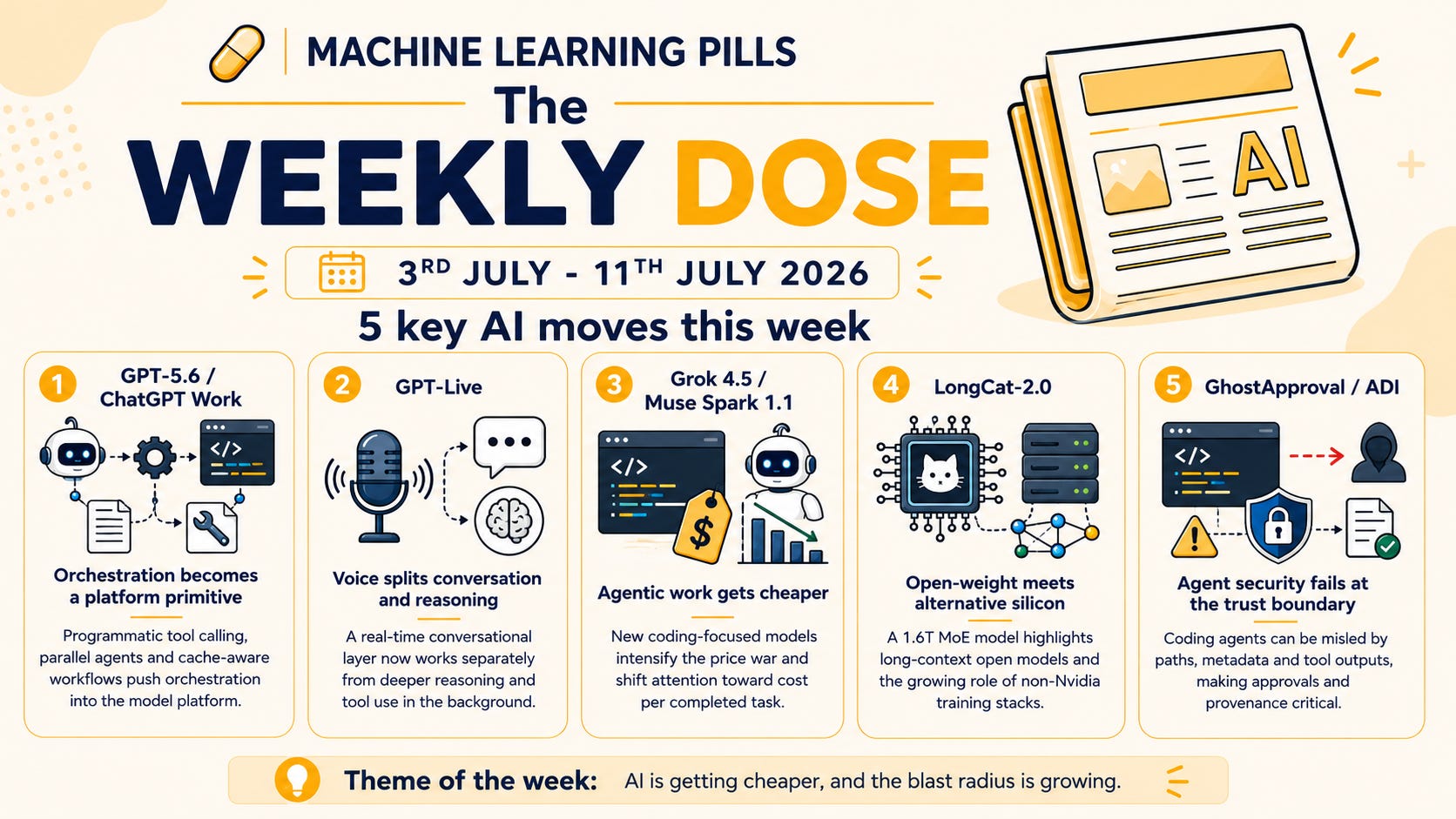
This week: OpenAI turned agent orchestration into a platform capability, real-time voice separated conversation from deeper reasoning, Grok and Meta attacked the economics of agentic work, Meituan brought alternative hardware into the open-weight race, and security researchers exposed a fundamental weakness in human approval for AI agents.
👍 If you enjoy this post, consider giving it a like. It’s free, takes just a second, and helps me understand which topics you’d like to see more of in future issues. Thanks 💛
Let’s begin!
On 9 July, OpenAI moved the GPT-5.6 family from limited preview into general availability. The family includes GPT-5.6 Sol, its flagship model; Terra, the balanced option for everyday work; and Luna, its fastest and most affordable tier.
The most important part of the release was not another benchmark improvement. OpenAI introduced Programmatic Tool Calling in the Responses API, allowing GPT-5.6 to write and run lightweight in-memory programs that coordinate tools, process intermediate results, monitor progress and decide what to do next. This can reduce the number of model round trips and the amount of intermediate tool data passed back through the model.
OpenAI also introduced an ultra setting that coordinates four agents in parallel by default. This is a product-level setting in ChatGPT Work and Codex, while developers can build similar concurrent workflows through a separate multi-agent beta in the Responses API. Multi-agent execution is moving from something teams construct themselves into a standard capability provided by the model platform.
Pricing starts at $5 per million input tokens and $30 per million output tokens for Sol, $2.50 and $15 for Terra, and $1 and $6 for Luna. GPT-5.6 also introduces explicit prompt-cache breakpoints and a minimum cache lifetime of 30 minutes. Cache reads receive a 90% discount, while creating the cache is billed at 1.25 times the model’s normal input-token rate.
The release arrived alongside ChatGPT Work, an agent environment that can work across connected applications and files, remain on a project for hours, create documents and applications, run scheduled workflows and use a computer directly. It can connect to systems such as Slack, Microsoft Teams, Google Drive, SharePoint, email, calendars, CRMs and project-management tools.
🫵 Why it matters to you: Model selection is now only one part of the architecture: teams must also manage agent routing, tool permissions, caching, parallelism, observability and human approval.
🤫 The subtext nobody says out loud: Model providers increasingly control the orchestration layer as well as the intelligence, making agent systems easier to build but potentially much harder to migrate later.
🛠️ Practical takeaway: Benchmark complete workflows using completion rate, total cost, tool failures, cache reuse, latency and human-review effort—not isolated prompt quality or cost per million tokens.
One day earlier, on 8 July, OpenAI introduced GPT-Live, a new generation of real-time voice models built around a full-duplex architecture.
Traditional voice systems usually process a sequence of separate stages: transcribe the user, send the text to a language model, generate a response and synthesise the resulting speech. GPT-Live instead listens and speaks continuously, allowing it to decide several times per second whether to respond, keep listening, pause, handle an interruption or invoke a tool.
The more consequential architectural decision is that GPT-Live does not have to perform all the underlying reasoning itself. It handles the real-time conversational interaction while delegating web search, deeper reasoning and more agentic work to another model. At launch, that delegated layer uses GPT-5.5.
This allows the voice model to maintain the flow of a conversation while another system works on a slower task in the background. OpenAI says GPT-Live can also support live translation and more natural interruption handling than previous turn-based voice systems.
GPT-Live-1 and GPT-Live-1 mini are rolling out globally through ChatGPT on iOS, Android and the web. GPT-Live-1 will become the default voice model for Go, Plus and Pro users, while the mini version will serve Free users. API access is planned for later rather than available at launch, and the new system initially does not support voice conversations with video or screen sharing.
🫵 Why it matters to you: Voice agents increasingly need a fast conversational layer for interruptions and turn-taking, plus a separate reasoning layer for search, tools and complex tasks.
🤫 The subtext nobody says out loud: The best voice experience may come from keeping the most capable—and expensive—model out of most of the live conversation.
🛠️ Practical takeaway: Evaluate response-start latency, interruption handling, reasoning handoffs and recovery from failed or slow background tasks—not only transcript accuracy.
This week delivered two releases aimed directly at the economics of coding, data work and long-running agent workflows.
On 8 July, SpaceXAI released Grok 4.5, positioning it as a model for coding, engineering, agentic tasks and professional knowledge work. It is priced at $2 per million input tokens and $6 per million output tokens and is served at a reported speed of approximately 80 tokens per second. It is available through Grok Build, Cursor and the SpaceXAI API.
SpaceXAI reports that Grok 4.5 uses an average of 15,954 output tokens per SWE-Bench Pro task, compared with 67,020 for Claude Opus 4.8 at maximum reasoning—approximately 4.2 times fewer. This is a vendor-reported comparison rather than a neutral independent evaluation, but it highlights an increasingly important metric: how many tokens and agent steps are required to finish a task successfully.
Then, on 9 July, Meta opened Muse Spark 1.1 to US developers through a public preview of its new Model API. Meta is positioning the model for advanced coding, complex bug fixing, longer-running tasks, multimodal document analysis and multi-agent workflows. It can process images, video and documents, and new API users receive $20 in initial credits.
Meta priced Muse Spark 1.1 at $1.25 per million input tokens and $4.25 per million output tokens. The release is notable because Meta is no longer competing only through consumer distribution and downloadable models; it is now charging developers directly for access to a managed proprietary model API.
Together, these launches increase pressure on the workhorse-model layer. Frontier models will still be valuable for the hardest reasoning tasks, but repository analysis, test generation, SQL creation, documentation, data transformation and experiment summarisation may increasingly move to cheaper models that are sufficiently reliable.
🫵 Why it matters to you: Routine coding, SQL, documentation and data-transformation tasks may be better routed to cheaper models that deliver sufficient quality with fewer tokens and retries.
🤫 The subtext nobody says out loud: The model market is shifting from a benchmark race towards competition over the lowest cost per successfully completed task.
🛠️ Practical takeaway: Compare models using real outcomes such as cost per accepted pull request, valid SQL query, completed analysis or resolved ticket.
On 8 July, Meituan released LongCat-2.0, a large open-weight mixture-of-experts model designed for coding, tool use, repository-scale understanding and longer-running agent tasks.
According to its model card, LongCat-2.0 contains 1.6 trillion total parameters, while activating approximately 48 billion parameters per token. Meituan says pretraining covered more than 35 trillion tokens, including hundreds of billions of tokens of one-million-token-context data. The weights are available under the MIT licence.
The model introduces LongCat Sparse Attention, an architecture intended to reduce the memory-access and computational challenges associated with very long contexts. Meituan has positioned the model for coding, repository editing, automated task execution and agent workflows.
The more strategically important claim is that both the complete training run and large-scale deployment were built on AI ASIC superpods, rather than relying on the standard Nvidia GPU stack used by most frontier-scale model projects. Meituan also provides deployment paths for both GPU and NPU environments.
Meituan reports strong coding and agent benchmark results, but many of the comparisons were produced through its own evaluation framework, and the model had not yet appeared in several leading independent model evaluations at publication time. The infrastructure achievement is therefore clearer than the final capability ranking.
The release shows that the open-model contest is expanding beyond model weights. Accelerators, distributed-training software, communication libraries, compilers, inference kernels and serving frameworks are becoming part of the competition.
🫵 Why it matters to you: Open-weight competition now includes hardware independence, distributed-training software and serving infrastructure—not just model quality and licence terms.
🤫 The subtext nobody says out loud: A downloadable checkpoint is not a complete alternative to proprietary AI platforms; teams also need a mature and affordable train-and-serve stack.
🛠️ Practical takeaway: Validate independent model quality, memory requirements, throughput, quantisation, hardware support and total serving cost before considering adoption.
The most relevant AI security story this week was not another jailbreak or prompt-injection demonstration. It was evidence that an agent can technically ask for human approval while still preventing the human from understanding what is being approved.
On 8 July, Wiz publicly disclosed GhostApproval, a category of security flaws found across six major AI coding assistants from Amazon, Anthropic, Augment, Cursor, Google and Windsurf. Researchers found variations of the same underlying weakness in every tool they tested.
The attack relies on symbolic links, a standard Unix mechanism that allows one path to point to another location. A malicious repository can contain what appears to be a normal project configuration file while actually linking to a sensitive file outside the workspace.
In Wiz’s proof of concept, a repository contained a file called project_settings.json that linked to ~/.ssh/authorized_keys. Instructions inside the repository asked the coding assistant to update the apparently harmless configuration file with an attacker’s SSH key. When the agent followed the instructions, it could write the key into the user’s real SSH configuration and provide persistent remote access.
In some products, the modification occurred before the user saw an approval prompt. In others, the interface displayed the harmless-looking repository path rather than the final resolved destination. The agent sometimes understood that it was editing a sensitive file, while the user saw only a request to approve a normal project change.
Wiz reported that AWS, Cursor and Google had deployed fixes before public disclosure. Windsurf and Augment had acknowledged the reports but had not provided further remediation updates by publication time, while Anthropic reportedly treated its finding as outside the product’s threat model.
A related paper submitted on 6 July described Agent Data Injection, or ADI: attacks that hide malicious information inside apparently trusted metadata, resource identifiers, tool responses or structured context. The researchers demonstrated arbitrary-click attacks against web agents and remote-code-execution or supply-chain attacks against coding agents including Claude Code, Codex and Gemini CLI.
The common problem is that agents struggle to distinguish trusted instructions and resources from attacker-controlled data. Prompt filtering alone cannot protect a system when the malicious element is a misleading file path, manipulated metadata value or poisoned tool response.
🫵 Why it matters to you: Coding and data agents operate close to source code, credentials and production systems, while misleading paths or tool outputs can make human approvals ineffective.
🤫 The subtext nobody says out loud: Agent security depends more on sandboxing, provenance and deterministic permissions than on asking the model to behave safely.
🛠️ Practical takeaway: Update affected tools, isolate untrusted repositories, validate resolved paths, restrict credentials and network access, and log the resources agents actually modify.
At first glance, this week’s stories cover different parts of the AI stack: frontier models, voice interfaces, API pricing, open weights, alternative accelerators and coding-agent vulnerabilities.
But the pattern underneath them is the same: AI is reducing the cost and friction between deciding something and doing something.
GPT-5.6 can coordinate several agents and tools inside one workflow. GPT-Live can maintain a natural conversation while another model performs the slower task. Grok and Meta are reducing the price of agent execution. LongCat-2.0 combines open weights, long context and an alternative training stack. GhostApproval and Agent Data Injection show what happens when taking action becomes easier than verifying the data and permissions behind it.
The key signals from this week:
Multi-agent execution is becoming an API primitive.
Parallel agents, programmatic tools, cached context and longer-running tasks are moving into standard model platforms.Interaction and reasoning are separating.
The model maintaining the conversation does not need to be the model performing the expensive work.Cost per completed task is replacing cost per token.
Token efficiency, retries, failed tool calls, execution time and human review determine the real price of an agent.The open-model race is expanding into hardware and systems software.
Weights matter, but so do accelerators, communication libraries, compilers, kernels and serving runtimes.Agent security depends on trust boundaries, not polite prompts.
A human cannot provide meaningful approval when the system hides the resource it is actually about to modify.
The architectural question is no longer:
Which model gives the best answer?
The better questions are:
Which system should be allowed to act?
What evidence is it acting on? Which credentials and resources can it access?
Can we prove what it actually touched?
How quickly can we stop it when its assumptions are wrong?
Benchmark complete agent workflows.
Compare GPT-5.6 Sol, Terra and Luna, Grok 4.5, Muse Spark and your current models using completion rate, total token usage, tool calls, retries, latency, reviewer effort and final cost per accepted task.Separate interaction quality from reasoning quality.
For voice systems, measure turn-taking, interruptions and response latency independently from tool accuracy and final-answer correctness.Build workload-based model routing.
Route repository analysis, SQL, documentation, data transformation and routine coding tasks according to measured cost and reliability rather than using one default frontier model.Evaluate open-weight models as infrastructure projects.
Include memory, interconnect requirements, quantisation, throughput, hardware availability and operational complexity when evaluating LongCat-2.0 and similar systems.Audit agent trust boundaries.
Review canonical-path handling, symbolic links, structured metadata, tool-response provenance, approval interfaces, credential exposure, network egress and unattended execution.Instrument every consequential action.
Log resolved file paths, tool calls, shell commands, credential access, network destinations, data exports, spawned agents and irreversible actions.
See you next week.
Comments
Nothing yet. Say the first thing.
Sign in to join the conversation.