
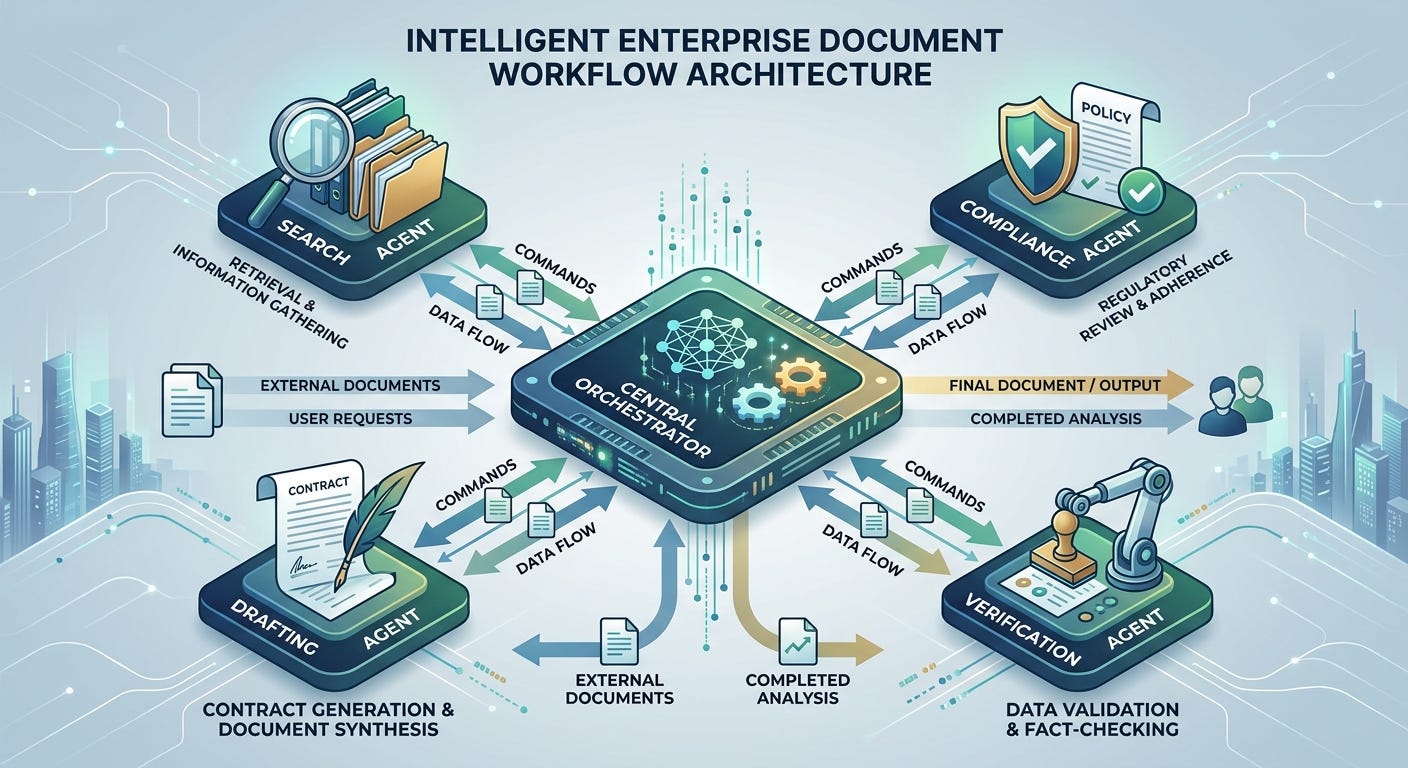
For a brief period in the early 2020s, it seemed like the enterprise document problem was finally solved. Developers plugged standard PDF parsers into Large Language Models (LLMs) and expected magic.
The results were often catastrophic. A multi-column financial report was read across columns rather than down, merging unrelated tables into nonsense. A footnoted legal clause was severed from the sentence it modified. A scanned invoice with slightly slanted text collapsed into a wall of incomprehensible characters.
We learned a hard truth: converting documents to machine-readable data is not just a text extraction problem. It is a visual reasoning problem.
Today we are watching a new paradigm emerge to solve it — Agentic Document Platforms. These systems don’t simply digitize characters or apply rigid coordinate-based templates. They deploy coordinated networks of specialized AI agents that analyze visual layouts, reason about spatial relationships, and self-correct their own mistakes in real time.
To understand why this shift matters, we have to look back at the long, brittle history of how machines have tried to read.
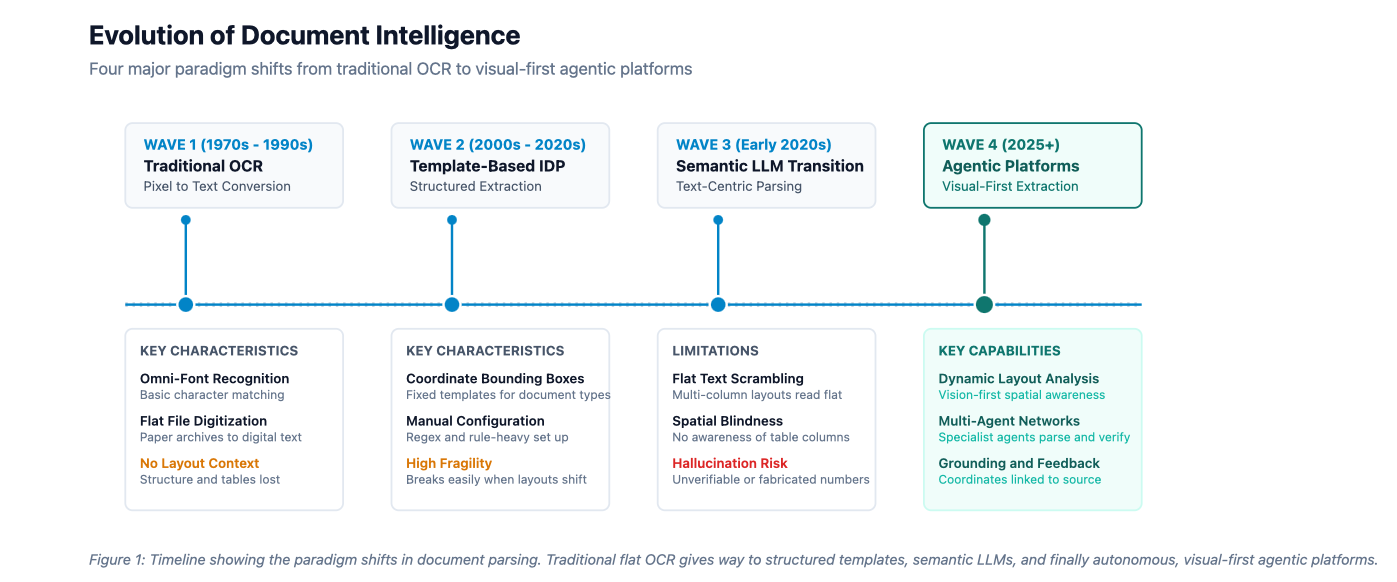
Figure 1: The paradigm shifts in document parsing. Flat OCR gives way to structured templates, then semantic LLMs, and finally autonomous, visual-first agentic platforms.
The quest to make machines read begins long before modern computers. In 1914, German physicist Emanuel Goldberg built a machine that could read printed characters and convert them into telegraph code. By the late 1920s, Goldberg had created his “Statistical Machine” — an electromechanical device that used a photoelectric cell to search microfilm archives via optical pattern recognition. His work was later acquired by IBM, setting the stage for modern digital archiving.
Commercialization accelerated in the mid-1950s. In 1954, Reader’s Digest became the first company to install an optical character recognition (OCR) reader, using it to convert typewritten subscriber data into punched cards. By 1959, IBM introduced the IBM 1287, the first commercial scanner capable of reading handwritten numbers.
These early systems were rigid. They demanded strict, pre-defined fonts and clean, high-contrast inputs. A slightly smudged letter or an unusual typeface was enough to make them fail.
The breakthrough came in the 1970s, when inventor Ray Kurzweil developed omni-font OCR. Influenced by a chance encounter with a blind man who said his greatest barrier was the inability to read printed material, Kurzweil built a system that could recognize text in virtually any font. Combined with flatbed scanners and text-to-speech synthesizers, it opened print media to the visually impaired and established OCR as essential infrastructure for libraries and offices.
Yet for all these triumphs, OCR remained fundamentally flat. It converted pixels into raw characters — but it had no understanding of what those characters meant.
As businesses digitized, they faced a flood of PDFs, scanned invoices, and forms. Plain OCR turned these into unstructured text files, but businesses needed structured data — specific fields like Invoice Number, Total Due, or Expiration Date to automate payments and audits.
The software industry’s answer was Intelligent Document Processing (IDP).
First-generation IDP leaned heavily on coordinate-based templates. A developer would configure a template for Vendor A, instructing the system to look for the invoice number in an exact bounding box at the top-right of the page.
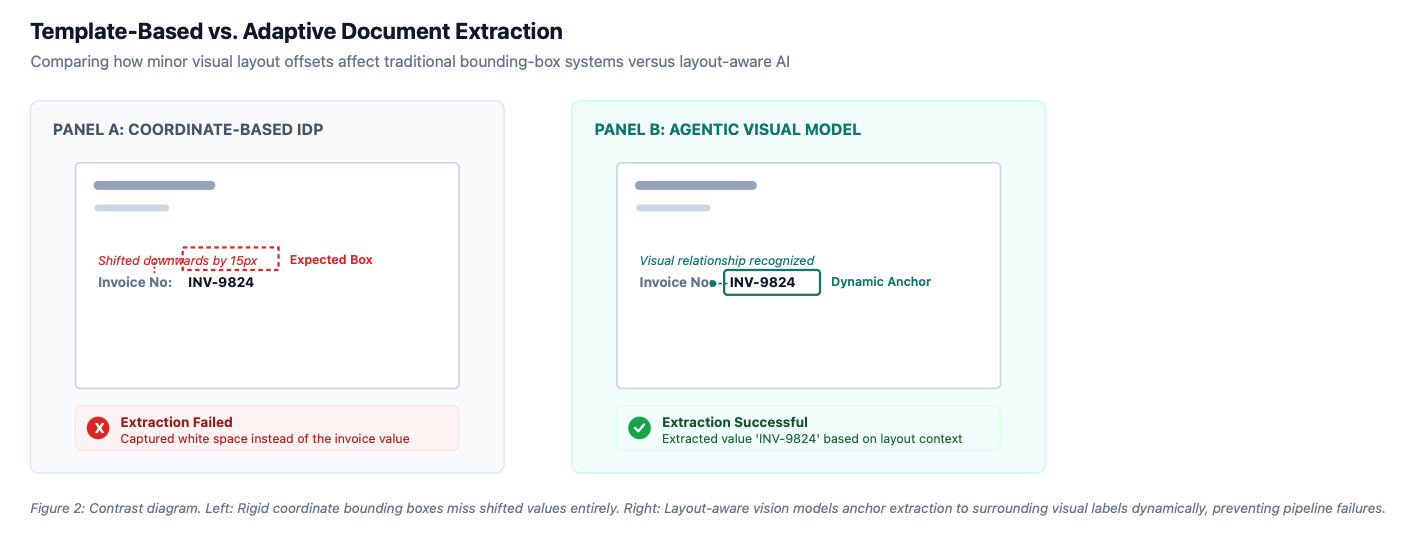
Figure 2: Left — rigid coordinate bounding boxes miss shifted values entirely. Right — layout-aware vision models anchor extraction to surrounding visual labels dynamically, preventing pipeline failures.
This worked beautifully — but only under perfect conditions. The moment Vendor A tweaked their layout, or a scanner introduced a slight skew, the system broke. Maintaining these pipelines became an expensive game of whack-a-mole. Companies spent millions hiring consultants to write and update thousands of custom regular expressions and template rules.
Even as machine learning and NLP models arrived in the late 2010s to add flexibility, the systems stayed brittle. They still lacked a unified understanding of visual structure and semantic meaning.
When generative AI arrived, many assumed the document pipeline problem was dead. The promise sounded trivial: feed the PDF to an LLM and ask it to extract the data.
Developers quickly hit three walls.
The Flattening Problem. Standard PDF parsers extract text by reading the underlying PDF code sequentially, stripping away all visual structure. When a two-column financial sheet is flattened into a single stream, the LLM reads line-by-line across both columns — scrambling the data beyond recovery.
The Spatial Blindness of LLMs. Text-based LLMs don’t see. They can’t tell whether a number sits under a column labeled “2025,” or whether a footnote modifies a specific paragraph on page three.
The Hallucination and Traceability Gap. When a document is messy or low-quality, an LLM will often confidently invent a missing number to make a table add up — with no way for a reviewer to audit where that value came from.
For high-stakes domains like healthcare, finance, and legal compliance, these failures were unacceptable. A wrong digit on a medical form or a missed clause in a commercial lease can mean millions in liability — or compromised patient care.
This brings us to the present era: the rise of Agentic Document Platforms.
Instead of treating document parsing as a single-pass extraction pipeline, agentic systems treat it as a multi-step, self-correcting reasoning task. They combine specialized Vision-Language Models (VLMs), layout-aware parsers, and autonomous agents to work through a document the way a trained human analyst would.
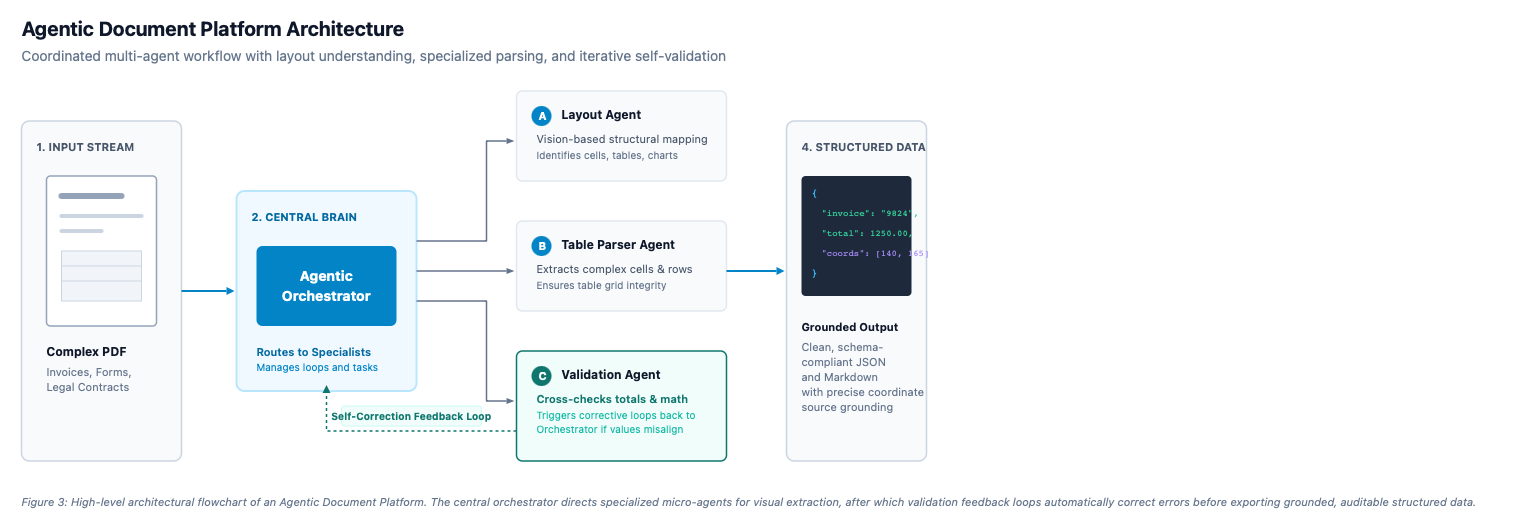
Figure 3: A central orchestrator directs specialized micro-agents for visual extraction; validation feedback loops automatically correct errors before exporting grounded, auditable structured data.
Here is how such a platform actually processes a complex file:
Dynamic Layout Analysis. Rather than treating a document as raw text, the platform uses a vision-first model — a Document Pre-trained Transformer and its relatives — to inspect the page visually. It maps headers, columns, tables, charts, margins, and footnotes into a hierarchical document tree rather than a flat string.
Specialist Agent Coordination. A team of micro-agents divides the labor. A Classification Agent identifies the document type. A Splitting Agent breaks a massive multi-part packet into logical sub-documents. A Table Specialist Agent reconstructs complex nested tables. An Extraction Agent pulls the required fields in business context.
Active Self-Correction. Like a human editor, the system checks its own work. If a table’s columns don’t sum to the stated total, or a date format looks anomalous, a Validation Agent flags it. The system re-inspects the original visual region, applies a different extraction strategy, and fixes the error before export.
Grounding and Auditability. Every extracted value is anchored back to its precise coordinate on the original page. A reviewer can click any field in the output JSON and instantly see the exact region of the PDF where the agent found it.
This isn’t purely theoretical. It’s the architecture shipping today in production platforms — LandingAI’s Agentic Document Extraction, built on its DPT (Document Pre-trained Transformer) model family, parses documents visually and grounds every value back to its source coordinates; Reducto segments a page with computer vision and layers an agentic OCR pass that reviews and corrects its own outputs across multiple cycles. The common thread is a move from configure-then-extract to understand-then-act.
That shift is a genuine leap. Setup times for complex enterprise pipelines have collapsed from months of custom coding to hours of natural-language schema definition. More importantly, agentic systems can handle documents they’ve never seen before, adapting to layout variation and messy real-world scans with ease.
Documents are the bedrock of global business, holding the vast majority of enterprise knowledge. For decades, that knowledge sat locked behind static pixels and rigid templates.
Agentic Document Platforms are changing the equation. By giving AI systems the ability to see, reason, and verify, we are moving past simple digitization into an era where documents become computable, dynamic assets that drive autonomous workflows.
The document is no longer just something we read. It is a system we converse with, build upon, and trust.
OCR to Agentic Document Extraction: The Evolution of Document Intelligence — LandingAI
Thanks for reading The MLnotes Newsletter! This post is public so feel free to share it.
Comments
Nothing yet. Say the first thing.
Sign in to join the conversation.