
I get a kick out of Marc Andreessen. I wrote about him a before. I notice with a lot of these guys, they’re playing around with a set of ideas. And when they do interviews or podcasts, 80% of their ideas are the same with some variation, but they slowly start introducing new material occasionally. And if you follow them, you get to see how it evolves. This is much like a comedian.
I listened to a recent interview on the A16Z podcast, and much of it is the same ideas he’s been espousing for years. But I found this particular exchange about a Mexican standoff with AI capabalities pretty entertaining and on point:
Interviewer
A lot of listeners to this podcast are product managers. They’re engineers, designers, founders, and also plenty of non-founders who are building products inside companies. Many of them are worried about where their careers are headed.
Are some of these roles going to disappear? Are some going to do especially well? How do you stay current?
You’re close with a lot of product teams. What’s your sense of the future of these three roles in particular: product manager, engineer, and designer?
Andreessen
It’s a funny question, because these three roles are the core roles for building tech companies.
The way I’ve been describing what’s happening is a Mexican standoff. You know the movie scene where two people are pointing guns at each other. In the three-way version, it’s a triangle—each person aiming at the other two. That’s what’s happening between product managers, designers, and engineers.
Every engineer now believes they can also be a product manager and a designer, because they have AI. Every product manager thinks they can be a coder and a designer. Every designer believes they can be a product manager and a coder. People in each role believe that, with AI, they no longer need the other two roles.
The irony is that all three will eventually realize AI can also be a better manager. That’s probably the next phase.
What’s fascinating is that they’re all kind of right. AI is now genuinely good at coding, design, and product management—or at least very good at many of the tasks involved in each of those jobs.
This connects to the idea of the super-empowered individual. If you’re a coder, the first step is deeply understanding AI coding and how the role itself is changing—from writing code by hand to orchestrating a dozen coding agents. That shift is already happening.
The next step is using AI so you can also be strong at product management and design. The same applies to product managers, who need to learn AI-assisted coding and AI-based design, and to designers, who can use AI to become capable coders and product managers as well.
What you end up with is a breakdown of rigid, stovepiped roles. Talented people in any of these roles become good at all three. Those people become incredibly valuable because they can design and build new products from scratch. That’s the real opportunity.
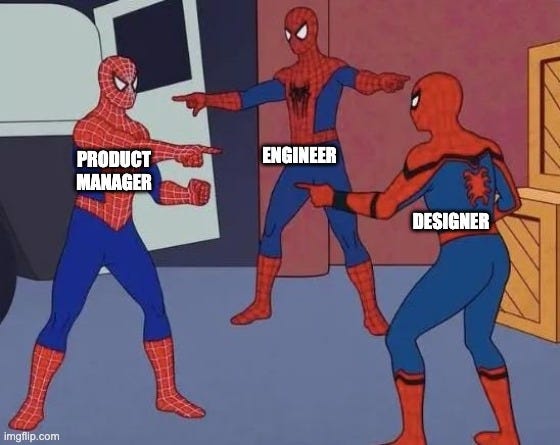
He goes on to give a similar example of a Mexican standoff between writers, directors and actors. Writers think that AI can direct and they can use generative AI for the actors. Directors think they can have AI write and act. And actors believe that AI can both write and direct, leaving them just to act.
I’ve seen this personally. I talked to someone that was more project management and he’s been using AI to code. It’s great, he doesn’t have to deal with coders requiring overly spec’d out designs and always brining up constraints and pushing back.
Not sure where it will land in the long run, but I think the generalist is more valuable. Andreessen does point out there will be great engineers that 100x with AI, while people without any fundamental understanding will be drowming in AI slop. But if you know just enough of a lot of areas (e.g. solid engineer, some design taste, decent sales skills, etc), AI will be the multiplier to make you formidable in all those areas. This will be proven out when you start seeing $1 billion single person startups.
For the average person, you really don’t want to compete on one domain, because you’re probably not especially great in any one domain. Rather its better to compete on an intersection of domains.
He also goes on to talk about the difference between jobs and tasks:
Andreessen
Yes—but being amazing now includes fully harnessing the new technology. If you’re a great coder but never learn how to leverage AI to multiply your output, you’ll eventually hit a wall.
Economists have a useful way of framing this. The job isn’t the atomic unit of work—the task is. A job is just a bundle of tasks. People talk about job loss, but what really matters is task change.
A classic example is executives and typing. In the 1970s, executives didn’t type. They dictated memos to secretaries. When email arrived, secretaries typed emails, printed them, brought them to executives, got handwritten responses, and typed those back into the computer.
Today, executives do all their own email. Secretaries still exist, but their tasks have changed—travel planning, event coordination, orchestration. The executive role persisted. The admin role persisted. The tasks changed.
That’s what’s going to happen with engineering, product management, and design. Jobs tend to persist longer than individual tasks. As tasks shift enough, the jobs themselves evolve.
At an individual level, you want to think of your job as a bundle of tasks. You need to be good at swapping tasks as technology changes. That means getting good at AI coding, then expanding your scope—design, product management—using these tools.
Ten years from now, is your title engineer, designer, or product manager? Or is it simply “I build products” or “I orchestrate AI to build products”? Whatever that role is called, it will be critical. Those people will be orchestrating AI systems, and that’s where the most leverage will be.
That’s the direction to lean into.
It’s a solid conversation, would recommend checking it out.
No posts
Comments
Nothing yet. Say the first thing.
Sign in to join the conversation.