
An instruction that seems obvious in your head can turn into a lot of guesses once your team has to act on it.
But hey, the machine can come to the rescue! This week I’m diving into how AI can actually help with this if you use it as a mirror to catch where your own language leaves room for guesswork before your team has to fill in the blanks. From there, we get into how AI can also hold onto the knowledge your teams build instead of losing it every time a team disbands, and why letting AI do your thinking is a different problem than letting it do your work. Plus, a story about how large metal boxes changed the world economy.
Cheers,
Kevin

We’re often not as clear as we think we are.
What’s clear in our head, shaped by our own background, biases, and experience, doesn’t always translate into the words we actually use with our team.
The good news is you can get better at this, and AI is actually a pretty useful partner to practice with.
Try this. Before you brief your team on something, paste the exact words you’re planning to use into AI. Then ask it two questions:
What do you think I want?
What did you have to guess or assume to answer that?
Here’s a quick example I tried. I typed this in:
“Hey, can you refresh our email newsletter? I want it to feel less corporate and get people actually clicking through to the blog instead of just skimming the subject line.”
A normal thing a leader might say, specific enough that you’d feel like you’d given clear direction.
Here’s how it said it would interpret it:
What you want: Refresh the newsletter’s copy, tone, and possibly layout so it feels more human and engaging. Improve subject lines, previews, summaries, and calls to action to increase clicks to the blog.
By when: No deadline is stated.
Why: Readers appear to notice, or skim, the subject line but aren’t clicking through to read the blog. The business goal is higher newsletter click-through traffic.
Then it told me what it had to assume:
Whether “refresh” means a one-time rewrite, a new reusable template, or a broader newsletter strategy.
Which newsletter issue, audience, and blog posts are in scope.
What “less corporate” sounds like: conversational, playful, opinionated, concise, or something else.
Whether the subject line is actually the problem, since no performance data or baseline was provided.
What success means: click-through rate, total blog visits, conversions, or another metric.
Who owns the work and who approves it.
What tools or elements may change: copy only, design, content structure, sending cadence, or all of them.
The deadline and priority.
Look at that fourth one again. Whether the subject line is actually the problem isn’t an established fact. It was assumed, by me first and then by AI on my behalf, because “less corporate” and “skimming the subject line” showed up in the same sentence and sounded like cause and effect. It wasn’t. It was a guess, and eight other open questions came along with it.
Here’s the same ask rebuilt from the outcome backward instead of from a fix forward:
“Our blog has been our top source of leads over the past year, but weekly leads have fallen below the previous average of 40. Our current hypothesis is that reduced newsletter-driven traffic is the main cause, but please validate that before deciding on a solution. Identify the causes, implement the changes within your control by August 31, 2026, and track the results. Success means returning to an average of at least 40 qualified leads per week for four consecutive weeks; the stretch goal is 44 per week. Please flag by August 7 if the investigation suggests a different cause or if you need additional resources or approvals.”
Notice what changed. Tone never comes up. Subject lines never come up. There’s a number, a deadline, a definition of success that can’t be met by one lucky good week, a clearly stated hypothesis that has to be checked rather than assumed, and a checkpoint date for surfacing problems early instead of finding out on August 31 that the whole theory was wrong. It doesn’t say how to fix anything. It states what’s broken, what’s suspected, what proof looks like, and when you need to know if the suspicion turns out to be wrong.
In my experience, the best way to take advantage of the power of the team to get the outcomes you most seek is to delegate the How. And the best way to do that is to provide context, a validated or at least a checkable hypothesis, a number that defines success, a specific due date, any guiding principles for how to think about it, and clear guardrails to work within.
This level of specificity doesn’t come naturally at first. It takes practice. That’s exactly why AI can be a good partner to help you improve. It’s a low-stakes way to see, in plain language, what’s actually landing when you translate what’s in your head into words someone else has to act on.
Delegating the how also depends on everyone working from the same facts, and that’s another way AI can help. Pod-based and agile teams generate real institutional knowledge, but when a team disbands, most of what it learned leaves with the people who were on it, and the next team starts over. Sky Kelley argues AI agents can hold onto that knowledge instead, carrying what dozens of past teams learned into whichever pod needs it next. Her real question goes further than where to automate work: what organizational architecture becomes possible once agents can carry knowledge, context, and continuity in ways no single person can.
Critical thinking is the one thing AI shouldn’t do for you, and this article explains why that’s harder to protect than it sounds. Fernandez and Cooper build their case around a real example of a sales team whose AI agent scored deals so well that leaders stopped questioning its decisions—until it missed three deals their VPs would have caught on instinct. As amazing as AI is, we’re still well-served to apply a good dose of critical thinking before letting it run completely on autopilot. I like that this article lays out four specific habits to use when working with your AI agents, starting with something as simple as writing down what you expect to see before you look at the output.
“Never tell people how to do things. Tell them what to do, and they will surprise you with their ingenuity.”
— General George S. Patton
I got completely pulled into this story about the shipping container and how much it actually shaped the global economy. Before it came along, loading a ship took an army of dockworkers days to finish. One guy’s idea for a standardized steel box changed all of that, and the ripple effects went way further than shipping. Small, unglamorous changes can end up reshaping something as massive as world trade. Worth the watch.
“Hey you, that’s not what I said I wanted!”
I hope you’ll check out my Amazon #1 bestselling book, The Strategy Trap: Why Companies Fail at Execution and How to Get It Right.
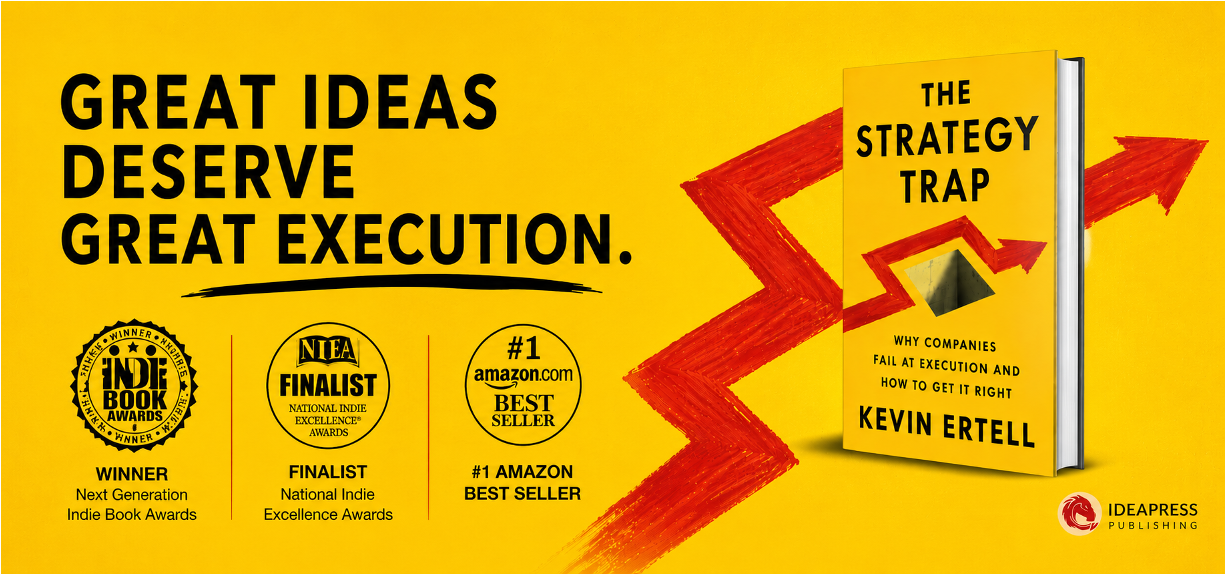
If you've ever struggled to turn team agreement into consistent action, the book goes deep on how to fix that, with practical tools, real-world stories, and a framework for turning strategy into results. If you know someone who struggles to turn strategy into results, please forward this along.
Thanks for reading The Strategy Trap Newsletter! This post is public so feel free to share it.
Comments
Nothing yet. Say the first thing.
Sign in to join the conversation.