
You told them once. Surely that was enough.
This week’s theme is the Signal Fade Trap—the fourth of six traps in the series. You launch the strategy, everybody claps, and then two months later it’s like the whole thing never happened. A single announcement can’t compete with the daily grind. A key fix is repetition, and this issue is loaded with proof: a list of ten communication tips, an article that does the math on how many times you have to say something, and one of my favorite quotes that nails why we fool ourselves into thinking the message landed. Plus an experiment on thinking yourself younger, which I fully intend to abuse.
Cheers,
Kevin

Strategy execution fails in predictable ways. Over the next six weeks, I’ll explore six traps nested inside the larger Strategy Trap. These are patterns that consistently derail even well-designed strategies, and what to do about each one.
Part 4 of 6
The strategy launch went extremely well. The leadership team spent weeks refining the message, building the deck, and rehearsing the delivery. People applauded at the all-hands meeting, and there were good, thoughtful, and engaged questions. You walked out feeling the organization was primed and ready to go.
Then the day-to-day took over.
For leadership, it was the next set of fires, the quarterly numbers, and plenty of decisions that couldn’t wait. For the team, it was the meetings that filled every hour and the immediate demands that pushed everything else to the margins. So the strategy got gradually buried—by both sides—under everything else competing for attention.
Two months later, you looked up and realized not much had changed.
That’s the Signal Fade Trap. The message launched. It just didn’t last. And the reason isn’t that people didn’t care or that the strategy wasn’t good. It’s that a single announcement—no matter how well crafted—can’t compete with the relentless pull of the day-to-day over time. Research on how people retain information suggests we forget roughly 90 percent of new information within 30 days without reinforcement. That means even a clear, compelling message delivered well is mostly gone within a month if nothing follows it.
The problem is often that leaders experience the announcement as a significant moment, but the team experiences it as one of many things that crossed their paths that week. The starting points are already misaligned before the fading even begins.
The energy from the launch fades fast. There’s often genuine enthusiasm right after the announcement. People are engaged, and the mood is positive. A few weeks later, though, that energy has largely dissipated and people are back to their routines.
People remember the announcement but not what it means for their work. Ask someone three months after the launch what the strategy is and they can maybe recite the headline. Ask them what it means for how they spend their time and you’ll get a much hazier answer.
Progress on strategic priorities slows without anyone deciding to slow it. Nobody made a conscious choice to deprioritize the strategy. The day-to-day just keeps winning the competition for time and attention.
Leaders assume silence means alignment. Nobody is raising concerns, so it seems like things are on track. But the absence of questions all too often means people have just stopped thinking about the strategy, not that they’ve figured it out.
When did you last really communicate the strategy to your team—not reference it in passing, but actually talk about it with intention? If you’re struggling to remember, that’s probably a signal.
If you asked five people in your organization what the strategy means for their specific work right now, how consistent would the answers be?
After the initial launch, what was your plan for keeping the message alive? If the answer is “we figured people had it,” the strategy was probably more dependent on that one moment than it could sustain.
Do your leaders—the people between you and the front lines—talk about the strategy regularly in their own team conversations, or did the messaging stop after the launch?
The antidote is continuous communication. You have to build a plan to keep the message alive long after the launch, not just delivering it well once. And a repetition has to be intentionally built with a specific cadence and distribution. People need to hear something many more times—and in many more ways—than leaders expect before it actually changes behavior.
Repetition alone isn’t enough, though. The same top-level message delivered over and over eventually becomes wallpaper. What keeps communication alive is translating the strategy into what it means for different teams, in different contexts, at different moments. The message has to stay connected to the work people are actually doing, or it loses relevance fast.
The framework I use is Early, Loud, Continuous—building communication as an ongoing rhythm rather than a one-time event. If you want the full picture on how to put that into practice, including how to structure the cadence, equip your leaders to carry the message, and keep it fresh without repeating yourself word for word, it’s all in The Strategy Trap.
Mark O’Donnell’s list of ten communication tips is a quick read and a really good one that is right in line with this week’s theme. His core point, which I wholeheartedly endorse, is the team isn’t bought in yet, and that’s usually about how the vision got shared, not the vision itself. He puts a number on repetition—people need to hear something around seven times before it sticks—and he makes the case for updating the whole company every 90 days so the plan keeps feeling real. Simple stuff, but it’s collectively missed all too often.
Robert Bogue put numbers behind this week’s theme, and his breakdown of repetition and channels is worth a look. His point is that we treat communication as one-and-done, but every message misses some chunk of people—buried email, distraction, bad timing. If your email open rate is under 30 percent, he figures you need more than eight sends to get a message to 95 percent of your organization. The part I really liked is his framework for picking the right channel: direction, scale, sensitivity, purpose, and urgency. It’s a simple way to break the habit of defaulting to the same few channels every time.
“The single biggest problem in communication is the illusion that it has taken place.”
— often attributed to George Bernard Shaw
This is a fun and fascinating one. A psychology experiment took eight older men, had them live for a week as if it were decades earlier—surrounded by the music, news, and furniture of their younger years—and measured them before and after. The results showed real shifts in things like posture, eyesight, and memory, just from getting them to inhabit a younger mindset. I’ll be over here thinking myself back to a full head of hair and a working jump shot.
This could be all of us in the coming heat wave.
My Amazon #1 bestselling book, The Strategy Trap: Why Companies Fail at Execution and How to Get It Right, is now available!
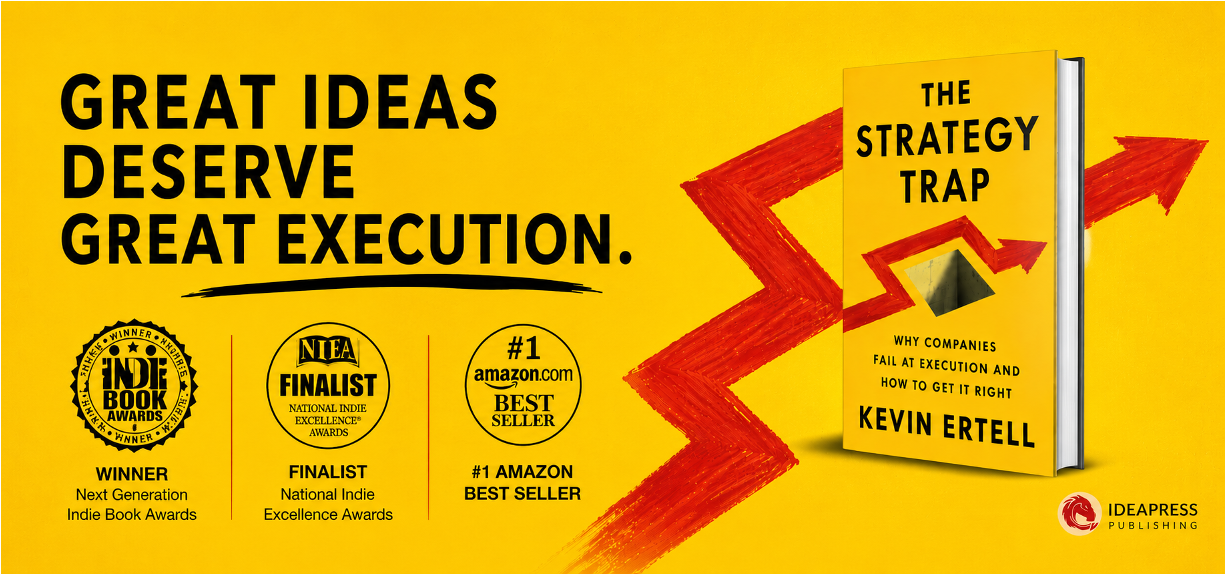
If you’ve ever struggled to turn team agreement into consistent action, the book goes deep on how to fix that—with practical tools, real-world stories, and a framework for turning strategy into results. If you know someone who wrestles with the gap between plan and execution, please forward this along.
Thanks for reading The Strategy Trap Newsletter! This post is public so feel free to share it.
Comments
Nothing yet. Say the first thing.
Sign in to join the conversation.