
Something interesting has been happening to me more and more: in somewhat hushed tones, people are telling me about how they used AI or, more interestingly, asking me if I think it’s ok for them to use AI. It turns out that over two years of thinking and writing publicly about my experiments working with AI has been an act of disclosure that enables people to feel like they can start a conversation with me or ask those uncertain and even shame-tinged questions.
The uncertainty and shame stands out to me because the mission driven professionals I work with everyday are simply brilliant. They are deeply committed to their communities and doing essential work every single day. And they are wrestling with this AI question on such deep levels. They don’t just want another free course or how-to guide, they want to have the deep conversations and, I think, they want permission.
As I’ve had these conversations, I’ve realized how much weight people (usually women, interestingly) are carrying about AI. Concerns range from a fear of using AI “wrong,” shame about needing help, fear of being “found out”, and worry that using AI is in direct opposition to their morals and values. And beyond that, the decision to use AI is tangled up with anxiety about whether and how to disclose that use.
It turns out that my openness — which I’d honestly never thought of as particularly brave — had created a small opening for an authentic conversation.
And that got me thinking much more about the act of disclosure around AI use. What can AI disclosure statements, when done intentionally, do within our teams, organizations, and communities? If you’re reading this, I’m guessing you’ve been thinking about it a lot, too. Maybe you’ve felt those same concerns. Maybe you’re managing a team trying to figure out disclosure expectations. Maybe you’re navigating funder requirements or organizational policies that feel more like landmines than guidelines. And maybe you’re wrestling with how to build authenticity and trust in the age of AI and the role disclosure plays.

Here’s what I want you to know: Disclosure is an opportunity. To disclose or not is actually not the question we should be asking. When done thoughtfully, disclosure can be so much more than just compliance or a checkbox, it can actually build the trust and open the conversations we desperately need right now with one another (you know…the humans).
And yet, disclosure is also a risk. Research shows that women (and likely other minority groups) are judged more harshly when they disclose AI use. This is why, in the absence of disclosure requirements for compliance (which are becoming increasingly more common), the decision to disclose AI use is a personal one.
I recently prepared a long list of sample disclosure templates for a client and, as I did so, I saw that there were some repeating layers and considerations that screamed out for a framework (h/t to Annie, my branding guru, for reminding us that we all have frameworks inside of us!). With my trusty thought-partner project that I’ve built and refined over the last few years in Claude, I set to work brainstorming memorable ways to share the layers of disclosure I see in a handy framework, and now I’m excited to share it with you!
SHARE helps you assess five key factors that shape your disclosure decision. These factors are situational and contextual. Not all factors will weigh equally all the time, and that’s ok. This isn’t a formula; it’s a tool for thinking through what you want disclosure to accomplish, and why.
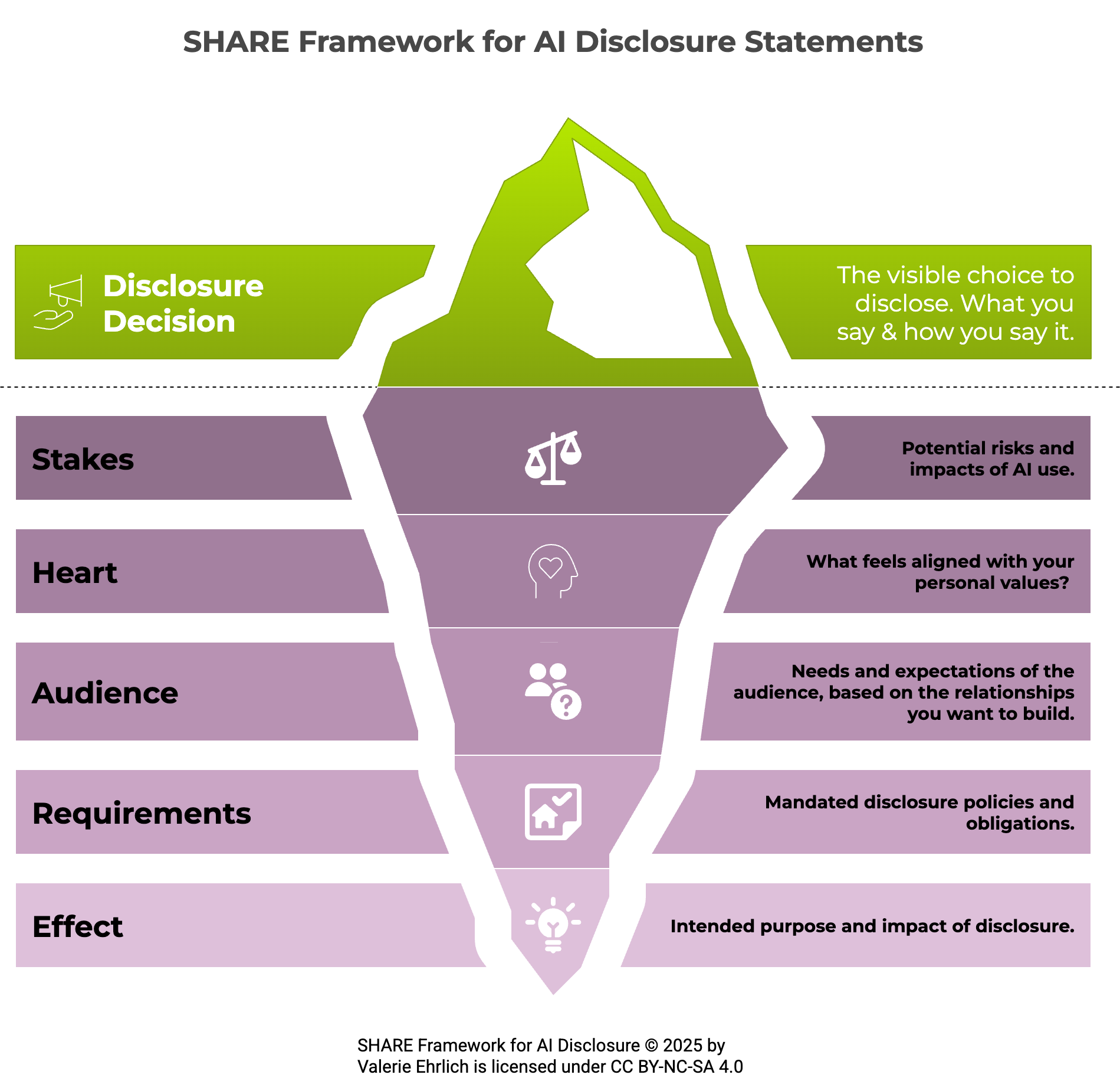
Start by honestly assessing the stakes of your AI use in this specific situation:
Could inaccuracy cause harm? If you’re using AI to analyze data that will inform funding decisions, the stakes are high. If you’re using it to brainstorm social media ideas, they’re lower.
How visible or public is this? A blog post has different stakes than an internal memo. A client deliverable has different stakes than a meeting agenda.
Who’s affected if something’s wrong? Consider both direct and indirect, intentional and unintentional impacts.
Is this reversible or permanent? Some outputs can be easily corrected; others can’t.
Stakes help you understand what is at risk (or not) with your AI use, how you want to mitigate those risks, how you will be held accountable, and what transparency you want to provide in the face of those risks. In general, if the stakes are high, you should probably be thinking a lot about error mitigation and accountability and, when you decide what and how to disclose, you’ll want to be able to explain all the steps you took to use AI responsibly.
Note: I’ve purposefully made “stakes” here about your use of AI, and not just the stakes of disclosure. Though that is relevant across all dimensions and will shape your overall choice, I think a step we often overlook is what’s actually at stake when we use AI and how that should influence our disclosure statements. We need to talk more openly about both the risks and strategies for mitigation, and disclosure statements are a way to do that. But only if we’ve thought it through for ourselves first.
Key question: If this AI-assisted work contains an error or bias, who could be harmed?
This is your integrity, values, and your moral compass. It’s what feels right to you, regardless of what’s required or expected.
What’s your personal stance on transparency? Some of us lean toward radical openness; others value privacy. Neither is wrong; and both carry risks.
How do you want to show up professionally? Are you trying to model something for others? Build a reputation as an early adopter? Maintain credibility as a careful practitioner?
What would you want to know if you were on the receiving end of the item you’ve produced? What would you want to understand about how it was created and how would that influence your perception of it?
When requirements are minimal and stakes are manageable, your values guide you toward the disclosure level that feels aligned with your self, your work, and your values.
Key question: If I don’t disclose this, will I feel like I’m hiding something that matters to the people I’m sharing it with?
Not all audiences are the same, and the same disclosure might land very differently depending on who’s receiving it. Audience considerations include not only who you are speaking to with your piece and your disclosure, but what relationship you want to have or build with them.
What’s the relationship context? New client relationships often need more explanation than established ones. Trust takes time. Disclosure can be part of that trust building. It can also be challenging if disclosure will impact trust at the outset. Only you can know each specific context.
What are the power dynamics? If you’re a grantee disclosing to a funder, that’s different than if you’re a funder disclosing to grantees. Be honest about how power shapes perception.
What’s the cultural context around AI in this space? Some communities and sectors are embracing AI experimentation; others are deeply skeptical or strongly opposed. Meet people where they are and be prepared for their response(s).
What does this specific audience actually need to understand? A board might need assurance about oversight processes. A peer might just need to know which tool you found helpful. Be mindful of what your disclosure can support in others in terms of either their own reassurance or opportunities to learn.
Audience considerations influence how much context and explanation your disclosure needs. The same level of disclosure might feel sufficient for one audience and inadequate for another.
Key question: What does this specific person or group need to know to feel informed and respected?
This is the non-negotiable baseline—the factors that remove some choices from the table. Disclosure requirements are becoming increasingly common as part of organizational AI policies. In addition to what you should do, there are likely some things you might be required to do, based on your role and work.
Organizational policy: Does your organization have guidelines about AI disclosure? If so, what are they? How frequently are they revised?
Funder expectations: Have funders explicitly addressed AI use in their guidelines? (If unclear, consider asking.)
Legal or regulatory obligations: Certain sectors and jurisdictions have emerging requirements, particularly around synthetic media.
Professional standards: Are there norms in your field you need to consider? Norms, by definition, grow and evolve and your participation in disclosure will likely help shape them.
Requirements create your floor, but they rarely tell you everything you need to know. Compliance is necessary but not sufficient for building trust.
Key question: What am I actually obligated to disclose here, and by whom?
Here’s where we get to the heart of what makes disclosure powerful beyond just checking boxes. What’s the purpose of your disclosure in this situation? Disclosure is both an opportunity and a risk and the act is rarely neutral.
Your disclosure might aim to:
Meet a compliance requirement (necessary but minimal)
Build credibility by demonstrating oversight and accountability
Start a conversation about how we’re all navigating these tools
Model transparency to create permission for others
Protect yourself from misunderstanding or liability
Normalize AI use by showing it’s not shameful
Educate about AI’s role and limitations
The effect you’re aiming for shapes how you disclose, not just that you disclose. The same basic information can be framed very differently depending on what you want it to accomplish.
This is where disclosure becomes generative instead of just defensive. When I disclose my AI use through how I talk about my work, the effect has been to create an opening. That was intentional. In many cases, I want people to understand how I’m using these tools as a thought partner and reduce the shame (and fear) around using them through my own transparency.
Key question: Beyond just being transparent, what do I want this disclosure to make possible?
Let’s walk through how SHARE works in real scenarios you might encounter.
S - Stakes: Low. Internal document, early-stage thinking, easily revised.
H - Heart: I value transparency with my team, and I want to normalize AI as a thinking tool.
A - Audience: My colleagues who I trust and who are also experimenting with AI.
R - Requirements: None for internal documents.
E - Effect: Model transparency, start conversations about what’s working.
Disclosure decision: Subtle to standard
Sample language: “These ideas came out of a conversation with Claude this morning. It’s still rough but I wanted to get them down while they were fresh. Curious what resonates with you all.”
Why this works: The disclosure is casual and conversational, matching the informal context. It invites dialogue without making AI use feel like a big deal.
S - Stakes: HIGH. Decisions will be based on this analysis. Accuracy is critical.
H - Heart: I need to be accountable for my methods and findings.
A - Audience: Client leadership who may have varying comfort levels with AI. Some may be skeptical.
R - Requirements: Check your contract and ask if unclear. Better to over-communicate than assume.
E - Effect: Build credibility through transparency about process AND demonstrate human oversight.
Disclosure decision: Detailed
Sample language: “Data analysis for this evaluation was conducted with assistance from Claude 3.5 Sonnet for initial pattern identification and coding support. All findings were independently verified by [evaluator name] using [traditional method]. AI was not used for interpretation of findings or development of recommendations, which reflect human judgment based on [X] years of evaluation experience. Limitations: AI analysis may not capture contextual nuances that emerged during site visits and stakeholder interviews.”
Why this works: This disclosure does multiple things at once: it’s specific about what AI did and didn’t do, emphasizes human oversight and accountability, acknowledges limitations, and builds confidence through detail. It treats the client as a partner who deserves to understand the process.
S - Stakes: Medium. Public and attached to your professional reputation, but not high-consequence.
H - Heart: I want to model transparency and reduce shame around AI use.
A - Audience: Mixed: colleagues, potential clients, people at various comfort levels with AI.
R - Requirements: None for social media, though norms are shifting.
E - Effect: Start conversations, normalize use, create permission for others to engage with AI thoughtfully.
Disclosure decision: Standard with conversational framing
Sample language: “I used Claude to help me synthesize patterns across several recent projects—it’s become such a useful thinking partner for connecting dots I might have missed on my own. These three themes kept emerging... [your insights]. What tools are helping you see your work differently?”
Why this works: The disclosure is embedded naturally in the narrative. It frames AI as a thinking partner, not a replacement. The question at the end explicitly invites conversation, turning disclosure into an opening rather than just a statement.
S - Stakes: High. Funding depends on this.
H - Heart: I value integrity, but I’m also aware of bias.
A - Audience: Funder with unknown stance on AI. Power dynamics are real.
R - Requirements: Check the guidelines carefully. If unclear, consider asking. If explicitly prohibited, don’t use AI in ways that would require disclosure.
E - Effect: This is complicated. Disclosure might demonstrate thoughtfulness OR trigger bias. There’s no easy answer.
Disclosure decision: Variable—this requires judgment.
Considerations:
If disclosure is required, comply fully but frame it to emphasize human leadership and organizational expertise
If disclosure is optional, consider: Will this help or hurt? Research shows women and people of color face disproportionate judgment when disclosing AI use
There’s no one right answer here, and that’s uncomfortable but true
Whatever you decide, be able to articulate your reasoning to yourself
Sample language (if disclosing): “Our team used AI tools to help organize research and draft portions of this narrative, which were then extensively reviewed and refined by [lead staff/ED] with [X] years of experience in this field. All data, outcomes, and organizational capacity descriptions reflect our direct work and verified information.”
Why this is complex: This scenario highlights that disclosure isn’t just about the transparency you’d like to have (and be respected for). It’s also about navigating systems where power dynamics exist and that may not evaluate AI use fairly. Your SHARE assessment might lead you to different choices depending on your specific context, and that’s okay. The framework helps you think through the decision intentionally rather than reactively.
Once you’ve worked through SHARE, you can choose where on the disclosure spectrum makes sense for your situation:
Silent: No disclosure
When it works: Truly minimal AI involvement (grammar check level), no requirements, very low stakes
When it doesn’t: When others would reasonably want to know, when required, when hiding it feels like deception
Subtle: Brief embedded acknowledgment
Example: “Prepared with AI assistance” in a footer or end note
When it works: Low-to-medium stakes, established relationships, when you want to normalize without making it the focus
Caveat: Will a short statement suffice for your audience? What else might you need to include, or say in a separate communication, about your use? Or, what additional info might you prepare so that you can be responsive to questions?
Standard: Specific but concise
Example: “Used Claude to help organize these ideas” or “ChatGPT assisted with initial research”
When it works: Most everyday professional contexts, when you want to be clear but not exhaustive
Detailed: Tool + task + human role + limitations
Example: Full explanation of what AI did, what humans did, and what the limitations are
When it works: High stakes, building trust with new relationships, when accountability really matters, or when you’re trying to model/educate others
Full Transparency: Complete process documentation
Example: Detailed methodology notes, prompts shared, full audit trail
When it works: Research contexts, when you’re specifically modeling practice, when you want to teach others
Right now, I don’t think there’s a “right” disclosure for anything and everyone. These levels are designed to match your disclosure to what the situation actually needs based on your SHARE assessment and intentional consideration of the trade-offs and context.
By and large, my own efforts at disclosure have been very well received. I have found it to spur more conversations than not. So, are you ready to put this into practice for yourself?
Here are three micro-moves you can make this week:
Pick something you created recently with AI assistance. Walk through all five SHARE factors. Did your actual disclosure (or lack of it) align with what the framework suggests? If there’s a gap, what does that tell you about your current approach?
Think about the three situations where you most often use AI. For each, create 2-3 sample disclosure statements at different levels (subtle, standard, detailed). Having these ready means you’re not reinventing the wheel every time, and you can make them sound authentically like you.
Store them somewhere accessible. Refine them as you learn what lands well with different audiences. Pro-tip: Add them to a tool like TextExpander to always have them at your fingertips!
Share how you’re thinking about disclosure with a colleague, your team, or even a trusted client. You might say something like, “I’ve been reflecting on how to be thoughtful about AI disclosure. Can I run some ideas by you?” or “I’d love to hear what matters to you about knowing when AI has been involved in work you receive.”
These conversations do two things: they help you refine your thinking, and they create space for others to share their questions and concerns.
Here’s what I hope you take away from this post: Disclosure isn’t a problem to solve once and be done with. It’s an ongoing practice that evolves alongside your AI use and our collective understanding of these tools, including the norms we’re co-creating and the standards of our professional fields and relationships.
The SHARE framework is meant to help you intentionally pause and think through your choices; to help you move from reactive anxiety (or shame!) about disclosure to thoughtful consideration of what serves your work, your relationships, and your values.
Some days, disclosure will feel easy and straightforward. Other days, you’ll wrestle with competing factors. That tension is okay. It means you’re taking this seriously. Remember, uncertainty and discernment are your superpowers when it comes to AI.
Disclosure, when done well, is an opportunity to build trust and open the conversations that let us learn together how to use these tools responsibly and effectively.
Before you go, take a moment with these questions:
When you think about disclosing your AI use, what comes up for you? Excitement? Anxiety? Confusion?
Where do you have the most discretion in your disclosure choices? Where do you have the least?
What would you want to know if you were on the receiving end of AI-assisted work in your field?
What’s one disclosure choice you could make more intentionally this week?
I’d genuinely love to hear your reflections. What’s working? What’s confusing? What did I miss? Drop a comment below or share this post with someone who’s navigating these same questions.
And if this resonated with you, consider these related posts where I explore the trust and relationship dimensions of AI use:
What will you SHARE this week?
Thanks for reading The Bloom Shift! This post is public so feel free to share it.
AI Disclosure Statement: This post was developed through conversation with Claude Sonnet 4.5 (Anthropic) within a project I have built to help me challenge, structure, flesh out, and brainstorm writing tasks (based on this guidance from Alexandra Samuel). I provided the framework concept, examples of disclosure that I’ve seen in practice and my own ideas about what disclosure should look like, personal stories, and strategic direction via a mixture of voice-to-text and typed notes. Claude helped me brainstorm acronyms that might fit my ideas, structure the ideas, offered a detailed outline which I refined, and write a simple first draft that I brought into Substack for my revisions, additions, editing, and reshaping. All final decisions about framing, tone, examples, and recommendations are mine, as is responsibility for the content. The back-and-forth process helped me clarify my thinking—which is exactly the kind of AI partnership I wanted to model.
💡Did you know?🌱 Helping mission-driven leaders, teams, and organizations thoughtfully and responsibly adopt AI is what I do! If you want to learn more, please reach out!
To stay up-to-date on my writings across platforms, please join my mailing list.
I’d love to hear your thoughts on this post. What resonated? What are you curious about? Do you see things differently?
Comments
Nothing yet. Say the first thing.
Sign in to join the conversation.