
“I have not lost control of the House.”
- Speaker Mike Johnson (R-LA), December 171
Speaker Johnson probably wished that he hadn’t said that. Just as law-abiding presidents don’t have to insist that they aren’t crooked, and moral ones don’t need to deny they’ve been unfaithful, strong leaders don’t have to proclaim that they have power.
The development that prompted Johnson’s unfortunate statement was the decision of four House Republicans – including a clearly furious Rep. Mike Lawler (R-NY) – to sign a discharge petition introduced by minority leader Hakeem Jeffries (D-NY). Their John Hancocks gave the petition enough signatures to circumvent the will of the Speaker and force a vote on renewing federal subsidies for individuals whose health insurance is covered by the Affordable Care Act.
For those accustomed to thinking of Congress (especially the House of Representatives) as an institution with strong party discipline and powerful party leaders, this event came as a surprise. It shouldn’t have. In fact, it is symptomatic of a development that has been going on for over a decade: the gradual erosion of the authority of Republican leaders over how the House operates.
Successful discharge petitions are a problem for majority party leaders because they circumvent their power to set the House’s legislative agenda, what is known as procedural authority (and in particular, negative procedural authority – the ability to keep bills from getting votes).2 Leaders thus discourage members of their party from signing them.
Unfortunately for Speaker Johnson, petitions have done remarkably well so far in this Congress: four have gotten the necessary 218 signatures, resulting in votes to release the Epstein files and protect the union rights of federal workers, plus a compromise that would make it easier for lawmakers who are new parents to vote in abstentia. This is the most petitions to reach that threshold since the 75th Congress, which met from 1937 to 1939 (as shown in this chart from Sarah Binder).
Though we do not expect members of the majority party to defy their leaders in this way, it was not considered unusual in the past.3 In their excellent analysis of petitions between 1929 and 1976, Kathryn Pearson and Eric Schickler found that lawmakers from the majority Democratic Party – in particular, northerners – were actually more likely to sign petitions than members of the minority GOP. These Democrats were largely shut out from positions of influence, so the petition was a way they could signal their legislative preferences and try to get desired bills to the floor.
This changed starting in the 1970s, when the majority started to expand its procedural authority and discharge petitions became a position-taking instrument of the minority. One can see this in the chart below, which expands upon data I gathered for my book Underdog Politics. The blue line in the chart shows the percent of petitions introduced by majority party members. The red bars indicate the average percent of petition signatures from members of the majority party. (The gap from 1983 to 1994 represents petition data not yet available or collected from the National Archives.)
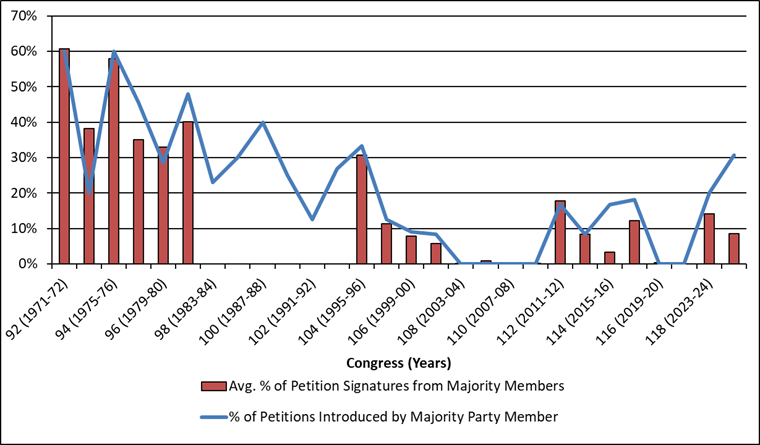
In the 1970s, many petitions were introduced by majority party legislators (who were Democrats), and they provided least 30% of signatures on average. But by the early 2000s, no one from the majority party (whether Republican or Democrat) was introducing petitions, and virtually none were signing them.
Something interesting started happening in the 2010s, however. Whenever the GOP was in the majority (2011-2019 and 2023-present), some Republicans would introduce and sign discharge petitions. This corresponded to the rise of the anti-establishment Tea Party movement and, later, the creation of the House Freedom Caucus, a group of conservative lawmakers that was willing to ignore norms of party discipline to achieve its goals.
Despite what Johnson may say, then, the current success of discharge petitions is not just a function of the GOP having a tiny majority. It follows years of Republicans defying their leaders on petitions and doing so with impunity. I’d also argue that, unlike previous congresses, lawmakers have filed discharge petitions on issues with stronger bipartisan appeal, and they have been helped by “Speaker overreach” and the willingness of both GOP conservatives and moderates to sign petitions.
The problem facing Johnson is much bigger than a handful of renegade Republicans willing to put their names to discharge petitions. The current popularity of petitions is but one facet of the eroding authority of Johnson and other Republican leaders over their party.
For example, in the last Congress, Republicans failed to pass eight special rules that govern how a bill will be considered on the floor, the most since the 1970s – another indication of leaders’ weakening procedural authority. The party has also struggled to pass bills and amendments: In the previous Congress, nearly a quarter of measures that were supported by a majority of the party nonetheless failed (so-called “disappointment votes”), which is far more than average. And we have seen both parties struggle to keep their members unified when choosing and keeping a Speaker (with particularly disastrous consequences in 2023, not to mention a close call in January of this year).
All of this defiance underscores in part how essential norms are for maintaining the authority of governing parties and their leaders.4 As Matt Glassman writes, party leaders’ power depends on “the implicit and ongoing backing of a majority of the Members of the House.” While leaders often have resources to incentivize that backing (like committee assignments), it’s just not possible to build coalitions for every vote that way.
Norms of compliance, by contrast, ensure that majority party members regularly support their leaders. Building and maintaining those norms is thus crucial to leaders who want to maximize their authority. As then-minority whip Steny Hoyer (D-MD) put it, “I wanted people to get up in the morning and think, ‘I want to be with the team’.”
Unfortunately for House Republicans, those norms are far weaker than they were a quarter century ago. It is no longer seen as unthinkable to sign a discharge petition, vote down a floor rule, or reject your party’s nominee for Speaker. And that spells trouble for party leaders who want to exercise substantial authority.
Yet Speaker Johnson still seems to behave as though those norms are as strong as ever. Josh Huder rightly notes that Johnson (and Republican speakers before him) act like “czars,” when really the best they can do, given the nature of their party, is to act as “brokers.” As a result, Johnson keeps “pulling rabbits out of hats,” barely winning legislative battles while regularly getting pwned by members of his own party.
Resolving this will not be easy. I suspect that Johnson has been representing the policy preferences of a majority of his party much of the time, fearing what will happen to him if he doesn’t. Yet there’s no sign that his party’s biggest renegades are going to change their tune, or that norms of party unity are about to be restored. And Johnson has little incentive to act as a broker and let a bipartisan majority work its will if, by doing so, he is excoriated by the media as weak.5
Until this puzzle is solved, we should expect to see more signs of defiance, party disunity, and frustration within the House GOP.
Yes, I know I started my previous post with quotes. But I just had to start this post with Johnson’s statement, which is one of the best uttered by any speaker ever.
For more on norms in Congress, I recommend the just-published edited volume The Folkways of Congress, which features a chapter by yours truly along with many outstanding scholars. There’s also this excellent article by Julia Azari and Jennifer Smith.
For example, when the Jeffries discharge petition got 218 signatures, Gabe Fleisher on X called it “another huge embarrassment for Mike Johnson.”
No posts
Comments
Nothing yet. Say the first thing.
Sign in to join the conversation.