
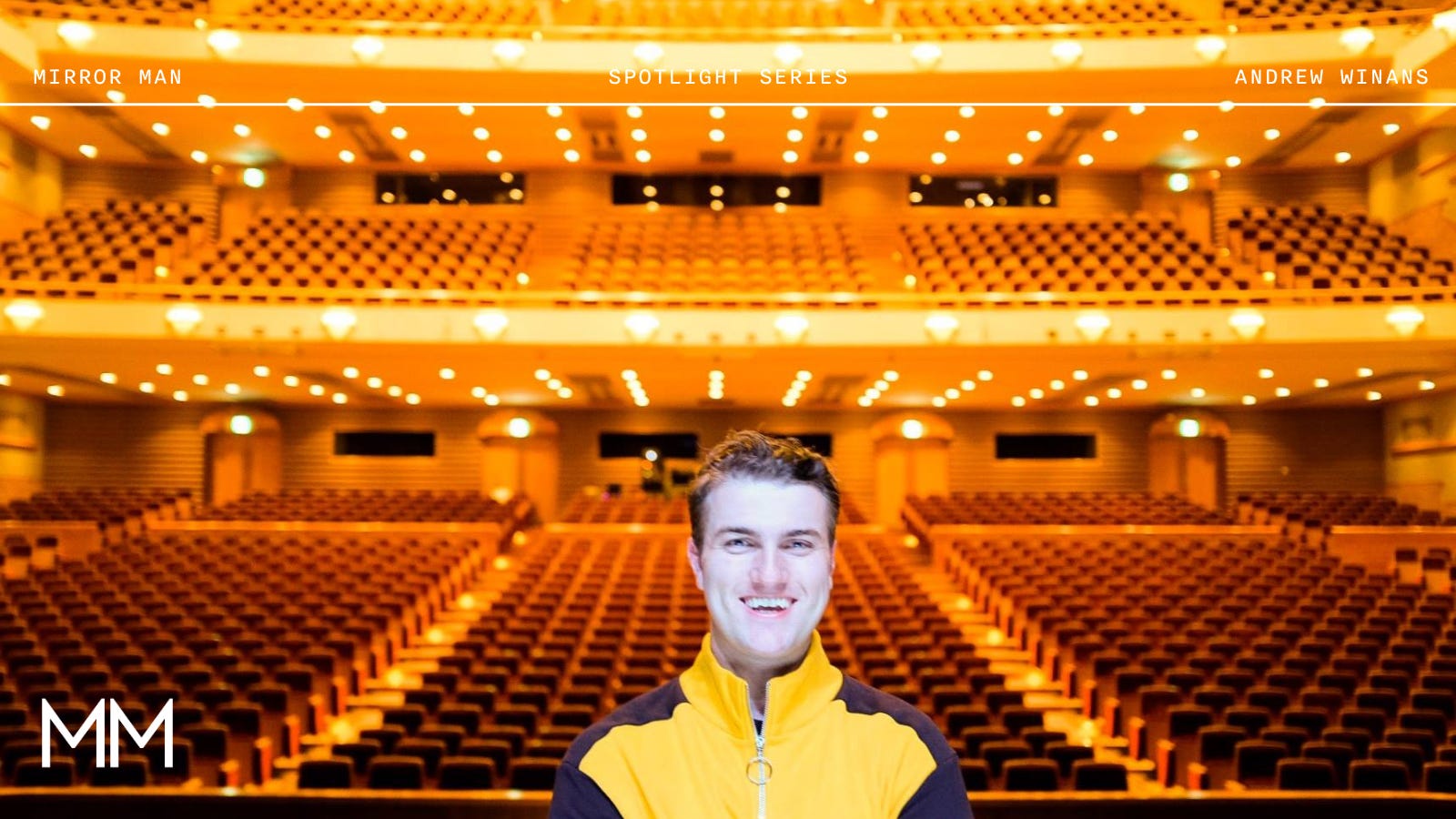
In Part One of my conversation with Andrew Winans, we discussed the formative years: how a teenager from New Jersey walked out of Wicked at the Gershwin Theatre and decided, quietly and completely, that this would be his life. We covered his training, his deep immersion in theatrical jazz dance, his mentors — among them Baayork Lee and the late Bob Avian — and his profound trajectory with A Chorus Line, from off-stage swing on tour to one of the show’s next-gen stewards, assisting Baayork for nearly a decade in setting productions of the show all over the globe.
We ended Part One discussing the specificity of Michael Bennett’s movement. In Part Two, we turn to the bigger picture: what it means to put today's Broadway performers on the line and where Michael's footprints are most visible in the theatre we make now.
This Mirror Man: A Portrait of Michael Bennett interview with Andrew Winans was conducted by me, Natalie Guevara, on September 13, 2025. Our conversation has been lightly edited for clarity.
Thanks for reading Mirror Man: A Portrait of Michael Bennett — The Substack. This post is public. Spread the word — and the work — of a Broadway legend.
Let’s talk ACL 50. I want to start with the casting, because it struck me as especially poetic. You assembled the cream of the crop of Broadway performers working today: alumni of the show, people who’ve done it internationally, and newer faces. All of them felt so of-the-moment and yet, seeing them on that line, they transported you straight back to the ‘70s. How did you and the team approach building that line? Where does a process like that even begin?
Even though the gala performance was primarily focused around big musical numbers [from A Chorus Line], we wanted everyone on that line to be right for their characters. Not just technically, but essentially. The most important thing to Baayork as a director is that the person has the essence of that character as a human being. It is clear when someone can connect personally to whoever they’re playing.
Having people like Robyn Hurder, Larkin Reilly, Nick Adams, Tony Yazbeck… so many of them are modern Broadway veterans at the top of their game. And that’s what A Chorus Line is: it’s about Broadway performers. In that case, it becomes so real. And I think that’s what we’re reacting to. It feels so genuine and it feels so real to where we are today. The show is still so alive.
The gala was a feat in and of itself. Considering Baayork and the core team involved, the new people coming into the fold, the producers Chris Ketner and Hunter Regian, Joey Chancey and the orchestra, costumer Matthew Kilgore and the wardrobe team… what was the alchemy like in the room, especially given the short amount of time you all had to pull it off?
I have to say, this team works together so well. We all respect one another really highly, and that goes such a long way in the room — especially when you're teaching the company, because the truth is the material is incredibly challenging. The choreography is not easy to learn quickly. The singing is very chromatic, really tricky.
But the energy in the room was so palpable, because we all knew what we were a part of. We knew we were making history; a genuinely monumental celebration. It was the most talked-about event in the Broadway community that July [in 2025]. We all knew how lucky we were to be in that room, and that made it feel really, really special. This team is just the best.
ACL 50 felt like it had really studied the Chorus Line milestones that came before it: the 1983 gala, the final night of the original Broadway run in 1990. That DNA felt woven into the whole evening. I got chills when it opened with Michael's voice, and again at the final kickline. For someone who wishes she'd been at the 1983 gala, this was as good as it gets. Hats off. And I'll just say: I was thinking, I hope every producer in that house is paying attention. Give us a revival.
I know. Honestly, we all feel the same way to what you just said.
Observing the events of that weekend, the Broadway community was yearning for it. Everyone who had ever performed in the show over the last five decades was posting their flashback photos of starring in A Chorus Line. Come on, theatre gods: give us a revival.
Yes, we all want it so badly. I think we definitely want to do one. I think that it’s just about the right place, right time.
There are also Broadway economics to consider. It’s a lot more challenging than it seems. But it was heartening to watch that outpouring and just be like, Oh, the love for the show is very much alive. You know what I mean?
Now more than ever.
Andrew, other than A Chorus Line, what Michael Bennett shows do you wish you could hop into a time machine and see live?
I would love to see the original Broadway production of Company (1970). I know he had done a few shows before that, but Company… that team blows my mind. Hal Prince, Michael Bennett, Stephen Sondheim in the same room. I literally just got chills thinking about it.
Chills! Dream team.
To be a fly on the wall in that rehearsal room, and then to see the show — to see Donna [McKechnie] do "Tick-Tock" — that would just blow my mind. And the same goes for Follies (1971).
I'd choose all of them, honestly, but if I had to pick just one, it would be Follies. Everyone who was there says the same thing: We don't even know how we pulled it off. I spoke with the wonderful Ted Chapin for this project, and if you've read his book [Everything Was Possible: The Birth of the Musical Follies], you know — Broadway was just so different then. They were pushing every limit, going over budget, doing things that couldn't happen today.
Besides shows, are there specific Michael Bennett production numbers you find yourself rewatching on YouTube?
Number one for me, and I think for most people, is "Turkey Lurkey Time" [from Promises, Promises, 1968]. Every Thanksgiving, without fail. It's so exciting, wild, fun, and inspiring. And I think that's where Michael was so ahead of his time: he created something that transcends any era, that so many people connect to regardless of when or where they encounter it. The content, the style, the steps. I love that number.
You know something has truly crossed over when even non-musical theatre people watch it and love it. That's the definition of iconic.
Yes, absolutely.
Have you ever been sitting in a theater — Broadway, regional, anywhere — and felt it hit you, This is Michael's lineage, in the way a show is structured, the way scenes transition? Has that ever struck you while watching a current show?
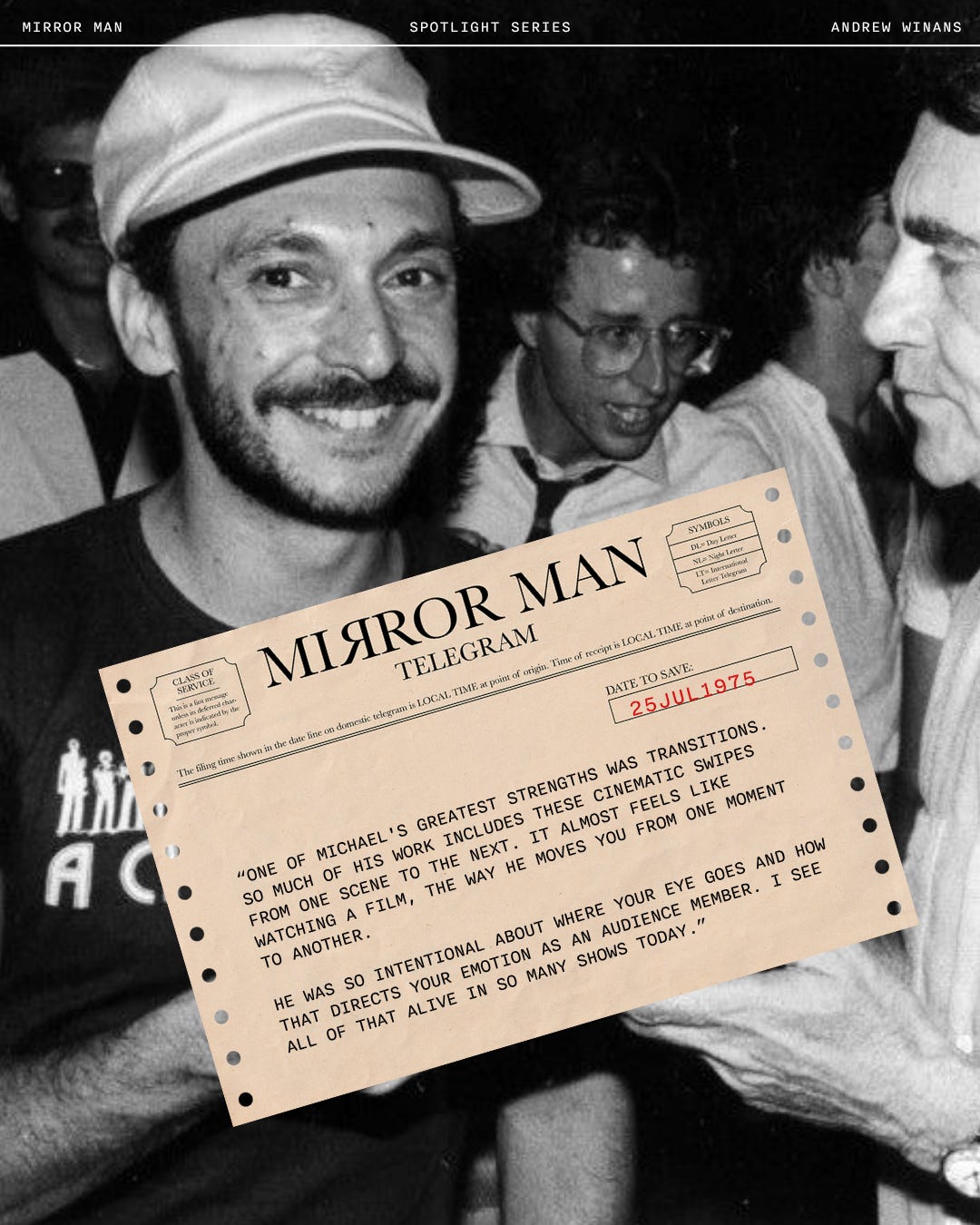
Absolutely. One of Michael's greatest strengths was transitions. So much of his work includes these cinematic swipes from one scene to the next. It almost feels like watching a film, the way he moves you from one moment to another. He was so intentional about where your eye goes and how that directs your emotion as an audience member. I see all of that alive in so many shows today.
Watching the recent Sunset Boulevard revival, it struck me — the screen work, the transitions, the multimedia storytelling. Michael was already thinking about all of this. His vision for Chess (1986) was a wall of screens, 40 years before Ivo van Hove and Jamie Lloyd made that language mainstream. It was all percolating back then.
Absolutely. Michael is part of an incredible foundation of people who truly reinvented the way we think about theatre, and we’ve all learned from them, whether we know it or not. [Contemporary theatremakers] may not mean to invoke Michael’s concepts, but what he invented is so alive in what we do today, because of how deeply he changed the musical form through this work.
Last question. I ask everyone this, because I want this project to help answer it: when you think about Michael Bennett and Bob Avian, what do you think is worth digging into further in terms of their legacies?
I think the responsibility is ours. Meaning you, meaning me, meaning the people learning from the people who learned from Michael and Bob. I was lucky enough to learn from Bob directly, and I think the focus has to be on moving this forward.
To go back to what Chet Walker drilled into me: if we don't continue this, it's going to die. That's the sad reality. So, the most important thing is to keep pushing it forward in whatever way we can, to keep their spirits alive. We've already learned so much [from them]. I hope more people get the chance to learn, too.
Comments
Nothing yet. Say the first thing.
Sign in to join the conversation.