

One of the characteristics of Michael Bennett’s that I find most profound was his need for control. It strikes me as lazy when others brand someone a “control freak.” The artists I admire most tend to seize the conditions around their work so that at every juncture, their vision stays intact. Is this supposed to be a bad thing? See Barbra Streisand, Prince, and, yes, Michael Bennett. “Collaborative and uncompromising” is a genuinely interesting tension to feel in someone’s work.
What I find equally compelling is how Michael’s need for control extended into world-building. And occasionally, that world was imbued with a little inside-joke whimsy. Such is the case with Plum Productions, Inc.
To set the scene: In the back-half of 1971, Michael was coming off co-directing Follies with Hal Prince, its own exercise in tension. (Follies will be one of the more intricate explorations coming soon to Mirror Man: A Portrait of Michael Bennett, including reflections from people who worked with and around Michael on the show, so make sure you’re subscribed.) On that project, the basic division of scope, which as anyone who has made anything can tell you was anything but neat, had Prince responsible for all book scenes, Michael for all musical staging and choreography.
Not that Michael Bennett needed more confirmation, but the endeavor solidified something: he was ready to assume full control of a production.
He set his sights on directing something no one would have thought of him for: a straight play written by George Furth, a Company (1970) collaborator (Furth wrote the book). Similar to Company, the play, about a mother and her three daughters, all rendered by the same actress, was structured vignette-style, comprised of four interconnected one-act plays. And it brought a brief reunion with Company and Follies collaborator Stephen Sondheim, who contributed incidental music and a song (“Hollywood and Vine”).
The play’s original title was A Chorus Line. It was later changed to Twigs.
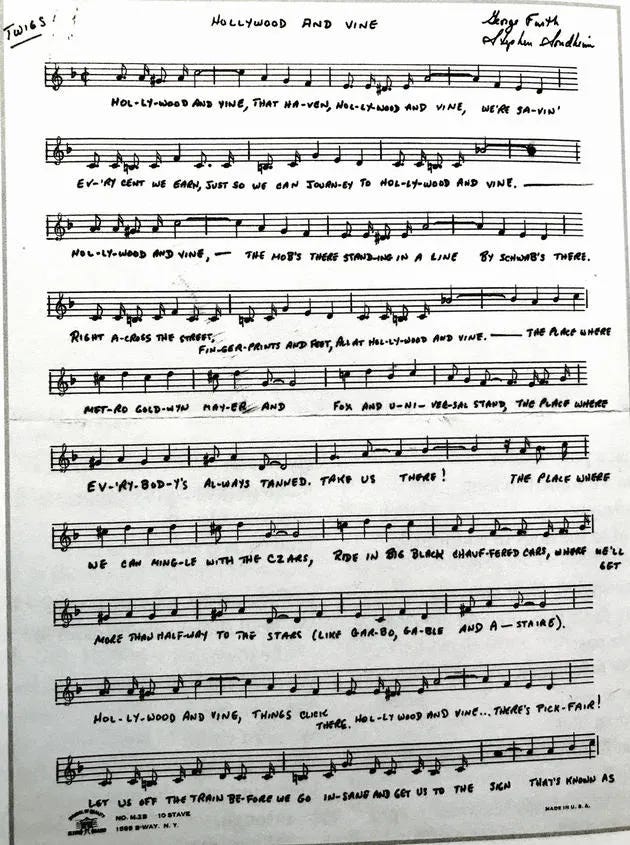
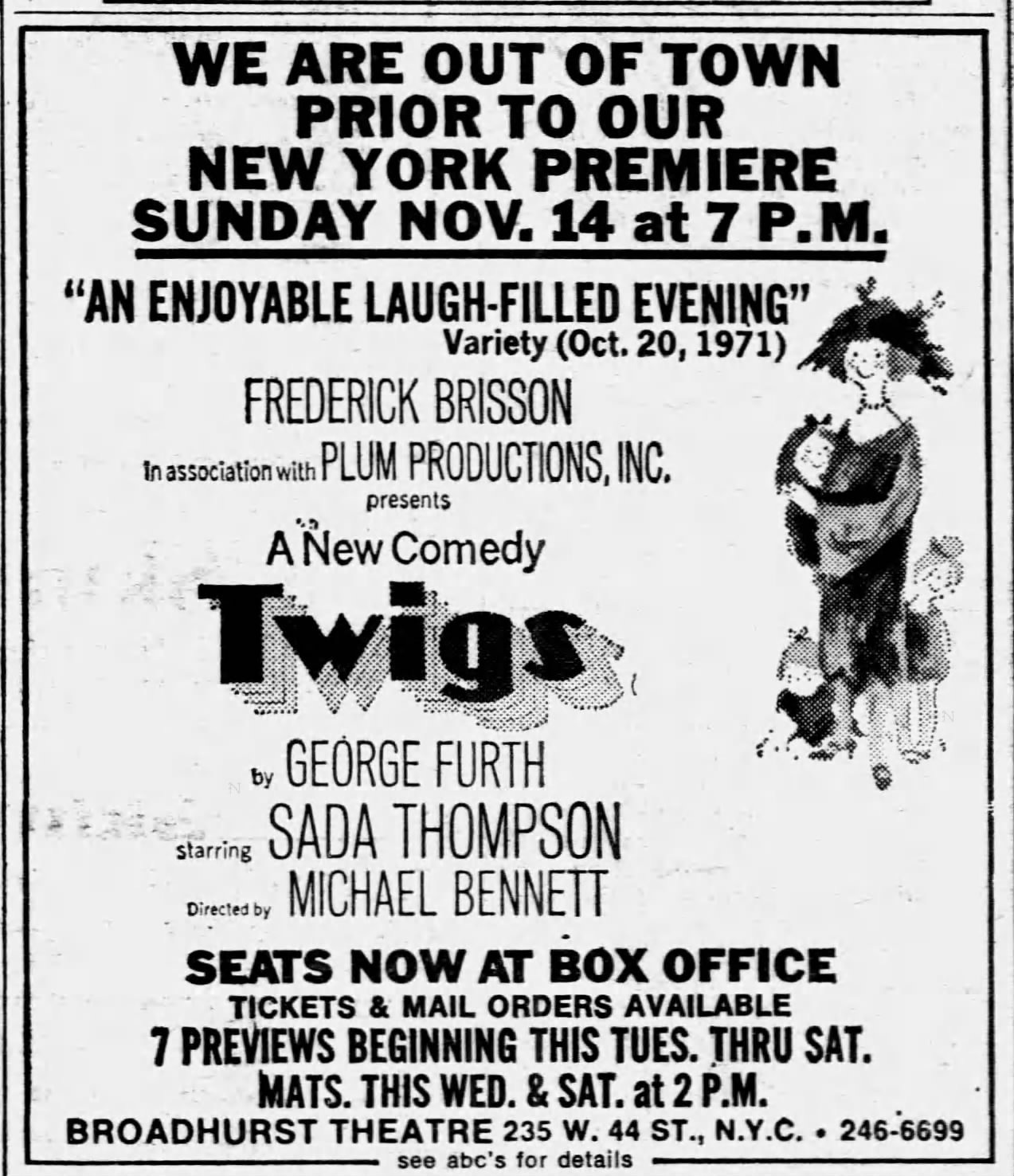
Twigs, which opened on Broadway on November 14, 1971 at the Broadhurst Theatre and starred Sada Thompson, in a Tony Award-winning turn, marked a coming out for Michael Bennett as both a solo director and a producer, under the banner of his freshly formed Plum Productions, Inc.
The lead producer of Twigs was Frederick “Freddie” Brisson (The Pajama Game, Damn Yankees): glamorous, transatlantic, equally at home on Broadway and in Hollywood, and married to showbiz icon Rosalind Russell. Brisson first encountered Michael’s talents when they worked together on the Katharine Hepburn vehicle Coco (1969), the star’s first stage musical comedy. Freddie produced, Michael choreographed and, as largely speculated, was the person most responsible for guiding Hepburn’s performance, given that the show's director, Michael Benthall, had proved ineffective in collaborating with the commanding star.
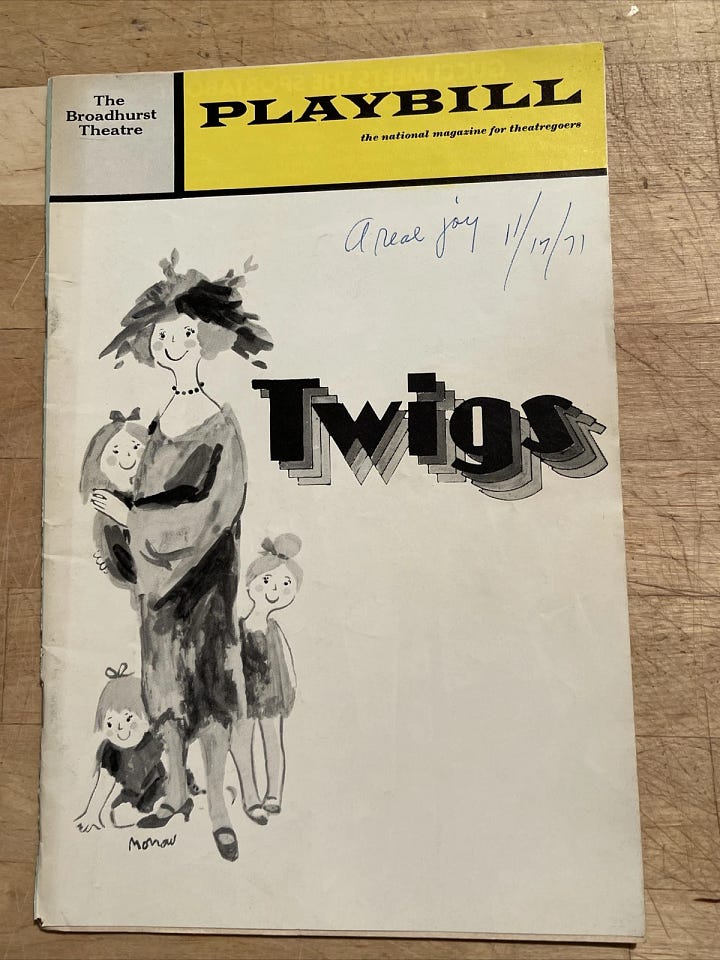
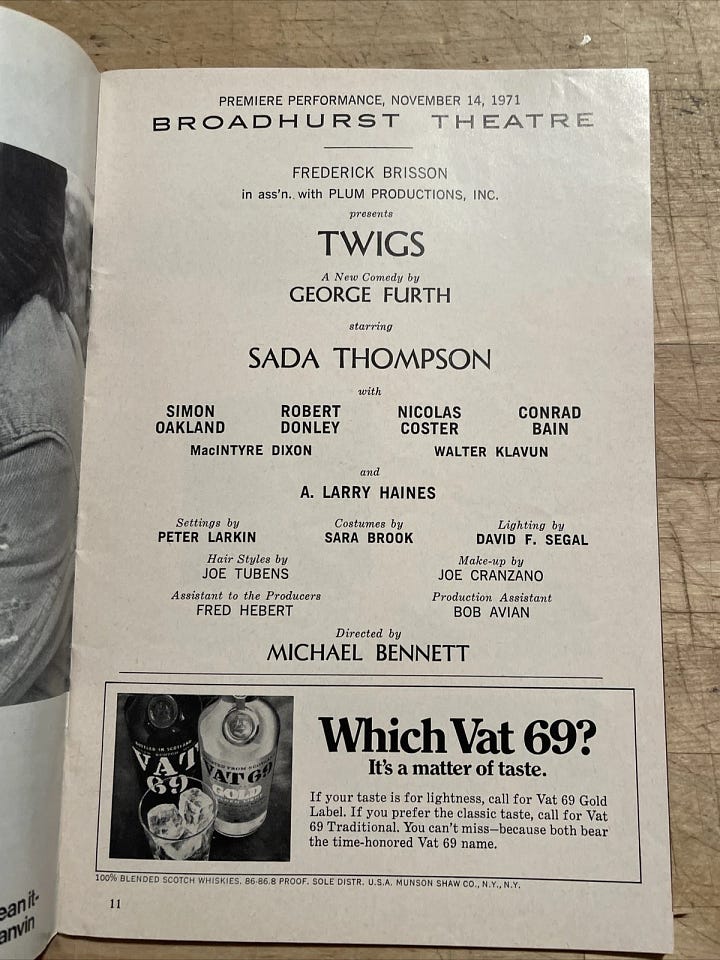
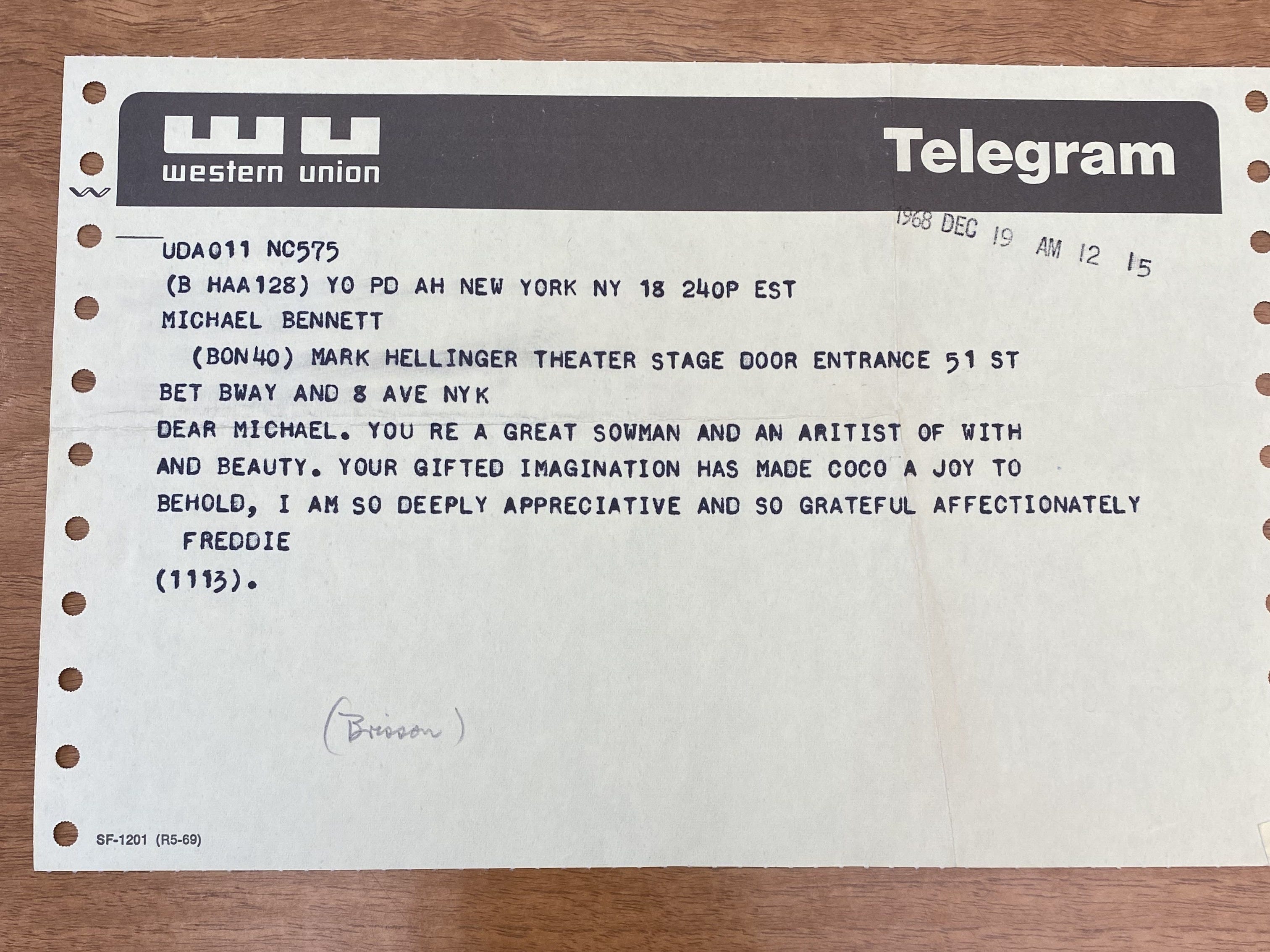
Michael appointed himself the president of Plum Productions, with Bob Avian as his vice president.
What’s in a name? As Bob recounted to Kevin Kelly for the book One Singular Sensation: The Michael Bennett Story (Doubleday, 1990):
“Tommy Tune came up with the name Plum Productions. Michael said one day there’s going to be this big basket on the top of the building with a plum, a banana, a pineapple, a kiwi, and we’re going to call each of our different companies after a different fruit. Sounded pretty funny, but the fact is we did have Tangerine, which was for the restaurant/bar in the building at [890 Broadway], and we did have a division called Tangerine Productions.”1
Tommy Tune, a prolific director-choreographer-producer in his own right, was a longtime friend, mentee, and collaborator of Michael's, going back to when he danced Michael's choreography in A Joyful Noise (1966). I love Bob’s anecdote because it's exactly the kind of detail I live for: a window into Michael's droll sense of humor, and proof that Tune has always had a gift for naming things. (He called his own loft “Giraffe House.”)
But in an interview for Kelly's book, Tune recalled something that reframes the cornucopia metaphor somewhat:
“Way before Chorus Line, I remember [Michael] sayin’, ‘I’m going to get an office high to the sky and we’re going to control all the choreography on Broadway, and if they want choreography they’re going to have to come to us to get it.’ […]
That’s a Mafia mentality applied to the theater, and I thought to myself: This is a young man talkin’ here and, wow, this is pretty amazing! He’s gonna control all the choreography in the world! I mean, I was amazed!”2
"Mafia mentality" is a colorful way to put it, but it points to something rooted a little deeper in Michael's story, tracing back to his upbringing in Buffalo. Perhaps an exploration for another time.
Going with the Plum Productions banner was shrewd on Michael's part, as usual. (Documents in his archives do also carry the name Michael Bennett Productions, a separate entity, but that came in later years.) In Ken Mandelbaum’s definitive biography A Chorus Line and the Musicals of Michael Bennett (St. Martin’s Press, 1989), Bob Avian shared the following:
“It was always about control, so we co-produced Twigs. At that time, Michael didn’t want to use his name as producer, because he felt it was too soon. He had this real instinct for timing.”3
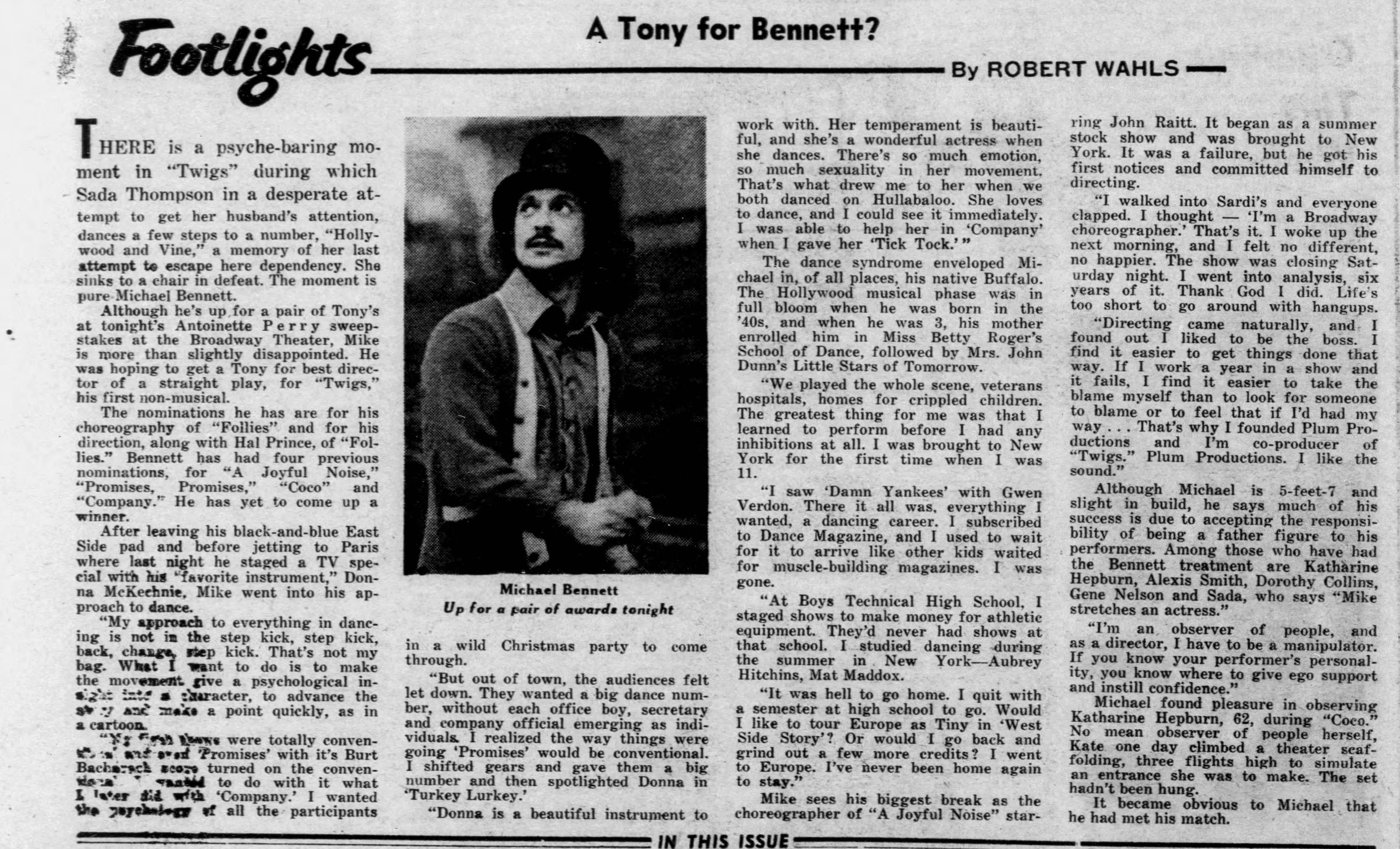
In a profile written by Robert Wahls and published in the New York Daily News on April 23, 1972, Michael explained:
“Directing came naturally, and I found out I liked to be the boss. I find it easier to get things done that way. If I work a year in a show and it fails, I find it easier to take the blame myself than to look for someone to blame or to feel that if I’d had my way… That’s why I founded Plum Productions and I’m co-producer of Twigs. Plum Productions. I like the sound.”
Four years later, Plum Productions, in association with Joseph Papp's New York Shakespeare Festival, would co-produce A Chorus Line when it transferred to Broadway, following an explosive preview period Off-Broadway in April 1975 and a rapturous opening night downtown at the Newman Theater (inside the Public Theater) on May 21, 1975, exactly 51 years ago today.
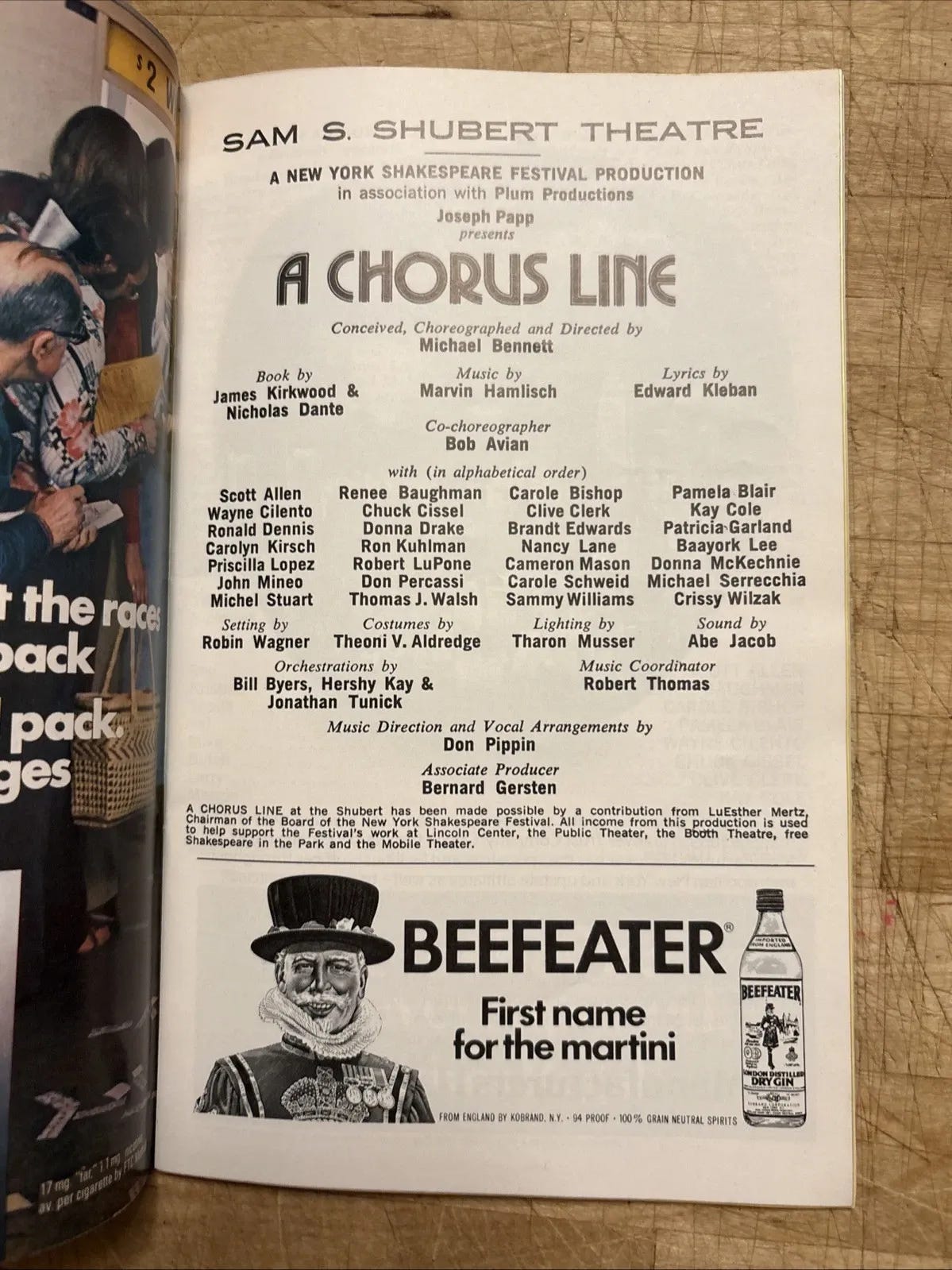
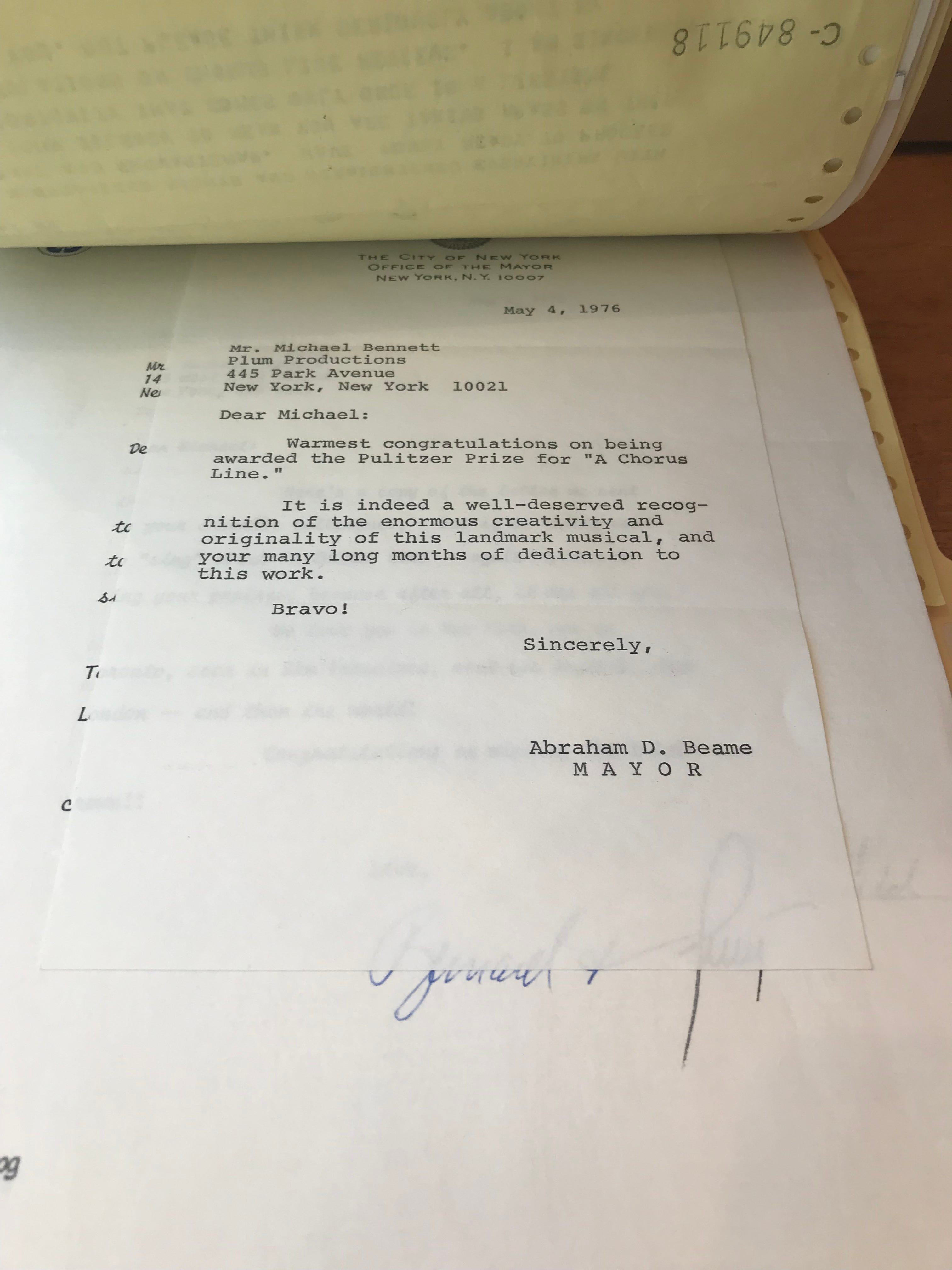
Initially, Plum Productions operated out of Michael’s apartment at 145 West 55th Street before establishing an office at 445 Park Avenue.
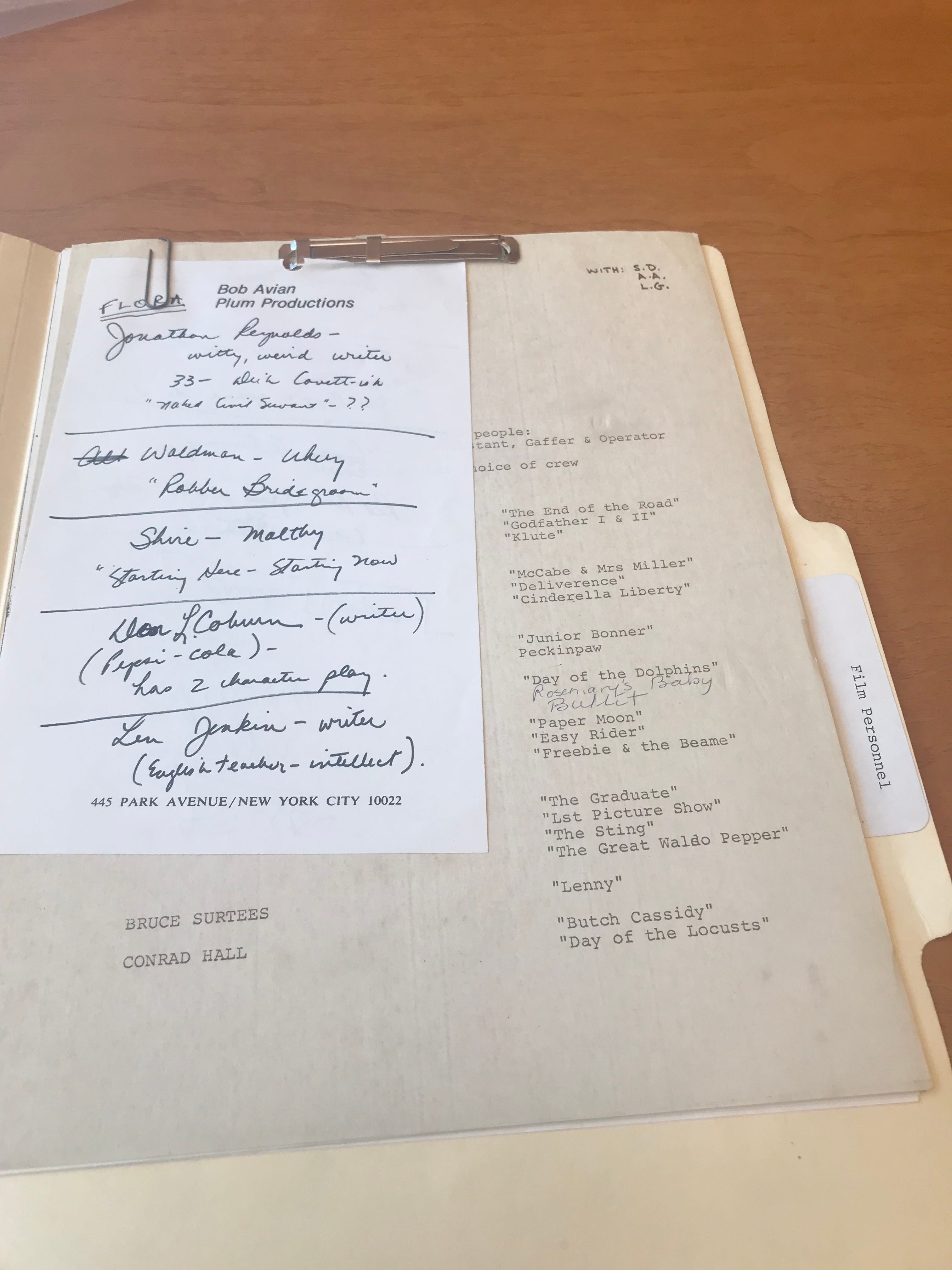
Just as striking as the name Plum Productions was the company’s pop surrealist logo, which started being used at some point during its Park Avenue era. An oversized purple plum, meticulously shaded, floating against a pale blue sky, with cartoonish white clouds behind it. (Remember Tommy Tune’s anecdote of Michael’s ambition, with that “office high to the sky”?)
The Plum Productions name and address, in a clean serif typeface, encircles the illustration. The logo lands somewhere between Magritte and a scholarly pamphlet. Altogether very ‘70s cosmopolitan.
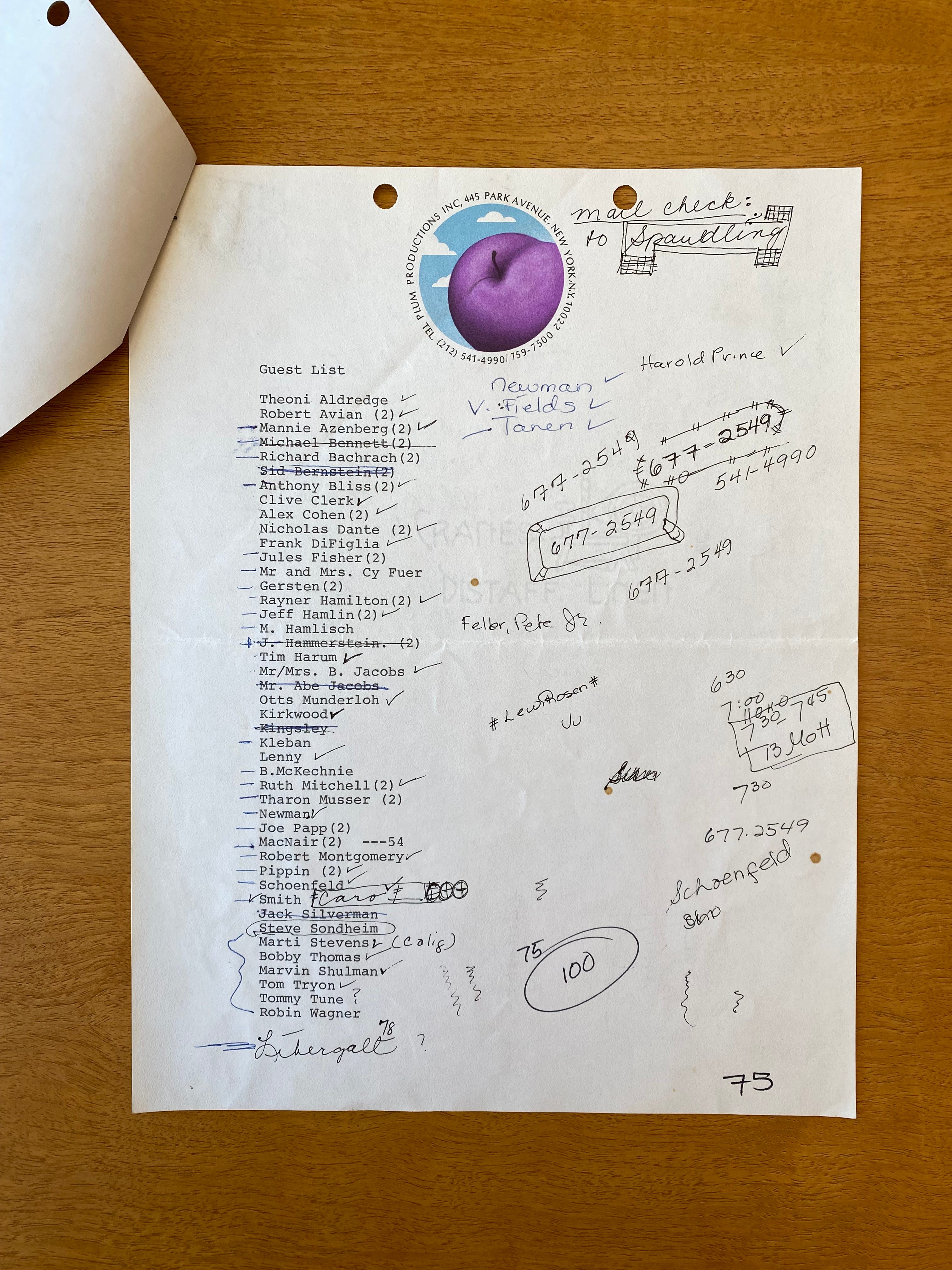
There’s also something of a hand-made mid-century Art Deco vibe (popularized by French graphic artist Razzia, who held to his traditional style even as computer-generated graphics came to the forefront). I see a thread of George Stavrinos in it, too, with the pencil shading. And that deadpan surrealist humor: is that not Paul Jasmin’s vocabulary? (I went over his connection to Michael here.)
I can’t prove if Jasmin designed the Plum Productions logo. My hours of research turned up nothing, and I’d genuinely love to know. (If you do, write me at natalie@mirrorman.studio). Michael kept Jasmin’s paintings when he lived on West 55th Street. It wouldn’t be the strangest thing if his acquaintance’s hand was behind the aesthetic of his production company, hmm?
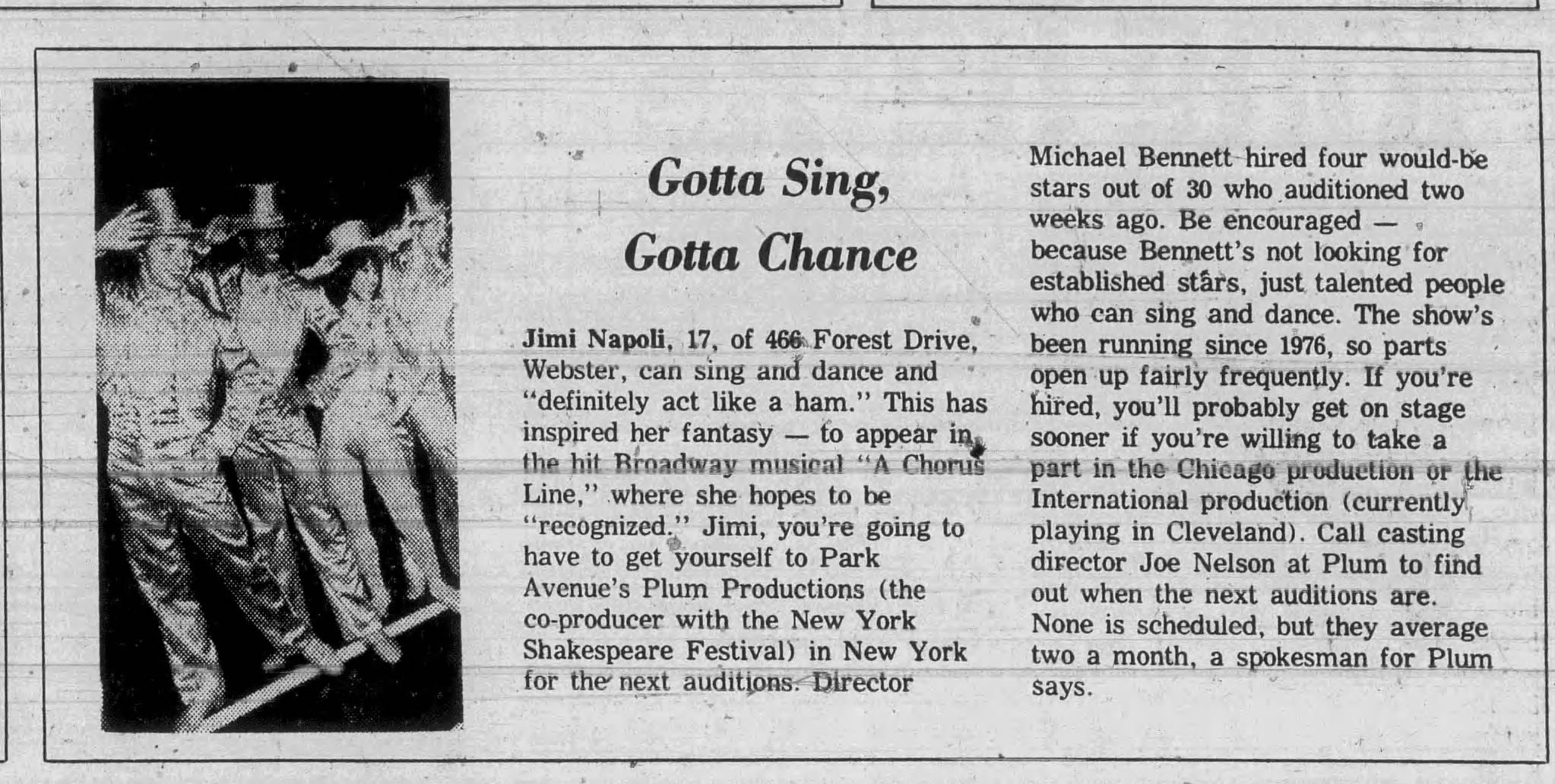
By 1978, Plum Productions’ Park Avenue headquarters were ground zero for one of the most coveted, some would even say "plum," gigs in show business. A Chorus Line had become an industry, with multiple companies running nationwide and globally. Keeping it all humming was a trusted core team that included performer-turned-casting director Joseph “Joe” Nelson and Susan “Sue” MacNair, who began as Michael's assistant and steadily gained undeniable influence. Theatre people knew exactly where to knock, as this March 3, 1978 excerpt from the Times Union makes clear:
That same year, Plum Productions’ base of operations would move from Park Avenue to 890 Broadway, the Flatiron District building Michael, buoyed by A Chorus Line profits, purchased on January 1, 1978, and quickly transformed into buzzing rehearsal studios, workspaces for theatrical craftspeople, and an incubator for new work. By the early 1980s, 890 was its own heady ecosystem, evocative of Papp’s Public Theater downtown or even filmmaker Francis Ford Coppola’s Zoetrope Studios on the West Coast.
As Bob Avian mentioned in Kevin Kelly’s biography on Michael, a different fruit-named company, Tangerine, Inc., was formed to run the ground-floor restaurant, 890 Theatre Café (sometimes spelled “890 Theater Café,” and later rebranded to 890 Café), which opened in the mid-’80s, circa late 1985 or early 1986.
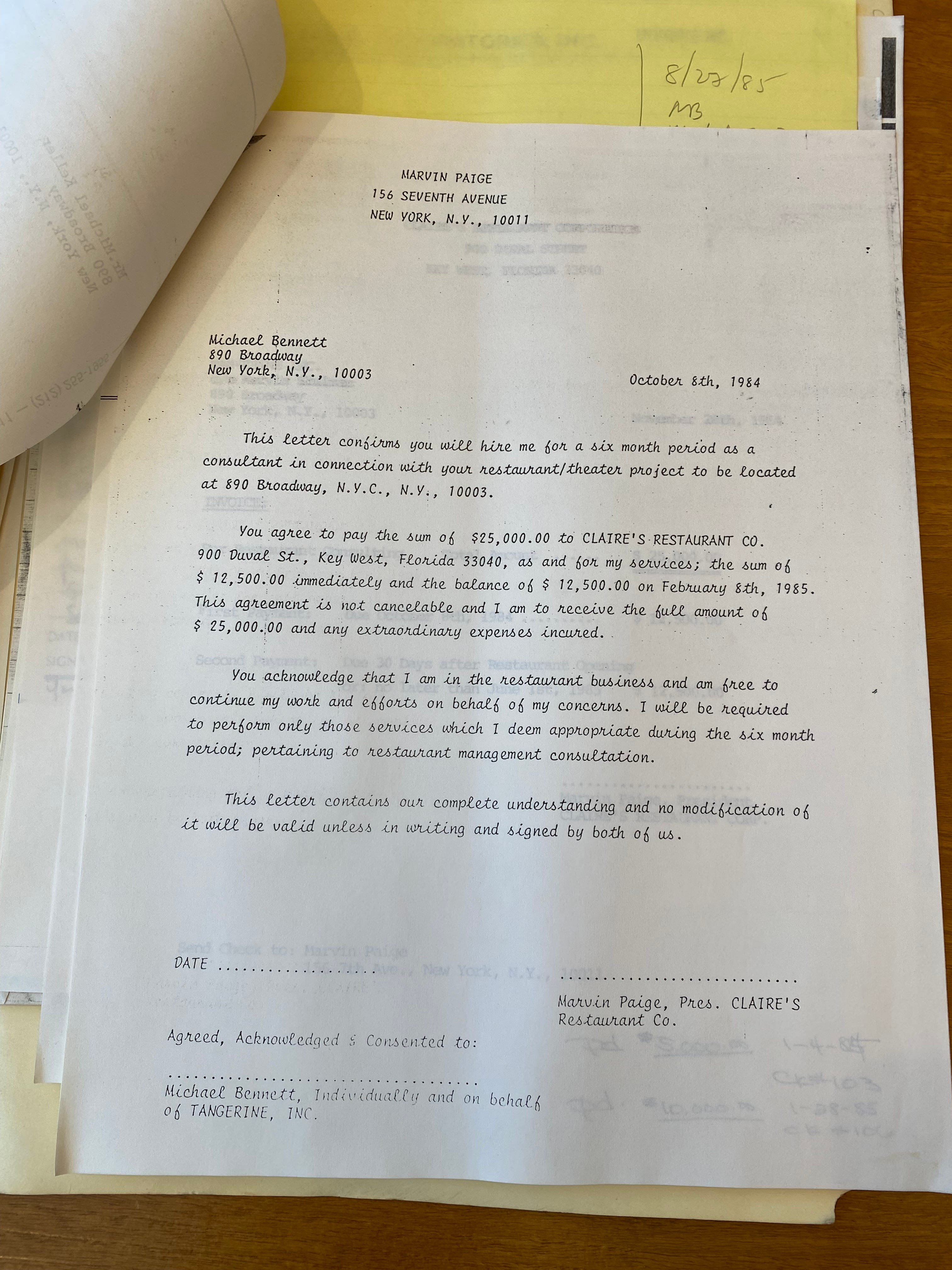
A year or so before the opening of 890 Theatre Café, the restaurateur Marvin Paige, who, along with his wife Claire, ran a string of beloved eateries in Manhattan and Key West, Florida, was hired as a dining consultant. (Robin Wagner, Michael’s brilliant scenic designer and dear friend, designed the interior of the Paiges’ Claire Restaurant in Chelsea, which opened in 1982.)
You can see the Tangerine, Inc. name used in the below document from Paige and addressed to Michael, which lists the terms of Paige’s consulting agreement:
Few people thrill over this kind of administrative minutiae. I’m one of them. It took whole days, across many years, of rifling through Plum Productions letterhead, memos, bank statements, contact lists, and torn Filofax sheets for me to fully appreciate the sheer scope of Michael Bennett’s work, because the dazzle required this. The dazzle required all of it! Everything I came across was an extension of the same obsessive intelligence and off-beat humor that created magic in the shows we know. The soul is in the details.
Comments
Nothing yet. Say the first thing.
Sign in to join the conversation.