
In the previous Chronicles, I began exploring what children’s questions about death reveal about their thinking. When my daughter Alexis was four years old and my brother died, she wanted to understand what had happened to his body. She asked whether his heart had stopped beating and whether he had stopped breathing. Her questions were not the questions I had anticipated. While I was thinking about grief and how to comfort her, Alexis was investigating what happens to a living body when life ends.
That experience taught me to listen differently. Children do not simply wait for adults to explain complex ideas to them. They observe, question, compare, connect experiences, and construct theories that help them make sense of their world. Their theories change as they encounter new information, and their questions often provide us with a glimpse of that process.
Then I heard the story of Zarayah and her grandmother.
Zarayah was asking about death too, but her questions took the inquiry somewhere entirely different. She was not asking what happens to the body when someone dies. She wanted to know something else.
Who dies first?
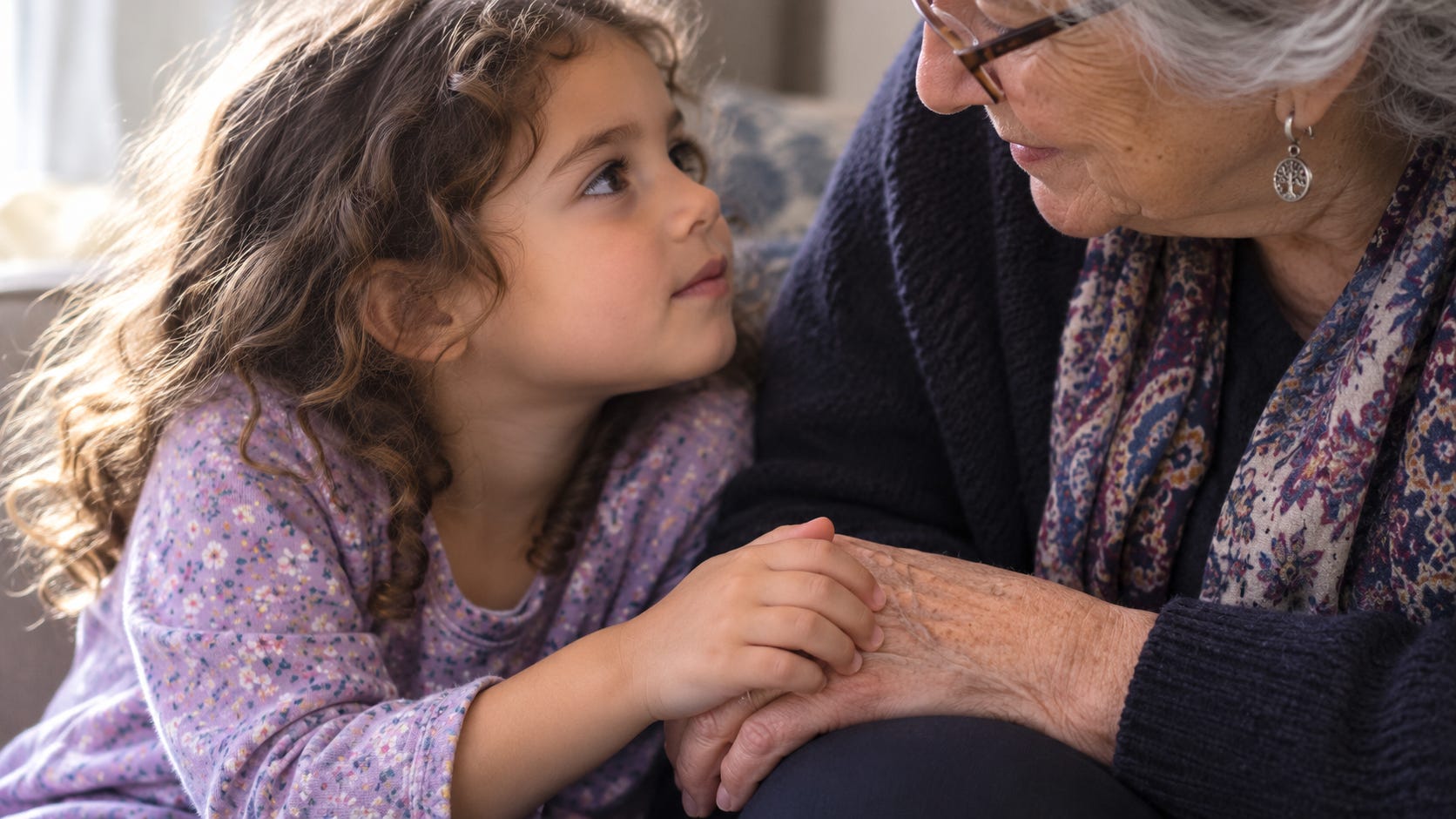
Zarayah was having a conversation with her grandmother when the subject of death entered their exchange. There was no planned lesson about mortality and no carefully prepared adult explanation. As children so often do, Zarayah simply brought forward the question that was occupying her thinking.
She wanted to know who would die first.
Her questions moved toward the people in her family. Would Grandma die first? Who would die after Grandma? Where did everyone belong in this order? Eventually, the question of where Zarayah herself belonged was also part of the larger idea she seemed to be exploring.
What fascinates me about this conversation is that Zarayah appeared to be doing much more than wondering whether her grandmother would die. She seemed to be searching for a sequence. There was Grandma. There were the other adults in her family. There was Zarayah. Some people were older, and some were younger. If everyone eventually dies, perhaps there was an order in which death was supposed to happen. Perhaps age could tell you what that order would be.
Her question sounded simple: Who dies first?
Yet inside that question was an extraordinarily complex investigation.
Consider the world from a child’s perspective. So much of life appears to follow an order. Babies become children. Children become adults. Adults become grandparents. Birthdays arrive one after another, and with each birthday we become another year older. Children notice that grandparents are usually older than parents and that parents are older than their children. They experience time as something that moves forward, and they encounter sequences everywhere.
There is a before and an after. There is a first and a next.
If life appears to unfold in a sequence, why would death be different?
If people grow older and everyone eventually dies, it is entirely reasonable for a child to wonder whether the oldest person dies first. Perhaps Grandma dies before Mom because Grandma is older. Perhaps Mom dies before Zarayah because Mom is older than Zarayah. Perhaps everyone has a place in the sequence.
Suddenly, “Who dies first?” is no longer simply a question about death. It is a question about order, time, age, sequence, and predictability.
Zarayah was looking for a rule.
Children search for patterns because patterns help them understand and predict their world. They discover that morning is followed by night, seasons return, birthdays happen every year, plants grow, bodies change, and people become older. These repeated experiences allow children to construct theories about what will happen next.
From what Zarayah had observed, a theory connecting age and death would make sense. People grow older. Grandparents are older than parents. Parents are older than children. People eventually die. Therefore, perhaps older people die before younger people.
There is logic in that theory.
The difficulty is that adults know something Zarayah is still discovering. Death does not always follow the sequence we wish it would. Sometimes a younger person dies before an older person. Sometimes a child dies. Sometimes someone who appears healthy dies unexpectedly. Sometimes a person who is very old continues living while someone much younger does not.
Life eventually presents children with information that does not fit the pattern.
What happens then?
This is one of the places where children’s thinking becomes especially fascinating to me. A contradiction does not necessarily mean that a child’s previous theory was wrong. The theory represented the best explanation the child could construct from the experiences and information available at that time.
Then something happens that does not fit.
Perhaps a beloved pet dies. Perhaps a child hears about the death of a younger person. Perhaps someone in the family dies unexpectedly. Perhaps a story, a conversation, or an observation introduces the possibility that younger people can die before older people.
Now the child has a problem to solve.
If older people do not always die first, how do we know who will?
Perhaps we do not know.
That possibility transforms Zarayah’s original question. If Grandma does not automatically die before everyone younger than her, then death cannot be organized simply by age. A new set of questions becomes possible. Can someone younger die before someone older? Can children die? Can parents die before grandparents? Can I die before someone older than me? How does anyone know when they are going to die?
The theory must be reconsidered.
This is not confusion. It is intellectual work.
Developmental research helps us understand another dimension of Zarayah’s questions. Children gradually construct several interconnected concepts about death, including biological cessation, irreversibility, universality, causality, and personal mortality (Fry et al., 2026).
Universality involves recognizing that all living things eventually die. Personal mortality brings that understanding closer to the self: if all people die, then the people I love will die, and eventually I will die too.
These ideas do not necessarily emerge simultaneously, nor do they develop according to an identical sequence for every child. Children encounter experiences, ask questions, receive information, construct explanations, and revisit those explanations as their knowledge expands (Fry et al., 2026).
Zarayah’s conversation with her grandmother allows us to glimpse this process as it is happening. She was not reciting a definition of death. She was trying to organize an enormous idea through the relationships she understood best: her family.
This is what makes the presence of her grandmother in the story so meaningful. Zarayah was not asking an abstract question about whether human beings die. She was sitting with someone she loved and trying to understand where that person belonged in the sequence of life and death.
Death had moved from an abstract concept to a relational one.
Adults can easily hear a child ask, “Who dies first?” and assume that the child wants a factual answer. Our instinct may be to reassure. We may want to say, “You do not need to worry about that,” or “Grandma will be here for a long time.”
That impulse is understandable. We want children to feel safe.
Yet if we move too quickly toward reassurance, we may inadvertently close the very conversation that could help us understand what the child is thinking.
What if, before answering, we became curious about the theory beneath the question?
Why does Zarayah believe someone must be first? What does she think determines who dies first? Does she think it is age? Does she believe death happens according to a particular sequence? What does she already understand about who can die? Where does she place herself within that understanding?
We do not need to ask a child every one of these questions. Some of them are questions for us, the observers.
They remind us to listen before interpreting.
Instead of asking, “What should I tell Zarayah?” we can begin by asking, “What is Zarayah telling us?”
There is an important distinction between supporting a child emotionally and making uncertainty disappear. We cannot honestly promise children that the people they love will always be with them. We also do not need to overwhelm them with every possible reality of death simply because they have asked a question.
There is another possibility.
We can stay with the child’s thinking.
We might wonder aloud, “You are thinking about who would die first.” We might ask, “How do you think it works?” or “What makes you think Grandma would be first?” Then we listen.
The purpose of these questions is not to test the child. It is not to determine whether the child has reached the correct developmental understanding of death. It is to make space for the child’s theory to become visible.
The answer might surprise us.
That surprise is often where our own learning begins.
This is where I return to Revisiting Journeys.
A theory is not a mistake waiting for an adult to correct it. It is an intellectual construction based on the information, relationships, observations, and experiences available to a child at a particular moment.
Learning becomes especially visible when children have opportunities to return to those constructions.
One conversation rarely tells us everything a child understands about a complex idea. Children revisit important questions repeatedly. Each new experience can expand, challenge, complicate, or transform what they previously believed. Documentation allows us to preserve children’s words, drawings, conversations, photographs, and representations so that we can notice these changes over time. This process of returning, reflecting, questioning, and connecting is at the heart of Revisiting Journeys.
Imagine documenting Zarayah’s question today: Who dies first?
Then imagine listening six months from now.
Perhaps she asks the same question.
Perhaps she asks something completely different.
Maybe the question becomes, “How do you know when someone is going to die?” Perhaps she wonders whether children can die. Perhaps she asks whether someone younger can die before someone older. Perhaps she develops an entirely different theory that none of us could predict.
The importance is not in moving Zarayah toward the question we think should come next. The importance is in noticing where her thinking actually goes.
That is the journey.
Developmental research offers us important ways to understand how children construct concepts of death. However, those concepts should not become a checklist through which we measure children.
Does Zarayah understand universality? Check.
Does she understand irreversibility? Check.
Does she understand personal mortality? Not yet.
Children’s thinking is far more complex than that.
Research can help us recognize possibilities within children’s questions, but careful observation helps us understand the individual child. The concepts described by researchers become meaningful when we see children encountering them in the context of their actual lives, relationships, cultures, experiences, and questions.
Zarayah reminds us of this.
She did not announce that she was investigating universality or personal mortality.
She asked her grandmother:
Who dies first?
That was enough to open a window into her thinking.
I keep returning to the simplicity of this story. A granddaughter and her grandmother were having a conversation, and then a child asked about death. There was no curriculum, no lesson plan, and no carefully prepared explanation. There was simply a question. Yet inside that question, Zarayah was comparing ages, thinking about generations, organizing people into a sequence, making predictions, considering time, and connecting what she knew about growing older with what she was beginning to understand about dying. She was taking pieces of information gathered from her world and trying to assemble them into a theory that made sense. She was trying to find order in something that adults know does not always happen in order.
Perhaps this is why children’s questions deserve more than our answers. They deserve our attention. When Zarayah asked, “Who dies first?” the most important thing happening in that moment may not have been whether her grandmother could give her the right answer. The remarkable thing was that Zarayah was already thinking. Her question was evidence of an active process of meaning-making, one in which she was using what she knew about age, family, time, and sequence to make sense of an idea that is difficult even for adults to fully understand.
As educators and families, we spend a great deal of time thinking about what children need to know. Complex topics such as death intensify that impulse. We search for the right words, the right books, the right explanations, and the right developmental language. Those resources can be valuable, but perhaps they should not always be where we begin. Perhaps we begin with the child. We can ask ourselves what the child has noticed, what connections the child is making, what theory seems to be emerging, and what the question itself might reveal. We might discover something important if we resist answering for just a moment longer and listen.
Zarayah’s story reminds me that children are not empty vessels waiting for adults to explain the mysteries of life. They are active meaning makers who continually observe, theorize, test ideas, encounter contradictions, and reconstruct what they thought they knew. “Who dies first?” may sound like a question requiring an answer, but it may also be an invitation to enter a child’s thinking, to wonder alongside her, and to recognize that while adults may know more about death, we do not necessarily know what a child is trying to understand about it.
Before we decide what to teach, we must learn to listen. The question may not be, What should Zarayah’s grandmother teach her about death? Perhaps the more important question is, What is Zarayah teaching us about how children make sense of life?
As educators and families, we spend a great deal of time thinking about what children need to know. Complex topics such as death intensify that impulse, and we often search for the right words, the right books, the right explanations, and the right developmental language. Those resources can be valuable, but perhaps they should not always be where we begin. Perhaps we begin with the child and pay closer attention to what the child has noticed, what connections are being made, what theory may be emerging, and what the question itself reveals. We may discover something important if we resist answering for just a moment longer and choose instead to listen.
Zarayah’s story reminds me that children are not empty vessels waiting for adults to explain the mysteries of life. They are active meaning makers who continually observe, theorize, test ideas, encounter contradictions, and reconstruct what they thought they knew. When Zarayah asks, “Who dies first?” she is not only asking for information. Her question reveals an effort to make sense of age, time, relationships, sequence, and mortality. It offers us an opportunity to enter her thinking and to wonder alongside her rather than immediately replacing her ideas with our own explanations.
This is why children’s questions can be understood as invitations. They invite us to look more closely, to listen more carefully, and to recognize that while adults may know more about death, we do not necessarily know what a particular child is trying to understand about it. Before we decide what to teach, we must first become curious about the theory the child is already constructing. The question, then, may not be, What should Zarayah’s grandmother teach her about death? Perhaps the more important question is, What is Zarayah teaching us about how children make sense of life?Continue the Conversation
Thank you for continuing this journey with me.
Zarayah’s story invites us to reconsider the questions children ask about death. “Who dies first?” can sound like a question about mortality, but when we listen more carefully, we can hear possibilities beneath it: ideas about sequence, age, predictability, family relationships, time, and the patterns children use to make sense of their world.
I invite you to listen for these theories in the children in your life. Has a child ever asked you who would die first? Has a child tried to determine whether death follows an order? Has a child said something about death that surprised you?
If so, instead of remembering only how you answered, return to the child’s words.
What was the child trying to figure out?
I would love for you to share those stories in the comments. When we document and share these moments, we contribute to a richer understanding of children as capable thinkers and theory builders.
If this Chronicle invited you to see children’s questions differently, please consider restacking it so that more educators, families, professors, and researchers can join the conversation.
In the next Chronicle, we will continue exploring children’s theories about death by beginning where children begin: with their observations, their experiences, their relationships, and the questions that reveal what they are trying to understand.
The Chronicles invite us to notice children’s ideas and theories. The Reflective/Planning Cards invite paid members to carry that thinking into their own observations, questions, documentation, and experiences.
Curious about what that looks like? You can experience The Museum of Important Things Reflective/Planning Card as a free example.
Fry, Z. D., Mendrek, A., Gieg, L., Léger-Goodes, T., Lefrançois, D., Smith, J., Maltais, N., Geoffroy, M. C., Éthier, M. A., & Malboeuf-Hurtubise, C. (2026). How do children think about death? A narrative review of historical and recent developmental perspectives examining children’s understanding of death. Clinical Child Psychology and Psychiatry. Advance online publication. https://doi.org/10.1177/13591045261430553
No posts
Comments
Nothing yet. Say the first thing.
Sign in to join the conversation.