
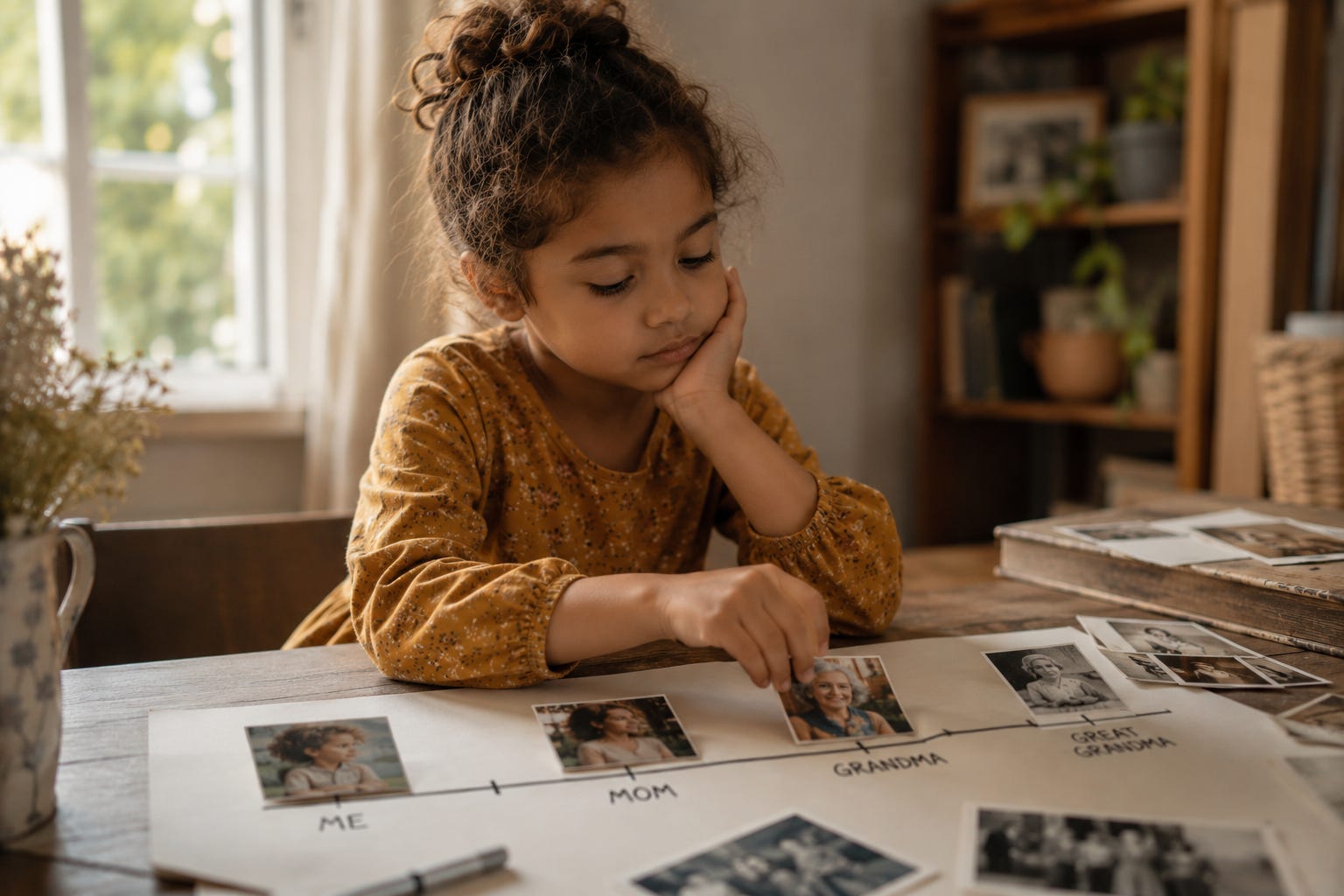
Earlier this week, I shared the story of Zarayah and a conversation with her grandmother that began with a seemingly simple question: Who dies first? As their conversation unfolded, Zarayah began thinking about the people in her family and trying to understand whether death follows an order. If grandparents are older than parents and parents are older than children, perhaps the oldest person dies first. Perhaps everyone has a place in a sequence that can somehow be predicted.
I have continued thinking about Zarayah’s question because it would be easy to hear it only as a question about death. An adult might respond by explaining that we cannot know who will die first or by reassuring a child that there is nothing to worry about. Those responses are understandable, particularly when the subject makes us uncomfortable. Yet if we move too quickly toward an answer, we may overlook the thinking that gave rise to the question in the first place.
At first glance, “Who dies first?” sounds like a request for information. Zarayah wants an answer, and the adult possesses information that she does not yet have. But what happens when we shift our attention away from the answer and toward the thinking that produced the question?
Zarayah already knows something about age. She knows something about generations. She has observed that children become adults and that adults grow older. She knows that her grandmother occupies a different generational place in her family than she does. Now she appears to be connecting those observations with another piece of knowledge: people die.
She is not beginning with nothing.
She is beginning with what she already knows and using it to construct an explanation for something she is still trying to understand.
This is what makes her question so powerful. Zarayah may not simply be asking who dies first. She may be testing whether what she knows about the sequence of life can help her predict the sequence of death.
Research gives us an important way to think about this connection. Longbottom and Slaughter (2018) explain that children’s concepts of life and death are developmentally intertwined. Children’s understanding of death does not develop in isolation from their understanding of living things, biological processes, aging, and the life cycle. Learning about one can contribute to the development of the other.
Zarayah’s question allows us to see what that might look like in an actual child’s thinking. She knows that people grow older. She recognizes generational differences. Now she is trying to determine whether those patterns can tell her something about dying.
Children construct theories from the information available to them. Some of that information comes from direct experience. Some comes from conversations. Some comes from books, stories, media, cultural traditions, family beliefs, encounters with nature, and observations of everyday life.
Longbottom and Slaughter (2018) identify three significant sources through which children learn about death: direct experiences with death, communication with parents and other adults, and portrayals of death in media and the arts. They also note that children’s understanding of the life cycle and their understanding of death develop in relationship to one another.
Menendez et al. (2020) offer another important perspective. They describe children as constructing understandings of death through biological reasoning in interaction with family conversations, cultural information, spiritual and religious ideas, and participation in cultural practices. Rather than simply absorbing what adults tell them, children ask questions and actively make sense of the different ideas available within their environments.
This matters when we return to Zarayah and her grandmother.
Their conversation was not something happening outside of learning.
The conversation was part of the learning.
Zarayah brought her existing ideas into the conversation. Her grandmother brought her own experiences, language, beliefs, and knowledge. Between them was a question that created an opportunity for Zarayah to continue constructing meaning.
Adults often imagine that difficult subjects such as death must be introduced to children. We wonder when children are ready, what language we should use, and how much information we should provide. Yet children frequently bring these subjects to us before we have decided that the time is right.
Research supports this observation. Menendez et al. (2020) report that parents describe children asking questions about death as early as three years of age. The authors also point to research suggesting that children’s questions become increasingly focused as they acquire more knowledge and attempt to fill particular gaps in their understanding. Questions about death can be broad, but children also ask remarkably specific questions, including questions about how old someone is when they die.
That finding makes me return once again to Zarayah.
Who dies first?
Perhaps we should hear this question differently.
It is not necessarily evidence that she is confused about death. It may be evidence that she already knows enough to recognize a gap in her theory.
She knows people grow older.
She knows people die.
What she does not yet know is whether one predicts the other.
So she asks.
This is where Zarayah’s story connects to something much larger than children’s understanding of death. Children are researchers of their own lives. They observe what happens around them, notice patterns, gather information, make comparisons, develop explanations, and ask questions when something does not fit.
A child who repeatedly drops an object may be investigating movement and gravity. A child who asks why a plant died may be investigating what living things need to survive. A child who notices that a grandparent is older than a parent may begin constructing ideas about generations, aging, and time. Zarayah’s investigation is no less intellectual because the subject happens to be death.
The question is different, but the process of thinking is familiar.
She is connecting.
Comparing.
Predicting.
Testing a possibility.
Looking for a pattern.
This is why I hesitate when children’s questions are described simply as curiosity. Curiosity is certainly present, but something more complex may also be occurring. A question can reveal a theory under construction.
There is another dimension of Zarayah’s story that deserves our attention: she asked her question in relationship with her grandmother.
Children do not construct knowledge in isolation. Their theories emerge within learning ecosystems composed of people, places, materials, experiences, cultural practices, language, stories, memories, and relationships. The adults within those ecosystems contribute information, but they also contribute something equally important: opportunities for children to articulate what they are thinking.
Research on family communication supports the importance of this relational context. Longbottom and Slaughter (2018) review evidence indicating that parental communication can contribute to children’s developing understanding of death. They also describe research suggesting that adults sometimes underestimate what young children already understand about death.
That finding should give us pause.
Perhaps one reason we underestimate children is that we are listening for the knowledge we expect them to have rather than the theories they are actually constructing.
Zarayah’s grandmother did not need to create the inquiry.
Zarayah brought it with her.
The opportunity was to notice it.
When a child asks a difficult question, our attention often moves immediately toward our response. What should I say? How much should I explain? What is developmentally appropriate? How can I reassure this child?
Those questions matter. However, another question can come first:
What is this child trying to figure out?
If a child asks, “Who dies first?” we might wonder what led to that question. Does the child believe age determines who dies first? Does the child think death follows the same sequence as growing older? Does the child understand that everyone dies? Does the child include themselves in that understanding? What experiences, conversations, observations, stories, or cultural messages may have contributed to the theory?
These do not need to become a list of questions we direct at the child. They can become questions we hold as observers.
That distinction matters.
Our goal is not to interrogate children until they reveal the correct answer. Our goal is to become more attentive to the thinking already taking place.
This is where the Revisiting Journeys lens becomes particularly important. Imagine documenting Zarayah’s question exactly as she asked it: Who dies first? Instead of treating the question as something that must be resolved in a single conversation, we preserve it as evidence of her thinking at this moment.
Then we pay attention.
Perhaps months from now Zarayah will return to the idea. Perhaps an experience will challenge her assumption that older people die first. Perhaps she will encounter the death of an animal, hear about someone younger who died, read a story, overhear a conversation, or simply think about the question differently because she has grown older.
What will happen to her theory then?
Will she ask the same question?
Will she revise it?
Will another question emerge?
We cannot know where Zarayah’s thinking will go, and that is precisely why revisiting matters. The purpose is not to move children toward a predetermined conclusion. It is to make the evolution of their thinking visible.
Zarayah’s story offers educators and families a practical lens that extends far beyond conversations about death. When a child asks a question that surprises us, perhaps we can resist moving immediately toward an answer and listen instead for the theory beneath it. We can wonder what the child already knows, what connections are being made, what pattern has been noticed, what prediction is being tested, and what experience might have prompted the question.
When we listen this way, our position changes. We are no longer simply adults who possess information children need. We become observers and researchers of children’s thinking while children remain researchers of their world.
Zarayah did not need an adult to begin the lesson about death. She had already begun the investigation. She arrived at the conversation carrying observations about age, generations, family, time, and life. Her question revealed where those ideas had taken her and where a gap remained.
Her grandmother was given something precious in that ordinary conversation: an opportunity to witness a theory while it was still being constructed.
Perhaps children offer us these opportunities more often than we realize.
We simply have to recognize them.
Children do not wait for us to begin the lesson. They arrive at the conversation with theories already under construction.
This week, I invite you to return to a question a child has recently asked you. Do not begin by thinking about how you answered. Begin with the question itself. What did the child already need to understand in order to ask it? What experiences might have contributed to it? What connections were being made? What theory might have been taking shape?
Write the question down exactly as the child said it.
Then keep listening.
You may discover that the question was never simply a request for an answer.
It was documentation of thinking.
The Chronicles of Children’s Thinking will continue to include two free articles each month, because I want these stories and ideas to remain accessible to educators.
For readers who want to take the thinking from the Chronicle into their own practice, I now offer a paid membership that includes a Reflective Card accompanying each Chronicle. Each card offers questions and invitations to help you pause, reflect, revisit your observations, and consider children’s ideas from different perspectives.
The Chronicle tells the story.
The Reflective Card invites you to bring the thinking into your own learning ecosystem.
If you would like to go deeper with each Chronicle, I invite you to become a paid member and receive the accompanying Reflective Cards.
Longbottom, S., & Slaughter, V. (2018). Sources of children’s knowledge about death and dying. Philosophical Transactions of the Royal Society B: Biological Sciences, 373(1754), 20170267. https://doi.org/10.1098/rstb.2017.0267
Menendez, D., Hernandez, I. G., & Rosengren, K. S. (2020). Children’s emerging understanding of death. Child Development Perspectives, 14(1), 55–60. https://doi.org/10.1111/cdep.12357
No posts
Comments
Nothing yet. Say the first thing.
Sign in to join the conversation.