
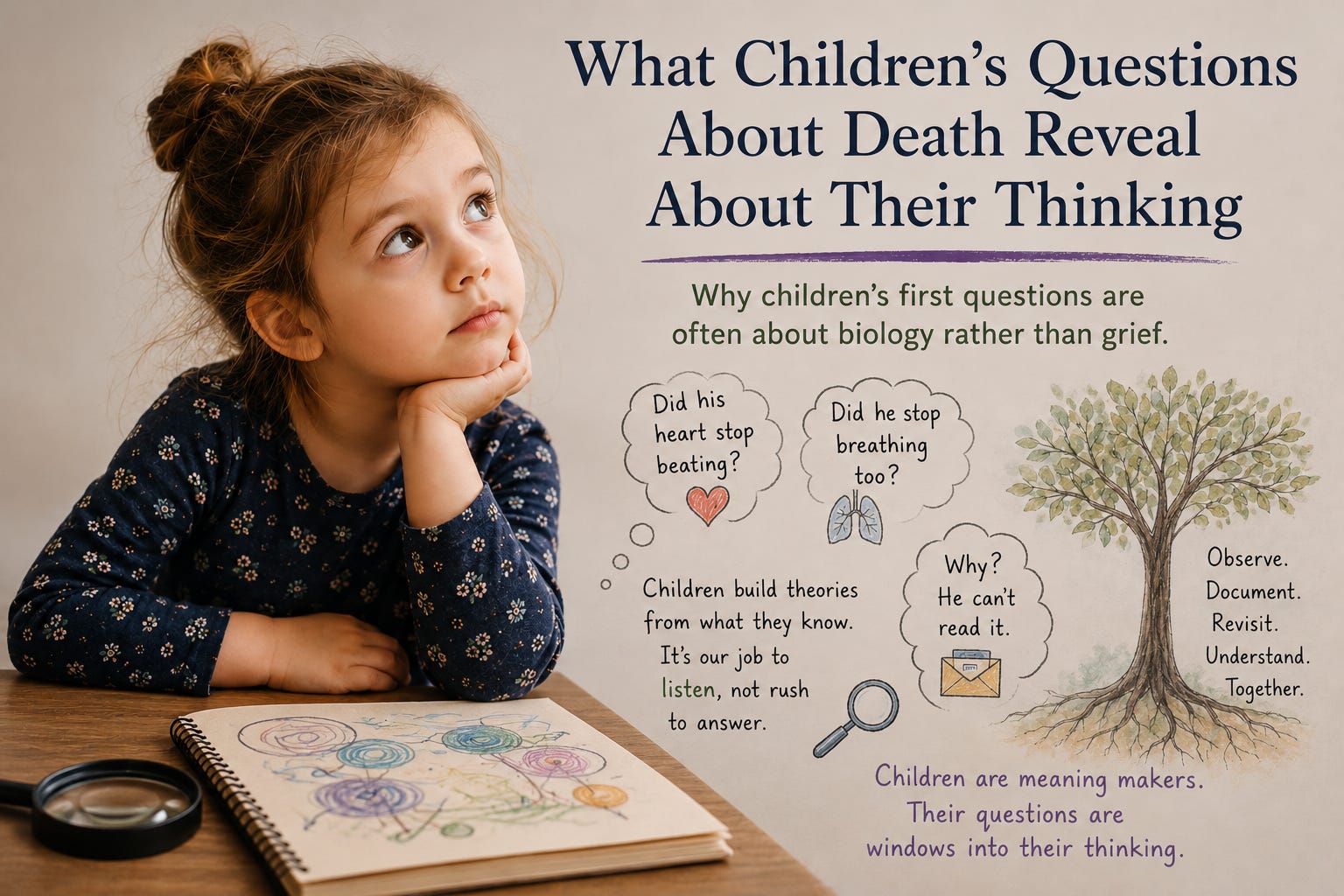
In my previous essay, Before Children Understand Grief, They Are Trying to Understand Life, I shared a conversation with my four-year-old daughter after my brother died. If you haven't read that story yet, I invite you to start there: [Insert link to previous article].
That conversation changed the way I think about children and death. More importantly, it changed the way I listen.
Like many adults, I assumed that my daughter needed comfort. What I discovered was something quite different. She was developing a theory about life itself. Her questions were not an attempt to avoid grief. They were her way of making sense of what had happened.
That experience led me to ask a question that continues to guide my work:
What do children’s questions about death reveal about their thinking?
This essay is the second in a series exploring children’s perceptions of death through developmental research and the lens of Revisiting Journeys. Rather than focusing on what adults should teach children about death, I invite you to consider what children’s questions reveal about the remarkable ways they construct knowledge and meaning.
Children do not approach death waiting for adults to provide all the answers. They arrive with experiences, observations, questions, and theories that help them make sense of the world. Like every significant experience, children investigate death by connecting new information to what they already know. They observe, compare, question, revise, and revisit their ideas as they construct increasingly sophisticated theories.
Contemporary developmental research supports this perspective. Rather than describing children’s understanding of death as a single developmental milestone, researchers explain that children gradually develop an understanding of death through several interconnected concepts that emerge across childhood (Fry et al., 2026).
Research consistently identifies three foundational concepts.
Biological cessation (nonfunctionality): Understanding that when a living being dies, the body permanently stops functioning. My daughter’s question illustrates this clearly.
Irreversibility: Understanding that death is permanent and that a living being cannot become alive again. Alexis’ response to the note shows her understanding that death is not reversible. “He can’t read it.”
Universality: Recognizing that all living things eventually die.
Researchers have also identified additional concepts that continue to develop as children’s thinking becomes more sophisticated.
Applicability: Understanding that only living things can die.
Personal mortality: Recognizing that death is a part of every person’s life, including one’s own.
Causality: Understanding the biological reasons why death occurs, such as illness, injury, or aging.
Noncorporeal continuation: Developing ideas about what, if anything, continues after death. These ideas are often influenced by family beliefs, culture, and spiritual traditions (Fry et al., 2026).
These concepts are not learned all at once, nor do they develop in a predictable sequence for every child. They evolve as children encounter new experiences, ask questions, and revisit their previous understandings.
Research also tells us that children’s theories about death are shaped by both direct and indirect experiences.
Some children experience the death of a grandparent, sibling, friend, or beloved pet. Others encounter death through books, films, television, video games, or conversations they overhear. Every experience becomes another opportunity to expand, revise, or challenge their existing theories (Fry et al., 2026).
This finding has important implications for educators and families.
When children are left to make sense of death without thoughtful guidance, they may develop misconceptions or fears that persist over time. They may believe that death is temporary, contagious, caused by ordinary thoughts, or something that happens only to certain people. These misunderstandings are not signs of confusion or failure. They are evidence that children are actively constructing theories from the information available to them.
Our role is not to replace those theories with adult explanations. Instead, our role is to understand their questions.
Many adults expect children’s first questions about death to focus on sadness, loss, or heaven.
Research suggests something different.
For many young children, understanding begins with biology (Rosengren, Gutierrez and Schein, 2020).
Children often ask whether the person can still breathe, eat, move, think, or feel. They are investigating the observable characteristics of living things. They are trying to understand what changes when life ends.
These questions are not signs that children lack empathy or emotional depth.
They are evidence that children are doing what they naturally do. They are observing, comparing, and building theories.
Children know that living people breathe.
They know that hearts beat.
They know that bodies move.
When those familiar patterns change, they begin asking questions that help them explain what they have observed.
Understanding biology becomes one pathway toward understanding death.
One of the greatest gifts children offer adults is that they often think out loud. Adults frequently ask questions because they want information. Children often ask questions because they are organizing information. Every question provides a glimpse into the theory they are constructing.
A child who asks why flowers die may be investigating what makes something alive.
A child who wonders whether insects die the same way people do may be comparing biological systems.
A child who asks whether someone can breathe after death may be exploring the relationship between different body functions.
These questions are not random. They reveal children’s efforts to organize their experiences into meaningful explanations. When we slow down and carefully observe these questions instead of rushing to answer them, we gain valuable insight into children’s thinking.
One conversation rarely transforms a child’s understanding. Children revisit important ideas repeatedly. Each new experience becomes another opportunity to refine an existing theory.
This is why documentation matters.
When we preserve children’s words, drawings, conversations, photographs, and representations over time, we make their thinking visible. We begin to see how their theories change, expand, and become increasingly sophisticated.
Death, like friendship, fairness, identity, belonging, and love, is not understood in a single conversation. Children revisit these ideas because they are continually reconstructing meaning. This is the heart of Revisiting Journeys. Learning is not a straight line. It is an ongoing process of returning, reflecting, questioning, and connecting.
Perhaps our responsibility is not to explain death as quickly as possible. Instead, our first responsibility is to understand the theory a child is trying to build. Every question a child asks offers us an opportunity to look beneath the words and consider how they are making sense of one of life’s most profound experiences.
When we shift our attention from providing answers to studying children’s thinking, our conversations become richer and more meaningful. We become careful observers before we become instructors. Rather than positioning ourselves as experts whose role is to deliver explanations, we become collaborators in children’s meaning making. We begin by listening, documenting, and reflecting before deciding how to respond.
Most importantly, we come to recognize that children’s questions are not interruptions to learning. They are evidence of learning. Each question reveals a theory in progress, inviting us to understand where a child is in their thinking and how that thinking might evolve over time. When we honor children’s questions in this way, we create opportunities for deeper inquiry, stronger relationships, and more authentic learning.
In the next essay, I will explore another common misconception about children’s understanding of death and examine how children’s theories continue to evolve as they revisit one of life’s most profound experiences.
Thank you for reading.
I would love to hear your thoughts. Have you ever been surprised by a child’s question about death or another complex topic? What did that question reveal about the child’s thinking? Please share your experiences and reflections in the comments. Your insights help deepen our collective understanding of children as capable thinkers and theory builders.
If you found this article meaningful, I invite you to restack it so that more educators, families, and researchers can join the conversation. Sharing these ideas helps us build a community that is committed to listening more carefully to children and honoring their ways of making meaning.
If you have not already subscribed, I hope you will join me as we continue this series exploring children’s theories about death through the lens of Revisiting Journeys. In the coming weeks, we will examine common misconceptions, explore additional research, and consider how careful observation and documentation can help us better understand children’s evolving theories about one of life’s most profound experiences.
Thank you for being part of this journey.
References
Fry, Z. D., Mendrek, A., Gieg, L., Léger-Goodes, T., Lefrançois, D., Smith, J., Maltais, N., Geoffroy, M. C., Éthier, M. A., & Malboeuf-Hurtubise, C. (2026). How do children think about death? A narrative review of historical and recent developmental perspectives examining children’s understanding of death. Clinical Child Psychology and Psychiatry. Advance online publication. https://doi.org/10.1177/13591045261430553
Rosengren, K. S., Gutierrez, I. T., & Schein, S. S. (2020). Children’s emerging understanding of death. Child Development Perspectives, 14(1), 55-60.
No posts
Comments
Nothing yet. Say the first thing.
Sign in to join the conversation.