

Organic farmers' markets, now commonplace across metros and large cities, were still nascent when I first encountered one more than a decade ago while living in Chennai.
Amid many varieties of mangoes from South India, I came across Imam Pasand. Having grown up on a steady diet of Dasheri and Langda in the north, Imam Pasand was such a delight to taste. One bite was enough to send me looking for ways to secure a regular supply.
India's love affair with mangoes is hardly exaggerated. Every summer, the fruit dominates conversations, family gatherings and newspaper pages. We write about varieties, regional specialities, recipes, harvests and prices. Mango season feels more like a prolonged festival, and thanks to e-commerce and farm-to-home platforms, it is now possible to get almost any variety delivered to your doorstep with a few clicks.
Given this near-insatiable appetite for the fruit, it was perhaps only a matter of time before someone decided to financialise it. Enter mango bonds, mango subscriptions and even mango tree rentals. The premise is simple—pay upfront today to secure a supply of mangoes, typically Alphonsos from Ratnagiri or Devgad, for a number of years. Some schemes promise a fixed quantity of fruit every season. Others allow you to “rent” a tree and enjoy its produce annually.
The names would have you think you are investing in a financial product for returns, but in most cases, they are nothing more than advance-purchase arrangements that lock in future mango deliveries at a fixed price. The story becomes more complicated when these offerings are structured as collective investment schemes that allow investors to receive returns in cash rather than mangoes, with inherent risks tied to weather conditions and harvest fluctuations.
And this is where buyers of these seemingly financial products often get it wrong, explains Shipra Singh in this story, decoding the various structures now being marketed to mango lovers.

The conclusion is clear: these products are best viewed not as investments but as spending tools for people who know they will consume large quantities of mangoes every year. The economics work only if your household has both the appetite and the capacity to absorb sizeable seasonal deliveries.
Getting the math right is crucial when taking a home loan. But it's just as important to understand how your loan is priced. The repo rate, or the rate at which the Reserve Bank of India lends to banks, serves as the benchmark for most floating-rate home loans. So when the RBI cuts rates, which was the case till last year, borrowers would obviously expect home loans to become cheaper. But reality has played out differently in many cases. And the reason lies in a lesser-spoken-about component of loan pricing called the spread, which is a markup over the benchmark rate.
Under the RBI's External Benchmark Lending Rate (EBLR) framework, banks are free to determine the spread they charge on new loans. While factors such as credit scores and loan-to-value ratios influence this spread, lenders also have considerable discretion to factor in broader commercial considerations and customer relationships. So while it’s now a common understanding that the RBI rate cuts do not automatically translate into an equivalent reduction in home loan rates, it’s equally important to understand that banks can potentially offset much or even all of the benefit of a rate cut by widening the spread for new borrowers.
Lenders have become increasingly sensitive to credit scores: borrowers with exceptional credit histories may receive some or all of the benefit of rate cuts, while others may see little or no relief. In this insightful story, Ananya Grover explains why banks, grappling with pressure on their margins, have increasingly relied on wider spreads to protect profitability, particularly for borrowers who do not fall within their most preferred credit-score bands. For you, this means a careful shopping exercise in the market and negotiating with your bank when your credit score improves.

And staying on the topic of loans, especially the myriad taken at very high interest rates to sustain an over-leveraged lifestyle or meet expenses beyond one’s means, the debt trap can be very real. And the damage extends beyond your bank account into your life—from the stress of arranging funds to harassment by recovery agents.
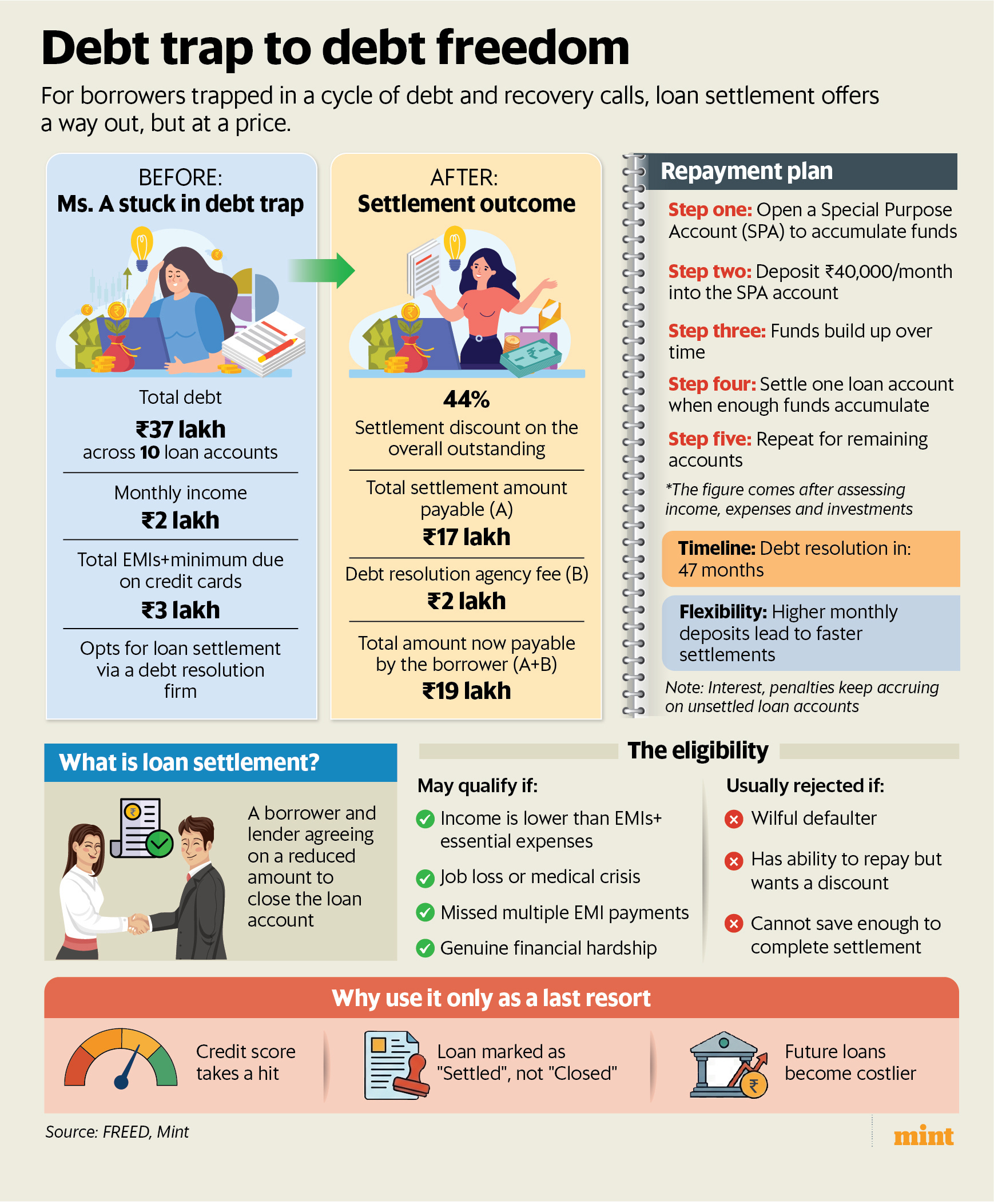
For customers with a clear intent to repay their loans and some income predictability, debt-resolution companies can provide a solution. These companies help borrowers negotiate loan settlements with lenders and escape relentless recovery pressure by helping them to close loans by negotiating a reduced outstanding amount when repayment has become genuinely impossible. But this relief comes at a cost: the loan is marked as “settled” rather than “closed”, which can severely damage your credit score and make future borrowing more difficult and expensive.
In this story, Aprajita Sharma explains why piling up loans to sustain a highly leveraged lifestyle can be a costly mistake, and why debt resolution companies can help, but the damage caused by a poor credit score can haunt you for many years. Read the story to learn that some of these companies are dealing with customers carrying as many as 55 loans on their heads. Yes, let that sink in!
In the investment space this week, Shipra Singh spoke with Radhika Gupta, chief executive of Edelweiss Mutual Fund, who doesn't like to tinker with her portfolio much, even though she keeps a close eye on how it is performing. For Gupta, this discipline is entirely intentional. She has built a personal portfolio designed to run largely on autopilot, anchored by systematic investments across 8 to 10 mutual funds.
Her investment strategy also includes a carefully maintained cash buffer, a handful of startup bets, and a global allocation she has been building since 2011. All of this is driven by the philosophy that the less she tinkers with her investments, the better they perform. And that is a good investment mantra even for the average investor, best achieved via sound professional financial advice grounded in investment goals, risk appetite, and asset allocation.

In the insurance space, Aprajita Sharma examines travel insurance policies and why they see a higher incidence of claim rejections. A travel insurance policy covers not just hospitalisation while travelling overseas, but also offers protection against baggage loss, trip delays, cancellations, and more. However, each of these coverages comes with caveats that are important to understand, something that people often overlook because they treat buying travel insurance as a tick-box exercise before travelling abroad.

And on the topic of insurance, Ann Jacob spoke with Asit Rath, managing director and chief executive officer of Aviva Life Insurance, who believes that while the regulatory ecosystem is increasingly focused on distribution practices and disclosures, the industry must also move beyond transactional selling and focus on building long-term customer relationships. According to Rath, the industry's biggest challenge is not claim settlement but systemic mis-selling.
That’s all from the Mint Money team this week. Until next time!
Deepti Bhaskaran is editor, Mint Money, with two decades of experience as a personal finance journalist. Her work reflects a strong focus on financial literacy, consumer protection and practical money management. She can found at deepti.bhaskaran@livemint.com.
No posts
Comments
Nothing yet. Say the first thing.
Sign in to join the conversation.