
The Nifty 50 is showing signs of a sturdier recovery from its April low, forming a series of higher highs and higher lows despite pricier crude, geopolitical tensions and weak foreign flows. The index has gained 6.85% since hitting a low of 22,182.55 on 2 April and touched a high 24,774.30 on 3 August.
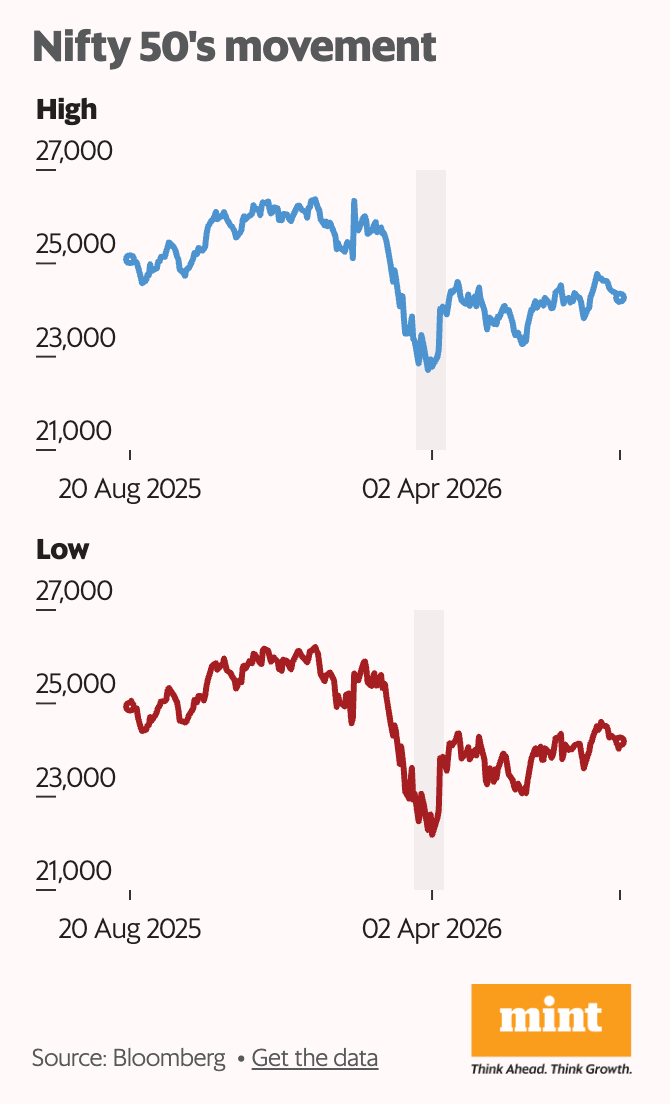
Analysts say the pattern suggests buyers are increasingly willing to enter at higher levels, pointing to an improving medium-term trend. A similar structure emerged in 2012 and 2018, both followed by strong gains, although with intermittent corrections.
The resilience is notable given the challenging backdrop. Foreign investors have net sold ₹1.09 trillion in Indian equities since April, while domestic institutional investors have bought ₹2.8 trillion. Retail and domestic liquidity have helped cushion the stock market.
Still, analysts caution that it is too early to call this a sustained uptrend. With crude oil prices, bond yields and geopolitical risks still elevated, the Nifty 50’s ability to hold higher support levels will be key to determining whether this recovery can turn into a longer-term rally.
India’s stock market ended flat today and posted weekly loss, as elevated crude oil prices and pressure in global bond markets kept investors cautious.
The Nifty 50 settled 0.08% higher at 24,252 points, while the BSE Sensex closed flat at 77,540.83. Both indexes fell 0.5% and 0.6%, respectively, for the week. Twelve of the 16 major sectors logged weekly losses. The small caps gained 1.2% while midcaps fell 0.1%.
🔗 Key factors that drove India’s stock market today
PM Modi’s ‘Sapt Dhara’: India’s farm-to-food strategy and why it matters
Saint-Gobain wants to change how Indians build homes and offices
For city gas distributors, policy support is short-term relief, at best
Physicswallah’s next test: Turning NEET recovery into growth
JSW Steel aims to eliminate iron ore imports as local supply improves
How independent streamers are fuelling India’s Formula 1 boom
Cockroach Janta Party and India’s culture of blame and shame
Turning 60 in India doesn’t just mark retirement. It can also unlock a bundle of financial perks, from higher fixed-deposit rates and tax deductions to cheaper travel and utility services.
The government-backed Senior Citizens’ Savings Scheme, for instance, currently offers 8.2% interest, while seniors can get additional deductions under the old tax regime. But these benefits are no substitute for a retirement corpus.
Unlike welfare states with generous pensions and subsidised healthcare, India expects individuals to largely fund their own retirement. That makes starting early, investing for growth and planning withdrawals just as important as knowing what concessions become available after 60. Read more.
Comments
Nothing yet. Say the first thing.
Sign in to join the conversation.