

Hello everybody,
This week we’re looking at Karl Jaspers' concept of "boundary situations."
A video version of this newsletter is found at the end.
I was sitting on the sofa talking to my mate’s dad. It’s always a little bit strange talking with your childhood friends’ parents when you’re all grown up. On the one hand, it’s nice to see them and their world with clearer eyes. It’s nice to see them as people. But on the other hand, childhood is not an easy thing to throw off.
“Hi Jonny, come on in,” he says.
“Hi Mr. Hammond! Thanks for having me stay. Can Alex come out to play?” I reply in a squeaky prepubescent voice, wearing shorts and carrying a primary school bag.
As I sat there in the nostalgic, liminal space between adulthood and childhood, Mr. Hammond told me about how he nearly died. It wasn’t one of those “I got a diagnosis then I pulled through” kinds of stories. It was a hit-by-lightning, hungry shark-attack, act of God kind of thing. One minute he was fine, the next he was in the back of an ambulance, careening down the road to the hospital. Without oversharing another person’s story, I’ll just say it involved a lot of blood, hours on an operating table, and a few weeks in a ward.
“Do you know what, Jonny?” he said to me. “All that ‘You need to make the most of it’ stuff is pretty abstract and remote until it happens. Of course, you think it and say it, but until something like this happens, you don’t feel it.”
I told Mr. Hammond to write down his story for me — especially his post-encounter philosophy. But until that time, you have me. And so, this week we’re going to look at life-changing moments.
Go well,
Jonny

In Anton Chekhov’s play, “The Seagull,” we are asked to imagine a seagull flying over a lake. The gull is swooping and diving, fishing and cawing. It’s entirely consumed by the busyness of being a seagull. And then, in the squeeze of a trigger, it’s gone. A man on the shore holding a rifle is bored. With no game and no fun to find, he pulls up his gun and shoots the bird for no other reason than idleness.
Of course, as with any great literature, there are metaphors wrapped in allegories. In the play, we meet a cast of characters all obsessed with their plans. They have unfulfilled longings. They want fame, riches, love, or a life of pure art. Like a seagull flapping back to land, they have eyes only for the shore. And so, blinkered and distracted, they are vulnerable to the misfortune of life’s mercurial rifle.
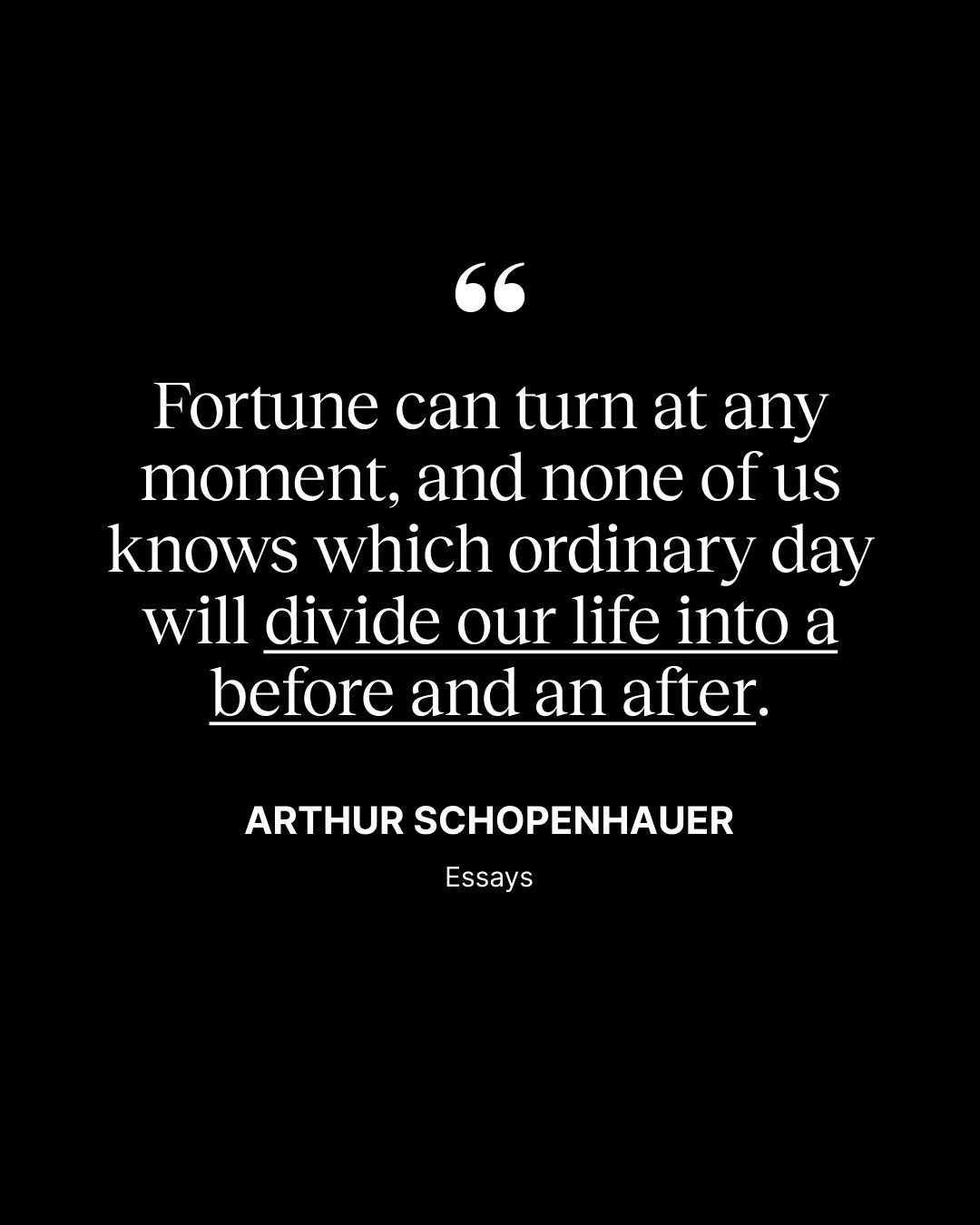
So much of our lives is spent in planning and preparation, and yet often the most significant moments come out of the blue. These are what the psychiatrist Karl Jaspers called “boundary situations.”
A boundary situation is a rupture. It’s a transformative experience that we cannot initiate, plan, or avoid. We can only “encounter” it. The mundane, everyday parts of our life — putting on socks, ordering a pizza, planning a holiday — are what Jaspers calls “situation being.” But a boundary situation is one that thunders down to shake the foundations of your being. It changes who you are. It is what happens when you wake up in a hospital bed, having only just beaten the reaper’s odds.
Although these “boundary situations” change a bit in Jaspers’ works, he broadly sorted them into four categories:
Death: We fear our loved ones dying, and we fear the fact of our own death. When we know grief, or when we reflect on mortality, we often find some kind of revelation. As my friend’s dad told me, we always know about death, but when it’s a boundary situation, it comes crashing into our lives like some grim and unforeseen final curtain.
Suffering: As the Buddha pointed out long before Jaspers, it is impossible to avoid suffering. Our paths will hit old age, sickness, and a great deal of pain. Some of this we can see coming: a tooth filling, a long run, a fourteen-hour flight to Australia. But the rest comes unexpectedly. It hits us with such a shocking intensity that we’re almost glad we didn’t see it coming. We come home from the hospital with a new life to live.
Guilt: There will come a moment, and often in adulthood, when we feel responsible for things. It’s the sudden awareness that our actions impact all those around us — that we are the reason for those tears, that laughter, that pain, that joy. The profound pull of the heart changes how we live, and it usually comes on unexpectedly.
Chance: No matter how ordered we might want our world to be, there will always be an unpredictable exception. We can hope for the best and make all the plans we want, but we will never fully control all of the facts that affect our existence. We want order and regularity but get the capricious throes of chance.
What Chekhov’s Seagull, Jaspers, and Mr. Hammond all get right is that we are each much more vulnerable than we might want to allow. A wedding, three years and a fortune in the planning, is ruined by a stomach bug. An hour-long journey home for Christmas winds up getting you stuck in the traffic of a freak snowstorm. A lifetime achievement is overshadowed by a national disaster. A long and gentle retirement is blown off course by a near-death detour to the operating table.
Our lives are defined by the unforeseen. We have our dreams and hopes, and we are flying to some distant horizon. Yet life doesn’t care. Around every corner, at every flap of our wings, everything can change. And that’s all the more reason to enjoy the view, as long as it lasts.
IN A QUOTE

Jonny is the creator of the Mini Philosophy social network. He’s an internationally bestselling author of three books and the resident philosopher at Big Think. He's known all over the world for making philosophy accessible, relatable, and fun.
No posts
Comments
Nothing yet. Say the first thing.
Sign in to join the conversation.