
$264m worldwide in three days, the best global launch Nolan has ever had. Three hours long, rated R, no franchise, no sequel number. Universal spent $250m making it and another $125m telling people about it. Half the ticket buyers were under 35, and about a quarter of the American takings came from IMAX screens alone.
Homer has been earning his keep for some time. The poems took shape around 700BC and were sung before anyone wrote them down. Alexandrian librarians cut them into the 24 books we still use. Byzantine scribes copied them through the collapse of the world around them. Chapman englished them, Pope versified them, Petersen put Achilles on a hundred million screens in 2004. Nearly 3,000 years on, the Odyssey is grossing $18m on a Wednesday.
We counted it instead.
Counting has nothing useful to say about why book 24 of the Iliad is unbearable. It is good at questions reading is bad at, and the first problem it runs into is what a word even is. In Greek, ἄειδε, ἀείδειν and ᾄδω are one verb wearing three faces. Sorting the faces from the verb is called lemmatisation, and it is where projects like this usually die. Ours did not, because classicists hand-checked the lemma and part of speech of 199,985 tokens across both poems, decades ago, and published the lot for free. No model stands between the text and the numbers. Somebody just did the work.
Here is what fell out.
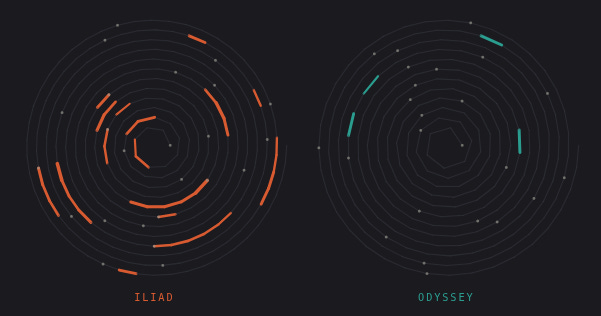
ναῦς, ship, turns out to be a lockword. Both poems reach for it at almost exactly the same rate. So much for the sea.
Then look at what the word travels with. Cut both poems into 574 passages of 50 lines, factorise the lot, and let clusters of words that keep co-occurring name themselves. One of those clusters is open water: πόντος, θάλασσα, ἄνεμος, κῦμα. It leads 21.3% of the Odyssey and 0.6% of the Iliad. A whole coil of one spiral fills with it. The other has two scraps.
The Iliad’s ships are beached furniture, something to argue beside and something to defend. The Odyssey’s are things you sit inside with the water all round. Same word, different life, and a word count cannot see the difference.
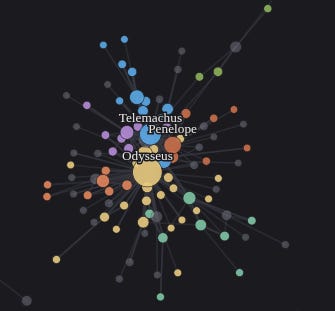
Every direct speech in Greek epic has been catalogued with its speaker and its addressee, 1,370 of them across the two poems. That turns each epic into a social network with no guesswork in it.
The Iliad is a crowd. Achilles is the biggest node and only just, holding 6.1% of the poem’s connections, with Agamemnon, Hector, Nestor, Odysseus, Diomedes and Zeus breathing down his neck. It is a network of peers arguing.
The Odyssey is one man and everyone else. Odysseus holds 14.5%, and he stays first however you measure it.
Both networks also behave like real human communities: tight local clusters, short hops between them, hubs that prefer talking to non-hubs. Six degrees of separation, except in the Iliad it is 2.9, and it is 700BC.
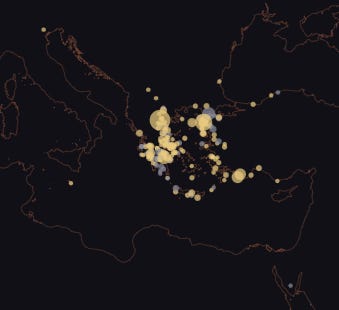
The Iliad names 209 distinct places. The Odyssey names 91.
One book does nearly all of it. The Catalogue of Ships, Iliad 2, reels off 151 places by itself, more than the entire Odyssey. Delete that book and the two poems are level. The poem that never leaves one plain recites the whole Greek world, in one enormous list.
What the Odyssey has instead is distance and absence. Its places sit half again as far from its centre of gravity, out to Mount Atlas at 7.9° west. And 16.5% of its place-mentions go somewhere no gazetteer holds at all. Ogygia. Scheria. Thrinacia. They are listed beside the map because they cannot be put on it, and the silence is itself the finding.
Its three most-named “places” in Homer came out as a Cretan sanctuary of Zeus, a shrine of Athena and an Egyptian town called Menelaos.
Gazetteers file cult sites under the bare name of the god, so every Zeus in both poems matched a temple in Crete. Separately, Hellenistic settlers named real towns after Homeric characters centuries after the fact. Homer means the people. Two thirds of that first pass was not places at all.
The fix was two filters and a short blocklist, both version-controlled, both wrong in ways someone can argue with. That is the point of publishing them.
Two problems we have not fixed: choosing between same-named places is a genuine scholarly question, and our tie-break just prefers the Aegean. And ToposText has no entry for Mount Ida in the Troad, so the Iliad’s mountain resolves to a Thracian town. It is flagged uncertain. It is still wrong.
There is one more piece in the essay, on book 10 of the Iliad, which antiquity already suspected of being stitched in later, and whether the arithmetic can still smell the seam.
The figures are interactive. The argument is in the prose, which needs no JavaScript.
No posts
Comments
Nothing yet. Say the first thing.
Sign in to join the conversation.