
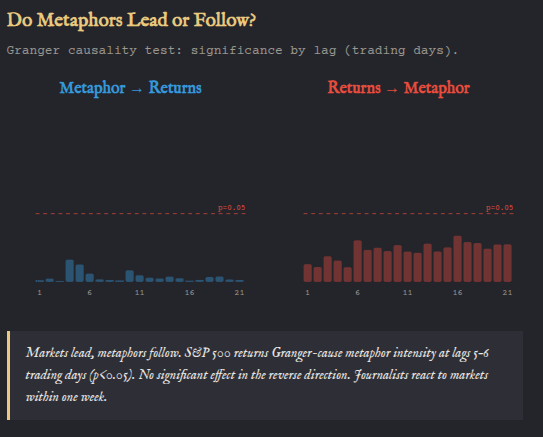
Financial journalism cannot see the future, but you can time its grief. When the S&P 500 falls, the metaphors of death and drowning arrive in the headlines about five trading days later, as reliably as thunder after lightning. We found this by running a metaphor detector over 158,666 headlines from a decade of crises, and it is exactly the kind of fact we set up shop to find: small, precise, and telling about how people think in public when money is at stake.
We are Crow Intelligence, a two-person research outfit working at the intersection of cognitive linguistics and natural language processing. Orsolya Putz, PhD wrote her PhD on the conceptual metaphors of the Treaty of Trianon, the 1920 treaty that still structures how Hungarians talk about loss a century later, and turned the dissertation into a book. I spent the past two decades in NLP, much of it in fintech and regtech: I co-founded the compliance startup Complytron and worked with clients across the industry. Neither of us is a finance professional, and this project does not pretend otherwise. We came to financial language because it is some of the best material for studying social cognition that exists: millions of people making decisions under uncertainty, narrating those decisions in public, in real time, with a price series attached that tells you what they actually did.
The intellectual debt is easy to name. Robert Shiller’s work on behavioral finance, and later his book Narrative Economics, convinced us that stories move markets. Shiller treats narratives the way an epidemiologist treats a virus: he tracks which stories spread, how fast, and when they peak. It is a powerful framework with one blind spot: it observes narratives from the outside and never opens one up to see what it is made of. Cognitive linguistics has held the answer since Lakoff and Johnson published Metaphors We Live By in 1980: narratives are built out of metaphors, and the metaphors do real inferential work. If the economy is a machine, someone should tune it. If it is weather, you carry an umbrella and wait. The metaphor you accept decides, before you notice it, which actions make sense to you. So when Shiller says narratives drive economic behavior, our immediate question was: which metaphors are those narratives running on? As far as we could tell, nobody had measured this at scale. Until recently nobody could, because metaphor identification meant trained annotators reading one sentence at a time. Language models changed that.
Our first study took the wide-angle view. We ran an open-source metaphor-detection model (a fine-tuned XLM-RoBERTa) over those 158,666 financial news headlines, published between 2009 and 2020 and covering five crisis episodes from the EU debt crisis to COVID-19. We sorted the detected metaphors into eight source domains — ascent, heat, light, movement, structural failure, water, weight, darkness and death — and mapped their frequencies onto the boom-panic phases Charles Kindleberger describes in Manias, Panics, and Crashes. The descriptive results were satisfying: each phase has a recognizable metaphorical palette, and in the COVID crash you can watch death language build through the distress phase and flood language wash in with the recovery.
Then we asked the question a finance person would ask first: do metaphors predict returns? They do not, and that is the asymmetry we opened with: returns predict metaphor intensity at a lag of five to six trading days, with no significant effect in the reverse direction. Journalists are chroniclers rather than prophets; the market falls, and about a week later the obituaries appear. We report this negative result with some affection, because it taught us something about newsroom cognition (shock is metabolized into metaphor on a measurable delay) and because it sharpened the next question. If headline language follows the market, whose language leads it?
There is one speaker in finance whose sentences move prices by design: the central bank. Entire trading desks exist to parse the connotations of Federal Reserve speech. So for the second study we traded 158,666 noisy headlines for a small corpus in which every word has been weighed before delivery: speeches by FOMC governors. We also traded the off-the-shelf detector for something of our own. Orsolya has spent years doing metaphor identification the slow way, by hand, following an explicit protocol, and we turned that protocol into an LLM-based annotation methodology: the model is guided through the same steps a trained cognitive linguist would take, so the automatic annotation inherits the method rather than improvising one. We read each speech along four dimensions. What topic is being discussed. Which metaphor family carries the reasoning, whether the economy appears as a machine to be tooled, an organism with health, an object under pressure, or a traveler on a path. Who is cast as the actor, the Fed intervening, the market moving on its own, or no one at all, the speaker merely diagnosing. And whether the gaze points forward to projections or backward to track records.
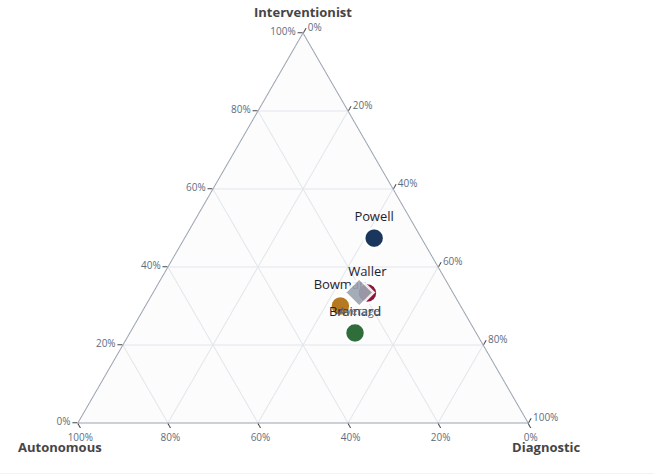
The differences between governors are individual, consistent, and occasionally striking. Jerome Powell speaks as the committee’s most interventionist and most forward-looking voice: in his telling, the Fed acts and the future is the tense that matters. Christopher Waller is his mirror image, retrospective and data-anchored, and he is a statistical outlier in one specific habit: he alone frames inflation as a journey, a path with distance covered and distance still to go. Michelle Bowman favors altitude, an economy of things rising and falling under pressure. And when governors do cast the Fed as the actor, they slip into recognizable personas: the calibrator making fine adjustments to a machine, the stabilizer steadying an object that would otherwise topple. These are not rhetorical accidents. A governor who thinks of inflation as a journey asks how far along we are; one who thinks of it as pressure asks when to release the valve. Different metaphors license different policies, and these people vote.
Both studies are up as interactive dashboards: Market Metaphors for the headlines, The Narrative Engine for the FOMC pilot. The Fed study is a pilot in the honest sense, four speakers and a method we are still stress-testing, and we plan to extend it across more voices and a longer horizon. If you work on narrative data, central bank communication, or metaphor at scale, or if you simply think we are wrong about something, write to us at hello@crowintelligence.org. Wisdom begins in wonder, and quite often in disagreement.
No posts
Comments
Nothing yet. Say the first thing.
Sign in to join the conversation.