
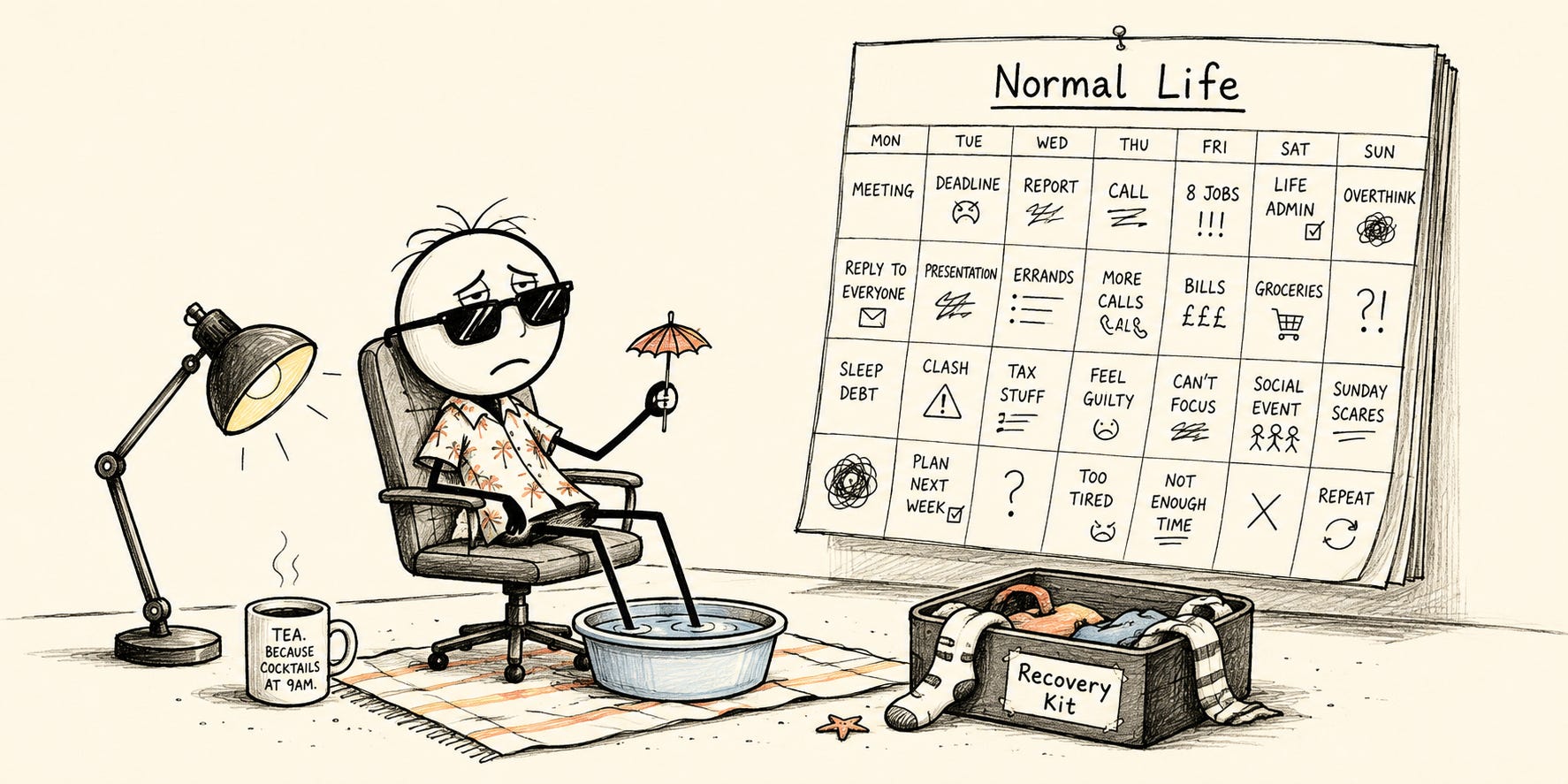
I spent a fortune escaping my life. Then I had to come back to it.
The Sunday-night dread started before I’d even left the hotel.
The holiday wasn’t over.
Technically.
The sun was still out. The drinks were still cold. Someone nearby was laughing with the carefree enthusiasm of a person who clearly didn’t have 847 unread emails waiting to cave their skull in.
My suitcase was open on the bed.
One pair of pants had been folded with optimism. Everything else had been launched into it like evidence during a police raid.
And there it was.
That feeling.
The tightening chest. The sinking stomach. The faint internal sound of Monday morning reversing towards me like a bin lorry with faulty brakes.
I hadn’t left the hotel.
But my nervous system had already gone back to work.
It had reopened Outlook.
It had remembered the traffic.
It had located the meeting invite titled “Quick Catch-Up”, which is corporate language for:
“Nothing may be wrong, but we’d like you to experience the physical symptoms of a hostage situation until Tuesday.”
That is the cruelest part of some holidays.
Not the airport.
Not the sunburn.
Not discovering your transfer coach has forty-three stops and a driver who treats corners as personal enemies.
It is realising how quickly your ordinary life can ruin your escape from several hundred miles away.
Because perhaps you didn’t simply need a holiday.
Perhaps you needed a life you didn’t have to keep escaping from.
Most holidays begin with the traditional British relaxation ceremony:
Absolute chaos.
You work twice as hard before leaving because apparently taking five days off requires performing eleven days of labour in advance.
You send handover notes nobody will read.
You set an out-of-office reply that politely says:
“I’m unavailable.”
What it actually means is:
“I will still glance at my inbox from a sun lounger because I’ve been psychologically trained to believe the company will collapse if I don’t answer Karen’s question about a spreadsheet.”
Then you pack.
Or, more accurately, you spend four hours moving the same seven items between a bed and a suitcase while asking increasingly philosophical questions.
Do I need three pairs of shoes?
What happens if it rains?
Why have I packed formal trousers?
Who am I planning to meet, the King?
By the time you arrive, your body is technically on holiday, but your brain is still charging through imaginary meetings wearing a tiny lanyard.
You sit beside the pool while mentally drafting emails.
You stare at the sea while remembering something mildly embarrassing you said during a Teams call in 2021.
You order a cocktail with a name like Sexual Pineapple Explosion, then use the hotel Wi-Fi to check whether your manager has replied “Thanks” with or without a full stop.
Because those are very different thanks, obviously.
A full stop could mean anything.
Disappointment.
Redundancy.
War.
For the first few days, you are not relaxing.
You are decelerating.
Your body is attempting to step down from seventy miles per hour while your brain keeps shouting:
“WE HAVE STOPPED MOVING. THIS FEELS IRRESPONSIBLE.”
Eventually, something changes.
Your shoulders drop.
You sleep properly.
You laugh without checking the time.
You remember that you are not merely an employment unit with lower-back pain.
You are a person.
A surprisingly decent one, actually.
Bit weird.
Questionable knees.
But still here.
Then, almost immediately, it is time to come home.
Marvellous.
“I just need a proper break” is one of the most comforting lies exhausted people tell themselves.
Not because holidays are useless.
They are not.
Time away from work can genuinely improve wellbeing, and research has found positive effects from holidays, although earlier evidence also showed that some benefits faded after people returned to work. More recent research suggests the benefits may sometimes last longer, particularly when the break allows real psychological detachment and restorative activity.
So take your holiday.
Book the cottage.
Sit by the sea.
Visit a castle and pretend to care about arrow slits while secretly wondering where the café is.
You deserve rest.
The lie is not that the holiday will help.
The lie is that the holiday will fix everything.
It is an attractive belief because holidays are straightforward.
You choose a place.
You spend money you were emotionally unprepared to spend.
You receive twelve emails from the airline.
You briefly become a logistics manager.
Then you leave.
Changing your actual life is messier.
That might involve admitting:
Your workload is unreasonable.
Your boundaries have the structural integrity of wet Weetabix.
Your job no longer fits you.
Your evenings belong to everybody except you.
The domestic workload is grinding you into human pâté.
You cannot keep saying yes without eventually screaming no through a locked bathroom door.
The life everyone congratulated you for building does not feel very nice to live inside.
A holiday lets you postpone those conversations.
It gives you a shiny object to crawl towards.
“Just make it to August.”
Then August becomes:
“Just make it to Christmas.”
Then:
“Once this project finishes.”
Then:
“When the kids are older.”
Then:
“When the mortgage is smaller.”
Then, one day, you find yourself searching for shepherd’s huts in Wales at 1:14am because apparently your entire emotional survival strategy now depends on spending two nights in a cupboard with a wood burner.
The real sentence underneath “I need a holiday” may be:
“I don’t know how much longer I can keep living at this speed.”
That sentence is much harder to put on a luggage tag.
Stress is not merely an annoying thought you can swat away with a lavender candle and an inspirational mug.
It can show up physically and mentally: muscle tension, headaches, stomach problems, a faster heartbeat, irritability, difficulty concentrating, racing thoughts and changes in sleep or behaviour.
Your body responds to the life you repeatedly live.
Not the brochure.
Not the sea view.
Not the fact that the breakfast buffet contains a suspicious quantity of melon.
Remove yourself from your stressors and you may feel better.
Of course you may.
You are sleeping more.
Commuting less.
Avoiding Trevor.
Nobody has asked you to “circle back”.
The photocopier is not making that grinding noise that suggests it has seen the future and objects to it.
But when you return to the same workload, uncertainty, conflict, interruptions, financial pressure, domestic overload and six hours of sleep, your body does not say:
“Ah, but remember Portugal?”
It says:
“Oh good. The fire is still here.”
A holiday can take you away from the smoke alarm.
It does not automatically put out the fire.
That is why you can feel wonderful after a break and mysteriously dreadful again within days.
You have not failed at resting.
Your environment has simply resumed its subscription to your nervous system.
Automatic renewal.
No cancellation button.
Bastards.
There is a difference between resting from your life and escaping it.
Rest says:
“My life matters to me, and I need time to recover so I can return to it.”
Escape says:
“For seven days, I would like to be legally declared missing.”
Rest restores you for something you broadly want.
Escape briefly removes you from something you increasingly cannot tolerate.
The difference is not always obvious.
It can look like lying beside a pool, thinking:
“Why can’t I feel like this at home?”
It can look like becoming unusually emotional on the last night.
It can look like wishing the flight would be cancelled, even though you have already spent two hours complaining that the airline is run by raccoons.
It can look like browsing jobs while abroad.
Or houses.
Or businesses for sale.
Or remote cottages where nobody can contact you without first crossing a field and defeating a goose.
Sometimes you feel more like yourself away because the noise has stopped.
No role to perform.
No alarm.
No commute.
No constant availability.
No one asking what is for dinner while standing directly beside the fridge like a confused Victorian orphan.
For a few days, you are not the employee, parent, organiser, fixer, bill-payer, emotional support mammal or family calendar wearing shoes.
You are just you.
And when that version of you begins to reappear, the return can feel less like going home and more like watching them disappear again.
That hurts.
Because it reveals something.
The holiday did not create an entirely new person.
It temporarily uncovered the person your routine keeps burying.
When people talk about stress, they often make it sound like a mildly inconvenient weather condition.
A bit breezy.
Wear a coat.
Try mindfulness.
Maybe download an app featuring a man called Benedict whispering about clouds.
But prolonged pressure does not merely make you sleepy.
It can shrink your life.
You stop reading because your attention is knackered.
You stop exercising because getting changed feels like organising the Commonwealth Games.
You stop seeing friends because conversation requires a level of executive function you currently reserve for locating your keys.
You become impatient with the people you love.
Not because you have stopped loving them.
Because every additional request lands on a system already displaying the warning:
STORAGE FULL. DELETE SOMETHING OR ACCEPT IMMINENT COLLAPSE.
You stop creating.
Stop imagining.
Stop taking risks.
Stop asking what you want.
Eventually, your ambition is reduced to making it through Thursday without saying something that requires an HR investigation.
Work-related stress, depression and anxiety remain a huge issue in Britain. The Health and Safety Executive estimated that 964,000 workers were suffering from work-related stress, depression or anxiety in 2024/25, contributing to 22.1 million lost working days.
Those are enormous numbers.
But numbers still fail to capture the private cost.
The child who gets your exhausted leftovers.
The partner who receives a grunt because you have spent your last polite sentence on a manager.
The hobby sitting untouched.
The Sunday afternoon poisoned by Monday.
The evenings spent scrolling, not because you are enjoying yourself, but because your brain is demanding the emotional equivalent of being hit with a tranquiliser dart.
The years measured in countdowns.
Six weeks until the break.
Four weeks until Christmas.
Three days until Friday.
Nine hours until bed.
You are not living for the holiday.
You are using the holiday as evidence that you are still alive.
Modern self-help loves resilience.
Resilience is useful.
Unfortunately, it is sometimes sold as the ability to absorb unlimited bollocks without making anybody uncomfortable.
Workload impossible?
Become resilient.
Manager communicates exclusively through vague criticism and facial expressions?
Try box breathing.
Company has removed half the team and redistributed the work among the survivors like a grim office-based version of The Hunger Games?
Here is a webinar on gratitude.
Bring your own lunch.
There is something deeply suspicious about systems that create distress and then ask individuals to become better at tolerating it.
The World Health Organization classifies burnout as an occupational phenomenon arising from chronic workplace stress that has not been successfully managed. It is not classified as a medical condition, and the term specifically relates to work rather than every form of exhaustion in life.
That distinction matters.
Not every awful Tuesday is burnout.
Sometimes you are tired.
Sometimes you are stressed.
Sometimes you have not eaten properly and are attempting to solve your entire existence while needing a sandwich.
But whatever label fits, personal coping tools cannot compensate indefinitely for conditions that keep causing harm.
Meditation can help you regulate yourself.
It cannot make an impossible workload possible.
A morning routine can support you.
It cannot repair a relationship in which one person carries every invisible task.
A gratitude journal may remind you what is good.
It should not be used to gaslight you about what is unbearable.
Sleep matters enormously.
But sleeping eight hours does not transform a terrible job into a meaningful one.
You can optimise yourself until you resemble a Formula One pit crew.
If your week is structurally hostile, you will still be exhausted.
Perhaps the question is not:
“Why can’t I cope better?”
Perhaps it is:
“What exactly am I being asked to cope with?”
That is a very different question.
It contains significantly fewer scented candles.
This is the point where some self-help lunatic would tell you to quit immediately, move to Bali and monetise your authenticity.
Don’t.
Unless you have substantial savings and a burning desire to sell an online course called Abundant Coconut Leadership, impulsively detonating your life may create more stress than it removes.
Noticing that something is wrong does not mean you must destroy everything by teatime.
It means you investigate.
Calmly.
Honestly.
Like a detective, except tired and wearing jogging bottoms.
Start with these questions.
Is it the commute?
The emails?
The noise?
The constant decision-making?
A particular person?
The sense that everybody can access you whenever they fancy?
Do not write “stress”.
That is too vague.
Stress is the smoke.
Find the toaster somebody has left burning under the grill.
The chest tightness?
Poor sleep?
Sunday dread?
Irritability?
Headaches?
The urge to consume enough biscuits to alter your blood type?
Notice the timing.
Your reaction contains information.
Maybe the job is tolerable, but the commute is eating twelve hours.
Maybe work is not the main problem; perhaps you never receive uninterrupted time at home.
Maybe you have accidentally become the unpaid project manager of everyone’s existence.
Maybe your phone has turned every room into a branch office.
Do not judge the answer.
Just find it.
One meeting.
One commitment.
One expectation.
One evening of availability.
One household responsibility that should never have become permanently yours.
You do not always need a new life.
Sometimes you need to stop volunteering for fresh nonsense.
A mortgage.
Care responsibilities.
A difficult workplace.
A financial constraint.
You may not be able to remove it this week.
But helplessness reduces when the vague nightmare becomes a named problem with a plan.
Not command.
Tell.
Exhaustion is not always a wise philosopher.
Sometimes it tells you to abandon society, become a lighthouse keeper and communicate exclusively with seabirds.
But repeated relief away from normal life is worth noticing.
It may be telling you that you need a boundary.
Support.
A conversation.
A job-search plan.
Professional help.
A redistribution of responsibilities.
Or a more substantial change you have avoided because it frightens you.
You do not need to obey every feeling.
You should probably stop pretending you cannot hear it.
Large life changes begin with evidence.
Not inspiration.
Not a vision board featuring a suspiciously white sofa.
Evidence.
Before deciding that your entire existence is broken, alter one part of the system and observe what happens.
There are three levels to consider.
These changes help your body and mind recover.
Protect one evening.
Go to bed earlier.
Take a proper lunch break.
Walk without listening to a podcast about becoming more effective at walking.
Stop checking email after a set time.
Create twenty minutes between work and family life so you do not carry one straight into the other like a dirty tray.
These actions are not trivial.
But remember: recovery habits support you.
They should not become another performance target.
You do not need to win resting.
There is no medal.
Nobody is standing beside the sofa with a stopwatch shouting:
“COME ON, ALEX! RELAX HARDER! YOU’VE GOT THIS!”
This is where you alter the machinery.
Question the recurring meeting.
Renegotiate a deadline.
Ask another adult in the house to notice that towels do not wash themselves through the power of feminine mysticism.
Turn off notifications.
Stop replying instantly.
Protect annual leave instead of packing your laptop as though it is a nervous rescue animal.
If your employer is contributing to work-related stress, this is not solely a private self-care issue. HSE guidance places responsibility on employers to assess and act on work-related stress risks.
You are still responsible for communicating, seeking support and taking practical steps where possible.
But you are not morally defective because a dysfunctional system makes you feel dysfunctional.
Sometimes the problem is not one meeting.
It is the entire building.
Or career.
Or arrangement.
That does not mean walking out tomorrow while dramatically throwing your security pass into a fountain.
It means building options.
Update your CV.
List transferable skills.
Speak to someone working in another field.
Save a buffer.
Test a side project.
Take a course.
Request flexible arrangements.
Explore internal roles.
Work out what “less stress” actually means instead of vaguely searching for jobs involving trees.
Create a transition plan.
Fear loves fog.
A plan switches on the headlights.
It may still be a horrible road.
But at least you can see the next pothole.
For the next seven days, do not try to transform your entire life.
You have enough admin.
Run an experiment.
Cancel something.
Delay something.
Delegate something.
Let something be adequate rather than immaculate.
Nobody has ever stood at a funeral and whispered:
“She could have been loved, but unfortunately the kitchen skirting boards were only moderately clean.”
Choose one block of time.
An evening.
A lunch break.
An hour on Sunday.
Protect it before the week begins.
Do not use it to catch up on work, deep-clean the house or reorganise a cupboard because TikTok persuaded you that inner peace depends on decanting cereal.
Use it for something that makes you feel more human afterwards.
Keep a note.
Time.
Situation.
Thought.
Physical feeling.
What happened immediately beforehand?
You are looking for patterns, not composing the world’s saddest diary.
Ask:
“Will this make me feel better afterwards, or merely help me feel nothing for a bit?”
Sometimes scrolling is fine.
Sometimes television is exactly what you need.
Sometimes you must lie flat and watch strangers renovate a French château because reality has exceeded the recommended daily allowance.
But notice the difference between rest and numbing.
Both have their place.
Only one tends to refill the tank.
One conversation.
One boundary.
One application.
One request for support.
One appointment.
One hour spent making a plan.
Not twenty-seven steps.
One.
Your brain changes its story when you give it evidence.
“I’m trapped” becomes:
“I have started looking for the door.”
That matters.
Persistent stress, anxiety, low mood, sleep problems or physical symptoms deserve proper attention.
Do not assume everything is “just work”.
Do not use an article on the internet to diagnose yourself.
And do not wait until you are completely flattened before speaking to your GP, a qualified mental-health professional or an appropriate workplace support service.
The NHS recommends seeking support when stress is affecting daily life or you are struggling to cope.
Practical life changes matter.
So does professional help.
It is not weakness.
It is maintenance.
Even Formula One cars need a mechanic, and they cost significantly more than you despite having no personality whatsoever.
Eventually, you have to zip it closed.
You check under the bed fourteen times.
You perform the traditional hotel-room departure ritual of becoming convinced you have lost your passport while holding your passport.
Then you go home.
The holiday ends.
That is not a failure.
A holiday is supposed to end.
The question is what you return to.
Not whether every Monday feels like Santorini.
That would be unrealistic.
For a start, most workplaces are strangely resistant to installing infinity pools beside Accounts Payable.
The goal is not permanent bliss.
It is not becoming so spiritually advanced that council-tax letters arrive and you whisper:
“Thank you, universe, for this opportunity to grow.”
The goal is an ordinary life that does not repeatedly grind you into paste.
A week containing enough rest that you do not need to collapse.
Enough autonomy that you still recognise yourself.
Enough meaning that Friday is welcome, but not a medical evacuation.
Enough boundaries that everybody else’s urgency does not become your personality.
Enough hope that holidays feel like additions to your life rather than temporary witness protection.
Take the break.
Enjoy the sun.
Eat the ridiculous ice cream.
Swim in the sea.
Visit the castle.
Buy the magnet that will live on your fridge until civilisation ends.
But when the dread arrives before the holiday is over, listen.
Not because it means you must burn your life down.
Because it may be trying to tell you where the fire is.
A good holiday should enrich your life.
It should not have to rescue you from it.
Before you book another escape, work out what you are escaping from.
The Life Recovery Audit is a practical, no-unicorn-dust worksheet to help you identify:
what drains you,
what genuinely restores you,
what needs a boundary,
what needs a plan,
and what may need a bigger change.
No “manifest a yacht by Thursday” nonsense.
Just honest questions, a seven-day experiment and a clearer picture of where your energy keeps disappearing.
👉 Download The Life Recovery Audit
Then choose one small change before your normal life eats the insight and asks for dessert.
Know someone who spends all year counting down to seven days away?
Not as an accusation.
More as a gentle emotional grenade.
Comments
Nothing yet. Say the first thing.
Sign in to join the conversation.