
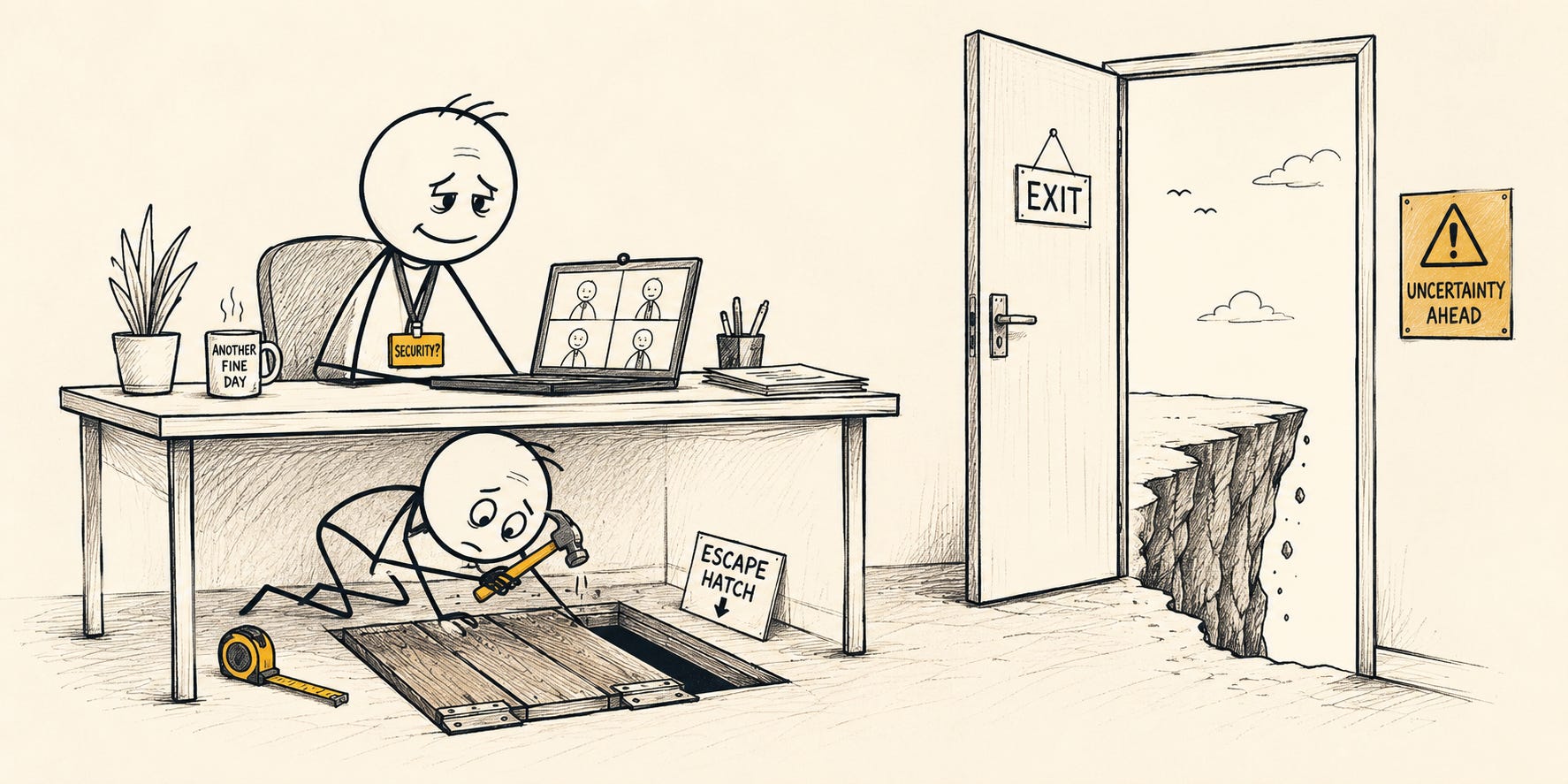
“I can’t keep doing this, but I can’t afford to stop.”
You’ve already rage-quit your job 400 times.
Admittedly, none of these resignations reached your employer.
But in your head?
It was utterly magnificent.
You’ve delivered speeches so powerful they should’ve been accompanied by dramatic music and a slow-motion shot of you lobbing your security pass into a bin.
You’ve told your manager exactly what you think of their “strategic realignment”.
You’ve finally explained that scheduling twelve pre-meetings to discuss why nobody has time to do any work might—just possibly—be part of the fucking problem.
You’ve marched through the office doors with your dignity restored, your shoulders back and the sort of swagger normally reserved for action heroes walking away from explosions.
Then you checked your bank balance.
And quietly joined the 9:03 Teams call.
Camera on.
Professional fake-smile activated.
Soul temporarily placed in airplane mode.
Because you don’t love your job.
In fact, you might even hate your job.
But quitting it?
That feels less like opening a door and more like leaping from an aeroplane while holding a Tesco carrier bag instead of a parachute.
And that’s the bit nobody puts on the motivational posters.
I kept calling it security. It was fear with a payslip.
The internet has plenty to say about jobs you hate.
Usually something along the lines of:
“Life is too short. Take the leap.”
Right.
Excellent.
I’ll just inform the mortgage company that I’ve taken a brave leap towards authenticity and will now be paying them in personal growth.
Perhaps British Gas accepts courage.
Maybe the weekly food shop can be covered by aligning with my purpose.
I’m sure the woman at the till will understand when I hand her a vision board and whisper, “Abundance is coming.”
The truth is that most people cannot simply walk out of a job because the lighting is oppressive and their manager has the emotional intelligence of a damp mop.
People have:
Mortgages.
Rent.
Children.
Partners.
Debts.
Parents who need support.
Prescriptions.
Cars that make a new noise every time the bank balance looks vaguely healthy.
Responsibility changes the calculation.
That doesn’t make you a coward.
It makes you an adult living in an economy where “taking a leap” can result in a beautiful new life—or three months of refreshing job sites while eating supermarket cereal directly from the box.
There’s now a cheerful little phrase for people staying in jobs they no longer enjoy because the outside world looks even more terrifying:
Job-hugging.
Imagine clinging to your job like it’s the last floating wardrobe after the Titanic has gone down.
You don’t particularly like the wardrobe.
It smells funny.
There’s definitely room for someone else on it.
But the water looks bloody freezing, so you hold on.
Only 22% of UK employees recently said they felt secure in their current role. Meanwhile, research from King’s College London found that 69% of workers were worried about the economic effects of AI-related job losses.
So no, you haven’t invented the uncertainty.
The job market does feel shaky.
Companies are restructuring, automating, downsizing, reorganising and “transforming”—a word that generally means something unpleasant is about to happen, but someone has prepared a colourful PowerPoint to make it look visionary.
Meanwhile, AI is apparently coming for everyone’s job.
Nobody knows precisely when.
Nobody knows precisely how.
But apparently we must all become prompt engineers, data scientists and part-time robot therapists before Tuesday.
It’s hardly surprising that people are staying put.
Your current job might be draining the life out of you, but at least it is draining your life out of you on a predictable payment schedule.
People often assume they are staying because they lack courage.
But courage is not always the missing ingredient.
Sometimes what you lack is:
Information.
Savings.
Evidence.
Energy.
Options.
Any clue what the hell you would do instead.
When you cannot see another route, the current job gains enormous psychological power.
It stops being a job and becomes the thing standing between your family and catastrophe.
Every alternative starts looking absurdly dangerous.
Apply somewhere else?
What if nobody responds?
Retrain?
What if you spend money and discover you’re crap at it?
Start something of your own?
What if nobody buys it?
Ask for reduced hours?
What if your manager laughs so hard they accidentally injure themselves?
Your brain doesn’t present these as possibilities.
It presents them as documentary footage from the future.
You don’t think:
“There is a chance this might not work.”
You think:
“I will fail publicly, lose every penny, disappoint my family and eventually be found living behind a retail park, fighting a fox over half a pasty.”
Fear is incredibly creative when it has access to your financial responsibilities.
This is what makes a job you hate so difficult to leave:
You know how to survive it.
You know which meetings require attention and which ones allow you to disappear behind a facial expression that says “interesting point” while mentally planning your dinner.
You know who to avoid.
You know which manager says “my door is always open” despite responding to every actual problem as though you’ve thrown a dead pigeon onto their desk.
You know the systems, the politics, the acronyms and the secret meaning of phrases such as:
“Quick question” — This will ruin your afternoon.
“Just picking this up” — You have failed to respond quickly enough.
“Let’s take this offline” — Stop exposing the problem in front of witnesses.
“We’re like a family” — Boundaries will not be respected here.
“Exciting changes ahead” — Hide your chair.
Your current misery is organised.
It has a pension scheme.
The unknown does not.
So your brain compares the two and says:
“Better the corporate dungeon you know.”
A truly horrific job often forces a decision.
If someone releases live wolves into the office every Thursday, you’ll probably start updating your CV.
But a tolerable job?
That can keep you trapped for years.
It is not bad enough to trigger action.
It is just bad enough to slowly erode you.
You tell yourself you will reassess after Christmas.
Then after the annual pay review.
Then after the restructure.
Then after the summer.
Then once the children are older.
Then once the economy settles down.
Then once your confidence returns.
Then one morning you discover you have been “temporarily” waiting for nine years.
Your salary may have increased.
Your responsibilities certainly have.
But your belief in your ability to function anywhere else has shrunk to the size of a frightened raisin.
That is one of the hidden costs of staying.
You stop receiving evidence that you can move.
You become exceptionally skilled at operating inside one particular box, then mistake your familiarity with that box for proof that you could never survive outside it.
Money matters.
Obviously.
This is not one of those self-help articles where we pretend money is merely an “energy” while quietly charging £4,997 for an online course filmed beside a rented swimming pool.
Losing income can have serious consequences.
But money is not the only cost in this calculation.
A job you hate can also take:
Every year spent telling yourself you cannot leave reinforces the belief that you are incapable of leaving.
It is difficult to build an alternative after spending eight hours pretending not to scream.
You stop asking what else might be possible because possibility becomes emotionally exhausting.
The job ends at five.
The frustration clocks off whenever it bloody feels like it.
It comes home, sits at the dinner table and snaps at someone for loading the dishwasher “incorrectly”.
Eventually you stop saying:
“I work here.”
And start believing:
“This is all I am qualified to do.”
This is the expensive one.
Money can sometimes be earned again.
Time cannot.
There is no reimbursement department for the seven years you spent waiting for permission to want something different.
Mental Health UK’s 2026 research found that nine in ten UK adults experienced high or extreme stress, while one in five workers had taken time off because of poor mental health caused by stress.
Not all of that stress comes from work.
But work occupies an enormous portion of adult life—and a job that leaves you constantly anxious, depleted or resentful does not stay politely inside office hours.
It leaks.
Now, before you open a new tab and start writing:
Dear Bastards,
I regret to inform you that you are all bastards...
Stop.
Do not rage-quit on a Wednesday.
Wednesday is dangerous.
Monday still has the numbness of inevitability.
Friday has the anaesthetic of imminent escape.
But Wednesday?
Wednesday is when hope goes to the toilet and cries.
It is the natural habitat of the pointless meeting, the patronising email and the manager who asks whether you have “capacity” before handing you three extra days of work due tomorrow.
A rotten Wednesday can reveal something important.
Your anger may be showing you that a boundary has been crossed.
It may be telling you that you feel undervalued, ignored, trapped or humiliated.
Listen to that information.
But do not allow one emotional afternoon to manage your mortgage.
Write the resignation email if you need to.
Make it vicious.
Make it lyrical.
Describe Gerald from Operations as “a baboon in a necktie”.
Then save it.
Do not send it.
Wait 72 hours.
Once your brain has stopped trying to launch itself through your forehead, ask:
Was this one dreadful incident, or part of a persistent pattern?
Is the job itself wrong, or does something specific need challenging?
Have I tried to change the conditions?
What would need to improve for staying to make sense?
What practical option can I create before the next Wednesday arrives?
Your anger should become evidence.
Not arson.
The usual career-change story is far too dramatic.
Person hates job.
Person has epiphany beside a lake.
Person resigns.
Person launches dream business.
Montage occurs.
Within six months, person is successful, moisturised and being interviewed on a podcast about courage.
Real change is usually less cinematic.
It looks like:
Opening a spreadsheet.
Updating three lines of your CV.
Sending an awkward message to someone you have not spoken to since 2019.
Taking a course on Tuesday evenings while everyone else watches television.
Putting £50 into an escape fund.
Testing an idea that may go nowhere.
Discovering that one of your assumptions was bollocks.
It is quieter.
Slower.
Less impressive on Instagram.
And considerably less likely to leave you unable to pay the council tax.
You do not have to kick the door down today.
You need to build the escape hatch before opening the door.
Your anxious brain uses phrases such as:
“We’d lose everything.”
Would you?
Maybe.
But probably not because you applied for another job.
Fear loves vague numbers.
Vagueness gives it room to install a cinema screen and show you Bankruptcy 2: This Time It’s Personal.
Replace the fog with facts.
Work out:
Your essential monthly costs.
Your current savings.
Your minimum acceptable income.
Which expenses are fixed.
Which expenses could change temporarily.
How much financial runway would help you feel safer.
Whether you need to leave—or simply move somewhere else.
You may discover that the gap is larger than you hoped.
Fine.
Now you have a number instead of a monster under the bed.
Numbers can become plans.
Monsters mainly ruin sleep.
This is not about convincing yourself that money does not matter.
It is about stopping your imagination from appointing itself Chief Financial Officer.
When people stay in one organisation for a long time, they often lose sight of what they actually know. Who they actually were before.
Their skills become invisible because they use them every day.
They say:
“I just sort things out.”
Right.
What does that mean?
Do you:
Solve complicated problems?
Calm furious customers?
Manage projects?
Train staff?
Fix systems?
Write reports?
Negotiate with difficult people?
Translate leadership gibberish into work normal humans can perform?
Keep an entire department functioning while three senior managers discuss the new logo?
That is evidence.
Write down:
Problems you have solved.
Results you have produced.
Situations you improved.
People you helped.
Processes you created.
Compliments you dismissed.
Responsibilities nobody else wanted because they looked like an unexploded bomb.
Do not write:
“Good team player.”
That phrase has been murdered by CVs.
Write what you actually did.
Confidence is not built by repeating:
“I am capable.”
It is built by producing a file marked:
Here are seventeen occasions on which I was demonstrably capable, despite feeling like an anxious potato.
Your brain says:
“Nobody else would employ me.”
Has the labour market formally confirmed this?
Have all employers gathered in a large conference centre and voted?
Or have you not applied anywhere in six years?
There is a difference between rejection and a prediction.
Test the outside world in small ways.
You could:
Speak to someone doing work that interests you.
Ask a former colleague what they think your strengths are.
Apply for one role without making it emotionally represent your entire future.
Take on a small freelance project.
Attend an industry event.
Try a short course.
Volunteer for work that develops a missing skill.
Ask about an internal move.
Create something publicly.
Update your LinkedIn profile without announcing that you are “thrilled to embark upon a transformative journey”.
The aim is not to secure your dream life by next Thursday.
The aim is to gather information.
Each experiment tells you something:
This appeals to me.
This does not.
I need this skill.
My experience is valuable here.
The salary is unrealistic.
The opportunity exists.
That idea was terrible.
Gerald may, regrettably, not be the only idiot in management.
Options grow through contact with reality.
Not through thinking harder in the shower.
A common problem looks like this:
You hate the job.
The job exhausts you.
Because you are exhausted, you cannot build an alternative.
Because you cannot build an alternative, you stay in the job.
The job continues to exhaust you.
Congratulations.
You have invented a perpetual misery machine.
Something has to interrupt it.
This may mean:
Saying no to unnecessary overtime.
Stopping the unpaid emotional labour.
Taking your lunch break.
Using annual leave.
Refusing to treat every request as a fire alarm.
Protecting two hours a week for your next move.
Doing a merely competent job instead of sacrificing your internal organs for an employer that would replace you before your office chair cooled down.
This does not mean deliberately performing badly.
It means remembering that your employer purchased a portion of your working time.
They did not buy the mineral rights to your soul.
Protect some energy for the person who has to build what comes next.
There is an enormous difference between:
“I am staying because I’m frightened.”
And:
“I am staying for six months while I build £5,000 in savings, complete this qualification and apply for five suitable roles.”
The first is paralysis.
The second is a plan.
A strategic stay needs:
A reason.
A timeframe.
A target.
Regular evidence of movement.
A date when the decision will be reviewed.
Conditions that would trigger an earlier departure.
Without those things, “I’m staying for now” becomes one of adulthood’s most dangerous sentences.
For now has no alarm clock.
It will sleep on your sofa for a decade and eat all the good biscuits.
You may be waiting to feel ready.
This seems reasonable until you realise you have been waiting since Winston Churchil was prime minister.
Readiness is unreliable.
Confidence is worse.
Confidence wanders in after the difficult thing has happened and behaves as though it organised the entire operation.
You do not become confident and then act.
More often, you act while feeling ridiculous.
Then survive.
Then your brain grudgingly updates its records.
You make one call.
You update one section of the CV.
You attend one interview.
You ask one uncomfortable question.
You hold one boundary.
You earn your first £20 outside your salary.
None of these acts changes your life instantly.
They change something more important first:
Your perception of what is possible.
The current job stops looking like the only solid object in the universe.
A door appears.
Then another.
Then perhaps a window.
Admittedly, one window leads directly into a hedge.
But that is still information.
You are allowed to stay.
That might sound strange after spending an entire article discussing escape.
But staying can be sensible.
It can be strategic.
It can protect your family, rebuild your finances and give you time to make a better decision.
You do not need to resign today to prove you are brave.
Bravery is not measured by how dramatically you can damage your income.
But there is a line you need to remember:
Staying temporarily is not failure; staying indefinitely without building options is surrender by instalments.
That is the distinction.
Strategic staying moves.
Slowly, perhaps.
Messily, definitely.
But it moves.
Fear-based staying repeats the same complaint, makes the same promise and waits for some external event to provide permission.
One day, confidence will arrive wearing a name badge.
One day, the perfect opportunity will appear.
One day, the economy will calm down.
One day, the company will improve.
One day, the children will need less.
One day, you will wake up certain.
One day, you will die.
Maybe.
But certainty is a terrible project manager.
It never commits to a deadline.
Do not create a 46-part transformation plan tonight.
You will colour-code it beautifully, frighten yourself with its size and never open it again.
Instead, do this over the next seven days:
Write down what the job is costing you.
Not only financially.
Emotionally, physically, relationally and creatively.
Calculate the minimum you genuinely need.
No fantasies.
No catastrophising.
Just numbers.
Write down ten examples of problems you have solved or value you have created.
Not an audience.
Not “the network”.
One actual person.
Ask a real question.
A role, course, industry, service, internal move or different working arrangement.
One uninterrupted hour for your escape hatch.
Not after every other person, notification and household object has taken a bite out of you.
Put it in the calendar first.
Something small enough to complete and real enough to produce evidence.
That is it.
You do not need a new life by Sunday.
You need one piece of proof that the current one is not welded shut.
Monday may arrive and find you in exactly the same chair.
The same inbox will be waiting.
The same manager may say “circle back” before you have finished your first coffee.
Externally, very little may have changed.
But there is a profound difference between being stuck and building your way out.
A trapped person sees one option.
A person with an escape hatch is creating another.
So no, do not rage-quit on a Wednesday.
Do not gamble the mortgage because somebody forwarded you a quote about courage.
Do not pretend money, responsibility and uncertainty are imaginary.
But do not spend another year calling your fear “security” either.
You do not have to kick the door open today.
You do not even need to know exactly where it leads.
Start with the measurements.
Gather the tools.
Protect the time.
Build the escape hatch.
Because the most expensive thing about a job you hate is not leaving.
It is the life you quietly spend convincing yourself you never could.
If this article felt suspiciously like someone had been reading your Teams messages, type in the comments:
ESCAPE HATCH
I’ll send you the link to download The Job Escape Hatch—a free, practical worksheet to help you work out whether you’re staying strategically or slowly becoming part of the office furniture.
It includes:
The Stay-or-Stagnate Audit.
A simple Financial Floor worksheet.
A Professional Evidence Inventory.
The Wednesday Rule.
A 90-day Escape-Hatch Plan.
No guru bollocks. No rage-quitting on Wednesday. Just a sensible place to start building options before you open the door.
You probably know someone who has mentally resigned 400 times but still turns up to the Monday meeting.
Send them this.
Not because they should quit tomorrow.
Because they may need reminding that staying today does not mean staying forever.
Then read:
👉 [I Was Told This Was a ‘Good Life’… So Why Did It Feel Like a Trap?]
Recognition shows you the cage.
Building options shows you the door.
Comments
Nothing yet. Say the first thing.
Sign in to join the conversation.