
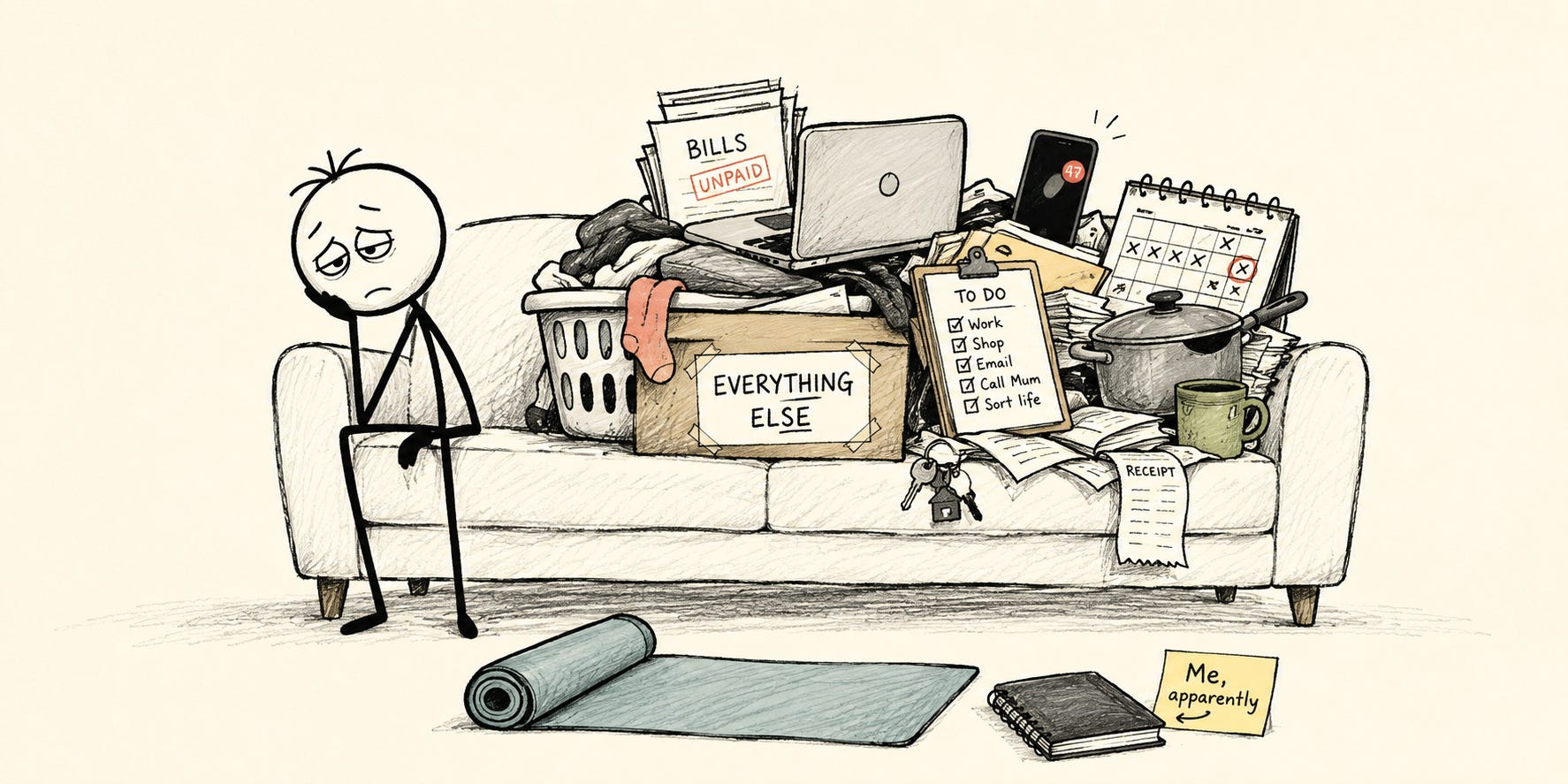
You finally sit down.
Actually sit down.
Not “sit down while answering something”.
Not “sit down while eating dinner with one hand and scrolling through tomorrow with the other”.
Properly sit down.
Work is finished. Shoes off. Laptop closed. Dinner has been dealt with to a standard unlikely to trigger intervention from the authorities. Nobody appears to be bleeding.
For five glorious seconds, your life asks absolutely nothing of you.
And there it is.
The moment you’ve been waiting for all bloody day.
Your time.
Finally.
You could exercise. Write. Read. Meditate. Sort your finances out. Message that friend you’ve been meaning to reply to since Easter. Work on the idea you keep saying matters to you.
Become the magnificent bastard you keep promising yourself you’re going to become.
Then you notice the washing.
A message arrives.
Something is needed tomorrow.
There’s a bill you’ve forgotten to check. Someone wants an answer. You remember the appointment you still haven’t booked.
The kitchen looks like a minor humanitarian incident.
And your brain—having apparently spent the entire day operating as receptionist, project manager, chauffeur, problem-solver, emotional support animal and finder of mysteriously missing household objects—quietly says:
Absolutely fucking not.
So you sit there.
Maybe you scroll. Maybe you put the television on and realise twenty minutes later you haven’t absorbed a single thing. Maybe you stare at the wall with the haunted serenity of a Victorian child encountering electricity for the first time.
And then comes the really shitty bit.
You don’t think:
Christ, I’m tired.
You think:
What is wrong with me?
Why can’t I get motivated?
Other people manage this.
Why am I so bloody lazy?
And that’s the accusation I’d like to investigate.
Because lazy is an interesting thing to call somebody who hasn’t stopped all day.
We are astonishingly quick to turn a moment into an identity.
You didn’t exercise.
Lazy.
You didn’t work on your goal.
Undisciplined.
You ignored a message because producing another socially acceptable sentence made you want to crawl beneath the floorboards.
Bad friend.
You ordered the easy dinner instead of preparing seventeen vegetables while listening to a podcast about becoming your optimal self.
Failing again.
Very efficient.
No trial. No witnesses. Straight to sentencing.
Except look at what happened before the crime.
You got up. Got ready. Worked. Commuted. Answered questions. Remembered things. Forgot things. Remembered the things you forgot. Made decisions. Fixed somebody else’s problem.
You bought things, booked things, paid things, cleaned things, fed people, checked things and worried about things.
You carried tomorrow around in your head while attempting to survive today.
Then, after the mandatory part of your life had eaten first, you reached the things you wanted to do.
And found there wasn’t much of you left.
That is not proof of laziness.
It is information.
There is a difference between:
“I cannot be bothered with anything.”
and:
“Everything else got to me first.”
One is a judgement about who you are.
The other is a question about how your life is built.
And if you keep answering a capacity problem with a character judgement, you end up trying to repair the wrong bloody thing.
Here’s one of adulthood’s nastier little tricks:
The things most important to you are often the easiest things to postpone.
Your health matters. But the washing is here now.
Your friends matter. But tomorrow’s school email contains seventeen bullet points, four attachments and the vague implication that your child needs to arrive dressed as an Aztec warrior by 8:40am.
Your relationship matters. But you’ve both spent the day being useful to everybody else and now you’re attempting romance with the energy of two sedated badgers.
Your creative work matters. Your career plans matter. The business idea matters. The walk matters. Reading matters.
Having absolutely nothing useful to do for half an hour also matters.
But none of those things necessarily screams.
Urgency screams.
Maintenance screams.
Other people scream.
Sometimes literally.
So the immediate stuff wins.
And eventually your whole life becomes dedicated to maintaining your life.
You work so you can pay for the house you’re too tired to enjoy. You clean the kitchen so everyone can wreck it again tomorrow. You answer messages so more messages can arrive.
You finish one week so the next one can climb through the window holding a clipboard.
Meanwhile, the things that make you feel like you get whatever capacity survives.
Usually the leftovers.
Three raisins. Half a biscuit. One emotionally damaged pea.
Then we wonder why our goals keep losing.
Wanting something and having the capacity to do it are not the same thing.
We often treat reluctance as proof that we never wanted the thing badly enough.
If I really wanted to get fit, I’d exercise.
If writing really mattered to me, I’d write.
If I cared about my friends, I’d go out.
If I genuinely wanted to change my life, I’d stop sitting here like a punched lasagne.
Except mental effort isn’t imaginary.
In one controlled study, people who completed a demanding cognitive task before an endurance test stopped sooner than in the control condition. Their physiological responses were largely similar, but the exercise felt harder sooner.
That does not mean science has certified your legal right to leave the dishwasher until Thursday.
Calm down.
It means something much more ordinary:
What came before can change how expensive the next thing feels.
That’s why you can genuinely want to exercise while locating your trainers suddenly feels like organising the Commonwealth Games.
You can love writing and stare at the blank page as if Microsoft Word has requested one of your kidneys.
You can miss your friends terribly and still receive:
“Fancy a drink tonight?”
like they’ve threatened you.
You want the thing.
But right now the entry fee feels enormous.
And when everything mandatory has already charged your account, even enjoyable things can arrive looking suspiciously like more work.
This is where things become gloriously stupid.
You’re overwhelmed.
You have no spare capacity.
So obviously you need:
Exercise. Reading. Meal prep. Meditation. Journalling. A side hustle. A digital detox. A sleep routine. Better hydration. Financial planning. A morning routine. Ten thousand steps. Breathing exercises. Weekly goal reviews. A gratitude practice. More meaningful relationships. Cold water somewhere unpleasant.
And fifteen minutes each morning staring directly at the sun while an American man explains dopamine.
None of those things has to be bad.
That’s what makes the trap so convincing.
Exercise may help you. Meditation may help you. Planning may help you. Sleep certainly matters.
Water remains disappointingly essential despite being extremely boring.
But every useful habit needs somewhere to live.
Time. Attention. Initiation. Energy. Remembering. Repeated effort.
Put enough excellent things into an already overcrowded life and you have simply built a more aspirational form of overcrowding.
Now you’re not only exhausted.
You’re exhausted and failing your gratitude journal.
Brilliant.
Your plan for feeling better has opened its own complaints department.
There comes a point where improvement cannot mean:
What else should I add?
It has to become:
What is already taking everything?
You can have an hour in which nobody has technically scheduled you for anything and still have absolutely no space.
Your body is on the sofa.
Your brain is still at work. And in the kitchen. And tomorrow morning. And inside the message you haven’t answered. And remembering milk. And replaying something somebody said at 2:14pm because apparently we’re reopening the investigation.
Researchers studying how people recover from work distinguish experiences such as psychological detachment, relaxation, mastery and having some control over leisure time.
The useful bit for us is simple:
Not working is not automatically the same thing as mentally getting away from work.
And, of course, when paid work ends, unpaid work does not politely put its coat on and leave.
Care. Admin. Money. Cooking. Cleaning. Planning. Transport. Decisions. Messages. Appointments. Family logistics.
The invisible work of remembering that things need remembering.
Researchers also use the term time poverty for situations where paid and unpaid work consume so much time that little discretionary time remains. Studies have linked heavy time demands and frequent rushing with barriers to physical activity and poorer self-rated or mental health.
That does not mean ordinary busyness automatically becomes an illness.
It means time deserves to be treated like the resource it is.
Time is a resource.
Attention is a resource.
Effort is a resource.
If virtually all of yours is already spoken for, your new goal doesn’t arrive in a vacuum.
It has to fight the washing for a chair.
This is the bit I think we miss.
We imagine there is your normal life...
...and then, somewhere after that, there is the life you’re going to build.
Normal life contains work, bills, housework, responsibilities, childcare, appointments, commuting and finding out why the boiler is making that noise.
Then the better life begins at approximately 8:37pm.
That’s when you’re going to get fit, write the book, repair your relationship, sort your money out, find meaningful work, build confidence, start the business, see your mates, discover your purpose and apparently sleep for eight hours.
Good luck with that.
Your better life isn’t separate from your existing life.
It needs resources from the same account.
The same evenings.
The same brain.
The same body.
The same Wednesday.
And if all of those resources are already allocated, repeatedly telling yourself to want it more isn’t ambition.
It’s bad maths.
This is why you cannot optimise your way out of a life with no spare capacity.
At some point there needs to be margin.
Something not already claimed.
Not because you deserve to spend six hours each afternoon reclining on a chaise longue while someone feeds you grapes.
Although, to be clear, I’d give it a go.
You need space because anything new requires somewhere to exist.
Even change.
Especially change.
There is an obvious danger here.
You read this and think:
Excellent. My responsibilities are the problem. Everybody can piss off.
No.
Some obligations are real. Some are immovable.
Children tend to resist being streamlined.
Mortgages display almost no interest in your personal growth.
Care responsibilities cannot always be delegated because a blog article told you to protect your energy.
There are periods of life where capacity is genuinely limited.
Sometimes there is no elegant solution.
Sometimes the situation is hard because it is hard.
But even then, there is a question worth asking:
Have I accidentally decided that every existing demand must remain exactly as it is?
Not whether every demand can disappear.
Whether none can change.
Because we collect expectations.
The house must be this clean.
Dinner must look like this.
I must answer immediately.
I must attend.
I must do it myself.
I must say yes.
I must never inconvenience anyone.
I must perform every responsibility at a standard suitable for televised inspection.
Some of that is responsibility.
Some of it is fear.
Some of it is habit.
Some of it is guilt.
And some of it is pure bullshit nobody remembers agreeing to.
Here is the entire practical exercise.
It will not require a workbook.
There are no coloured pens.
You do not need to draw a wheel of life or spend Sunday afternoon completing seventeen reflective prompts until recovery itself becomes exhausting.
Find one demand.
One recurring piece of your week that consumes time, attention or energy.
Then ask whether it can be:
removed, reduced, delayed or done less perfectly.
That’s it.
Buy the easy dinner.
Leave something unfolded.
Decline the optional thing.
Reply tomorrow.
Clean one room.
Exercise for twenty minutes without deciding this commits you to becoming an Olympian.
Ask another adult to own something rather than “helping” while you remain Managing Director of Knowing When Everything Needs Doing.
Pay for convenience where you comfortably can.
Let B-minus work leave the building.
And then comes the bit we’re astonishingly bad at:
Do not immediately fill the space.
You cancel something and your brain goes:
Lovely. We could use that hour to clean the garage.
No.
Sit down.
Go for a walk.
Write.
Talk to somebody you actually like.
Read three pages.
Lie horizontally and stare into the middle distance.
Or do nothing.
Nothing is allowed.
You’re not testing whether you can squeeze more productivity from the recovered space.
You’re testing something much more useful:
When my life demands slightly less, what happens to me?
Do you become more patient?
Does the exercise you’ve been forcing suddenly seem possible?
Do you talk more? Think more? Create? Sleep?
Do absolutely bugger all for an evening and wake up feeling human?
That is data.
And it tells you far more than calling yourself lazy ever did.
We respect addition.
Addition looks ambitious.
New goal. New routine. New habit. New system. New challenge. New planner containing enough stationery to invade Belgium.
Subtraction feels suspicious.
Surely successful people do more?
Sometimes.
But systems also need slack.
They do not run every component at maximum capacity every second and then act shocked when something goes tits-up.
Yet that is exactly what many of us expect from ourselves.
Every evening accounted for. Every gap useful. Every weekend productive.
Then life produces one unexpected bastard of a Tuesday and the entire operation collapses like IKEA furniture assembled during an argument.
Space is not waste.
Rest is not necessarily wasted capacity.
A deliberately easy dinner is not moral decline.
Doing something at 80% does not summon the Four Horsemen.
And one thing disappearing from your week might create more useful change than adding another heroic habit to a system already coughing blood.
The goal isn’t to build a life where nothing is required of you.
The goal is to stop every available scrap of you being permanently pre-sold.
Tonight you might arrive back at that same sofa.
The washing may still exist.
Almost certainly will, the needy little bastard.
The kitchen may remain an active conflict zone.
Tomorrow may already be demanding documentation.
And you may still feel absolutely no desire to work on yourself.
Before the insults begin, ask something different.
Not:
What’s wrong with me?
Ask:
What has already had me today?
What got the best concentration?
What got the patience?
What got the decisions?
What followed you home?
What are you still carrying even though nobody can see it?
And then:
Does all of it need the same amount of me tomorrow?
You may discover the answer is yes.
Life occasionally does that.
But sometimes you’ll find one loose brick.
One expectation. One standard. One task. One commitment.
Take that seriously.
Because you may still need discipline.
There will absolutely be days when the correct advice is:
Get off your arse and do the thing.
But discipline works inside reality.
It does not create extra hours.
It does not make attention infinite.
Before you fix yourself, inspect what is using you up.
Because the problem might not be that you’ve failed to build a better life.
You may be trying to build it with whatever is left after everybody and everything else has finished with you.
Don’t add twelve new habits.
Find one demand.
Make it lighter.
See what returns.
Your patience.
Your curiosity.
Your energy.
Your sense of humour.
Your desire to move.
Your ability to sit still without treating it as evidence in a criminal case against your character.
You don’t always need to become more capable.
Sometimes your life needs to demand slightly less.
And sometimes the space you create doesn’t need to become anything at all.
It can simply be yours.
I’d love to know this one.
What is one thing you could remove, reduce, delay or deliberately do less perfectly this week?
Put it in the comments.
Not because we’re going to solve each other’s lives with inspirational bollocks.
Because I suspect a lot of people who privately think they’re failing are going to recognise themselves in somebody else’s answer.
And if you want more, subscribe.
This is the sort of self-help I’m interested in:
Less guru theatre.
Less pretending you have unlimited energy.
More looking at the actual life you’re living before deciding you are the thing that needs fixing.
One final thing.
If stress is persistently affecting your life or you’re struggling to cope, don’t reduce everything to a motivation problem or an article you’ve read online. NHS support is available, including routes into talking therapies.
Sometimes you need less on your plate.
Sometimes you need proper support.
Both are allowed.
Comments
Nothing yet. Say the first thing.
Sign in to join the conversation.