
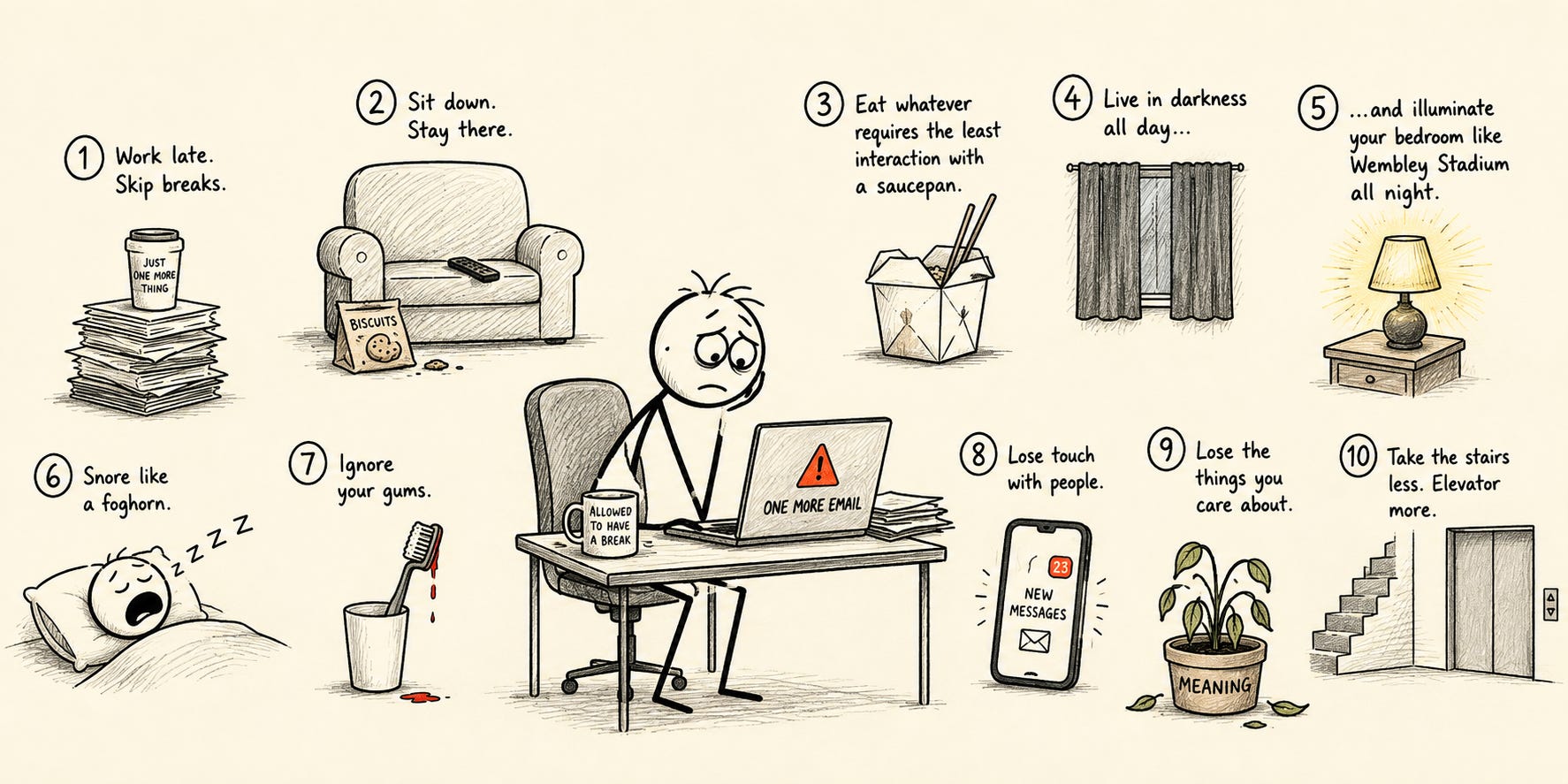
Most health advice tells you how to live longer.
Tedious.
So we’re going to do this backwards.
Here’s how to make the odds worse.
Your only responsibility is to treat this as the world’s least desirable to-do list.
Because if I called this:
10 Evidence-Based Lifestyle Factors Associated With Increased Mortality
you’d already be gone.
I’d be gone.
My soul would have left my body somewhere around associated and I’d currently be haunting the kettle.
So instead, we’re going to look at ten surprisingly ordinary ways to make your long-term health prospects slightly more shit.
Not smoking forty cigarettes while drinking paint thinner.
Not licking asbestos.
Not driving down the M6 with your knees while attempting to remove a contact lens.
Ordinary stuff.
Work.
Sitting.
Losing touch with people.
Going to bed whenever Netflix releases you.
Living in darkness all day and illuminating your bedroom like Wembley Stadium all night.
Snoring.
Ignoring your gums.
Losing the things you care about.
Eating whatever requires the least interaction with a saucepan.
That’s what makes this interesting.
The dangerous behaviour doesn’t always look dangerous while you’re doing it.
Sometimes it looks responsible.
Convenient.
Normal.
Productive.
Even virtuous.
Which is considerably more sinister.
So, if you’d like to shuffle off this mortal coil while feeling reasonably pleased with your administrative efficiency, follow me.
This one annoys me because I keep doing it.
And the strange thing is, nobody actually tells me I can’t take a break.
Nobody stands behind me at lunchtime with a Victorian cane.
Nobody says:
“Don’t you dare step away from that spreadsheet, minion.”
Technically, I’m allowed to stop.
Technically, I have a lunch break.
Technically, I finish work at a particular time.
The problem is that everything feels like it needed to be done yesterday.
There’s always something urgent.
Something overdue.
Something somebody is waiting for.
Something I’m being asked for an update on.
Something else that has suddenly become a priority despite the previous six priorities apparently retaining full diplomatic status.
And when the pile gets big enough, the message doesn’t need to be spoken.
Nobody has to say:
“Don’t take your break.”
The workload says it for them.
Because if I stop for half an hour, that’s half an hour I’m not catching up.
If I finish on time, the unfinished work is still sitting there.
If deadlines slip, nobody is going to say:
“Fair enough. Alex maintained a healthy work-life boundary.”
My anxious little brain skips directly to:
“They’re going to think I can’t cope.”
Then:
“They’re going to think I’m not doing enough.”
And eventually:
“If I keep falling behind, I’m going to lose my fucking job.”
Whether that fear is proportionate in any particular moment almost becomes irrelevant.
Because it changes the behaviour anyway.
So I work through lunch.
I stay on.
I try to claw back enough time to feel safe again.
And every so often I catch myself doing it and internally shout:
FFS! I’M ALLOWED TO HAVE A BREAK!
Which is an extraordinary thing to have to remind yourself when your employment contract already contains the break.
That’s the clever part of this particular health risk.
It doesn’t feel reckless.
It feels like job preservation.
Responsible.
Conscientious.
Necessary.
Nobody needs to chain you to the desk if they’ve created a system where walking away from it feels professionally dangerous.
And that makes the research underneath it considerably more uncomfortable.
The World Health Organization and International Labour Organization estimated that working 55 hours or more per week was attributable to 745,000 deaths from stroke and ischaemic heart disease in 2016. Compared with working 35–40 hours, 55+ hour weeks were associated with an estimated 35% higher risk of stroke and 17% higher risk of dying from ischaemic heart disease.
Obviously, that does not mean staying late on Wednesday causes a cardiac event on Thursday.
This is population-level risk associated with sustained long working hours.
But that’s exactly why I find it unsettling.
The dangerous behaviour doesn’t have to feel dangerous.
Sometimes it feels like:
“I’d better get this finished or somebody might decide I’m not good enough at my job.”
I’d love to finish this section with:
Take your fucking lunch break.
And yes, I need to hear that.
But that would also let the system off suspiciously easily.
Because sometimes the individual behaviour needs changing.
And sometimes the workload does.
If you’re skipping breaks because you personally keep deciding one more email matters more, catch yourself doing it.
But if everything is permanently urgent, the work cannot realistically fit into the hours available, and stopping makes you genuinely frightened about being judged for falling behind, that isn’t merely a “remember to practise self-care” problem.
Something upstream is broken too.
I still need to take the break.
But management doesn’t get to create fourteen simultaneous emergencies and then sell me mindfulness because I look a bit tense.
Modern death has terrific upholstery.
We sit to work.
Sit to travel.
Sit to eat.
Sit to relax after the exhausting day we spent sitting.
Then, because all that sitting has really taken it out of us, we lie down.
At no point does the sofa announce:
WARNING: I AM PART OF A COMPLEX LONG-TERM MORTALITY RISK PROFILE.
It’s a sofa.
It has cushions.
Possibly a biscuit nearby.
Hardly Jaws.
But large studies using movement sensors rather than people’s famously reliable estimates of how active they are have repeatedly found that high sedentary time is associated with higher mortality, particularly among people doing little moderate-to-vigorous activity. A harmonised analysis involving more than 44,000 adults found that around 30–40 minutes of moderate-to-vigorous activity per day attenuated the association between high sedentary time and mortality.
This is where health advice often becomes unnecessarily annoying.
Because you hear that and imagine:
Wonderful. Apparently I need Lycra, a Garmin and a personal relationship with a rowing machine.
You don’t need to become Exercise Man.
The useful lesson is less dramatic:
Sitting is far less impressive at killing you when movement keeps interrupting the plan.
Walk.
Take the stairs when practical.
Go outside at lunch.
Walk during a phone call.
Carry things.
Actually use your body to get somewhere occasionally instead of outsourcing every journey to a chair with wheels.
The NHS recommendation for adults remains activity across the week—generally at least 150 minutes of moderate activity or 75 minutes vigorous, alongside strength work—but the deeper point is simply that movement does not need to arrive wearing gym branding to count.
Which brings us neatly to one of the weirdest findings in this entire article.
But first, we need to fire your friends.
Don’t have an argument.
That’s too much admin.
Just let it happen naturally.
Stop messaging.
Turn down the drink because you’re tired.
Don’t arrange another one.
Realise six months later that the person you used to speak to every week has somehow become somebody whose birthday Facebook occasionally reminds you about.
Do this enough times and you can construct a wonderfully efficient life containing work, television, household maintenance and absolutely nobody who knows you’re having a shit week.
Again: doesn’t look dangerous.
It looks like adulthood.
We’re all busy.
We’ll catch up soon.
Soon becomes Christmas.
The WHO’s Commission on Social Connection reported in 2025 that around one in six people worldwide experiences loneliness. Its global estimates linked loneliness with more than 871,000 deaths annually — roughly 100 every hour. Loneliness and social isolation are not identical: loneliness is the painful gap between the connection you want and the connection you have; isolation is an objective lack of sufficient social connection. Both matter.
A hundred deaths an hour.
From something that can look, on Tuesday evening, like:
“Nah, can’t be arsed going out.”
That’s the pattern running through this entire article.
The dangerous behaviour doesn’t necessarily arrive dramatically.
Sometimes it quietly arrives through the back window and removes things.
Don’t “build a thriving social network”.
That sounds like homework.
Think of one person you’ve accidentally allowed life to push to the edge.
Send:
Fancy a coffee?
Four words.
No relationship optimisation dashboard required.
Monday: bed at 10:45.
Tuesday: 12:30.
Wednesday: fell asleep on sofa at 9:20, woke at 11:07 feeling like you’d crossed time zones, then watched YouTube until 1:43.
Thursday: excellent intentions.
Friday: all laws suspended.
Saturday: who even are you?
Sunday: panic.
Most sleep advice obsesses over how many hours.
Seven.
Eight.
Nine.
Cue people lying awake at 2am calculating how badly they’re failing at sleeping, which is a wonderfully efficient system.
But one of the more interesting recent findings is that regularity matters too.
In a UK Biobank study of more than 60,000 people using wearable data, greater sleep regularity was associated with lower all-cause mortality risk, and sleep regularity was a stronger predictor of mortality in the analysis than sleep duration.
That’s fascinating because an erratic bedtime doesn’t feel remotely health-related.
It feels like:
“One more episode.”
Or:
“I’ll catch up at the weekend.”
Or:
“For fuck’s sake, why am I watching a man restore a 1978 lawnmower at 12:36am?”
Your biological clock apparently lacks appreciation for the lawnmower.
Give your sleep a reasonably predictable rhythm.
Not military perfection.
Not “I went to bed fourteen minutes late and therefore longevity is cancelled”.
A rhythm.
Your body likes knowing roughly when night happens.
Very inconsiderate of it.
This one is magnificent.
We evolved with an extremely complicated lighting system called the Sun.
It comes on in the morning.
Goes off at night.
Very intuitive interface.
We replaced it with:
8:30am — dim house.
9:00am — office.
12:30pm — perhaps glimpse outdoors through glass while holding a sandwich.
5:00pm — dark.
10:30pm — every lamp in the building on.
11:47pm — phone six inches from face.
12:15am — check one more completely unnecessary thing beneath lighting bright enough to conduct minor surgery.
Researchers put wrist light sensors on 88,905 UK Biobank participants and followed mortality for around eight years. The pattern was striking: brighter daytime light was associated with lower mortality, while brighter night-time light was associated with higher mortality. People in the brightest night-light group had all-cause mortality hazard ratios roughly 21–34% higher than the darker reference group, depending on the measure.
Again: association.
Your bedside lamp is not stalking you with a tiny knife.
But I love this finding because it takes something utterly mundane—when your eyeballs see light—and makes it surprisingly consequential.
We spend enormous money on supplements while sometimes giving our brain:
Night during the day.
Day during the night.
Then wondering why the machinery looks confused.
Get daylight when daylight exists.
Especially earlier in your waking day where practical.
At night, let night look a bit more like night.
Dim things.
Put the glowing rectangle down occasionally.
Your ancestors managed this without buying a £179 circadian wellness lamp.
You have access to an enormous free one approximately 93 million miles away.
Here comes my favourite bit of research.
Because it is almost offensively achievable.
Researchers examined more than 25,000 people who reported doing no structured exercise.
So not gym people.
Not marathon people.
Not people on Instagram photographing porridge while using the word grind.
They looked instead at tiny bursts of vigorous activity embedded in normal life—what researchers call vigorous intermittent lifestyle physical activity, or VILPA.
Which is science language for:
occasionally moving like you’re late.
Among these non-exercisers, roughly three bouts a day lasting one or two minutes each were associated with around 38–40% lower all-cause and cancer mortality risk and 48–49% lower cardiovascular mortality risk compared with doing none. The researchers were careful: this was observational, so it cannot prove those tiny bursts caused the reduction. But the size of the association is difficult not to notice.
Three tiny bursts.
That is hilarious.
We have built an entire fitness industry involving monthly fees, protein flavours that sound like discontinued Quality Street and men filming themselves shouting at tyres.
Meanwhile, your body may be surprisingly impressed if you occasionally move with genuine urgency.
Take the stairs quickly.
Walk up the hill like it insulted your family.
Carry the shopping.
Move fast enough occasionally that your cardiovascular system thinks:
Oh! Apparently we’re still needed.
This does not replace general physical-activity recommendations.
It does destroy the excuse that health only counts when you have forty-five spare minutes and matching shorts.
We have somehow made snoring charming.
At least retrospectively.
“Your grandad used to shake the windows.”
Everyone laughs.
Grandad apparently slept like a malfunctioning chainsaw trapped inside a wardrobe.
Lovely memories.
Snoring itself does not automatically mean obstructive sleep apnoea.
But loud snoring combined with breathing repeatedly stopping and starting, gasping, snorting, choking, frequent waking or significant daytime tiredness are recognised NHS symptoms of sleep apnoea.
This matters because severe untreated sleep-disordered breathing is not merely “bad sleep”.
In the long-running Wisconsin Sleep Cohort, severe sleep-disordered breathing was associated with roughly three times the adjusted risk of all-cause mortality compared with none. When researchers excluded people who had used CPAP treatment, the association was even larger, although the confidence intervals were wide.
This is one of those places where the joke stops for a second.
Because if somebody repeatedly stops breathing while asleep, “LOL, he snores like a tractor” is not a complete medical strategy.
If you have the warning signs, get assessed.
That is the whole action.
Not track.
Optimise.
Score.
Biohack.
Check the breathing thing.
Then we can return to being idiots.
Here is something nobody puts on the inspirational health poster.
Heart.
Lungs.
Brain.
Muscles.
Gums.
Sorry, what?
Gums.
Those pink things you mainly notice when they bleed all over the toothpaste foam and you think:
“Hmm. That’s probably fine.”
A 2023 meta-analysis combined 39 cohort studies involving more than 4.3 million people. Periodontal disease was associated with a 31% higher risk of all-cause mortality, as well as higher risks of several cardiovascular outcomes. Because these were observational studies, that does not establish that gum disease itself causes those deaths; health behaviours, inflammation and other factors can overlap.
Still.
Four-point-three million people is a fairly aggressive way for dentistry to tap you on the shoulder.
Your mouth is not a detached garage attached to your face.
It belongs to the same organism as everything else.
If your gums regularly bleed, are swollen or painful, or you have persistent bad breath, the NHS recommends seeing a dentist.
This may be the least sexy longevity intervention ever devised.
Brush properly.
Clean between the teeth.
Get gum disease treated.
No powder.
No podcast.
No billionaire required.
Purpose is a horrible word.
It immediately makes everything sound enormous.
FIND YOUR PURPOSE.
Fantastic.
I’ll put it between clean shower screen and buy bin bags.
But purpose does not have to mean founding a charity, climbing Everest or discovering your sacred destiny beneath a waterfall in Bali.
It can mean having something that makes tomorrow matter.
People.
Work you care about.
An animal.
A project.
A garden.
A stupid little business idea.
A grandchild.
A book you’re writing.
A place you’re trying to reach.
Something unfinished that you actually want unfinished because it gives you a reason to come back tomorrow.
That’s why this research surprised me.
A study of 6,985 US adults over 50 found a strong association between purpose in life and mortality. Those in the lowest purpose category had substantially higher mortality during follow-up than those in the highest. The researchers did not prove that somebody can simply “install purpose” and extend life; purpose may travel with social, behavioural, economic and health differences.
But the idea deserves more attention than:
“Purpose is nice for wellbeing.”
Nice?
Apparently your reasons for getting out of bed may be mixed into the same messy health picture as what you eat and how much you move.
So a truly efficient death programme should probably involve removing all enthusiasm from your existence.
Stop hobbies.
Stop making plans.
Stop seeing anyone.
Do work you hate.
Come home.
Scroll.
Sleep.
Repeat until Thursday has become indistinguishable from 2019.
You don’t need to find your purpose.
Find one thing you give a shit about.
Then give it somewhere to live.
That’s smaller.
And considerably less likely to require a vision board.
This section could very easily become unbearable.
You know the genre.
PROCESSED FOOD IS POISON.
Then somebody points out that yoghurt is processed.
Everybody argues.
A man called Darren appears in the comments demanding to know whether frozen peas are killing his testosterone.
Nobody learns anything.
The actual evidence is more interesting.
A 2024 BMJ study followed 74,563 women and 39,501 men for more than three decades. People in the highest quarter of ultra-processed food consumption had a modestly higher all-cause mortality rate than those in the lowest quarter.
But here’s the bit that usually gets murdered by headlines:
Not all ultra-processed foods showed the same association.
Ready-to-eat processed meat, poultry and seafood products showed particularly strong associations, while overall dietary quality still mattered enormously.
The NHS makes the same useful distinction: some foods classed as ultra-processed—such as wholemeal sliced bread, higher-fibre cereals and baked beans—can still fit inside a healthy diet. Its advice is more practical: eat less of the ultra-processed foods high in saturated fat, salt or sugar.
Thank God.
Because “eat food rather than industrial chemistry” is memorable but not especially useful when you’re knackered at 7pm and dinner needs to happen now.
And that’s how this behaviour becomes ordinary.
You’re tired.
The convenient thing wins.
Then it wins tomorrow.
Then Thursday.
Nobody dramatically decides:
From this day forward, Pickled Onion Monster Munch shall become a cornerstone of my nutritional philosophy.
Life simply makes convenience disproportionately attractive.
So don’t create a diet that requires you to cosplay as a Tuscan grandmother every evening.
Make the slightly better option easy enough to actually happen.
That’s the Minimum Effective Health Intervention:
Not perfect.
Less shit, more often.
Here’s the real problem.
Almost none of these things happens alone.
You work late.
So you miss the daylight.
You’re too tired to exercise.
You order something easy.
You stay up because late evening is the first part of the day that feels like yours.
Your sleep becomes erratic.
Morning arrives and you feel like roadkill with a Teams account.
You drive instead of walking.
You’re too knackered to see friends.
You sit all day trying to recover while continuing to work.
Then someone tells you to manage your stress by adding meditation, meal preparation, journalling and resistance training.
Excellent.
Another four jobs.
This is where “healthy living” gets misunderstood.
None of these studies gives us a Death Tesco Clubcard.
You don’t collect five risk factors and receive a free stroke with your next shop.
The associations come from different populations, methods and time periods. They are not points you can simply add together.
But ordinary behaviours do cluster.
And that’s the part worth noticing.
A dangerous life does not have to look like chaos.
It can look extremely respectable.
Laptop.
Sofa.
Takeaway.
Phone.
Bed.
Repeat.
Everything individually reasonable.
Everything normal.
Everything easy to explain.
Which is why the question isn’t:
“Which one of these is secretly killing me?”
That would be tabloid bollocks.
The better question is:
“Which ordinary pattern have I stopped noticing because it looks too normal to question?”
That is where this article earns its keep.
So, if you genuinely wanted to make the odds worse:
Work absurd hours.
Sit whenever possible.
Let friendships quietly evaporate.
Make sleep timing completely random.
Avoid daylight and illuminate the night.
Never make your heart work unexpectedly hard.
Treat serious snoring as comedy.
Ignore bleeding gums.
Remove whatever gives your life meaning.
Let convenience make every food decision.
Simple.
The disturbing part is that you could do almost all of it while looking like a perfectly functional adult.
That’s what stuck with me while researching this.
The dangerous behaviour doesn’t look dangerous while you’re doing it.
It looks like sending one more email.
Staying on the sofa.
Cancelling tonight.
Watching another episode.
Leaving the curtains closed.
Avoiding the stairs.
Laughing about your snoring.
Ignoring a little blood on the toothbrush.
Letting the thing you cared about slide because you’re busy.
Ordering whatever is easiest because you cannot face another decision.
No violins.
No skull and crossbones.
No moment where your life flashes:
Which is why I don’t think the answer is to leave this article with another enormous health programme.
Fuck that.
Pick the one step that made you think:
“Oh shit. I do that.”
Then make that one slightly harder to keep doing.
Take the lunch break.
Walk.
Message somebody.
Give bedtime a rhythm.
Go outside.
Run up the stairs.
Get the snoring checked.
Book the dentist.
Make time for something you care about.
Improve the easiest meal you eat most often.
One.
Not ten.
Because if you’re already tired, the world’s least desirable to-do list should not become the world’s eleventh self-improvement project.
I’m interested in this because several of these genuinely surprised me.
Which step made you think: “Oh shit, I do that”?
Tell me in the comments.
And if you like my particular approach to self-improvement—research, practical action and the occasional suggestion that your gums are plotting against you—subscribe.
I’m Not Lazy. My Life Has No Space Left.
Because sometimes the healthiest thing you can do isn’t adding another perfect habit.
It’s noticing what your ordinary life is already asking you to carry.
Comments
Nothing yet. Say the first thing.
Sign in to join the conversation.