
There are moments in life when you look at yourself and think:
“Ah. So this is who I’ve become.”
For some people, that moment is buying a sports car during a divorce.
For others, it’s joining a CrossFit gym and saying things like “hybrid athlete” without immediately apologising.
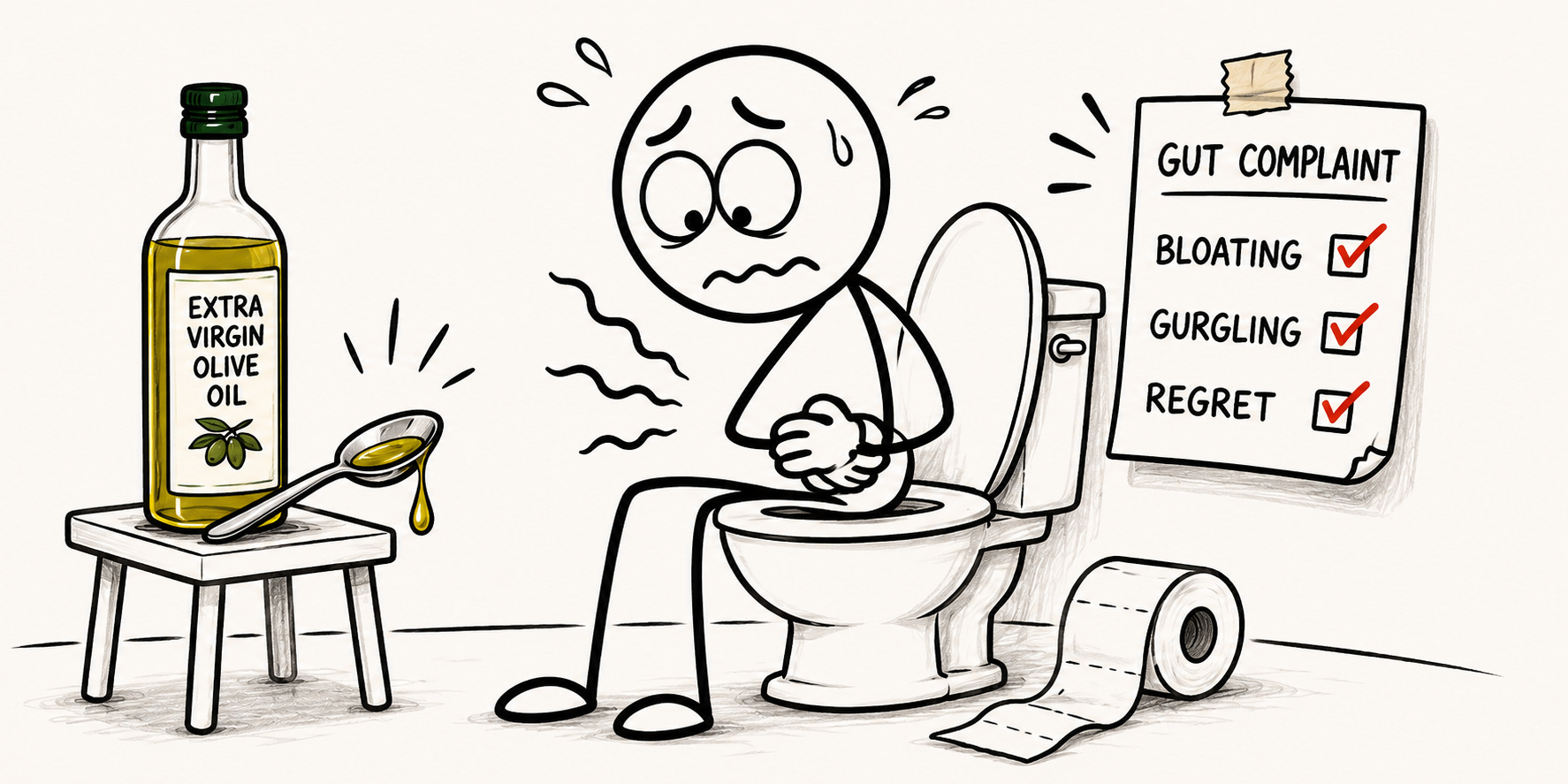
For me, it was standing in my kitchen, holding a tablespoon of extra virgin olive oil, trying to convince myself to swallow it like a tiny Mediterranean man with issues.
Not drizzled on salad.
Not lovingly pooled on warm sourdough.
Not mingling with balsamic vinegar in a civilised little ramekin like a middle-class pond.
No.
Straight.
From the spoon.
Like medicine.
Like punishment.
Like I’d lost a bet with someone called Giuseppe.
And the worst part?
I hate olives.
Not “oh, they’re not my favourite.”
I mean I hate olives with the calm, ancestral certainty of a man whose bloodline was once wronged by a Greek salad.
So the idea of drinking concentrated olive juice three times a day was, spiritually speaking, quite close to licking a garden slug for wellness.
I was not ready to deflower that extra virgin.
And yet…
I did it.
For 10 days.
Three tablespoons a day.
Morning. Afternoon. Evening.
Mostly between meals.
Mostly.
Because life, as ever, refused to behave like a clean little spreadsheet.
The experiment was simple:
Take one tablespoon of extra virgin olive oil in the morning.
One in the afternoon.
One in the evening.
Do that for 10 days.
Try not to vomit.
Record what happened.
I started with a fairly normal UK supermarket bottle: Waitrose Duchy Organic Italian Extra Virgin Olive Oil. It’s organic, extra virgin, Italian, and described by Waitrose as fruity and peppery, like all true Italians. What it does not do is publish a lab-tested polyphenol number on the bottle, so I’m not going to pretend it’s some certified golden medical potion because I am annoying, not dishonest. Waitrose describes it as “fruity and peppery,” but that’s flavour language, not a lab report.
And this matters because the whole olive oil health conversation often gets hijacked by marketing.
Suddenly everyone’s shouting:
“High polyphenol!”
“Early harvest!”
“Cold pressed!”
“Single estate!”
“Blessed by a Greek grandfather called Stavros!”
And before you know it, you’re considering spending £39.99 on a bottle of oil because the label makes it sound like it might reverse time and make your knees 24 again.
So let’s be clear.
All extra virgin olive oil contains some polyphenols.
That’s not the special bit.
The special bit is how much.
That depends on the olive variety, harvest timing, freshness, storage, processing, bottle colour, light exposure, and how long it’s been sitting on a shelf slowly turning into expensive sadness. EVOO quality and phenolic compounds are affected by storage conditions, and better oils tend to protect themselves with dark glass, fresher harvests, and careful handling.
So no, you don’t necessarily need to mortgage your cat to buy some influencer-approved oil from a website that looks like it was built by a monk with a Shopify account.
But also, no, the £4.50 bottle in clear plastic that tastes like nothing and has been sunbathing under fluorescent supermarket lights since the Brexit probably isn’t going to be your metabolic saviour.
Annoying, isn’t it?
Life keeps refusing to be simple.
Rude.
One rough way to tell if your olive oil might be richer in certain polyphenols is the famous throat burn.
That peppery little sting at the back of your throat.
The one that makes you cough once and briefly wonder whether your oesophagus has started legal proceedings.
That sensation is associated with oleocanthal, a compound in extra virgin olive oil that researchers have compared with ibuprofen-like anti-inflammatory activity. Newly pressed EVOO containing oleocanthal causes a throat-stinging pungency, and research published in Nature reported that oleocanthal inhibits COX enzymes in a way that resembles ibuprofen’s mechanism.
Now, before anyone starts replacing their medicine cabinet with a bottle of Bertolli and a hopeful expression:
Don’t.
This is not medical advice.
This is not “throw away your ibuprofen and drink salad dressing.”
This is “huh, that’s interesting, maybe food is doing more than just keeping us from chewing the furniture.”
The throat burn is not a perfect test.
It is not a certificate.
It is not a tiny scientist living in your tonsils.
But if your olive oil tastes bitter, peppery, grassy, and a bit aggressive, that’s generally more promising than one that slides down like beige furniture polish.
The first spoon was the worst.
Psychologically, I mean.
Physically, it wasn’t horrific.
Emotionally, I was at war.
There is something deeply unnatural about standing in your kitchen at 9am with a spoonful of oil and thinking:
“Right then. Down the hatch.”
My body did not understand the assignment.
My brain immediately opened a complaints department.
“This is not breakfast.”
“This is not tea.”
“This is not even toast.”
“This is lubricant for bruschetta.”
Still, eventually, I did it.
And the texture was exactly what you’d expect.
Thick.
Slippery.
Wrong.
It went down my throat like someone else’s saliva.
And not in a good way.
Not that there’s a good way.
Actually, let’s move on.
The first day, I managed the full three tablespoons: morning, afternoon, evening. Roughly 9am, 3pm, 9pm, like a responsible biohacking adult with a calendar and no emotional problems.
By the evening, my stomach felt… aware.
Not painful.
Not dramatic.
Just aware.
Like an old Victorian plumbing system hearing thunder in the distance.
By day two, life had already started smearing jam on the plan.
Instead of neat little timings, it became:
11am.
4:30pm.
11pm.
Which is less “controlled experiment” and more “man remembering olive oil exists at increasingly stupid intervals.”
I tried to keep it between meals, but sometimes I failed.
Because unless you live in a wellness retreat staffed by monks and macro-tracking angels, perfect timing is a fantasy.
Real life has emails.
Errands.
Children.
Work.
Mysterious admin.
And that one cupboard you open for no reason every time your brain wants a snack.
I still got the three tablespoons in.
But by the end of day two, my gut had begun making noises.
Not normal noises.
Not “I’m digesting lunch” noises.
More like a haunted radiator trying to communicate with the dead.
I felt bloated.
Heavy.
A bit backed up.
A bit not backed up.
Somehow both.
Which feels medically unfair.
Pick a lane, intestines.
Day three was when things got interesting.
And by interesting, I mean my digestive system briefly behaved like it had been possessed by the ghost of Thomas Crapper.
Sorry.
Thomas Shitter.
Because we respect historical accuracy here.
I woke up feeling… not terrible exactly.
But my gut was moving.
Bubbling.
Gurgling.
Holding meetings.
Passing motions, emotionally and otherwise.
It was as if my body had finally clocked what I was doing and gone:
“Hang on. Is this idiot drinking fat?”
And then all departments panicked.
I was bloated.
Crampy.
Constipated and diarrhoea-ish at the same time, which should not be possible, but apparently my intestines had discovered quantum mechanics.
My intestines had abandoned biology and joined the avant-garde.
I was afraid to sit on the toilet in case my entire lower half simply resigned and slid out of me like a badly packed suitcase.
I spent a good portion of the day afraid to trust myself.
Afraid to sit down.
Afraid to stand up.
Afraid that if I sneezed, something ancient and structural might leave my body forever.
Afraid to fart, in case Mount Vesuvius erupted from my bottom.
Was I dying?
No.
Did I briefly consider that my bowels were preparing to deposit themselves into the toilet bowl like a collapsed camping chair?
Yes.
Was this dramatic?
Also yes.
But the pain was real.
And this, I think, is the bit people skip when they talk about food experiments.
They love the shiny results.
The “my cravings disappeared.”
The “my waist shrank.”
The “my energy improved.”
They do not linger lovingly on the bit where your digestive system becomes a bubbling swamp monster with WiFi.
But honestly, it makes sense.
I’d suddenly added three tablespoons of oil a day.
That’s a lot of fat if your body isn’t used to it arriving neat, on a spoon, without the softening presence of bread, salad, cheese, or dignity.
Fat digestion involves bile, enzymes, gut motility, and your microbiome quietly wondering why the catering department has gone feral.
So day three was not a miracle.
It was an adjustment.
An uprising.
A very wet committee meeting.
Here’s the irritating part.
After the digestive drama calmed down, I started noticing actual benefits.
Which was deeply inconvenient because I enjoy being cynical.
I went into this at about a 4 out of 10 on the belief scale.
Open-minded, yes.
Curious, yes.
Expecting life-changing results?
Not really.
I expected one of three outcomes:
Nothing happens.
I feel sick (check).
I become briefly obsessed then abandon it like every other self-improvement experiment that requires consistency and isn’t immediately entertaining.
But after a few days, I noticed my joints felt better.
Not “I have transcended into a panther.”
But better.
Less creaky.
Less stiff.
Less like my knees were being operated by a team of underpaid apprentices using Victorian pulley systems.
I also felt less tired.
Less foggy.
Less like someone had replaced my blood with warm gravy.
And then there was the weird skin thing.
I had this annoying rough, flaky patch on the back of my calf.
A tiny patch of reptile cosplay.
It had been there long enough to become part of the furniture.
And during the experiment, it disappeared.
Now, can I prove the olive oil did that?
No.
I am one man with a spoon, not a dermatology department.
But did it happen during the experiment?
Yes.
And did my skin generally feel a bit better?
Also yes.
A bit more supple.
A bit more “functioning mammal.”
Less “forgotten prune left on a dashboard.”
Here’s where we need to be grown-ups.
Briefly.
Sorry.
Olive oil has been studied as part of Mediterranean diet patterns, and some of the data is genuinely interesting. The PREDIMED trial looked at Mediterranean diets supplemented with extra virgin olive oil or nuts compared with a control diet, and analyses reported that a higher-fat Mediterranean diet did not lead to weight gain; waist circumference actually decreased slightly in the olive-oil group over time.
That does not mean “drink three spoons of oil and watch your belly fat melt like a dropped Magnum in July.”
It means the old “eating fat automatically makes you fat” story is too simplistic.
Which, frankly, is annoying because simple stories are easier to shout on the internet.
There’s also evidence that extra virgin olive oil may help with post-meal glucose responses in some contexts. One small study found EVOO improved post-prandial glucose and lipid profiles, and another trial in people with impaired fasting glucose also found improved post-meal glucose and lipid markers.
Again:
Not magic.
Not a cure.
Not a replacement for medication.
Not “one weird oily trick doctors hate.”
Just interesting.
A plausible reason why some people report fewer cravings, more stable energy, or less of that 3pm urge to climb into the biscuit tin and live there permanently.
For me, appetite did feel steadier.
I wasn’t suddenly floating around the house in linen trousers, immune to snacks. But I did notice less desperate grazing.
Less cupboard-opening behaviour.
Less “maybe there’s something emotionally meaningful behind the crackers.”
This is where the marketing gets both useful and shitty.
Because some of it is nonsense.
And some of it matters.
A proper extra virgin olive oil should be obtained directly from olives and by mechanical means. That’s the basic category. But within that category, there’s a huge range. Some oils are fresh, peppery, bitter, vibrant, stored well, and made from olives picked early. Others are technically extra virgin but taste like beige in liquid form.
So here’s my current buying logic:
Look for extra virgin.
Look for dark glass or tins.
Look for harvest dates where possible.
Look for early harvest if available.
Look for single origin or single varietal if you want to get fussy.
Taste for bitterness and pepperiness.
Avoid clear plastic bottles sitting under bright lights unless you enjoy paying for sadness.
And, if a brand publishes polyphenol numbers, lovely.
That’s better than vibes.
For example, Odysea Good For You Polyphenol Greek EVOO states a minimum of 250mg polyphenols per kilo of olive oil, and Odysea’s own product page says the same.
Tenute Cristiano Bio Organic Carolea EVOO on Ocado is described as early harvest, cold extracted, single estate, and high in polyphenols.
Bio Orto Organic Coratina EVOO is described as “loaded with polyphenols” and having bitter and spicy notes, which is exactly the sort of thing that sounds unpleasant until you become the kind of person who drinks olive oil and says “mouthfeel” without being escorted from the premises.
But for cheaper supermarket options, you can still look for the sensory clues.
Sainsbury’s Taste the Difference Greek Athinoelia EVOO is described as having pleasant bitterness and a warming peppery finish.
ASDA Exceptional Greek Koroneiki EVOO is made with Greek Koroneiki olives and described as ripe and fruity with spicy notes.
Belazu Early Harvest EVOO is made from early-harvest Arbequina olives and has a mild peppery finish.
Filippo Berio 100% Italian EVOO is described as having a spicy and slightly bitter finish.
These are NOT affiliate links. I’m not being paid, bribed, stroked, massaged, or shat on with Mediterranean marketing money by any olive oil brand.
They’re just examples I found while researching oils that either publish polyphenol information or have the kind of bitterness, pepperiness, harvest details, or olive variety clues I’d look for.
I haven’t personally tested all of them yet.
That’s the next experiment.
God help my digestive system.
Are all of these lab-confirmed high-polyphenol oils?
No.
And I’m not going to pretend they are.
But if you’re trying to test this without spending the monthly tax bill on a bottle of oily ambition, they’re sensible places to start.
No affiliate links.
No magic discount code.
No “use code IDIOT10 at checkout.”
Just options.
Because sometimes the difference between “I’ll try that” and “absolutely not” is whether the bottle costs £7 or £37 plus shipping and self-hatred.
I would not jump straight into three tablespoons a day if your normal fat intake is modest.
That was perhaps ambitious.
By ambitious, I mean stupid.
If I were starting again, I’d probably do this:
Week one: one tablespoon a day.
Week two: two tablespoons a day.
Week three: three tablespoons a day, if your digestive system hasn’t started writing complaint letters to your brain.
I’d also be stricter about timing.
Between meals worked best for me.
Taking it too close to food felt heavier. And my belly backfired.
Taking it late at night felt slightly deranged, although that may have been because standing in the kitchen at 11pm drinking olive oil gives strong “Victorian snake oil” vibes.
I’d keep water nearby.
I’d use a proper tablespoon.
I’d not free-pour it like a man who has fully lost contact with society.
And I’d keep expectations realistic.
This is not a fat-loss spell.
This is not metabolic witchcraft.
It’s a dietary experiment.
Some people may feel better.
Some people may feel nothing.
Some people may spend day three negotiating with the toilet bowl from the bathroom floor.
All outcomes are possible.
This is where I’m going next.
Because now I’m curious.
Annoyingly curious.
I started with a decent supermarket organic EVOO, but not one that publishes its polyphenol content.
So the next stage is obvious:
Try a few of the more expensive, properly marketed, higher-polyphenol extra virgin olive oils and see if they actually feel different.
Not because I trust marketing.
I trust marketing about as much as I trust a seagull holding my chips.
But because some of these oils do give more information.
Harvest timing.
Polyphenol content.
Olive variety.
Storage.
Origin.
And if we’re going to test this properly — or at least as properly as one person with a blog, a spoon, and a questionable relationship with self-experimentation can — then it makes sense to compare.
Cheap-ish supermarket EVOO versus verified high-polyphenol EVOO.
Taste.
Throat burn.
Digestion.
Joint stiffness.
Energy.
Skin.
Cravings.
And, crucially, whether my intestines file another formal complaint.
Yes.
With caution.
Which is not as sexy as “MY BODY TRANSFORMED IN 10 DAYS,” but is significantly less stupid.
I didn’t turn into a Mediterranean demigod.
My abs did not emerge from hiding like rescued miners.
I did not wake up speaking fluent Greek and bench pressing a goat.
But I did notice enough to keep going.
My joints felt better.
My energy felt steadier.
My skin improved in a way I wasn’t expecting.
My appetite seemed less chaotic.
And after the initial digestive opera, my body seemed to tolerate it much better.
So yes, I’ll keep experimenting.
But I’ll do it like a sensible idiot.
Not a reckless idiot.
There’s a difference.
Mostly paperwork.
If you have gallbladder issues, digestive problems, pancreatitis history, diabetes, are on medication, or have any medical condition where suddenly adding a load of fat might be a terrible idea, speak to someone qualified.
Not me.
I am not your doctor.
I am a man who willingly drank oil despite hating olives.
Judge the hierarchy of wisdom accordingly.
Start small.
Buy a decent extra virgin olive oil.
Look for freshness, pepperiness, bitterness, dark glass bottles, and ideally actual polyphenol information if you can get it.
Don’t fall for every shiny bottle with Mediterranean adjectives slapped on the front.
But also don’t assume the cheapest, smoothest, blandest oil is going to do the heavy lifting just because it says “extra virgin” and winks at you innocently next to the pasta.
Try it.
Track it.
See what happens.
And if day three turns your bathroom into a National Trust plumbing exhibit curated by Thomas Crapper himself…
Well.
At least you’ll know you’re not alone.
Drop a comment if you’ve tried this, if you’re going to try it, or if your digestive system has already instructed a solicitor.
Give me your feedback - do you think I should up my dosage to 4 TBSP a day? Try a more potent EVOO? What’s worked for you?
And subscribe if you want the next instalment, where I compare supermarket olive oil with the fancy stuff and find out whether “high polyphenol” is genuinely worth the money…
…or just another way to make people like me spend £22 on spicy fat in a glass bottle.
Either way, I’ll report back.
Possibly from the toilet.
Comments
Nothing yet. Say the first thing.
Sign in to join the conversation.