
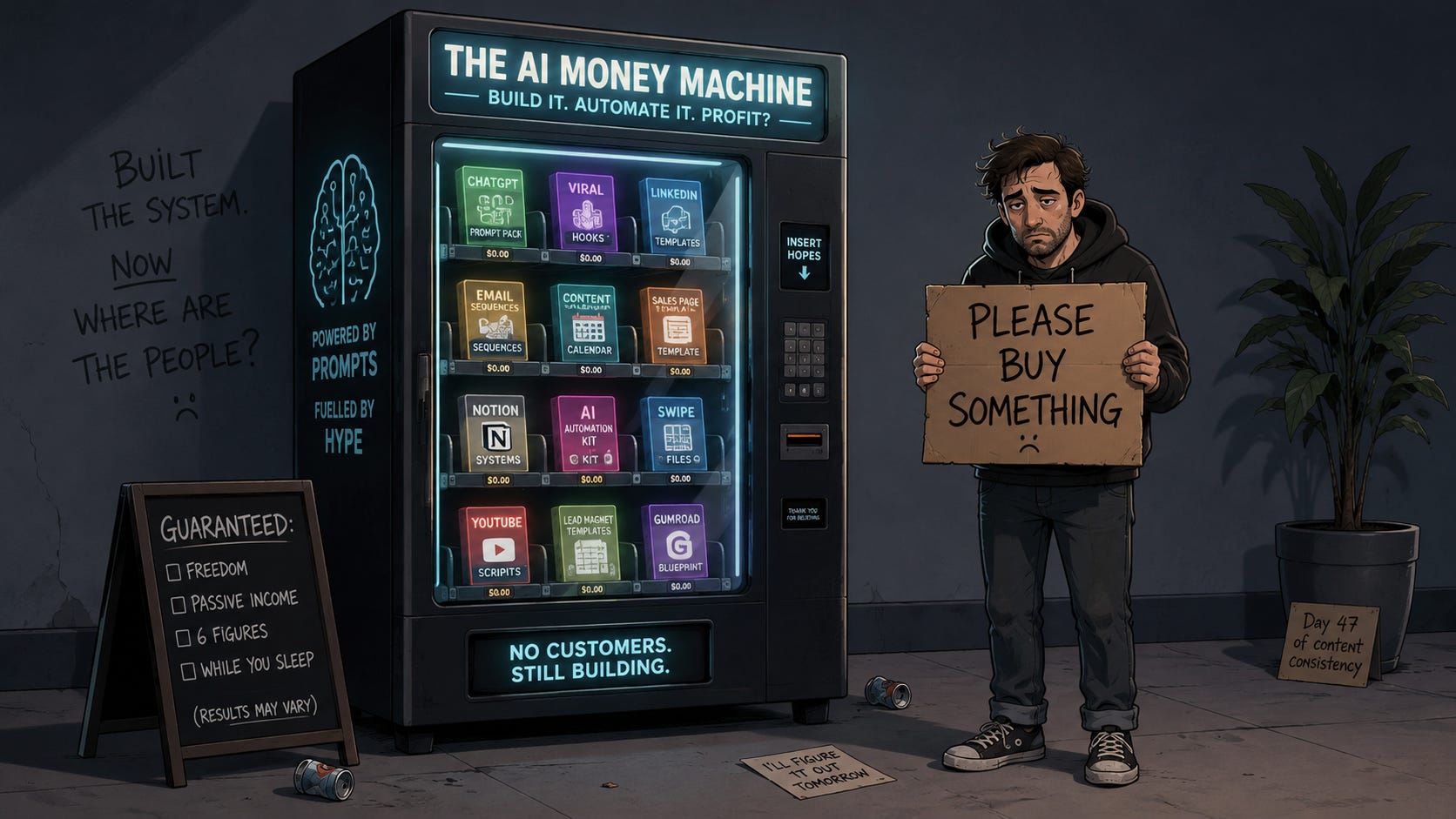
Everyone wants the AI money machine, but nobody wants to talk about the awkward bit where another human has to trust you with actual money.
That’s where a lot of AI side-hustle advice quietly puts on a fake moustache and exits through the fire door.
You’ve seen the articles.
The “$0 AI stack”.
The “this simple workflow made me money while I slept”.
The “I connected ChatGPT to Notion to Gumroad to my toaster and now I earn passive income from a beach hammock made of Stripe notifications.”
Lovely.
Truly.
I enjoy a good system as much as the next person. Probably more, to be honest. I’m the sort of person who can get emotionally attached to a well-labelled folder structure, which is not something I’m proud of, but here we are.
But there is one question those articles often tiptoe around like a burglar in Crocs:
Where did the customers come from?
Not the tools.
Not the prompts.
Not the workflow.
Not the digital product.
Not the “I automated everything possible” bit.
The customers.
The actual people.
The living, breathing, slightly distracted humans with inboxes full of nonsense, tabs open since 2021, and a deep suspicion that your “AI-powered solution” might just be a PDF wearing a party hat.
That is the part worth talking about.
Because building is easier than ever.
Selling is still where the dragon lives.
Building feels amazing.
You can open ChatGPT, generate ideas, organise them in Notion, build a template, create a Gumroad product, write a sales page, make a thumbnail, and feel like a tiny digital emperor.
Look at me.
I’ve made a system.
Marvel at my blocks and databases.
Behold my automated workflow, peasants.
And genuinely, that stuff matters.
A clear system helps. A useful product helps. A good prompt helps. A simple workflow helps.
But none of those things prove there is a market.
They prove you can assemble something.
Which is good.
But building something before proving anyone wants it is like lovingly preparing a banquet for ghosts.
Very tidy.
Very impressive.
Slight issue with attendance.
This is the trap with AI right now.
Because AI removes a lot of friction from creation, it becomes incredibly easy to mistake output for progress.
You made 30 LinkedIn post prompts.
Great.
Who needs them?
Why now?
What pain do they solve?
How are you getting in front of the person who is already annoyed enough to pay for that solution?
Those are the questions that actually matter.
They are also the questions that ruin the dopamine buffet, so naturally most people skip them and go back to making another free guide.
Here is the annoying truth:
The selling starts before you build the thing.
Not after.
Not once the product page is polished.
Not once you have chosen the perfect shade of “trustworthy but not boring” blue.
Before.
Selling starts when you understand a specific person with a specific problem they already want solved.
Not:
“I help people with content.”
That is fog in a blender.
More like:
“I help freelance designers turn messy portfolio projects into case studies that make potential clients understand the value faster.”
Or:
“I help career changers rewrite their LinkedIn profile so recruiters stop treating them like confused furniture.”
Or:
“I help coaches turn rambling voice notes into clear weekly content that points back to their offer.”
That is sellable because the buyer can recognise themselves.
This is where AI can help, but it cannot do the courage bit for you.
AI can analyse Reddit threads, LinkedIn posts, YouTube comments, job boards, reviews, and sales pages.
It can show patterns.
It can extract pains.
It can suggest offers.
But you still have to choose.
You still have to say:
“This is who I help.”
“This is the problem.”
“This is the outcome.”
“This is why it matters.”
Without that, you are not building a business.
You are releasing digital confetti into a wind tunnel.
This is the bit people don’t want to hear because it sounds suspiciously like effort.
The first sale usually does not come from some elegant automated funnel quietly purring in the background like a luxury robot cat.
It comes from a conversation.
A comment.
A reply.
A DM.
A post that says something specific enough for someone to think:
“Oh. That’s me.”
Then you talk.
You ask questions.
You understand the problem properly.
You explain how you can help.
You might offer a small sample.
You might do a quick audit.
You might say:
“Send me your LinkedIn bio and I’ll show you the first three things I’d fix.”
Or:
“Send me the product page and I’ll tell you why people might be bouncing.”
Or:
“Send me one messy idea and I’ll turn it into a clear post so you can see the difference.”
That is not passive.
It is not glamorous.
It is not “money while you sleep”.
It is money while you are very much awake, slightly caffeinated, and trying not to sound like a desperate influencer.
But it works because trust has to start somewhere.
And at the beginning, trust is usually built manually.
You find clients where the pain is already visible.
Not where you wish they were.
Not where some guru told you “buyers are everywhere”.
Where the problem is already being discussed.
For AI microservices, that could mean:
LinkedIn posts where people complain about content, hiring, outreach, sales pages, resumes, writing, or consistency.
Reddit threads where people are asking “how do I fix this?” or “why isn’t this working?”
Freelance job posts where buyers are already describing the task.
YouTube comments under tutorials where people are stuck.
Newsletter replies.
Communities.
Your existing network.
Your old colleagues.
People you have helped before.
The point is not to barge in shouting, “HELLO I HAVE A TEMPLATE” like a maniac with a clipboard.
The point is to notice repeated pain.
Then respond like a useful human.
For example, if people keep saying:
“I know I should post on LinkedIn but I never know what to say.”
You do not build “The Ultimate LinkedIn AI Mega Vault 9000”.
Not yet.
You start smaller.
You offer:
“I’ll turn one messy idea into three LinkedIn posts in your voice.”
That is concrete.
That is low-risk.
That is easy to understand.
And more importantly, it gives you something every early offer desperately needs:
Evidence.
Most people make their first offer too clever.
They bundle everything.
They add bonuses.
They create tiers.
They write 19 sections of sales copy.
They include “lifetime access”, “bonus prompts”, “community”, “templates”, “modules”, “resources”, “swipe files”, “monthly updates”, and some poor little FAQ section at the bottom gasping for medical attention.
Stop.
Your first offer needs to be simple enough that someone can understand it while waiting for the kettle to boil.
Try this:
I help [specific person] get [specific outcome] without [specific frustration].
Examples:
I help job seekers rewrite their LinkedIn profile so recruiters understand their value faster.
I help small business owners turn customer reviews into better website copy.
I help coaches turn messy ideas into clear posts that point back to their offer.
I help YouTubers turn rough video ideas into sharper scripts.
Boring?
Maybe.
Useful?
Yes.
And useful sells before clever does.
Clever can come later, wearing sunglasses and being all smug.
At the start, marketing is not a giant content machine.
It is not a perfect funnel.
It is not a 27-email nurture sequence with a “cart close” timer pretending the universe will explode on Thursday.
It is repeated signal.
You keep showing the same useful message to the same kind of person until they understand three things:
You understand their problem.
You know how to solve it.
You are not going to make the buying process feel like being trapped in a webinar basement.
That is it.
So your marketing might look like this:
Write posts about the problem.
Show examples.
Break down mistakes.
Share before-and-after improvements.
Explain your thinking.
Talk about the cost of doing nothing.
Show how your service works.
Invite people to send you something small to review.
Turn conversations into insights.
Turn insights into content.
Turn content into clearer offers.
That is the loop.
Not sexy.
Not complicated.
But neither is brushing your teeth, and apparently that works too.
This is the question everyone wants answered.
The honest answer is:
It depends on trust.
If you already have an audience, warm relationships, or people who know what you do, your first sale could come quickly.
Days, sometimes.
If you are starting from scratch with no audience, unclear positioning, and an offer nobody understands yet, it may take weeks or months.
Not because you are doomed.
Because the market has no idea why it should care yet.
That is not a personal insult.
That is business.
A stranger does not owe your offer attention just because you spent three hours in Canva and named the product something dramatic.
The first sale usually takes longer when:
Your offer is vague.
Your audience is too broad.
Your content is interesting but disconnected from what you sell.
You are waiting for inbound interest without creating conversations.
You are hiding the actual offer because you do not want to seem salesy.
That last one is a sneaky little bastard.
A lot of people are not failing because they are too pushy.
They are failing because nobody knows what they offer.
They post value.
They share ideas.
They educate.
They motivate.
They sprinkle insight across the internet like a thoughtful pigeon.
But they never connect the dots.
So people think:
“Great post.”
Then they leave.
No enquiry.
No sale.
No movement.
Just a polite little dopamine shot and silence.
Most “passive income” becomes passive after a deeply unpassive beginning.
The product that sells while you sleep usually needed:
Manual conversations.
Clear positioning.
Repeated content.
Proof.
Feedback.
Offer tweaks.
Awkward early sales attempts.
Refunds, maybe.
Silence, definitely.
A first version that looked like it was assembled during a minor electrical emergency.
That is normal.
The dream is not wrong.
It is just missing the messy middle.
You can absolutely build assets.
You can absolutely sell templates.
You can absolutely productise services.
You can absolutely use AI to create leverage.
But if nobody trusts the offer, the automation is just a conveyor belt carrying tumbleweed.
Here is a simple version that actually makes sense.
Not “creators”.
Not “business owners”.
Not “people who need help online”.
Pick one.
Coaches.
Job seekers.
Consultants.
Estate agents.
Newsletter writers.
Therapists.
YouTubers.
Founders.
Whoever.
One buyer sharpens the message.
A broad audience makes your offer wobble around like a shopping trolley with a wanky wheel.
Do not start with the tool.
Start with the frustration.
What are they already trying to fix?
What are they already paying for?
What are they embarrassed by?
What keeps causing delay?
What makes them think, “I know I need to sort this, but I keep putting it off because it feels like wrestling a squid in a filing cabinet”?
That is where the offer lives.
Not a huge product.
Not a course.
Not a giant template vault.
One useful outcome.
A profile rewrite.
A landing page audit.
Five posts from one idea.
A sales email draft.
A YouTube script outline.
A content repurposing pack.
Small enough to buy.
Specific enough to understand.
Useful enough to recommend.
People need to see what changes.
Show:
Before and after.
Mistake and fix.
Bad example and better example.
Vague version and clear version.
Messy input and polished output.
This is where a lot of AI offers fail.
They talk about the stack instead of showing the transformation.
Nobody buys your Notion dashboard because it has three databases and a charming little emoji.
They buy the outcome.
Show the damn outcome.
Comment properly.
Reply to people.
Send useful DMs.
Ask if they want a quick suggestion.
Offer a small diagnostic.
Do not spam.
Do not pitch-slap strangers like a malfunctioning LinkedIn monkey.
Start real conversations around visible problems.
Your first clients are often found through attention that becomes trust.
Not attention that becomes vanity metrics.
After the first paid job, document what happened.
What was the problem?
What changed?
What did the person say?
What result did they get?
What was easier after?
This becomes your next content.
And your next sales asset.
And your next reason for someone to trust you.
Proof compounds.
Vague posting evaporates.
This is the bit I keep coming back to.
The AI stack is not the business.
The prompt is not the business.
The Notion workflow is not the business.
The Gumroad page is not the business.
The business is the connection between:
A painful problem.
A clear buyer.
A trusted solution.
A simple path to purchase.
AI can help you build the solution faster.
It can help you create content faster.
It can help you analyse problems faster.
It can help you package ideas faster.
But it cannot remove the need for clarity.
It cannot remove the need for trust.
It cannot remove the need to sell.
And honestly, that is probably a good thing.
Because if everything could be automated instantly, the internet would become one giant vending machine full of identical prompt packs, crying entrepreneurs, and abandoned Notion templates.
Actually, we might already be halfway there.
The better question is not:
“What AI stack can make me money?”
The better question is:
“What painful problem can I solve clearly enough that someone wants to pay for it?”
Then:
Where are those people already talking about it?
What would make them trust me?
What small offer could help them quickly?
What proof can I show?
What is the next obvious step?
That is selling.
Not manipulation.
Not cringe.
Not cornering someone at a networking event until their soul leaves their body.
Selling is helping the right person understand:
“I have this problem.”
“This person gets it.”
“This solution makes sense.”
“I know what to do next.”
That is the missing bit.
And it matters more than the stack.
Because a clever system without sales is just a very organised ghost town.
Nice buildings.
No people.
Bit creepy.
Terrible for revenue.
If your content, offer, or “AI-powered thing” gets attention but not enquiries, the problem might not be the tool.
It might be the path.
The Content-to-Client Engine helps experts turn messy ideas into a clearer offer, sharper content, and a simpler way for the right people to say yes.
No giant funnel circus.
No hard-selling pantomime.
No becoming a full-time content monkey.
Just clearer signal, stronger trust, and content that actually leads somewhere useful.
Apply for The Content-to-Client Engine and see if it’s a fit.
Comments
Nothing yet. Say the first thing.
Sign in to join the conversation.