
As a former legislator and scientist, I say directly that money influences policy and regulation, which is the primary reason I ran for Congress in 2018. I have talked extensively and written about this subject; however, I had no idea how large the problem is. Part 2 of this Follow the Money series traced a joint fundraising committee (JFC) called Better Blue Fund, which allows AIPAC-adjacent donors to split a single check among several candidates at once. Following that same money trail, I set out to better understand how coordinated and widespread the American Israel Public Affairs Committee (AIPAC) political action committee (PAC)’s efforts are. The following analysis uses publicly available Federal Election Commission (FEC) filings.
In Part 3, we take a close look at earmarking, a legal, disclosed campaign finance mechanism: a donor gives money to a PAC with instructions to forward it to a specific candidate, and the PAC must pass along the full amount; it can’t redirect or keep any of it. For an organization like AIPAC PAC, earmarking multiplies its reach without technically making a large contribution itself: it can solicit many individual donors, each writing a check within their personal contribution limit, and channel all of it toward the same candidates it has endorsed. Nothing about the mechanism itself is improper. What’s worth examining is the scale, the pattern, and how visible any of it is to a voter who isn’t already looking for it.
Evidence of AIPAC Coordinated Fundraising.
First, I wanted to assess whether patterns in AIPAC’s fundraising methods could be identified.
Four distinct donor patterns show up in this data:
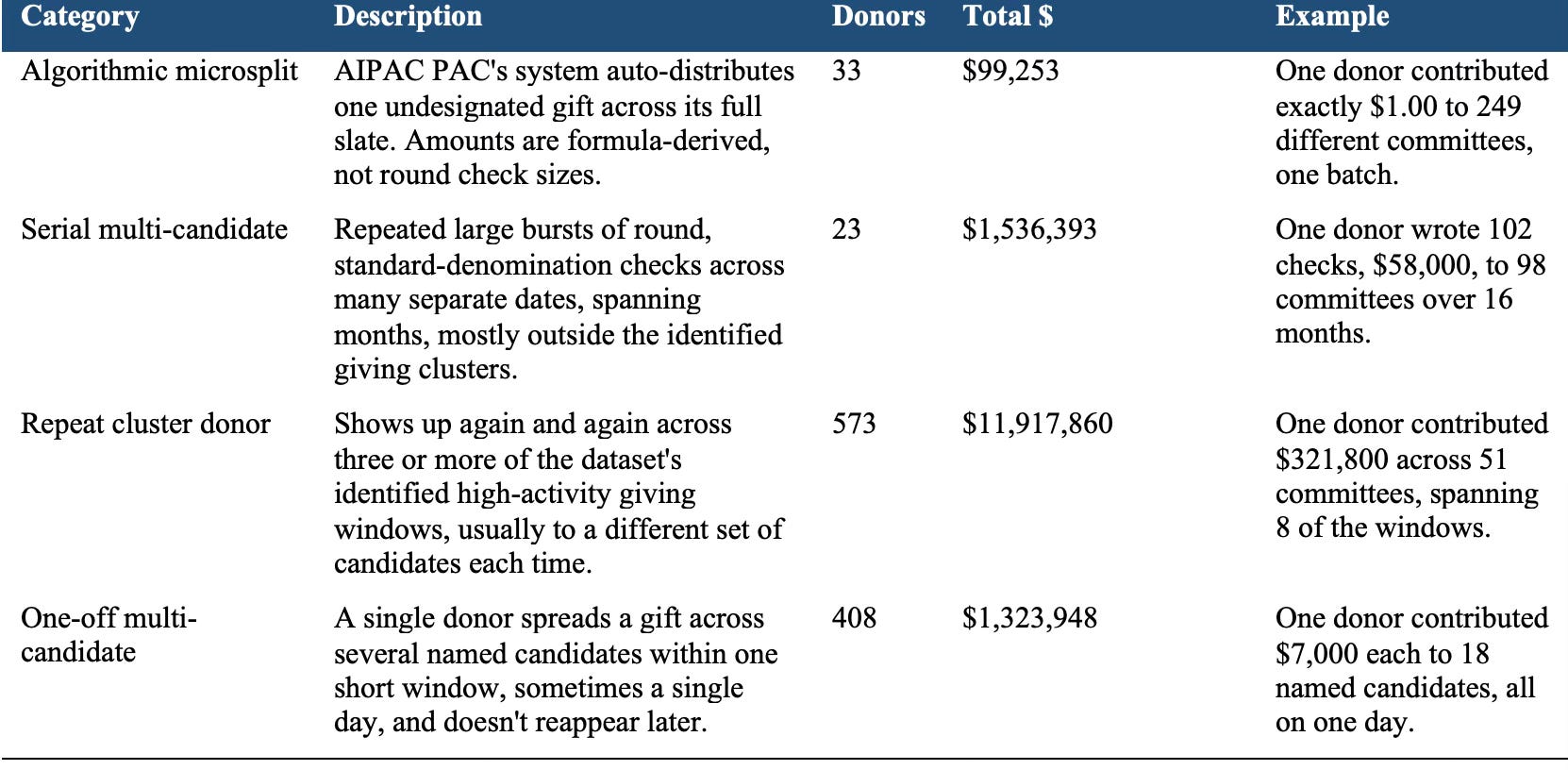
The distribution of total AIPAC disbursements by donor pattern is shown in Figure 1.
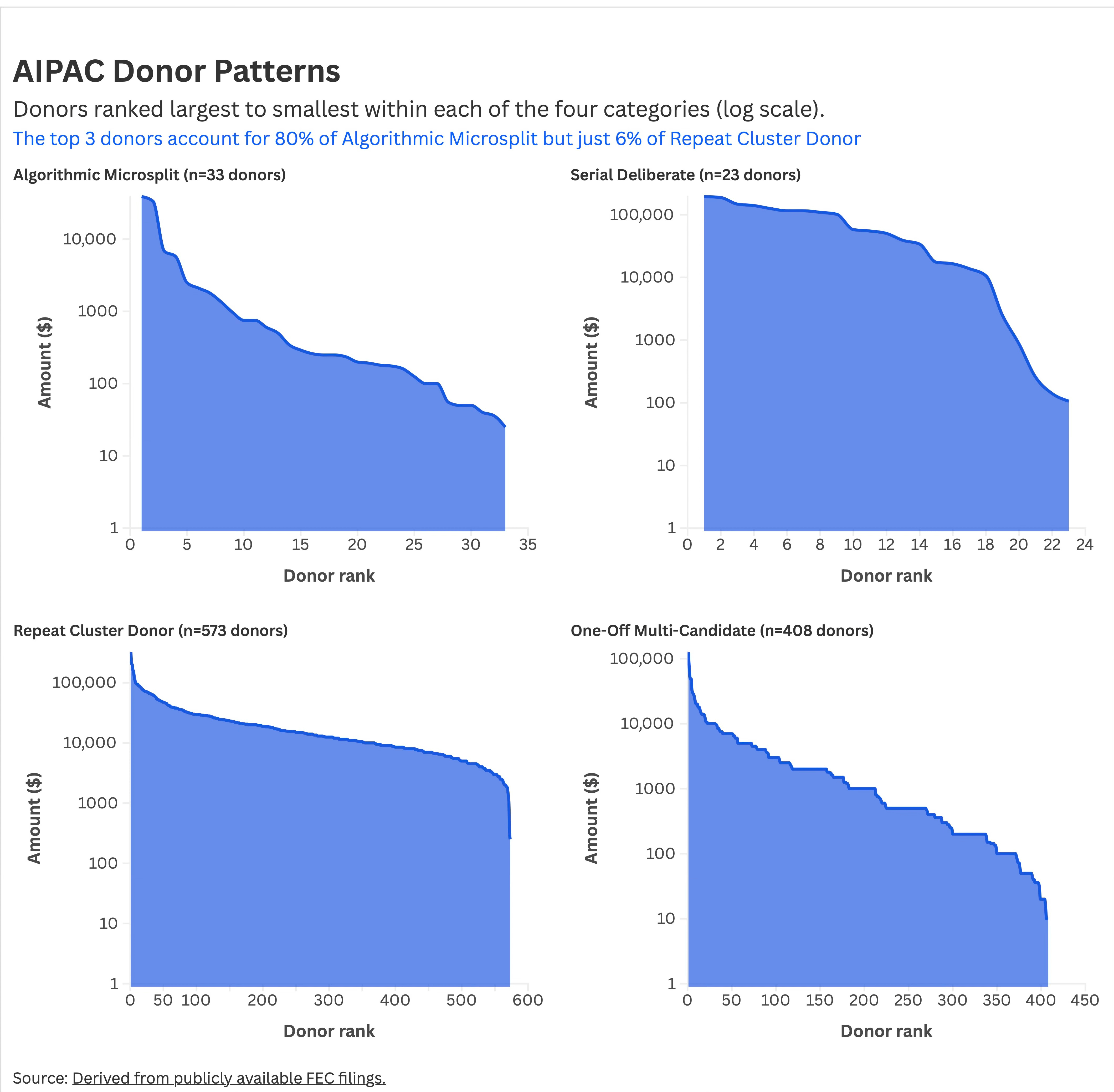
Figure 1. Distribution of AIPAC disbursements by donor pattern.
The evidence for each of the four donor categories is summarized below.
Algorithmic microsplit. The analysis found that about 12 percent of all earmarked entries in the dataset, but only 0.23 percent of total dollars, aren’t from donors choosing individual candidates. It appears that they are AIPAC PAC’s system splitting a single donor’s undesignated contribution across its full slate of currently endorsed candidates: one donor gave exactly $1.00 each to 249 different committees in a single batch; another split $1,795.74 across 274 committees using only five distinct dollar amounts, evidence of a tiered formula rather than an even split. That’s a different mechanism from a donor deliberately choosing individual candidates by name. It means a candidate’s appearance on an earmarking list doesn’t always reflect a donor’s individual choice.
Serial multi-candidate. One donor’s FEC filings, under two spelling variants of his name in different AIPAC PAC filings, both listing the same address, employer, and title, reveal a far broader pattern than a single week’s checks. This donor wrote 102 separate checks totaling $58,000 to 98 different candidate committees between February 2025 and June 2026, nearly the entire span of this analysis. Ninety-nine percent of those checks are round, standard amounts: $500, $1,000, $1,500, $2,000, not the arbitrary, formula-looking figures AIPAC PAC’s automated system produces, evidence that this is a person choosing recipients, not software dividing a check. Their contributions occurred in bursts: a 15-committee week in March 2025, already documented in Part 2 of this coordinated-giving pattern, then a much larger stretch in June 2025, with twenty committees on the 12th, thirty-one on the 18th, fourteen on the 20th, eleven more over the 23rd and 24th, 76 checks and $28,500 in under two weeks, then scattered single checks continuing for another year. Only a small fraction of his activity, five dates worth $5,000, falls within the dataset’s broader identified giving clusters.
Repeat cluster donor. Beyond one-time bursts, 573 donors appear repeatedly across three or more of the 23 high-activity giving windows identified over the full eighteen months, together accounting for $11,917,860. The clearest example is a donor who appears in eight of those windows, with a total of $321,800 across 51 different candidate committees. Only six of those 51 committees received more than one gift from this donor; the rest are one-time appearances, each on a different slate. That pattern, broad and repeated but not loyal to any race, reads less like a donor with favorite candidates and more like someone who reliably responds whenever AIPAC PAC is actively soliciting for a slate of candidates or committees.
One-off multi-candidate. The remaining pattern is a single, concentrated decision: 408 donors gave to two or more candidates within a short window, usually a single day, and never appear in the dataset again, for a total of $1,323,948. The cleanest example is a donor who gave $7,000 to each of 18 named candidates, for a total of $126,000, all sent on the same day, November 26, 2025. Unlike AIPAC PAC’s own automated batches, the amount is a deliberately chosen round figure, not a formula splitting one pool across many recipients; unlike the serial donor above, it happened once and didn’t recur.
Another pattern identified is that the timing of these earmarks isn’t random. Giving is heavily concentrated early in the week (see Figure 2).
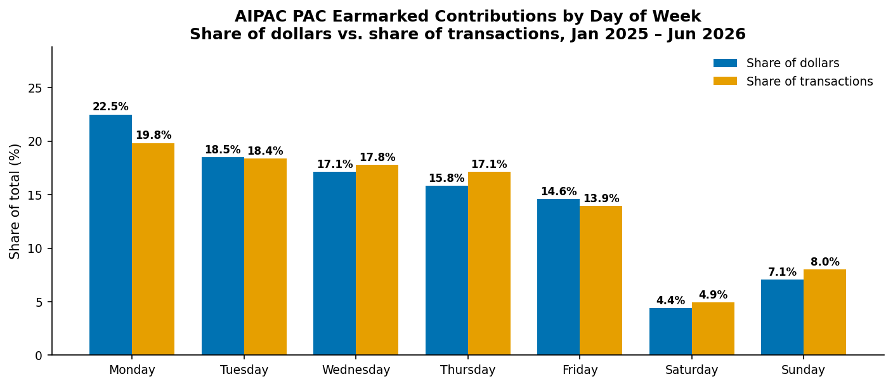
Figure 2. Weekly distribution of AIPAC earmarked contributions 2025 to 2026.
Monday alone accounts for $9.5 million of the full $42.3 million dataset, more than any other day and 5.1 times Saturday’s total. That weekday pattern isn’t a one-year artifact: when broken out by year, 2025’s weekday profile and 2026’s correlate at 0.976, and Monday’s share changes by just 0.21 percentage points between the two years, a consistency a single unusual year wouldn’t produce.
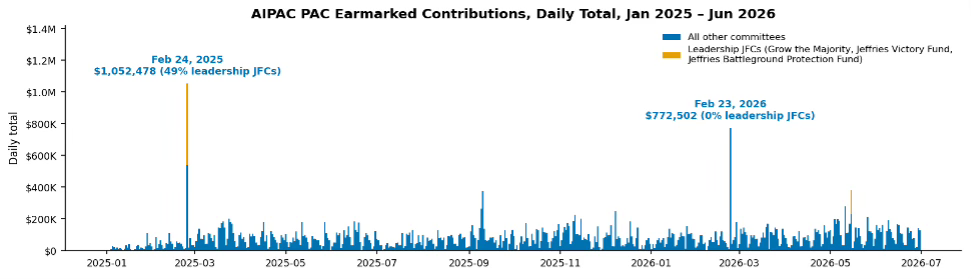
February 24, 2025, and February 23, 2026 (see Figure 3), the two largest single days in the entire eighteen-month span, a year and a day apart, together totaling $1,824,980 across 42 distinct candidate committees, both fall on a Monday. With only two years of data, an annual cycle is suggestive rather than confirmed. The two spikes also have different causes: nearly half of the February 2025 spike, 49 percent, is the three leadership committees above getting fully funded in a single coordinated push; the February 2026 spike is spread broadly across 26 different individual candidates’ own committees, with Dan Sullivan ($133,250) and Jon Husted ($126,250) the largest; a genuinely bipartisan mix received the bulk of disbursements; neither day lines up with a quarterly FEC filing deadline. The Monday pattern extends beyond AIPAC PAC’s filings: Better Blue Fund’s disbursements to its nine candidates, detailed in Part 2, are also overwhelmingly on Mondays; 89 percent of that money, in a small sample of eight transfers, even though Better Blue Fund’s donor receipts, the checks individual donors write to the JFC itself, are spread evenly across weekdays. The Monday rhythm looks like an administrative one, tied to how these committees process and move money internally; not a reflection of when donors happen to write checks.
Figure 3. Daily totals of AIPAC earmarked contributions between 2025 and 2026.
Where the Money Went
Leadership Committees. Three committees that received AIPAC-earmarked contributions are led by House Republican and Democratic leadership: all three are joint fundraising committees that split money among multiple participants. Grow the Majority (C00858373) lists 89 joint fund participants: Speaker Mike Johnson’s own campaign committee and his leadership PAC, American Revival PAC, sit alongside the Congressional Leadership Fund, the NRCC, the RNC, roughly a dozen state Republican parties, dozens of individual House Republican candidates, and a set of “GTM Nominee Fund” accounts pre-registered for specific districts before either party’s nominee is even chosen.
The Jeffries Victory Fund (C00768200) is narrower, with three participants: Minority Leader Hakeem Jeffries’ campaign, his leadership PAC (Jobs, Education, & Families First – JEFF PAC), and the DCCC. The Jeffries Battleground Protection Fund (JBPF, C00916429, registered in August 2025) has 26 participants: Jeffries’ own committee, 25 other House Democrats, and the DCCC, as detailed below.
Table 2. AIPAC contributions to leadership committees between 2025 and 2026
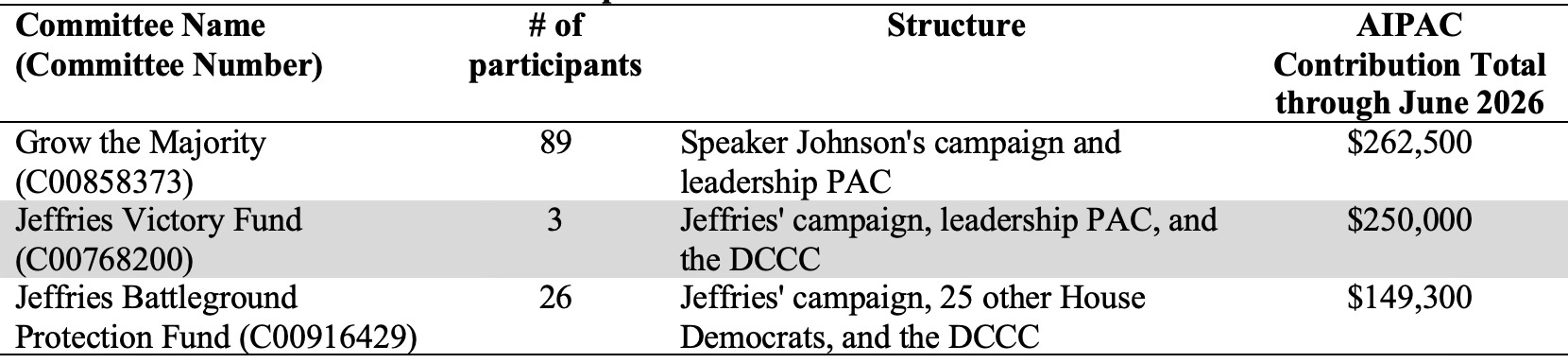
JBPF’s disbursements confirm the same pass-through pattern established for Better Blue Fund in Part 2. Between April and June 2026, JBPF sent $1,001,053 to its 26 joint fund participants. The single largest recipient by far is the DCCC itself, which received $624,260, 62 percent of everything JBPF sent out, dwarfing the $26,400 that went to Jeffries’ campaign committee. Two names already shown in Figure 4 are also direct recipients: Don Davis ($9,929) and Greg Landsman ($15,965).
Congressional disbursements. AIPAC contributions were funneled to 29 members of Congress, 15 Republicans and 14 Democrats, totaling $20,220,451 in combined direct earmarking and Better Blue Fund joint fundraising committee funds, with the latter documented in Part 2.
Susan Collins is the top beneficiary in this analysis: $2,721,923 from 1,490 individual donors, the broadest donor base of any name in this table. The single biggest day, February 24, 2025, brought in $126,250 from 48 of her donors alone. Her earmarking is broad and sustained, spanning nearly the entire eighteen-month period covered by this analysis. Collins isn’t an outlier. The same earmarking language appears in AIPAC PAC’s FEC filings for 28 additional members of Congress; each was independently confirmed the same way: the literal text of the filed document naming that candidate’s committee (see Figure 4).
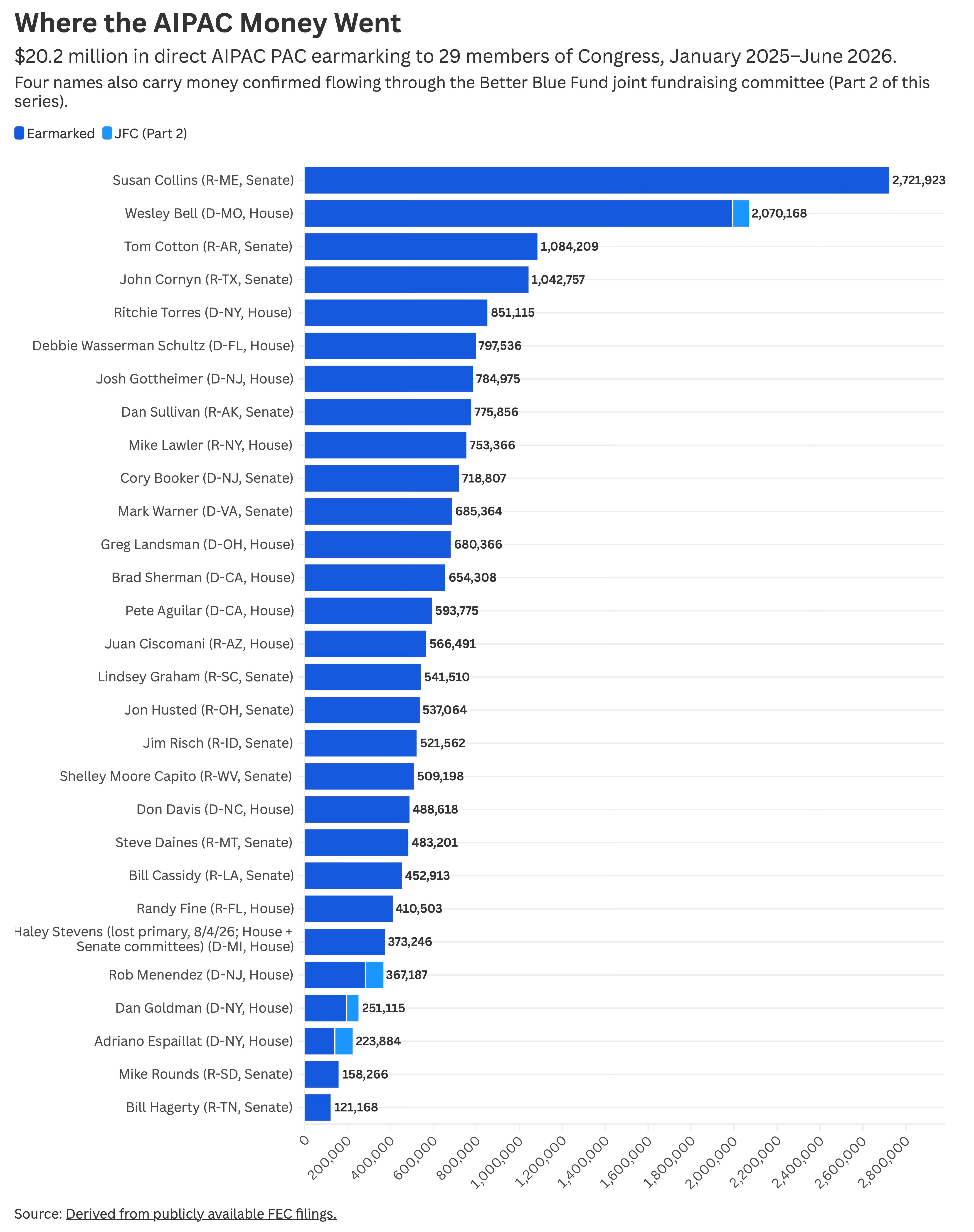
Figure 4. AIPAC contributions totaling $20,220,451 from 29 confirmed names, 15 Republicans and 14 Democrats, spanning both chambers of Congress.
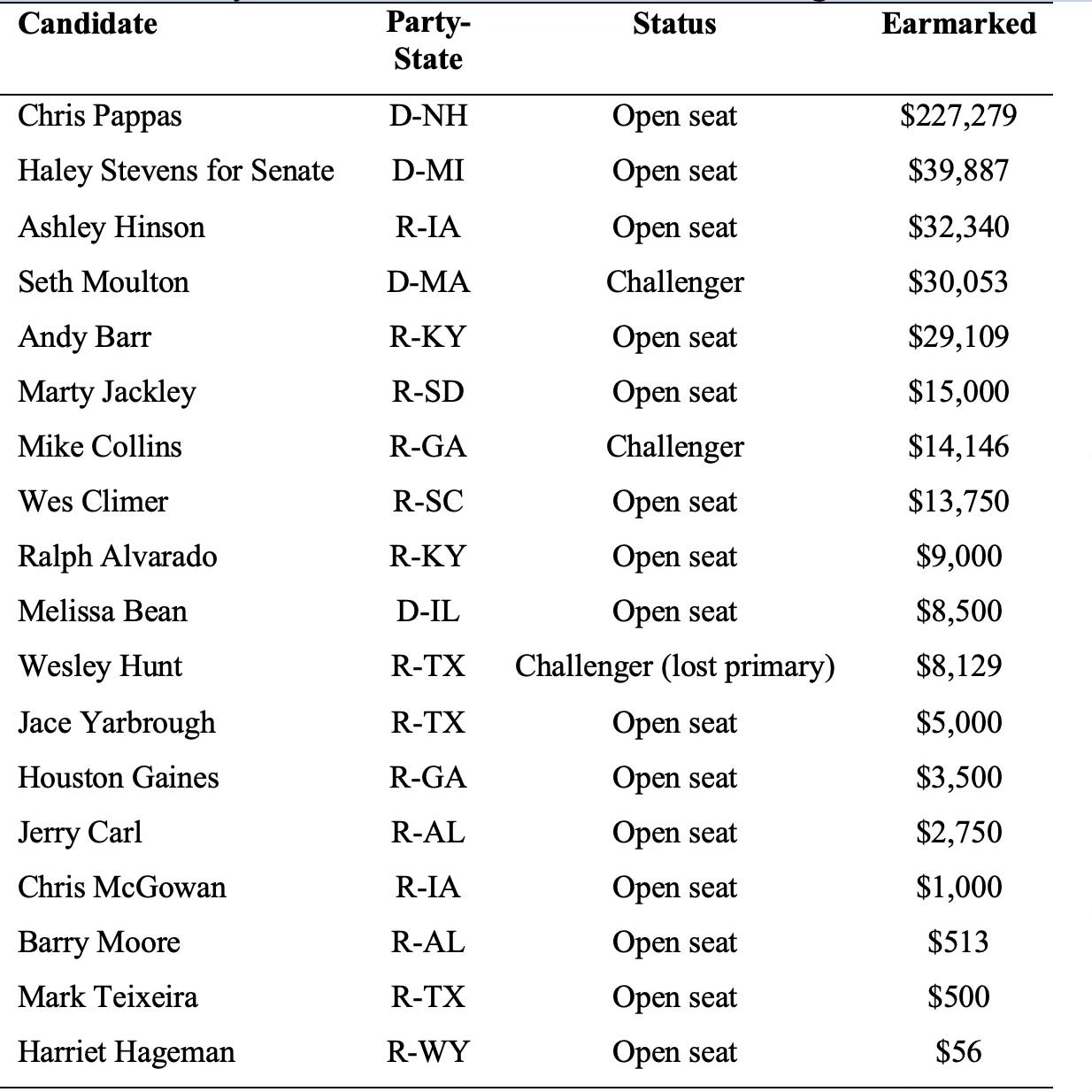
Cross-referencing every committee listed in AIPAC PAC’s earmarking data, not just the 29 featured above, with verified candidate status for the current cycle shows that 98.94 percent of the dollars, $40,932,263 of $41,372,788, go to sitting incumbents defending the seats they already hold. Open-seat candidates receive 0.93 percent; challengers receive 0.14 percent, and even that residual isn’t outside challengers: it’s sitting House members running for Senate against a sitting senator, including Seth Moulton against Ed Markey in Massachusetts, Mike Collins against Jon Ossoff in Georgia, and Wesley Hunt, who lost his primary, against John Cornyn in Texas, plus one genuine political outsider, Jace Yarbrough, in a $5,000 open-seat race in Texas. (Leadership PACs and national party committees are excluded from these percentages entirely; they aren’t individual candidates.) Whatever else this mechanism is, it is almost entirely a tool for protecting incumbents already in office, not for buying new seats or engineering primary upsets. The rare exception is itself telling: at least one race in this data shows AIPAC PAC money on both sides of a contested Republican Senate primary, funding both the incumbent and a challenger running against him.
Candidate Committees. There are also 18 candidate committees that received AIPAC earmark funds and are non-incumbents: mostly current or former House members running for a different, usually higher, office, plus a handful who’ve never held federal office (see Table 3).
Table 3. Summary of candidate committees listed as receiving AIPAC earmark funds.
Limitations. First, the recipient names in this analysis come from AIPAC PAC’s document viewer, which resolves the earmarking language, not from the literal text in the machine-readable bulk data or from matching committee IDs alone. Second, this analysis is limited to the current eighteen-month cycle, January 2025 through June 2026, not career totals; a member’s cumulative AIPAC support across multiple election cycles, the kind of figure local reporting sometimes cites, could be higher than the numbers in this analysis. The analysis captures only AIPAC PAC’s earmarked pass-through money and Better Blue Fund JFC money, both of which are “support” channels. It does not capture AIPAC PAC’s direct contributions from its treasury, a separate and legally distinct channel capped by law at $5,000 per candidate per election, small next to the earmarked totals here. Finally, this analysis does not capture independent expenditures, positive or negative, made through AIPAC’s affiliated super PAC, United Democracy Project, which is legally barred from contributing to candidates and instead spends separately, without any dollar limit, including money spent specifically to oppose a candidate’s primary rivals. Haley Stevens is the clearest example: her $373,246 table total is a small fraction of the more than $30 million United Democracy Project reportedly spent supporting her and opposing Abdul El-Sayed in Michigan’s 2026 Senate primary, a race Stevens lost on August 4, 2026. The same kind of opposition spending may exist, unexamined, behind other names in this analysis.
The larger point from this analysis carries over from Part 2, sharpened by its breadth. A voter scanning Susan Collins’ or any of these 29 names’ FEC filings would see a dollar figure attributed to their campaign committee, with nothing indicating where it came from unless you already know to look for AIPAC PAC’s own conduit data. Disclosure law answers the question of who gave the money. It was never built to answer why or through which of several available channels. The pattern that started with one race and one surprising number turned out to reach into both chambers of Congress, both political parties, and the fundraising operations of both parties’ top House leaders, all of it sitting in plain sight in public FEC filings. The hope is that this analysis will be helpful as voters head to their polling places.
Notes: Figures are drawn from FEC Schedule A filings for AIPAC PAC (C00797670) and each lawmaker’s principal campaign committee, matched against current-cycle bulk data. Leadership committee receipts are confirmed the same way, directly from AIPAC PAC’s filings; JBPF’s disbursements are confirmed from its Schedule B filings. Sludge’s July 2026 reporting independently reached the same $149,300 figure for AIPAC PAC’s earmark to JBPF. Each total above is individually confirmed against AIPAC PAC’s itemized Schedule A filings by retrieving the underlying document and reading the earmarking language that names that committee. The complete underlying dataset, every donor-category breakdown, cluster window, and name-merge decision, is available at that link.

Mindi F. Messmer, DMSc, MS, is a Senior Research Scientist at a national non-profit and Assistant Professor at Georgetown University School of Medicine. She identified the pediatric cancer cluster on the New Hampshire seacoast in 2014, served on the Pease Restoration Advisory Board, and co-founded the New Hampshire Safe Water Alliance. Her research program includes PFAS ecological epidemiology and perinatal exposure.
No posts
Comments
Nothing yet. Say the first thing.
Sign in to join the conversation.