
This is part 2 of my “Follow the Money” series; part 1 covered the NH-01 congressional race.
Highlights
As with AIPAC, when a donor network’s brand becomes a liability, the money doesn’t disappear; it just moves.
Nine members of Congress, one shared conduit.
Legal compliance and genuine transparency aren’t the same. A committee tied to AIPAC-adjacent donors can satisfy every FEC disclosure requirement and still leave voters unable to understand who gave the money and why.
Reporting can substantially undercount political action committee (PAC) activity.
Careful analysis of publicly available data can reveal coordination that no single filing shows.
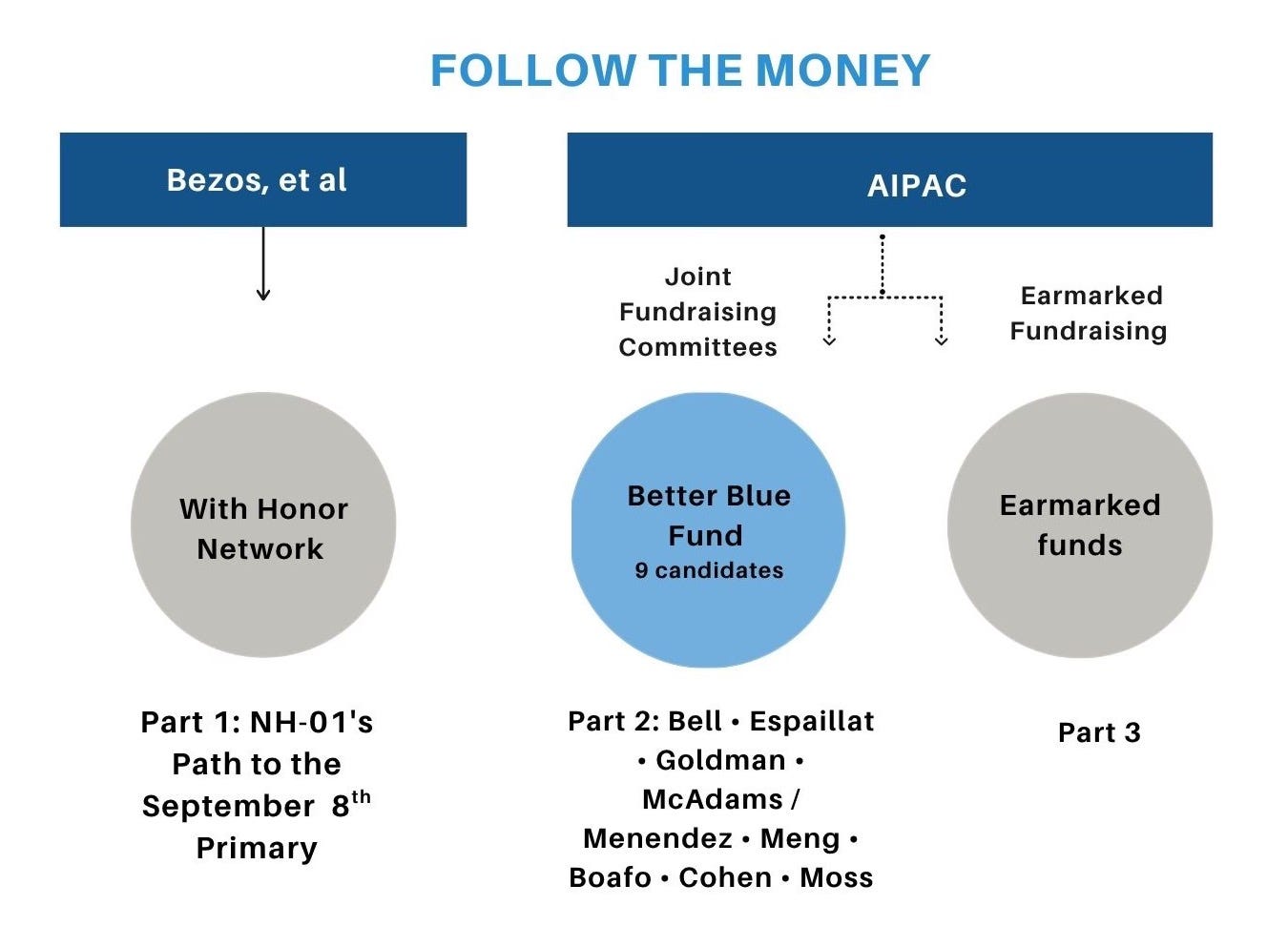
As a research scientist, former elected legislator, and congressional candidate, I have learned a few things about money in politics and how to identify patterns in data. My previous blog, which traced a money trail through the NH-01 congressional race, showed how public Federal Election Commission (FEC) candidate filings can reveal who is trying to influence our elections.
Independent reporting from The Lever and Jacobin identified The Better Blue Fund, a joint fundraising committee (JFC) registered with the FEC on February 25, 2026, as a new vehicle for AIPAC-aligned donors. A JFC receives checks from donors, splits them, and reports the disbursement to each participating committee on the date it processes the split. The Lever’s reporting named eight beneficiaries: Rep. Wesley Bell (D-MO), Rep. Adriano Espaillat (D-NY), Rep. Dan Goldman (D-NY), Ben McAdams, a former congressman now running again in Utah, Rep. Bob Menendez (D-NJ), Rep. Grace Meng (D-NY), Rep. Steve Cohen (D-TN), and Jeremy Moss, a Democratic challenger for Michigan’s 11th District. Better Blue Fund’s FEC filing confirms a ninth participant, Maryland’s Adrian Boafo, who was not named in that reporting.
I decided to dig a bit deeper to see whether publicly available FEC candidate filings could help explain one lobbying effort: the American Israel Public Affairs Committee (AIPAC)’s fundraising. However, to trace the money’s path, one must traverse and cross-reference data across several organizations. To help identify patterns suggesting coordination between AIPAC and the candidate committees, I built a script to cross-reference donor names in each committee’s FEC filings with AIPAC PAC’s donor list, then checked how often a person who gave to both committees made those two donations on the same calendar day. Chance alone rarely produces that kind of overlap; a shared processing date is the signature of a joint fundraising committee splitting one check into two.
Better Blue Fund’s Statement of Organization, as filed with the FEC, lists all nine joint fundraising participants: Bell (C00842336), Espaillat (C00701953), Goldman (C00816660), and McAdams (C00658633), plus Rep. Grace Meng (D-NY, C00516666), Rep. Steve Cohen (D-TN, C00422980), Rep. Rob Menendez Jr. (D-NJ, C00799767), Maryland’s Adrian Boafo (C00933994), who won Steny Hoyer’s former seat this cycle, and Michigan State Senator Jeremy Moss (C00904581), who is running for the state’s 11th District. According to Better Blue Fund’s two quarterly filings in 2026, $709,260 was raised from 34 individual donors, and $535,722.50 has been disbursed to candidates. Approximately 79 percent of donors gave amounts that were exact multiples of $3,500, the individual contribution limit, multiplied by the number of the nine participants they chose to support. One married couple sharing a New York address each gave exactly $31,500, the maximum possible across all nine. At least seven donor pairs in the data share an address and gave separately.
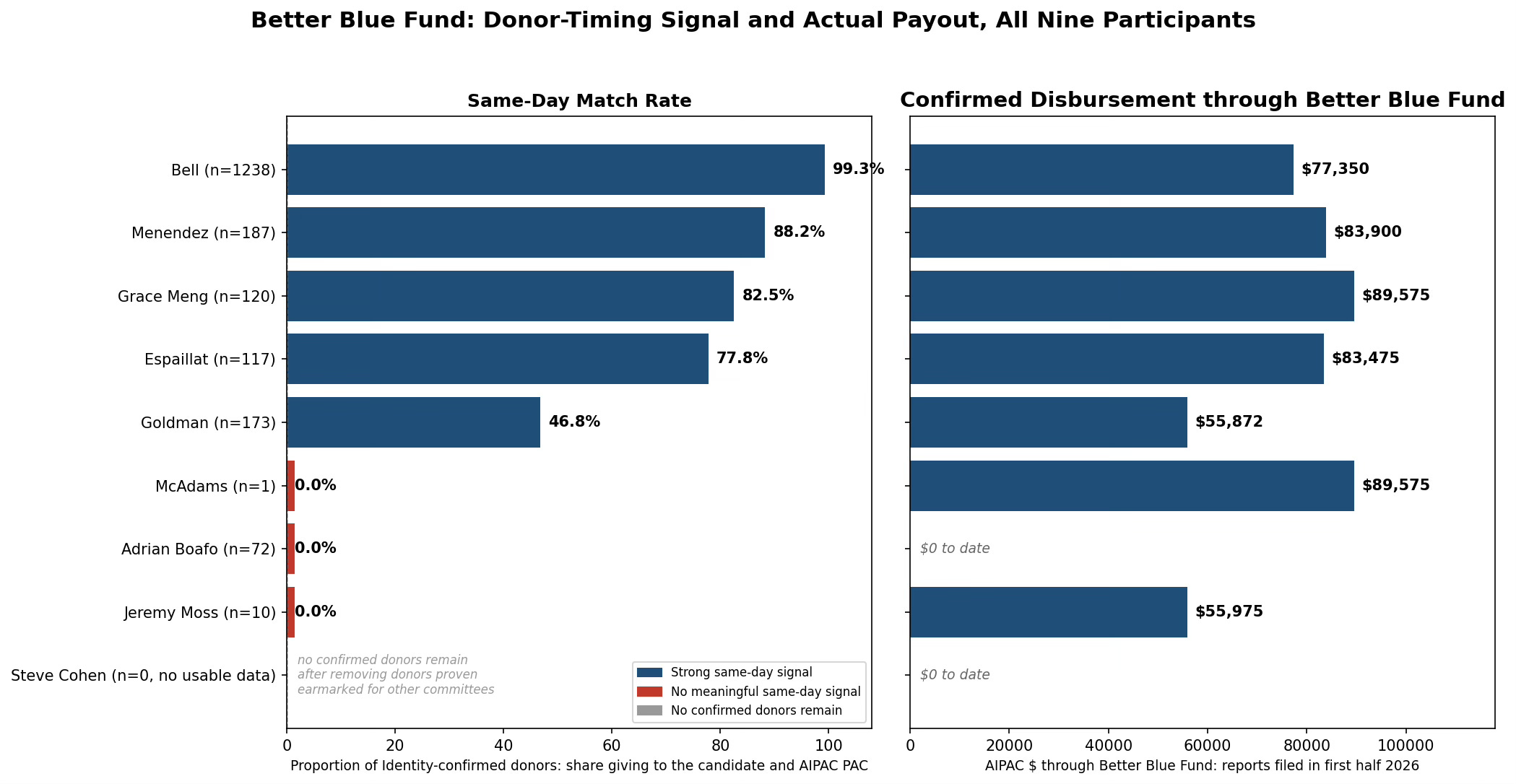
Bell’s FEC filings present the clearest case of contribution clusters that cannot be explained by chance. Of the 1,238 Bell donors independently confirmed by matching employer, ZIP code, or an eponymous company name to the same person who also appears on AIPAC’s FEC filings, 1,229 (99.3 percent) gave to both on the same calendar day. Both Bell and McAdams list Better Blue Fund as their joint fundraising representative in their respective FEC Statements of Organization, providing direct evidence of coordination between AIPAC and the candidate committees, independent of the timing pattern itself.
Timing alone doesn’t prove that the money moved specifically through Better Blue Fund; a donor giving to both a candidate and AIPAC PAC on the same day is only consistent with a joint fundraising committee splitting one check. The Statements of Organization above prove it. The timing pattern is corroborating evidence, showing the mechanism operating at scale, not the primary proof.
The same donor-timing test shows a similarly strong pattern among the rest of Better Blue Fund’s participants, as shown in the figure below. Espaillat, Goldman, Menendez, and Grace Meng share AIPAC PAC’s donor base far beyond what chance would produce, a pattern comparable to Bell’s. Boafo, Cohen, and Moss show none: no same-day donors survive once matches proven to belong to other committees are excluded, and Boafo and Cohen have received zero disbursements from Better Blue Fund in either quarterly filing to date.
Better Blue Fund satisfies FEC disclosure requirements: its donors are named, its transfers are itemized, and its beneficiaries are in the public record. None of that reveals the AIPAC-adjacent character of the money moving through it; a voter scanning a candidate’s FEC filings would see a committee that, on its face, appears unconnected to AIPAC.
JFCs are legal, disclosed structures and, in themselves, are not evidence of wrongdoing. The timing data shows the mechanism operating at scale, not an individual donor’s intent. What this piece adds to reporting that already named eight of the nine participants (Boafo required Better Blue Fund’s own Form 1 to surface) is a way to measure that scale: which participants carry a statistical fingerprint of coordinated giving, and which don’t. Bell, Espaillat, Goldman, Menendez, and Meng do so decisively.
The point is that when a donor network’s brand becomes a liability, the money doesn’t disappear; it just moves.
The data needed to trace this kind of pattern is entirely public. What’s scarce is the time it takes to search for it, so communicating the results to voters falls to data scientists and journalists.

Mindi F. Messmer, DMSc, MS, PG, CG, is a Senior Research Scientist at a national non-profit and co-founder of the NH Safe Water Alliance. She is a former NH State Representative and a nationally recognized environmental health advocate.
Notes: Figures are from FEC Schedule A filings for AIPAC PAC (C00797670), Bell for Missouri (C00842336), Adriano Espaillat for Congress (C00701953), Dan Goldman for New York (C00816660), Friends of Ben McAdams (C00658633), Better Blue Fund (C00940890), and Bi-State Blue Fund (C00939835), current-cycle bulk data. Better Blue Fund reporting per The Lever and Jacobin. Bell and McAdams’ joint fundraising representative disclosures per their respective FEC Statements of Organization (Form 1). Identity-confirmed figures reflect donors whose employer, ZIP code, or eponymous employer name independently corroborates the name match. The nine-participant roster is confirmed directly from Better Blue Fund’s FEC Form 1 (Statement of Organization), not inferred; the five additional participants are Grace for New York (Grace Meng, C00516666), Cohen for Congress (Steve Cohen, C00422980), Menendez for Congress (Rob Menendez Jr., C00799767), Adrian Boafo for Congress (C00933994), and Jeremy Moss for Congress (C00904581). Disbursement and donor-receipt figures are drawn directly from Better Blue Fund’s own Schedule A and Schedule B filings (FEC-1993151 and FEC-1962848).
No posts
Comments
Nothing yet. Say the first thing.
Sign in to join the conversation.