
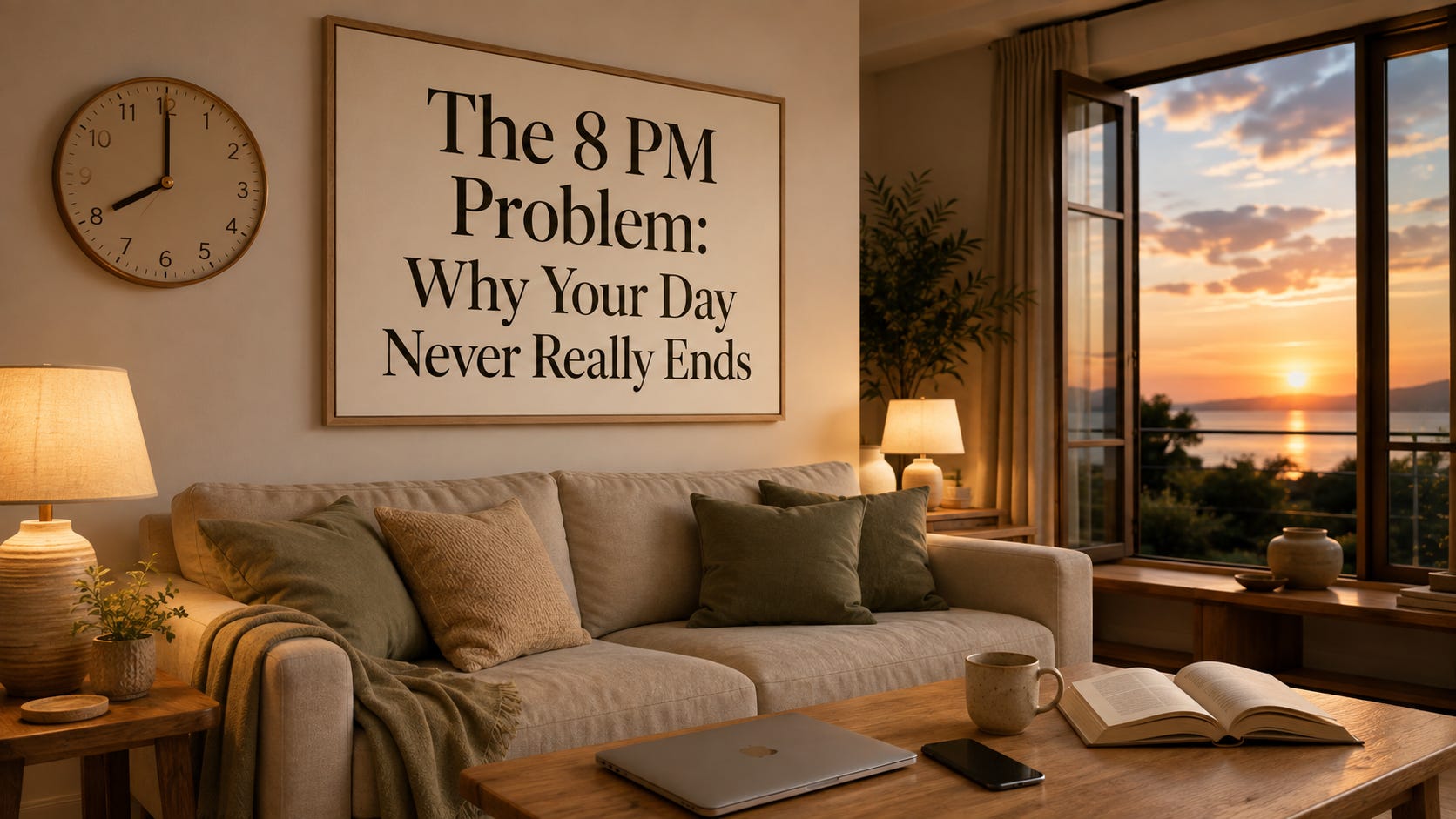
There is a strange part of the evening that many people know well.
The important things are mostly done. You are home. You have eaten. Maybe you changed into comfortable clothes. Nothing urgent is happening.
Yet you do not feel finished.
You pick up your phone.
You remember something you forgot to do.
You check tomorrow’s schedule.
You answer a message because leaving it until morning feels uncomfortable.
You open one app, then another. You think about work. You think about something someone said earlier. You wonder whether you should make better use of the evening.
By 10 PM, you have technically been resting for two hours.
But you do not feel rested.
This is the 8 PM problem.
The day ends on the clock long before it ends inside your head.
And when this happens night after night, evenings stop feeling like a separate part of life. They become the final shift of a day that never properly closes.
Most of us have clear signals for beginning the day.
The alarm goes off.
We shower.
We get dressed.
We make coffee.
We leave the house or open the laptop.
Everything tells the body, “The day has started.”
But the end of the day is much less clear.
Work may stop at five, but you still check a message at six.
Dinner may finish at seven, but you start thinking about tomorrow at seven thirty.
You sit on the couch at eight, but your phone keeps bringing small pieces of the outside world into the room.
There is no real closing point.
Your mind stays open because there is always one more thing that could be checked, remembered, answered, planned, or improved.
That matters.
A day that never clearly ends begins to leak into the next one.
You go to bed still mentally carrying unfinished pieces of Tuesday, then wake up on Wednesday without ever feeling that Tuesday fully left.
For many people, 8 PM is when the hidden list appears.
You remember the laundry.
You need to order something.
There is an email you did not answer.
You should probably check your bank account.
You promised yourself you would exercise.
You need to prepare something for tomorrow.
You have been meaning to call someone.
And because the evening looks empty on the calendar, all of these things seem as though they should fit.
This is how free time becomes recovery time, admin time, planning time, and catch up time all at once.
You are no longer working for your employer, but you are still managing your life.
That management takes energy.
It may not feel stressful enough to name as stress. But it keeps your attention pointed toward what is incomplete.
The body is home.
The mind is still at the office of your own life.
The phone is often blamed for everything, which is too simple.
Phones are useful. They connect us. They entertain us. They help us organize ordinary life.
The problem is not that the phone exists.
The problem is that it makes the day incredibly easy to continue.
Work can reach you.
News can reach you.
Friends can reach you.
Family can reach you.
Shopping can reach you.
Entertainment can reach you.
Every unfinished curiosity can be answered immediately.
There is no natural stopping point.
Years ago, many activities had clearer endings. A store closed. A television program finished. An office was physically left behind.
Now almost everything remains open.
At 8 PM, you can still work, shop, compare, plan, answer, research, watch, and react.
Your body may be tired, but the world keeps offering your attention another reason to stay awake.
You might expect exhaustion to make you want silence.
Often it does the opposite.
You feel tired, so you reach for easy stimulation.
You scroll because reading a book feels like too much effort.
You watch short videos because choosing a film feels strangely demanding.
You keep checking your phone even though nothing particularly interesting is happening.
This can feel confusing.
If you are tired, why can you not simply put everything down and rest?
Because tired attention does not always want nothing.
Sometimes it wants the easiest possible something.
Something that asks very little from you while still giving your mind enough input to avoid feeling bored, lonely, anxious, or unfinished.
So the evening fills with small pieces of stimulation.
None of them feels satisfying enough to stop.
By bedtime, you are both tired and wired.
There is another reason evenings become difficult to end.
For some people, 8 PM is the first real moment of freedom all day.
The morning belonged to getting ready.
The day belonged to work.
The afternoon belonged to errands, commuting, children, family, exercise, cooking, or responsibilities.
Then suddenly, the house becomes quiet.
Nobody needs anything.
You finally have time that feels like yours.
Of course you do not want to give it up.
Going to sleep can almost feel like surrendering your only personal time so tomorrow can begin sooner.
So you stay awake.
You watch another episode.
You scroll a little longer.
You tell yourself you deserve this time.
And you do.
The problem is that late night freedom often borrows energy from tomorrow.
What you may actually be missing is not discipline around bedtime.
You may be missing personal time earlier in the day.
If the only part of life that feels fully yours begins when you are already exhausted, your evenings will naturally become difficult to release.
We have routines for almost everything now.
Morning routines.
Workout routines.
Meal plans.
Skin care routines.
Productivity systems.
But many people have no real way of closing the day.
They simply keep going until they become too tired to continue.
A closing ritual does not need to be complicated.
In fact, complicated routines can create another thing to fail at.
A useful ending might take ten minutes.
Write down anything you need to remember tomorrow.
Put away the few things that visually remind you of work.
Plug your phone in somewhere that is not directly beside you.
Turn off the brightest lights.
Make tea.
Take a shower.
Stand outside for five minutes.
The exact activity matters less than the message.
“I am no longer solving today.”
There is something powerful about deciding that certain problems are now tomorrow’s problems.
They do not disappear.
You simply stop carrying them tonight.
A lot of evening fatigue comes from living tomorrow before it arrives.
You imagine the meeting.
You think about everything you need to accomplish.
You calculate what time you should wake up.
You picture difficult conversations.
You prepare for possible problems.
Some planning is useful.
But there is a point where preparation becomes anticipation.
And anticipation has no natural finish.
You can prepare tomorrow’s clothes once.
You can think about tomorrow’s problems for three hours.
One helps.
The other quietly consumes the evening.
Try giving tomorrow a small container.
Ten minutes.
Look at the calendar.
Write down the three things that matter most.
Prepare whatever genuinely needs preparation.
Then stop.
You have acknowledged tomorrow.
You do not have to live there yet.
If you remove your phone at 8 PM and leave nothing in its place, the evening may feel empty.
That is why strict rules rarely last.
It helps to have something softer to move toward.
A shower.
A slow meal.
A book that is easy to read.
A simple hobby.
Stretching.
A conversation with someone you enjoy.
Sitting outside.
Making something with your hands.
Even watching one film can feel different from endlessly switching between clips, apps, and messages.
The goal is not to eliminate entertainment.
It is to reduce the number of things competing for your attention at once.
An evening begins to feel restful when your mind is allowed to stay somewhere.
This can feel uncomfortable at first.
An hour that is not for productivity.
Not for learning.
Not for improving yourself.
Not for catching up.
Not even for preparing for better sleep.
Just an hour where the day asks nothing more from you.
We have become so used to optimizing our time that even rest is often given a job.
We rest so we can perform better tomorrow.
We walk so we can hit a target.
We meditate to become calmer.
We read to improve ourselves.
Sometimes wellness begins when an experience is allowed to exist without becoming useful.
Drink something because you enjoy it.
Sit somewhere because the evening is pleasant.
Listen to music without doing anything else.
Let the day become smaller.
You are allowed to stop producing value before you go to sleep.
The hardest part of ending the day is accepting that something will remain unfinished.
There will always be another email.
Another message.
Another task.
Another room that could be cleaner.
Another plan that could be improved.
Another thing you could prepare.
If you wait until everything is finished before allowing yourself to feel done, your day will never end.
At some point, you have to decide that enough has happened.
Not everything.
Enough.
That is a wellness skill in itself.
Knowing when effort has stopped helping.
Knowing when tomorrow can carry its own weight.
Knowing when your attention deserves to come home.
The 8 PM problem is not really about eight o’clock.
It is about living without a clear boundary between doing and being done.
Your day keeps following you because there is always another place for your attention to go.
Another notification.
Another task.
Another thought about tomorrow.
Another small reason to stay mentally available.
You do not need to build a perfect evening routine.
You do not need to disappear from technology.
And you do not need to become someone who spends every night reading quietly under a lamp.
You simply need an ending.
A point in the evening where you stop asking the day to give you anything else.
Where unfinished things are allowed to remain unfinished.
Where tomorrow waits outside the door for a little while.
Where your phone becomes less interesting than the room you are actually sitting in.
Where your attention slowly returns to you.
Because sleep should not be the first moment your day finally stops.
You deserve a little life after everything else is finished.
Mindful wellness
If this resonated with you and you’re feeling even a little more calm, please share it with a friend who’s also running on tired-and-wired mode.
Your share might be the gentle reset they need today.
Thank you for spreading a little more peace.

No posts
Comments
Nothing yet. Say the first thing.
Sign in to join the conversation.