
Locals say Galway is where ambition goes to die. They mean it as a compliment.
I spent a week there, having shown up skeptical. My Italian-American upbringing came with a reflexive distrust of all things Irish, the roots of which I’ll spare you. A week later it was gone, replaced by something closer to envy. Galway is a place of spectacular natural beauty, music and creativity of every kind, and a relentless hospitality that had worn my defenses down by about day three.
It also handed me a way of thinking about AI I didn’t have when I arrived.
It Happens in Person
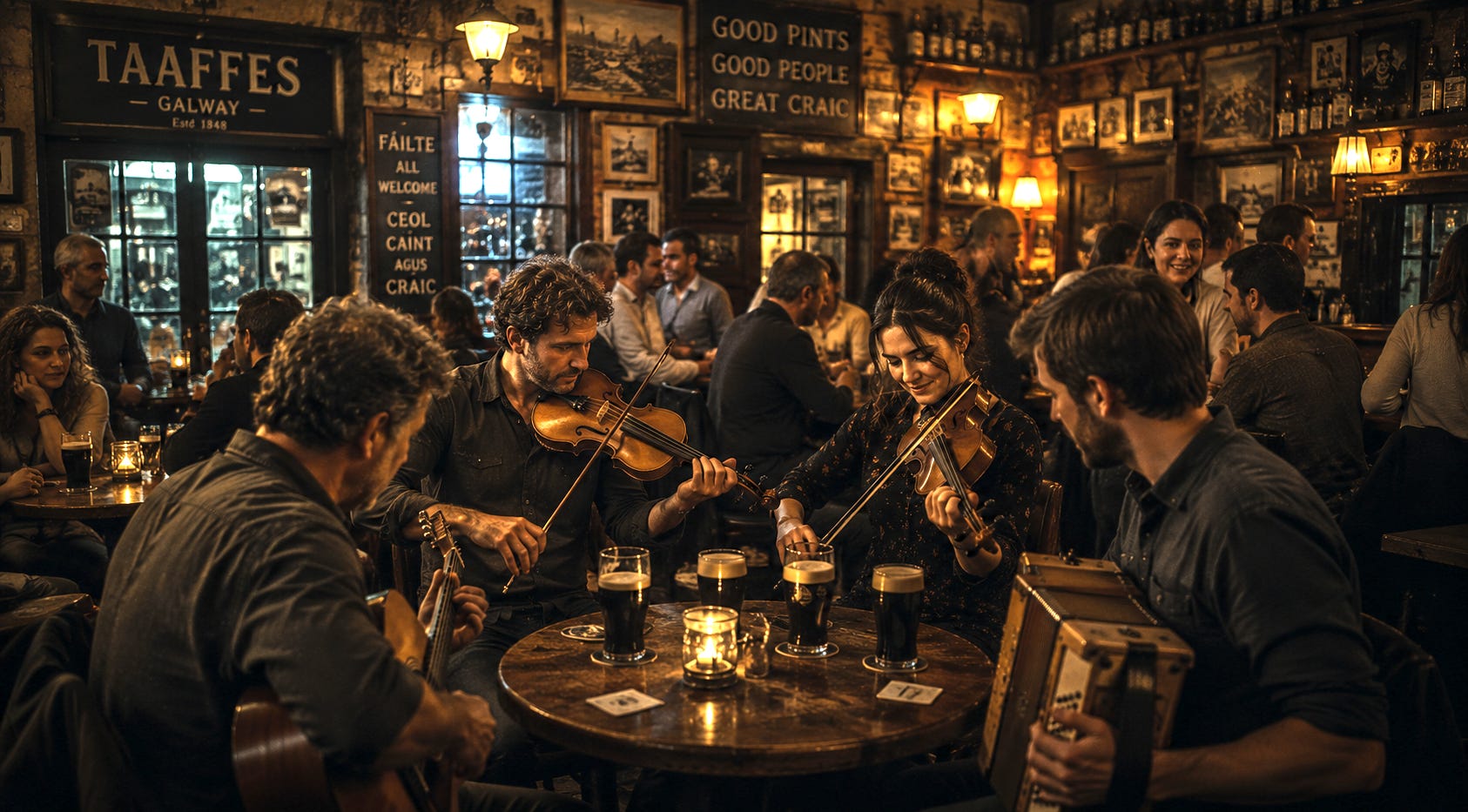
I was at Taaffes, a pub on Shop Street in the Latin Quarter, on Wednesday night when I caught a spark of hope for the AI revolution.
The Guinness was flowing — grab a pint here and you understand why it becomes a lifestyle. But the music was the point. A few people at a table, instruments out, everyone around them talking as they listened. I had come to understand this wasn’t incidental. Irish “trad music” is meant to be played that way — at a table, with people close enough to listen. There’s something intimate about the arrangement, perfectly Irish, and it doesn’t scale.
Recorded music is a recent thing in the long story of us. A blink, really. And for all the convenience of streaming, it’s a massive dilution of the experience of a few people making something in a small room while others sit close enough to feel what they’re feeling.
Real music happens in person. So does most of what actually matters.
A Puritanical Definition of Work
Here’s what struck me, somewhere around the third pint.
There’s a definition of work that looks at that room and sees leisure. I guarantee you, having spent the week around musicians, that the fiddle player who held that room had some kind of day job. The people listening were either experiencing the joy of life, or massively under-productive for those few hours, depending on your point of view. The whole scene, the music and the pints and “the craic,” all filed under things you do once the real work is done.
It’s a Puritanical definition, and most of us carry some version of it. Work is output. Work is productive. Work is the serious, morally load-bearing thing, and everything else is what you get to do after.
I’d like to think that definition is about to have a very bad decade.
Machines already took most of the manual work — the mechanical, blue-collar labor a lot of men in particular built their identities on. We spent the century since deciding the knowledge work that replaced it was the higher calling. The clerical, the analytical, the information-processing, the white-collar stuff you needed a degree to do. That was the serious work now.
AI is coming for it. Not all at once, and not cleanly, but the direction is clear enough that pretending otherwise is its own kind of denial. We’ve created a calculator for words, and it’s going to do to knowledge work what the industrial machines did to the work before it.
So what’s left, when both are gone?
One thing is the work they value in Galway, especially on summer nights during the World Cup semi-finals. It’s the work of entertaining each other. Feeding each other. Teaching each other. Minding the history in the stone and the fields around the city. Taking care of the people we’re responsible for. The work that only the most Puritanical definition would ever have excluded in the first place.
Ahead, Not Behind
I didn’t see much evidence of AI in and around Galway, but I left thinking maybe they were ahead of us, not behind. It’s a place already organized around the things a machine can’t do, sitting there looking like a charming, quasi-medieval holdout right up until it starts to feel like a preview.
I’ve been circling this idea for a while now, from different angles. That the only moats left are brand and culture. That you’re still talking to a person, and what moves them is a story. That we talk about AI like it’s the weather — like a storm we’re tracking instead of one we’re seeding. The through-line under all of it is the same: the human part is the scarce part. Galway is what it looks like when a whole society is built around the scarce part, mostly by accident, a long time before the rest of us needed it to be.
Look… I don’t want to oversell this, and I’d be suspicious of anyone who wouldn’t temper it with a little economic reality.
A society organized around taking care of each other sounds lovely until you ask who pays for it, and how much. Many of the people who play the music and pour the pints and mind the history can’t afford to live near the thing they’re creating together. Galway has the same brutal gap between what housing costs and what work pays that every desirable place now has, and there’s no law of nature saying the human work will pay enough to live on just because it’s the work that’s left.
“There’ll be plenty of work taking care of each other” is exactly the comforting thing a man in my position wants to be true. It might be. It also glosses over the ugly part — the stretch between here and there runs straight through a lot of people whose skills stop paying before the new arrangement figures out how to pay them at all. I don’t have the answer. I’m not built to be a UBI guy, for God’s sake. But the old answers look thin against how fast this is moving, and I’d rather admit that than pretend the music drowns it out.
The Fiddle at the Table
My job is to find ambition and pour money on it. I’m doing my bit to finance the storm. I spend my days betting on the founders building machines that eat knowledge work.
I get that there’s irony in finding some peace in the place “ambition goes to die.” I felt it all week. I still don’t know what to do with it.
I certainly didn’t solve anything in Ireland last week. I drank my body weight in Guinness, listened to some good music, made by and next to some wonderful people, and let a place with a longer memory than mine give me a little hope about what comes next.
There have always been fiddles and pipes and concertinas at tables in Galway, and there always will be. You just have to be there, shoulder to shoulder with other people, to get it.
Here’s hoping that as the appeal of what we can get on our phones collapses, we find better ways to reward the people who create the experiences we value most, so we can create those experiences everywhere.
Comments
Nothing yet. Say the first thing.
Sign in to join the conversation.