
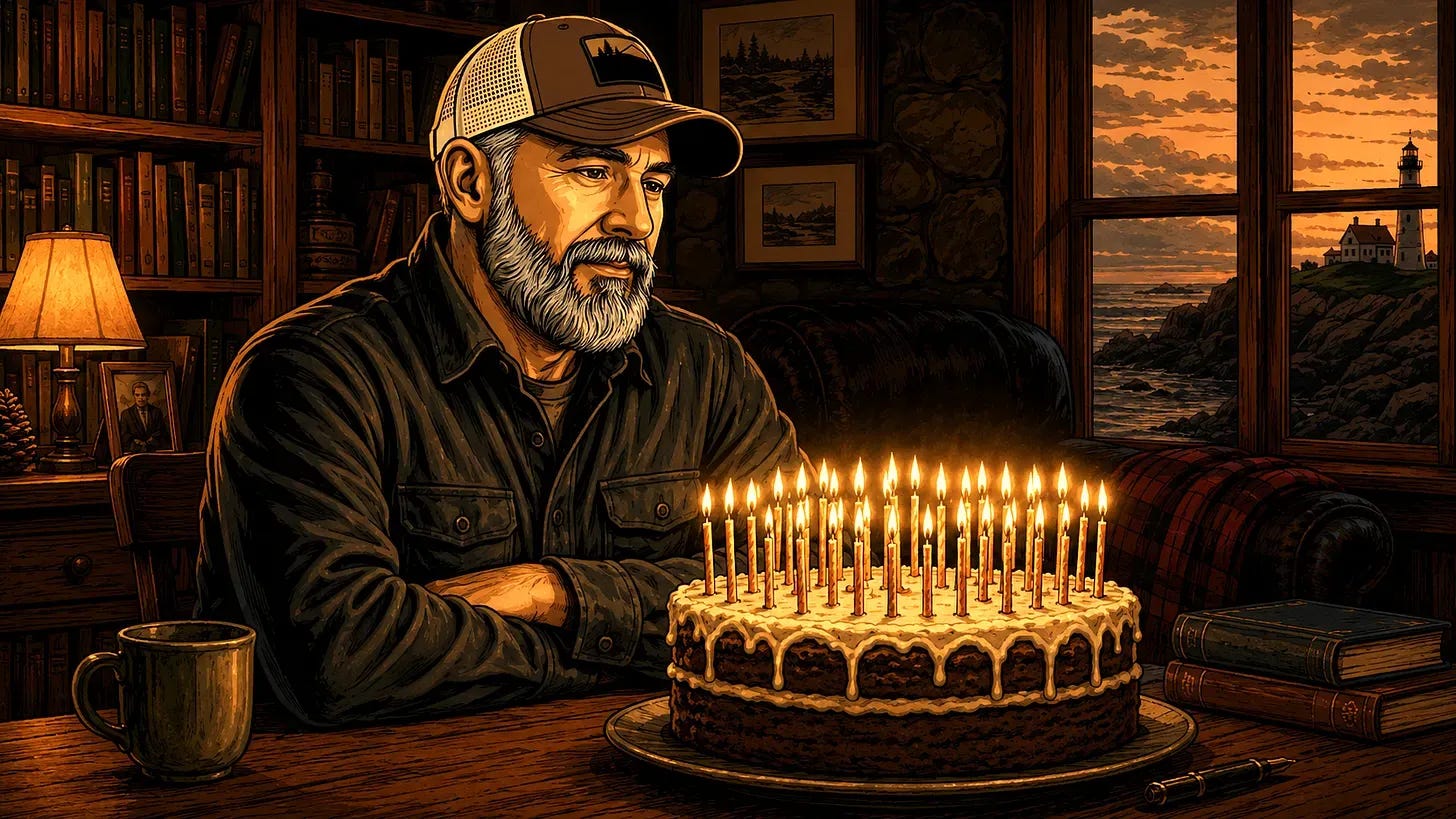
I turned 60 this week. It went fast.
I’ve written hundreds of thousands of words about strategy, brands, founders, and the people problems that decide whether any of it works. Looking back, ten good ideas are braided throughout.
Here they are. Not philosophy, and not advice. Just ten things I believe after 60 trips around the Sun. Most I learned by getting them wrong first, several I’m still getting wrong on any given Tuesday. I promise at least one is a mistake you’re about to make too, the rest you can tuck away.
1. There is only now.
The future is worry, the past is regret. Neither exists anywhere but in your head, and both charge rent you pay today.
I spent most of my twenties missing college… the daily rhythm of my friends, the freedom, the person I was then. They were all gone. I spent my thirties and forties chasing a version of myself who lived a few years out — a title, an exit, a number that meant I could stop. I thought I caught him a couple times, but he was gone when I got there too.
Meanwhile actual life was happening in whatever room I was in, sometimes to people I loved, and I was about sixty percent there for a lot of it. Not absent. Buffering.
What matters is happening now. Show up, and be there for it.
2. Let go of what happens to you. Own how you respond to it.
The Stoics worked this out two thousand years ago, but I still needed a couple of market collapses to get it.
You don’t control the round, the market, the diagnosis, the vote, or what the person across the table decides about you in the first ten seconds. You do control how well you see the truth of it, your choices, and your conduct. That’s the entire list.
Some read that as resignation, but it’s the opposite. Letting go of what you don’t control frees up everything you’ve got for what you need to do now.
The people I most admire in this business aren’t the ones who caught the wave. Plenty of idiots caught the wave. They’re the ones who took a tough situation, saw the truth of it, and kept working the problem to find the opportunity in it. Some found it. Those who went down at least did what they could for the people affected, and came through more worthy of another shot at the title.
The obstacle is the way. Spotting the iceberg early helps, sure. But you get judged on what you do after you hit it, and the guy who figures out how to sell the ice does fine.
3. If you want to change what someone does, change what they feel, not just what they think.
You’ve heard this one before. I’ve made a good living on it, so weigh it accordingly.
Information changes minds. Emotion changes behavior. They run on two different rail systems, and most startup execs — even marketing people — spend their time riding the wrong one. Better data, tighter logic, one more slide… all aimed at the part of the person that isn’t driving.
You’ve seen it, when the founder with worse metrics closes a massive A round. Or when your spouse agrees with every word you said and does nothing about it. Or when you know exactly what you should be eating for breakfast, and reach for the donut instead.
Ever been argued into caring? Nobody else has either.
So what does change people? Experience changes the people who have it. Only a story can change everybody else.
The only way to move an idea from your head into somebody else’s at scale is a story — a character they recognize, facing a problem they feel, on a journey that costs them something. That’s it. It’s been true since we sat around fires deciding whether the strangers across the river were dangerous enough to attack. It worked on cave walls, then in tapestries, in sacred texts, and in TV commercials. Today it’s memes. Tomorrow, something else. It has always worked. It always will.
4. If you’re not growing, you’re dying.
When you’re young you just kind of absorb stuff. We’re born plastic, for the same reason we crave connection and belonging to a tribe. There’s only so much that can be knit into our genes, the rest we have to get from other people.
Sometime in your early thirties that starts to get harder. In the aughts most of my friends thought MySpace was stupid. They were right. But ignoring it kept them off the better platforms that followed, and now it’s harder for them to stay connected to what’s happening in their grown kids’ lives.
Our thirties were when those kids arrived. Having them was punishingly expensive in every way, but eventually it started to pay back. Seeing the world through them — paying attention to what they’re interested in, how they think and talk — forces you to keep learning. Tech, music, culture, politics, language, art of every kind, an endless buffet of new stuff you can turn your nose up at or dig into.
Digging in pays. My taste in music has evolved thanks to my kids, as have my beliefs, and even my politics. One of my son’s friends told me last week she was “loving my Reels,” and it made my month.
I didn’t start cooking seriously until after B-school. We got our first dog when I was 50. Camping was a steep hill during COVID — after half a century as a dedicated indoorsman — but I figured it out one cold night and a few YouTube videos at a time. Crypto was a bust. Maybe AI is different, maybe not. But I’m willing to make the mistakes to learn it, and whatever comes next.
The Japanese have a word for the mental posture this requires: Sho Shin. It means “beginner’s mind,” a state of humility and openness that lets you meet something new unfettered by what you already think you know. It’s a lot harder at 60 than it was at 30, which is why I’m trying harder than ever to embrace it.
5. Most people are good, including most of those you’ve decided aren’t.
Ten minutes online will convince you everyone is an asshole. Ten minutes talking to somebody in person usually turns up an exception.
Social media has devolved into Attention Thunderdome, an unnatural spectacle with powerful incentives to say something outrageous and little social pressure to treat anyone with kindness. Shame is dead, replaced by an endless cycle of amped-up dumb-fuckery and virtue-signaling. No wonder we feel so alone.
The guy who plows my driveway has a red hat in his truck somewhere. When the snow is bad he shovels in front of my garage doors, which he isn’t paid to do, and I refill his thermos, which I don’t have to. Neither of us has moved the other an inch on anything that matters to the internet. We just like each other, which turns out to be available at a much lower price.
When I see something outrageous, I try to remember that no group agrees with everything its most backward and misinformed member says. Nobody is their best tweet, and nobody is their worst. We’re all out here seeing the world imperfectly, trying to get the people in our own tribe to see us, and to love us.
It’s really hard to hate anyone when you know what they’ve lived through. — Dawes
Cynicism feels like sophistication. It’s mostly just cheaper.
6. Build your professional life around your superpower.
People often tell me my career took some odd turns — New York ad man to entrepreneur to tech marketing leadership to VC.
To me it’s a straight line. A book I read a long time ago drew it for me.
It’s called “The Big Leap,” and it describes each of us as operating from four zones:
Zone of Incompetence — things we’re just not good at.
Zone of Competence — things we’re pretty good at. Most things, most people.
Zone of Excellence — things we’re very good at, through talent and experience.
Zone of Genius — the one thing we’re uniquely good at, even among people very good at that thing.
I figured out early that despite the long list of things I’m no good at — sense of direction, patience, attention to detail — I was uniquely good at storytelling. I could reframe a complicated idea as narrative, then share it in a way that changed how people understood it, and sometimes what they did about it.
I built my career around that skill. I sharpened it at McCann and Ogilvy, and learned that selling your time is a hard way to make a living. I started and sold an agency, and learned the exit multiple on a services business is nothing to write home about. I raised capital and ran technology companies, some of which worked, and learned that betting your whole career on one of them at a time is a hell of a way to manage risk. Eventually I moved to the investing side, where I could make multiple bets at once, and capture value through capital appreciation. Today storytelling sits at the center of my practice:
I source deals by being useful to the venture community, helping early-stage founders tell their story.
I pick deals based partly on whether a team can tell a story good enough to carry them to a venture-scale exit.
I support the portfolio by helping them sharpen those stories as the ground shifts beneath them.
I’ve created value the same way since I left Cornell. It just took thirty years to work out how to capture my fair share of it.
Here’s the trap, and it’s the reason most people aren’t able to do this. It isn’t the Zone of Incompetence that holds you — you know what you’re bad at. It’s the Zone of Excellence. The thing you’re very good at pays pretty well, people keep asking you for it, and saying no to it feels insane. You spend a career being excellent at something that isn’t the thing you’re better than everyone else at.
Find the one thing. Then be ruthless about the rest.
7. People deserve your loyalty, not companies.
A company is a legal fiction with a payroll. It can’t love you back, and in a bad quarter it will make an entirely rational decision about you. That’s not villainy, it’s arithmetic. Don’t take it personally, and don’t expect otherwise.
A person is something else. Thirty years in, the through-line of my career isn’t the logos on my resume. It’s a few dozen people who’d take my call at midnight, and whose calls I take every time. Nearly every good thing that’s happened to me professionally came through one of them, often years after we worked together, and never because I planned it.
Don’t “network.” Be useful to people who need your help, without strings, for long enough that you forget who owes you what. Then one day, in a room you’re not in, somebody says your name.
Be worth vouching for. Then vouch, loudly, for the people who are. Your network isn’t LinkedIn. It’s whoever would help you move.
8. Culture eats strategy for breakfast, and brand does the same to product.
Maybe Drucker never said the first half, but he should have.
Strategy is a document. Culture is what survives contact with your actual people. You can write the sharpest plan in your category and watch it die quietly because your VP of Sales doesn’t believe it, and everybody else can tell.
Culture isn’t the values on the slide. Integrity! Respect! Diversity! Nobody’s against any of those, which is the problem. Real values are the ones that help somebody decide. Hometap’s mission is helping people love their homes more and stress about them less, and I’ve watched front-line marketers and engineers there hold a tactical call up against that sentence and land exactly where the CEO would have, without the CEO in the room. That’s culture doing work. It gets built one uncomfortable decision at a time — who you promote, who you let go, what you refuse to tolerate from the person carrying the number.
Brand does the same thing to product. Product is what you give your customers. Brand is what they expect before they try it, what they feel when they do, and what they say about it after. Two products that do the same job at the same price never sell the same amount, and the gap isn’t rational. It never was. A brand nobody objects to is a brand nobody remembers.
I’m an ad man who became an investor, so weigh this accordingly. But the ground is moving my way. AI is making strategy cheap to copy and product cheap to build. Your competitor has the same models, the same playbook, and roughly the same prompts you do.
Product and strategy you can buy. Culture and brand you have to earn.
9. You can’t measure what matters most.
Business school taught me you can’t manage what you can’t measure. Mostly true, and the most expensive half-truth in American management — because of what it implies and never says: that if a thing can’t be measured, it probably doesn’t matter.
My watch knows my resting heart rate. It knows nothing on the depth of my relationships, my progress toward being the man I meant to be, or whether the people closest to me are actually okay. Those are the things that make extra years worth having.
Same trade at work. Trust. Taste. Nerve. Whether anybody tells you the truth while there’s still time to do something about it. Try building a dashboard for that.
Optimize everything you can count and you’ll finish marginally ahead of the guy next to you. You’ll also never get the magic that sets great, enduring businesses apart from good, temporary ones.
10. Everything ends.
Every job. Every company. Every era of your life, every version of yourself, every friendship you assumed was permanent. And eventually you.
In 1982 I was a curly-haired sophomore in Johnston, Rhode Island, and my father watched the news every night. The night Tom Brokaw first anchored NBC Nightly News I remember thinking he talked funny, and that he looked impossibly young. The man he replaced was John Chancellor — a giant of the news business, a fixture in my living room and a few million others for the better part of two decades.
If you were born after 1980, you may know Brokaw as a doyen of the news business. You’ve probably never heard of Chancellor.
That’s how it goes. That’s how it will go for you, and for me. And it’s ok. Knowing it doesn’t make it sad, it makes it legible. A thing that lasts forever has no shape. Endings are what give beginnings and middles their meaning.
Read this at 25 and it probably sounds morbid. Write it at 60 and it sounds like the weather. Somewhere in between, if you’re paying attention, it turns useful — the moment you stop treating your time as an unlimited resource and start spending it like a person who can see the bottom of the ledger.
Everything ends. Act accordingly.
Sixty isn’t old. Ask anybody who’s seventy. But the arithmetic changes. There’s more behind me than in front of me, and no quantity of peptides fixes that.
It bothers me less than I expected. What I notice instead is that the room I’m in has gotten more interesting — the conversation, the dog, the kid on the phone who needs something I can give them, the friend who’s struggling and hasn’t said so yet.
I don’t know what “retire” really means now, but it’s not the right word for whatever comes next. That word looks backward, at something you’ve already done. A better one is remake. There’s a world we’re born into and a world we build over a lifetime, but there are infinite others besides. If you’re done working but not done growing, go find one. You get to remake yourself, one last time.
I’m a ways from there. I’d just like to be more present the next stretch than the last one, which brings this list back around on itself. Number ten is why number one matters: everything ends, so there is only now. The other eight are footnotes.
I’ve spent this last week with people I love, doing things we’ll remember, eating things my doctor wouldn’t approve of. A capper of a week on the Maine Coast, marking another milestone along the way. I intend to be greedy about the rest.
Hope to see you out there.
Comments
Nothing yet. Say the first thing.
Sign in to join the conversation.