
At Glendale Community College this spring, the school used an AI system to read graduates’ names as they crossed the stage. It got some wrong, and skipped others entirely. Kids who’d spent four years and a pile of money to hear their own name said out loud, at a ceremony built for that moment, instead got a machine that fumbled the only line that mattered to them.
The crowd booed.
It wasn’t a one-off. Across the country, graduates booed it off the stage. At the University of Central Florida, a speaker called it the next industrial revolution and got drowned out mid-sentence. At Middle Tennessee State, a record-label CEO told the class AI was rewriting his industry as they sat there, and they let him know how that landed. The apex was the University of Arizona, where Eric Schmidt — former CEO of Google, a man who’s made AI-scale money — got booed repeatedly for telling graduates the technology would touch everything they do.
What stuck with me: it wasn’t just the technology getting booed. It was the people selling it.
The Kitchen Argument
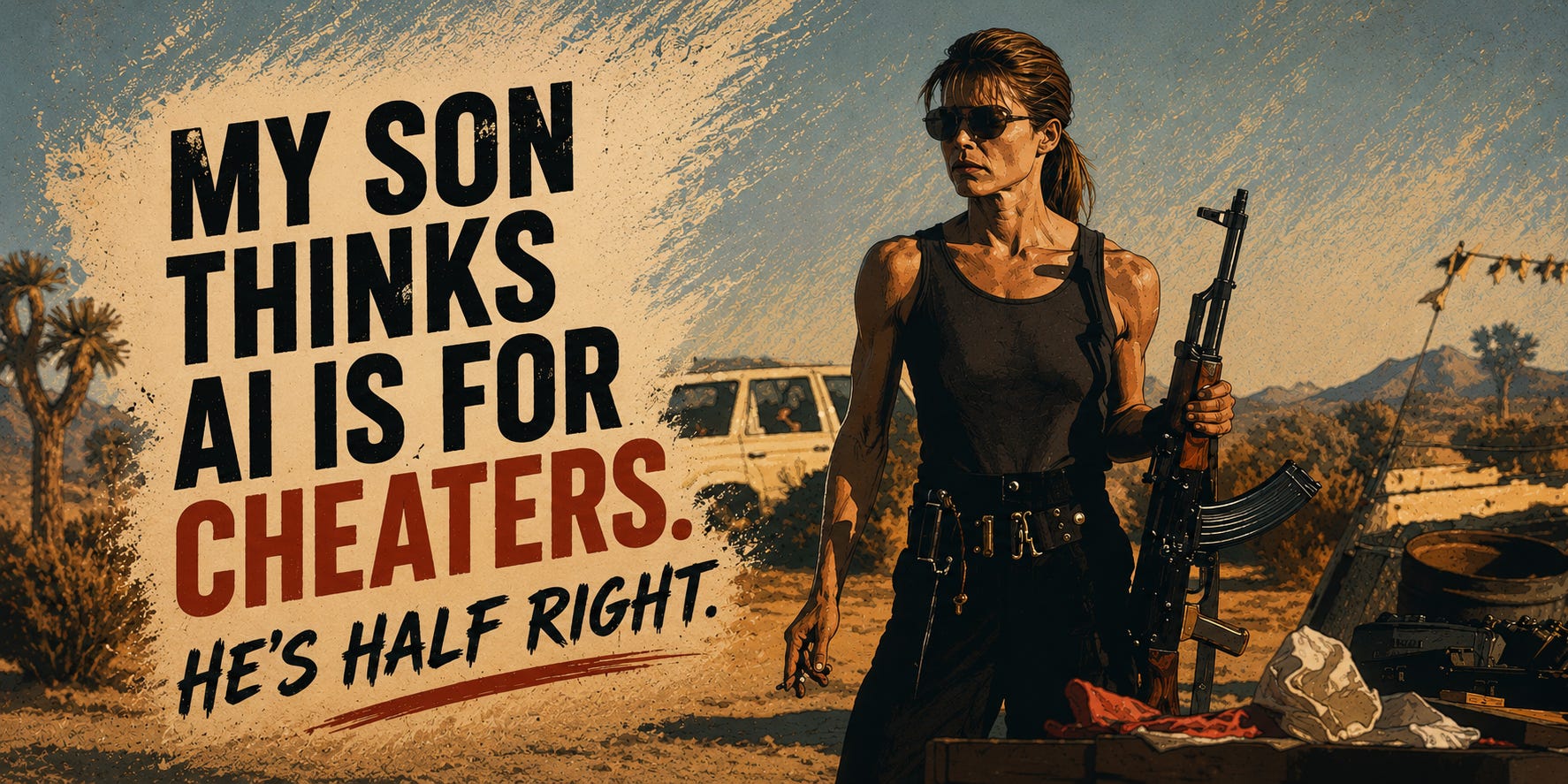
My son is twenty, in college, and would have been booing right along with them. I know, because we got into it over spring break.
He and his friends were at our house, bags by the door, waiting on a car to Logan. We got to talking about AI. For every story I had about something exciting in the venture world — a founder building in weeks what used to take a year, a kid with no money and a good idea suddenly able to make the thing — they had one going the other way. A classmate who stopped showing up to lecture and let Claude carry him to a B-minus. Another who’d perfected the art of hiding AI’s fingerprints from professors a step behind on banning it. More than one who can’t write (won’t, really) because they figure they’ll never need to now. To my son and his friends, AI isn’t a superpower. It’s an enticement to laziness, with a dishonesty chaser.
Full disclosure… our fund is long on AI, just like every other venture fund in the world right now. But I know AI looks very different from the dorm room than it does from the boardroom. Standing there that day in my kitchen, what I didn’t want to admit was that the dorm room view isn’t wrong, it’s just incomplete.
They’re right…
This generation has drawn some tough cards. They’re the first raised inside an algorithmic feed, and have the scars to show for it. It taught the girls to hate their bodies and gave the boys somewhere to disappear. It tracks with a rise in teenage depression and loneliness so steep that the people who study this for a living are still arguing about how a whole generation got this sad this fast. They watched the platforms that did it grow enormous, and the people who own those platforms get close enough to power to run the country.
Now those same people are on a stage, in robes, telling them the next thing is going to be even bigger.
Of course they booed.
When my son looks at AI and sees a machine that lets people fake the work, plus a handful of billionaires who get richer whether or not it’s good for anyone else, he’s reading the evidence in front of him correctly. He’s not paranoid. He’s paying attention.
And his real worry isn’t about cheating at all. It’s that all the small good uses and all the small bad uses aggregate into something worse for everyone — a flatter, faker, lower-trust world, arriving one convenient shortcut at a time. A world getting more deeply enshittified while a few assholes somewhere outside Santa Clara get absurdly rich.
I’m not going to pretend I’m above that fear. I actually share it.
…and incomplete.
That said, he’s only half right — and he’s letting that half-truth harden into a verdict that could shape his whole career.
The whole truth? The harms are coming for him and his friends either way.
The enshittified world doesn’t check whether you opted in. It doesn’t spare the kid who refused to touch the stuff on principle. He gets the same flattened world as everyone else, just with none of the skill, leverage, or standing to do anything about it. Refusing AI doesn’t keep him clean of the downside. It keeps him out of the room where the downside gets allocated.
That’s what the boos miss. Schmidt earned some of what he got. But buried in his speech was something true the kids couldn’t hear because of who was saying it: the technology isn’t finished, and they’re the ones who get to finish it. From the guy who got rich on the last wave, that lands as a taunt. From a parent who’s scared right alongside them, it might be the most useful thing I can offer.
What Employers Want
Here’s what I’m watching happen in the job market my son is about to walk into.
College used to be where you went to acquire specialized knowledge. The thing that made you hireable was the belief you knew something most people didn’t. That edge is evaporating fast because a machine knows all of it now, and can recite it on demand.
Just like calculators made basic math skills less valuable in adult life, AI is doing the same to big swaths of knowledge, analysis, and even creativity. AI is like a calculator for words, and forbidding it in the classroom will seem as foolish 20 years from now as forbidding the use of my HP-17B would have been 20 years ago.
Employers have quietly stopped screening for what you know. They’re screening instead for what you’ll do.
I wrote a while back, after a night with a roomful of go-to-market executives, that the AI advantage isn’t about tools — it’s about people, specifically people with agency. The ones who don’t just spot the problem and write a memo about it, but grab it by the throat and solve it. That hasn’t changed. It’s intensified. Every company I see still hiring entry-level talent is screening for two things at once: agency, and proof you can use this new generation of AI-native tools to deliver on it.
Now, I’ve also argued — more than once — that AI adoption is a treadmill, not a moat. The second a capability is available to you, it’s available to your competitor, and whatever speed you gained dissolves into the new baseline. True for companies, but not for a twenty-year-old at the start of a career, at least not when he’s hunting for that first job.
For him, the gap between the kid who learned to think with these tools and the kid who refused isn’t a treadmill. It’s a head start that compounds — the way learning to write well, or read a balance sheet, or talk easily to strangers paid off for thirty years. What keeps me up isn’t that my son falls a step behind. It’s that the step becomes a gap, the gap becomes a wall, and by the time he decides he’s ready, the people who started at twenty are the ones running things.
He Already Has the Hard Part
Here’s the irony... My son already has the one thing all of this depends on.
The refusal to fake the work — to be the kid who’d rather earn an A than steal one — is integrity, and integrity is the rarest thing on the hiring market. He doesn’t have the wrong values. He’s just drawn the line in the wrong place.
Using AI to skip the thinking is exactly the cheating he thinks it is. He’s right about that kid in his class. But using it to go further than he could go alone — to pressure-test an argument, find the hole in his own logic, do in an afternoon the kind of exploration that used to eat a week — isn’t cheating. It’s the opposite. It’s more of the real work, not less.
The cheater and the craftsman can hold the same tool. The difference is not whether you use it. It’s whether you’re using it to dodge the work, or to do more of it. To do it better. My son already knows which kind of person he is. He just hasn’t clocked that it makes him the one who should be using it better — not the one refusing to.
For Fellow Parents Watching This
If you’ve got a kid recoiling from this stuff, I don’t think the job is to talk them out of the fear. The fear is earned. Cheerleading them past it only makes you sound like the guy on the stage they already booed.
The job is harder. It’s helping them see that refusal isn’t the principled stand it feels like, that opting out doesn’t protect them from the world they’re afraid of. It just guarantees they’ll meet that world with no leverage and no say. You don’t have to sell them on the technology. You have to keep their good instincts from talking them into surrender.
They’re right to be afraid. They’re right that some people will use this to cheat, and that some of the people pushing it don’t have their interests at heart. Let them keep every bit of that.
Then help them understand that the people best equipped to fight for a better version of this world are the ones who bothered to learn how it actually works.
———
My son heads back to school in the fall. I hope he’s still booing… wary, skeptical, and unconvinced. That instinct is among the best things about his generation, and it just might save us all. I’d hate to watch it go quiet. I just don’t want it to be the whole story.
Be afraid of AI, sure. Be suspicious of the people selling it. But let those impulses drive you to master it, not hide from it.
The future isn’t written yet.
Like they said in a movie back in our time: “There is no fate but what we make.”
Comments
Nothing yet. Say the first thing.
Sign in to join the conversation.