
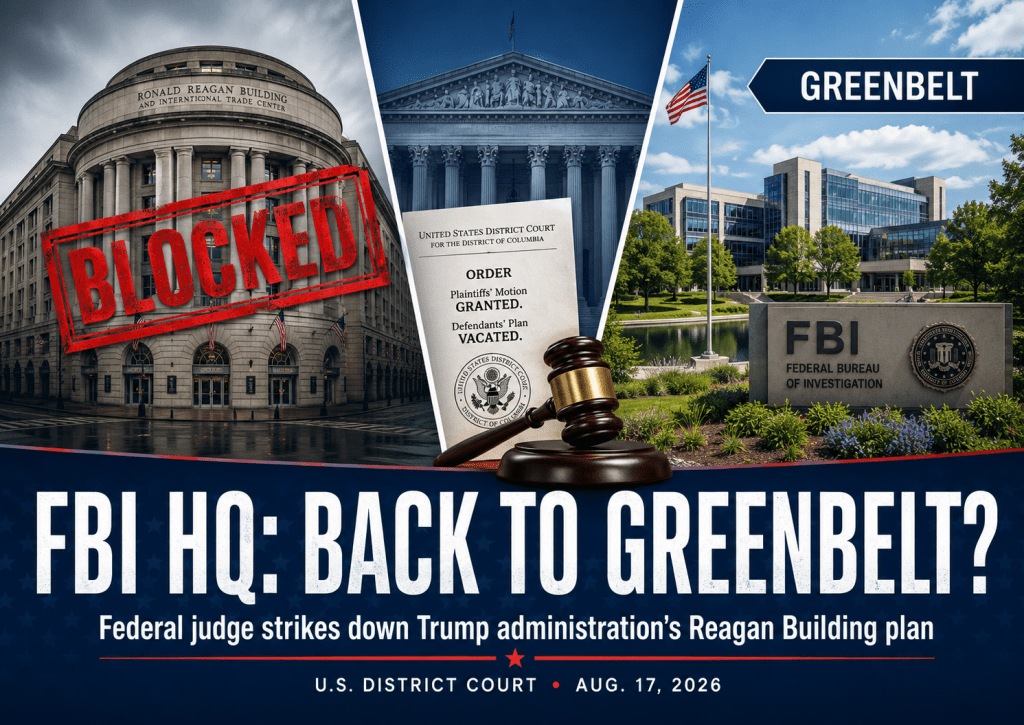
A federal judge sitting in Greenbelt ruled Monday that the Trump administration had no legal authority to move the FBI’s new headquarters from the congressionally mandated Greenbelt site to the Ronald Reagan Building in downtown Washington — and permanently blocked the administration from spending another dollar to make that move happen.
Congress gave the government three choices. The Reagan Building wasn’t one of them.
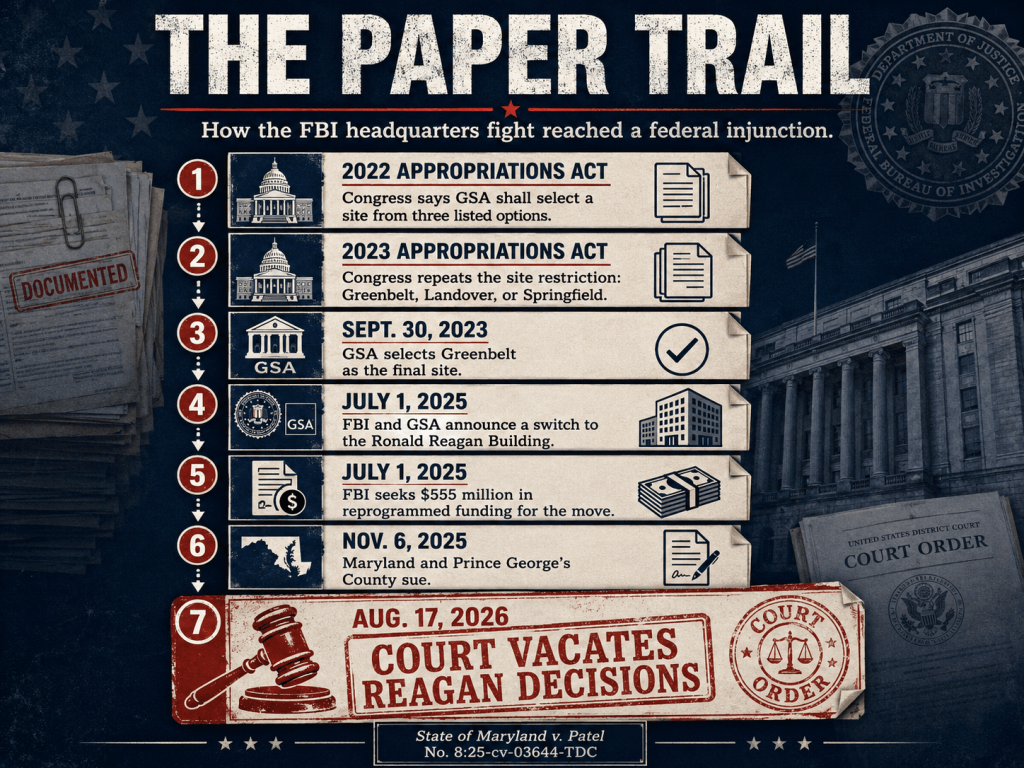
U.S. District Judge Theodore D. Chuang granted Maryland and Prince George’s County’s motion for judgment on the pleadings on three of the six counts in their lawsuit, State of Maryland v. Patel, and denied the administration’s cross-motion outright. In a 47-page memorandum opinion, Chuang held that both the FBI’s and the General Services Administration’s July 2025 selections of the Reagan Building violated the Administrative Procedure Act because neither agency had the statutory authority to pick a site Congress never approved. He further found the FBI’s related decision to reprogram $555 million toward the Reagan Building was “arbitrary and capricious” because it rested on that same legal error.
The court vacated and declared void all three actions — the FBI’s site selection, GSA’s site selection, and the funding reprogramming — and issued a permanent injunction barring the administration, its officers, agents and anyone acting in concert with them from taking any further steps to advance the Reagan Building relocation, including spending, obligating, or disbursing any funds toward it. The order requires the parties to file a joint status report within 14 days addressing next steps and whether the case can be closed.

The opinion turns on language Congress wrote into two appropriations laws. In both the 2022 and 2023 Consolidated Appropriations Acts, Congress directed that “the Administrator of the General Services Administration shall select a site from one of the three listed” in a 2017 GSA prospectus — Greenbelt, Landover, or Springfield, Virginia — “for a new fully consolidated Federal Bureau of Investigation headquarters.” GSA picked Greenbelt in September 2023, in a 38-page decision by then-Public Buildings Service Commissioner Nina Albert that explicitly overruled a site-selection panel’s recommendation for Springfield and stated the choice was GSA’s “final determination.”
When the FBI and GSA announced the switch to the Reagan Building in July 2025, neither agency’s press release so much as mentioned the statutory site-selection requirement. FBI Director Kash Patel called the move “cost-effective and resource-efficient”; GSA Public Buildings Service Commissioner Michael Peters said it would save “billions of dollars on new construction.” Chuang found that beside the point: the statute’s mandatory “shall select” language, he wrote, “provides no conditions under which the selection could be unilaterally rescinded or switched to a nonconforming site,” and the administration’s lawyers didn’t seriously argue otherwise until oral argument in June — an argument the court ruled came too late to consider, and rejected on the merits anyway.
The question wasn’t whether the Reagan Building was cheaper. It was whether the administration had the authority to choose it.
On the money. Because the reprogramming’s stated purpose was to implement a site decision the court had already found unlawful, Chuang held it was arbitrary and capricious under the APA — a decision “based on a misapprehension of existing law,” in his words. He noted the problem was especially acute for $323 million of the reprogrammed total that Congress had specifically earmarked in 2017 for a consolidated headquarters in one of the three approved locations, not the Reagan Building.
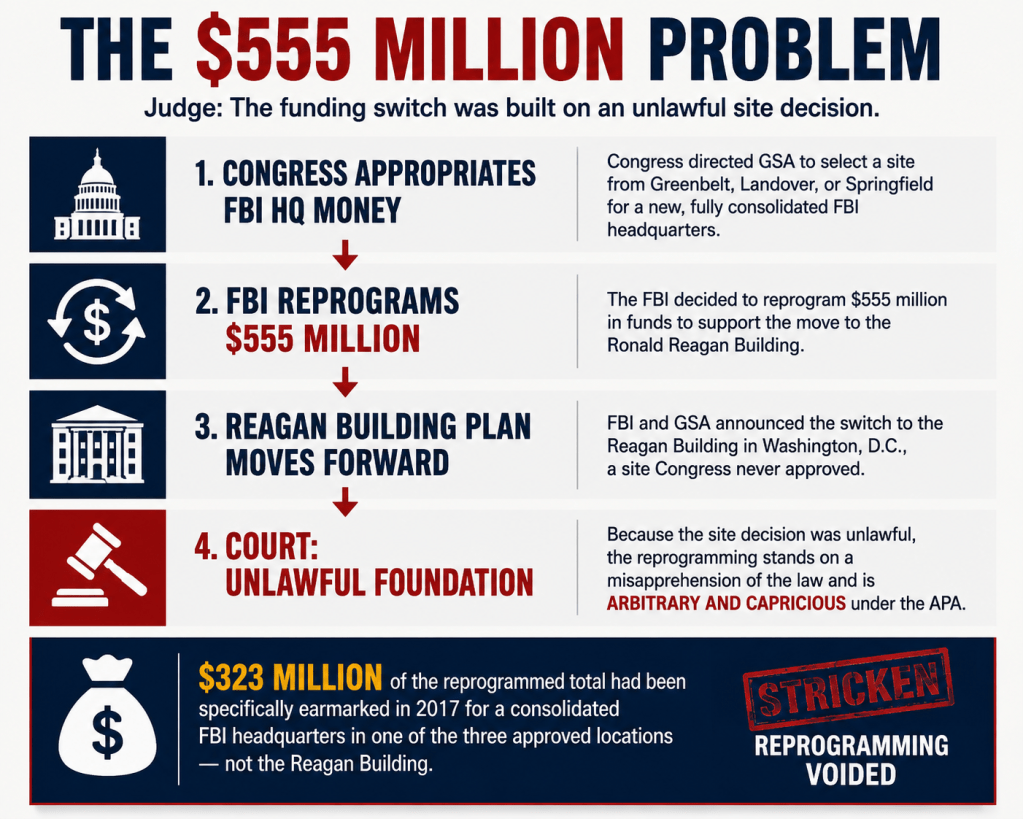
Once the site decision fell, the $555 million reprogramming fell with it.
The ratification argument. The administration’s central fallback was that Congress had effectively blessed the switch through a provision buried in the 2026 appropriations act — one requiring the FBI to submit completed architectural and engineering plans before spending any of the reprogrammed funds, language that referred to the funds as having been “subsequently reprogrammed.” The government argued the past-tense phrasing amounted to congressional ratification. Chuang rejected it, finding the provision “does not endorse or approve of that action but instead immediately imposes a specific restrictive condition to block the use of those funds.” He also pointed to the provision’s legislative history: it was introduced by Sen. Chris Van Hollen (D-Md.), who described it on the floor as aimed at addressing “the Trump administration’s ongoing efforts to set aside and ignore the decades-long site selection process” — the opposite of an endorsement. Ratification, the court noted, requires “clear and unequivocal language,” and ordinary appropriations riders are “a particularly unsuitable vehicle” for it.
Congress restricting the money was not the same thing as Congress blessing the move.
Notably, Chuang observed that the administration “cited no case in which a court actually found that Congress ratified an Executive Branch action” under comparable circumstances. Its lead authority, Ex parte Endo, actually cuts the other way: that 1944 case held Congress had not ratified the wartime internment of Japanese Americans through an appropriation, because a lump-sum appropriation didn’t “plainly show a purpose to bestow the precise authority” the government claimed — the same defect Chuang found in the FBI’s reprogramming here. The court noted that to the extent Endo points to any successful ratification in that era, it’s Executive Order 9066 itself, validated in Hirabayashi v. United States — a precedent Chuang said would be “unbecoming of the United States government” to invoke, given that the related Korematsu decision has since been thoroughly repudiated by the Supreme Court. He added that he assumed the administration wasn’t actually asking the court to rely on that comparison.
Standing. The government’s other major argument was that even a win for Maryland wouldn’t fix anything, because Congress still hasn’t fully funded construction at Greenbelt and some House committee chairs have raised concerns about the site. Chuang called that kind of forecasting outside the court’s “role,” citing Fourth Circuit precedent that redressability requires only a “realistic possibility” of ultimate relief, not certainty. He noted GSA had already signaled it was prepared to begin site work at Greenbelt using existing balances before full funding arrived, the same approach used for the DHS consolidation project at St. Elizabeths.
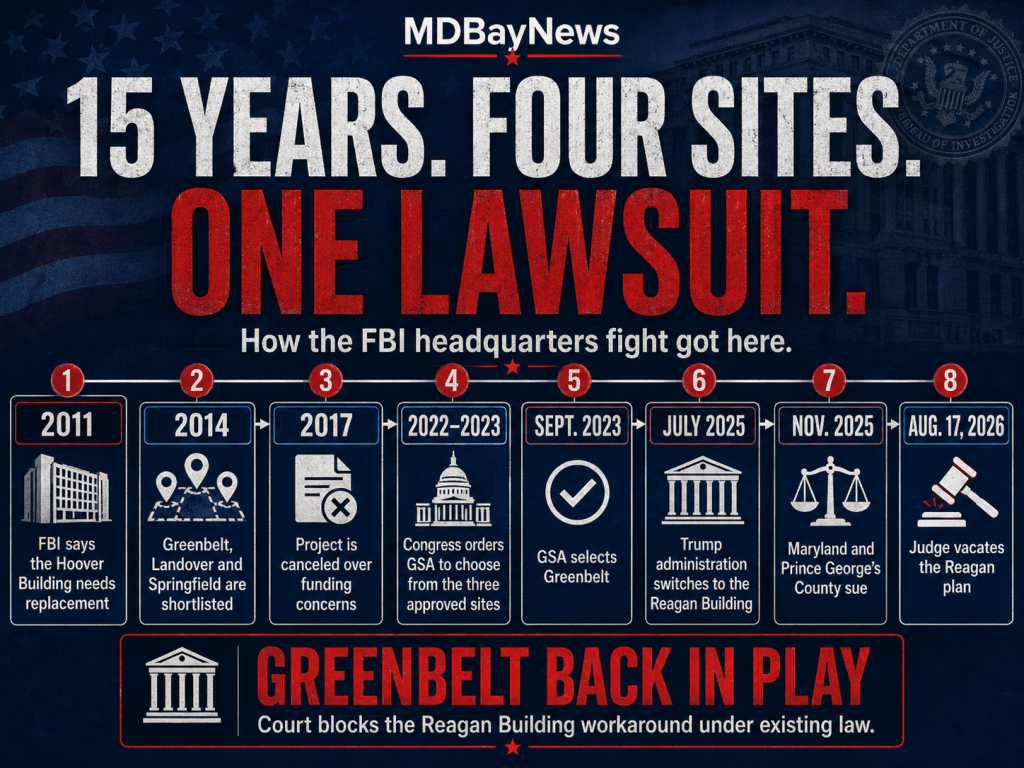
The memorandum opinion includes an extensive history of the project that even close followers of the story may not have seen assembled in one place. The push for a new FBI headquarters dates to a 2011 FBI report describing the J. Edgar Hoover Building as having “the worst physical security of any Agency-level headquarters in the Intelligence Community or Department of Defense.” GSA shortlisted Greenbelt, Landover and Springfield in 2014. The project was abruptly canceled in 2017 over funding concerns — a decision that drew bipartisan anger from the Senate Environment and Public Works Committee at the time, with then-Chairman John Barrasso (R-Wyo.) complaining that “Senators should not have to find out about a decision of this magnitude by reading about it in The Washington Post.” Congress revived the project via the 2022 and 2023 statutory mandates at the center of this ruling.
The ruling does not order the FBI to start building in Greenbelt tomorrow. It removes the administration’s Reagan Building alternative under the existing law.
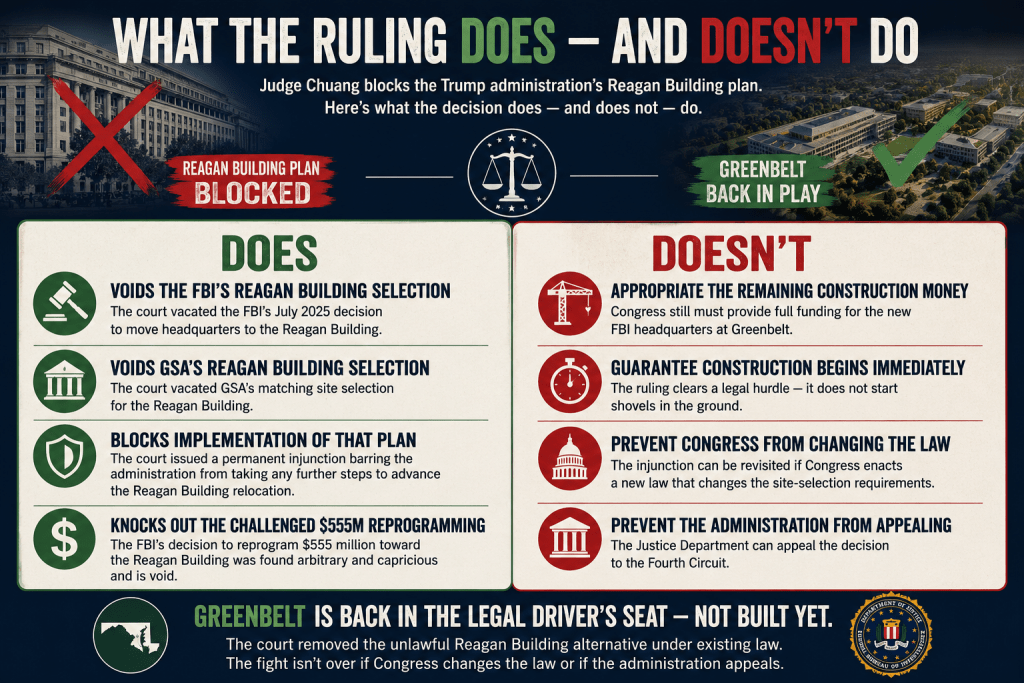
The court’s injunction can be revisited “in the event that Congress takes statutory action to rescind or alter the Site Selection Provisions” — meaning the fight isn’t necessarily over if Congress itself changes the law, as opposed to the executive branch acting unilaterally. Separately, the Justice Department has not indicated whether it will appeal to the Fourth Circuit. Neither the FBI nor DOJ has issued a public statement responding to the ruling as of this writing.
Attorney General Anthony Brown, in a statement issued after the ruling, said the decision “cleared the path back to Greenbelt” and framed it as bigger than one building: “It is about ensuring that when Congress makes a decision, the Federal Government cannot simply ignore it because they do not like the outcome.”
Sources: Order and Memorandum Opinion, State of Maryland v. Patel, No. 8:25-cv-03644-TDC (D. Md. Aug. 17, 2026), ECF Nos. 32–33; Complaint filed Nov. 6, 2025, and Motion for Judgment on the Pleadings filed Feb. 17, 2026, same docket; Statement of Maryland Attorney General Anthony G. Brown, Aug. 17, 2026 (oag.maryland.gov); statement of AG Brown, Gov. Wes Moore, Sen. Angela Alsobrooks, Rep. Steny Hoyer, Rep. Glenn Ivey and PG County Executive Aisha Braveboy, Nov. 6, 2025 (oag.maryland.gov); case docket via the Civil Rights Litigation Clearinghouse and CourtListener.
Comments
Nothing yet. Say the first thing.
Sign in to join the conversation.