
Editor’s note: This is a more complete version of the abridged version available at Epoch Times: https://www.theepochtimes.com/opinion/new-trump-class-ships-could-face-setback-over-railgun-failures-5964743
On December 22, 2025 President Trump announced plans to design and build a new class of large surface combatants—dubbed “Trump-class battleships.” These ships would be the centerpiece of his “Golden Fleet” initiative, with initial plans calling for two ships (lead vessel USS Defiant, ~35,000–40,000 tons), scaling potentially to 20–25. Renderings and Navy statements highlight advanced armament: hypersonic missiles, nuclear-capable cruise missiles, directed-energy lasers - and explicitly, a 32 megajoule (MJ) electromagnetic railgun as its main gun.
Railguns Sound Super Cool, but…
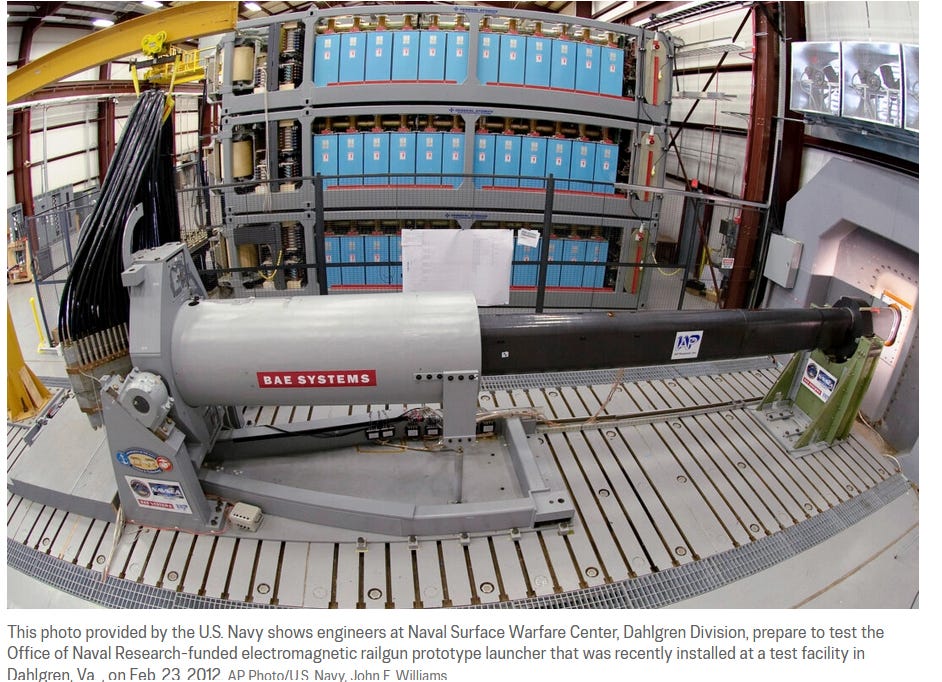
Railguns promise Mach 7+ velocities and 100+ nautical mile ranges with inexpensive kinetic projectiles. This certainly sounds cool, but while defense contractors would love a multi-billion dollar contact to try and make railguns viable, the reality is that insisting on incorporating a railgun into President Trump’s new proposed missile battleship will delay its construction and deployment indefinitely. What’s more, even if the intractable problems that have made the railgun a fantasy in terms of an operational Navy gun for the foreseeable future were magically overcome, incorporating a railgun into the Trump-class ship would cripple both its offensive and defensive firepower potential relative to currently available, vastly superior options.
The first really big clue that this indeed the case is that the U.S. Navy spent over $500 million from 2005–2021 pursuing this technology before canceling the program in 2021, concluding it offered no viable path forward for the foreseeable future.
Intractable Issues That Forced Program Cancellation
The same fundamentals science barriers the Navy was trying overcome I highlighted in 2014 doomed the Navy’s railgun effort. Immense electromagnetic forces eroded rails after just dozens to a few dozen full-power shots—far short of the thousands combat demands. Accelerations exceeding 40,000 g destroyed guidance electronics. Gigawatt-scale pulses require massive capacitor banks that degrade rapidly and consumed impractical shipboard volume and cooling. Designers never achieved promised repetitive firing rates, and integration on power-constrained ships proved impossible. Downrange, hypersonic drag bleeds off railgun velocity, delivering less terminal effect than conventional explosive rounds. In 2021, the Navy shifted resources to hypersonics and lasers, implicitly acknowledging that railguns were not the path forward regardless of how much more money was spent.
But did the Navy surrender prematurely? Have other nations cracked the problems the United States could not?
Railgun Efforts in Other Nations: Marginal Progress Without the Needed Scientific Breakthroughs
China, Japan, and India have continued researching railguns, but none are anywhere near producing a viable naval railgun. While there have been some clever engineering tweaks, none of these nations have made the revolutionary scientific breakthroughs necessary to develop a workable naval railgun.
But even if the intractable durability problems that led to cancellation of the Navy’s railgun program were someday solved, on a per-ton of displacement basis, a railgun is vastly outperformed by more mature conventional guns. A modern Mk 45 5-inch mount is many times more efficient in delivering destructive energy downrange. And on a per-ton of installed weight basis, a 1940s-era Mk-7 16-inch gun firing a high-capacity shell is at a minimum 22 times more efficient in delivered destructive energy to a target than our notional naval railgun on a per ton of installed weight basis —and this includes its 14 to 17 inches of armor.
The weight and size of 32 MJ railgun system is truly enormous
The unarmored turret and railgun barrel assembly (including rails, containment, and controls) weighs 60 to 80 tons. The below-deck infrastructure—including the massive pulsed-power supply, capacitors, cooling, and ammunition handling—adds another 300 to 400 tons or more.
For context, a modern Mk 45 5-inch gun mount weighs just ~25–30 tons total. The WWII-era Mk 7 triple 16-inch turrets on Iowa-class battleships gives us a ~575 ton per gun average (including heavy armor and all below-deck ammunition handling). Yet the battleship gun fires a 1,900 lb. high-capacity shell that delivers 410–470 MJ of total destructive energy (kinetic + explosive) to a downrange target—compared to the ~20 MJ or less a railgun projectile can realistically retain after the atmospheric drag losses that are so devastating to small rounds.
Even though a notional railgun might achieve roughly three times the firing rate of the big 16-inch gun, its ability to attack fortified targets or deliver devastating area-effects is orders of magnitude inferior due to the lack of explosive payload and the sheer mass needed to penetrate meters of reinforced concrete.
Regarding range, both 16-inch and modern 8-inch guns can fire low-drag, sub-caliber guided projectiles with ranges of 100 miles and beyond with much more destructive energy than a railgun projectile. But unlike the railgun, the technology to build and sustain such guns already exists today.
Railguns are Terrible at Ranges that Conventional Guns Handle Easily
Another nail in the coffin for the railgun is because it depends entirely on velocity and kinetic energy for damage, it is downright terrible at engaging over-the-horizon targets at mid-ranges of 5 to 20 miles due to a combination of its very high initial velocity not allowing the railgun to strike targets just over the horizon and that the vast majority of kinetic energy is bled away by air resistance for targets over 15 miles away.
Very briefly: if fired on a least-time-to-target flat trajectory, the hypersonic projectile will overshoot close-in targets (e.g., 5 miles) and arrive at longer ranges (e.g., 20 miles) with insufficient retained energy for serious damage. Alternatively, it can be fired on an energy-maximizing high-arching trajectory that can hit both 5-mile and 20-mile targets, delivering in the neighborhood of 14–16 MJ on impact. However, these high-arc shots take up to six minutes to reach their targets—giving the enemy ample time to maneuver or evade.
And this assumes the railgun actually has a working guidance package capable of surviving launch and providing mid-flight corrections—which, at this time, it does not.
Conventional guns can hit targets at both ranges in under minute with explosive shells and a higher percent of retained kinetic energy.
All of the above is not necessarily an argument for big-caliber naval guns, but rather to dispel the illusion that railguns represent a major advance. In reality, they are not possible for the foreseeable future without revolutionary breakthroughs that show no signs of emerging. But even if those breakthroughs miraculously occurred, the weight and space necessary for railguns would greatly reduce the ship’s lethality compared to incorporating a mix of small, medium, and larger-caliber conventional guns—as well as leaving room in the ship’s design to integrate even more powerful advanced light-gas propellant guns in the future.
So, with no path forward to actually building a viable railgun, the Trump-class designers should avoid the siren call that billions more in research and development can produce the necessary scientific breakthrough on a schedule. Instead, pivoting to a ship design incorporating modern guns firing a vast variety of guided (and unguided) projectiles that will provide improved missile defense, defense against drone swarms, long-range surface bombardment, and ship-to-ship offensive capabilities would be a wise move that would greatly increase the chances of the ship actually being built and deployed.
No posts
Comments
Nothing yet. Say the first thing.
Sign in to join the conversation.