
Do people still use hashtags?
I don’t tend to see them anymore on X or Instagram, and it definitely feels like they’ve dropped off a bit.
So a few days ago, I ran a search on X for #amwriting and #WritingCommunity (two hashtags that were big before I got published) and was pleased to see that these ones, at least, are still very popular.
I skimmed through a few tweets – and the discussion mostly revolved around an age-old writing tip that pops up all the time.
One that, like ‘show, don’t tell,’ is as old as the hills, and slips off the tongue like a song lyric.
Write what you know.
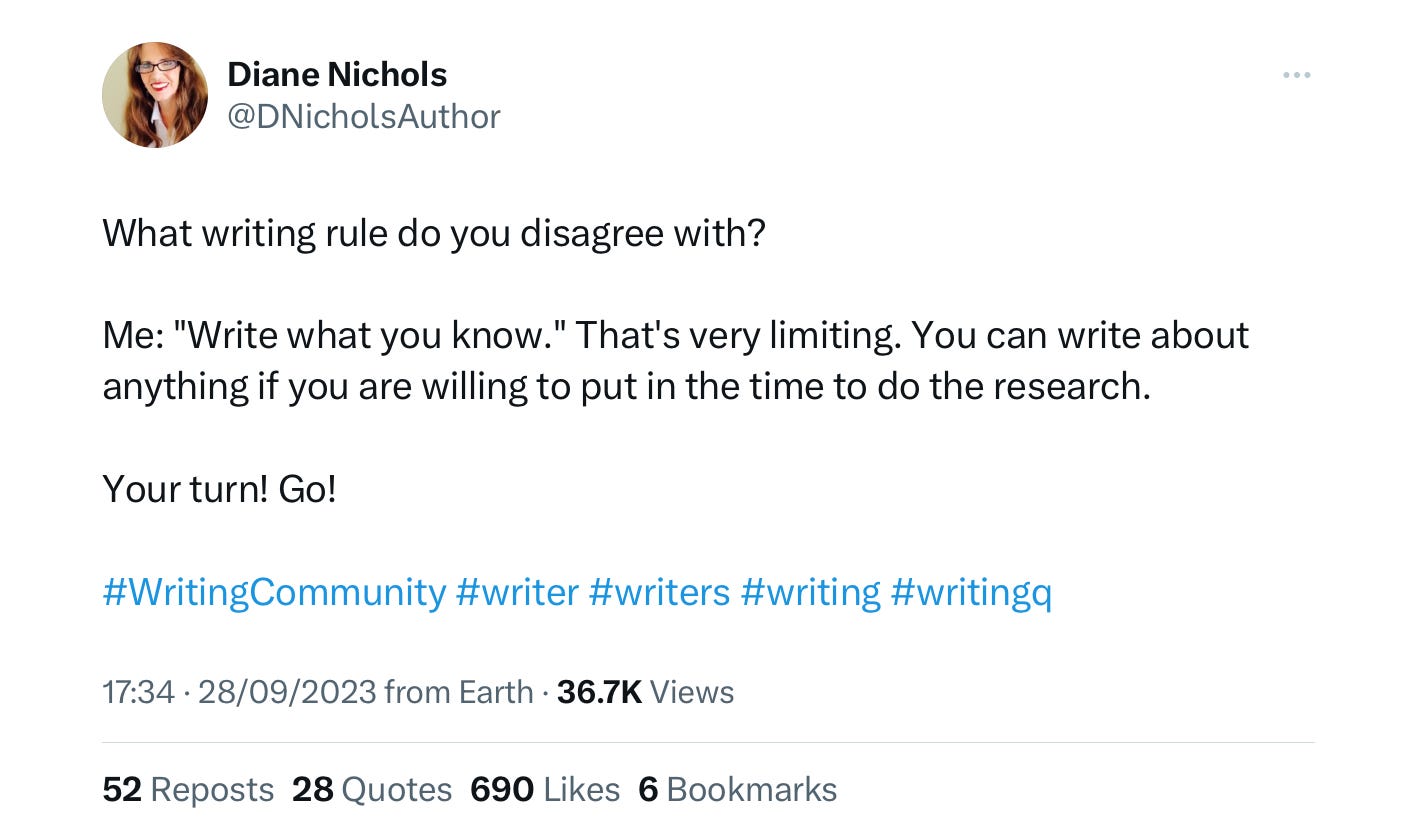
The trouble is, most of the comments were getting it completely wrong.
Today we’re going to break down what it actually means, so you can ‘write what you know’ more effectively in your own work.

If ‘write what you know’ literally meant that you could only write about things you have first-hand experience in, the vast majority of the stories in the world wouldn’t exist.
There would be no Game of Thrones, because nobody knows about dragons.
There would be no Harry Potter, because nobody knows how to cast a spell.
There would be no James Bond, because, while Ian Fleming did work in intelligence, he certainly didn’t know what it was like to ride a motorbike across a roof and through a market before leaping onto a moving train.
Most of the time, when you write, you’ll be writing about things you don’t know.
But within those things, no matter how crazy, will be an element of something you do know. Something you’ve felt before. Something you remember.
The key is to let your first-hand experience drip into the story.
Maybe that’s a tiny droplet of personal insight, or maybe it’s an open tap where your knowledge is flooding everything.
You can ground even the most fantastical idea in a few key details of reality, and it becomes all the better for it.
When I wrote Stonebird, I obviously didn’t know what it was like to see a huge gargoyle come to life – but I did know what it was like to see my grandma have her memories stolen by dementia. That influenced the book heavily: every scene involving Liam’s grandma was based on my own experience.
Here are 3 more examples of writing what you know…
1 – You don’t know what it’s like to go to wizard school, but you do know what it was like to go to your school for the first time, and you can use as much or as little of that in your work.
2 – You don’t know what it’s like to be chased by spies, but you do know what it’s like to walk home at night and have the hair tingle on the back of your neck. Yeah, there was no one chasing you then, but you can tap into that fear and use it how you wish.
3 – You don’t know what it’s like to go back in time, but you do know what wonder feels like; whether that’s going into Toys “R” Us as a kid, or seeing Skyrim for the first time, or getting your first subscriber on YouTube (who isn’t your mum).
The key, with all fiction, is to drill down into the core feeling of the scene and think back to any element of your life where you’ve experienced that feeling yourself.
You can write about anything, and still write what you know.
I was listening to Jimmy Carr on Modern Wisdom this week, and he was talking to Chris Williamson, the host, about a way of thinking Chris had outlined.
It’s the idea of the 24-Hour-You.
“What would you tomorrow want you today to do?”
It’s great, I think, because of its immediacy.
Sometimes if you’re trying to improve, or if you’re trying to achieve something big, the end goal is so far in the distance that it’s easy to slip up.
Easy to say, ah, I’ll let it slide this once.
I’m feeling a bit tired, so I’ll skip going to the gym today.
I can’t really be arsed to cook, so I’ll grab that cheeky McDonalds for dinner.
But you tomorrow will probably regret it.
Stepping out of the moment like this can be a great way to avoid the immediate gratification that’s whispering in your ear.
I’m really enjoying the vlog series from Steven Bartlett on YouTube.
Every episode is completely packed, and it’s fascinating to see behind-the-scenes of one of the most popular podcasts in the world as it blows up.
But it’s also incredibly well edited, which is probably the coolest thing about it. Just super slick, and well put together.
If you haven’t watched it already, then take a look. There are only a few videos out so far, so easy to catch up!

That’s all for this week. See you next Sunday!
Cheers,
– Mike
Ps. If you found this useful, please feel free to tap that ❤️ button to let more people find it on Substack. And send this email to a friend!
No posts
Comments
Nothing yet. Say the first thing.
Sign in to join the conversation.