
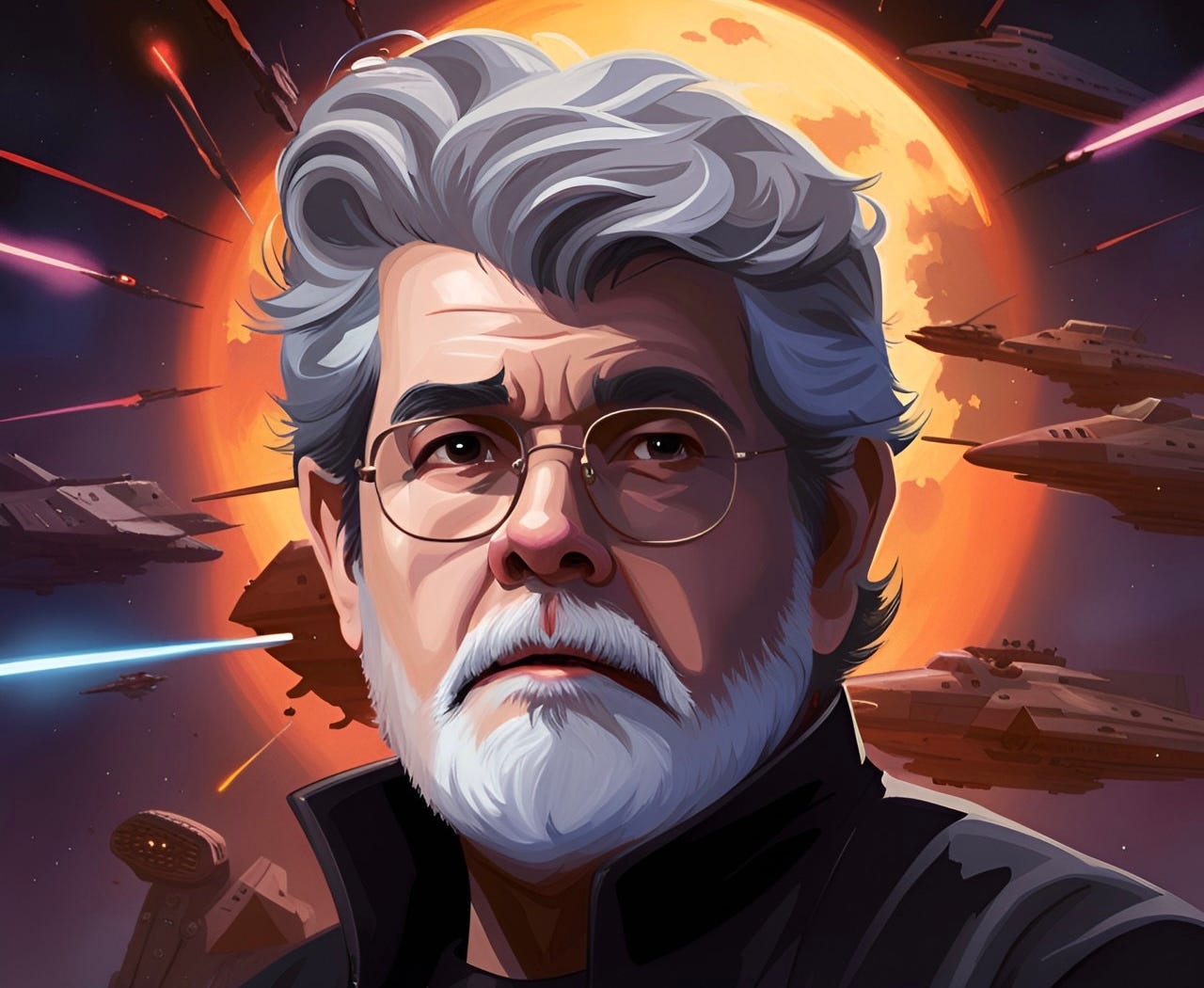
Welcome to Feed Your Muse! This is a deep dive into storytelling, and this week we’re taking a look at one of the most popular movies in the world, and how it may never have existed. Want more like this in your inbox?
Star Wars.
As soon as you hear the name, you're transported to a galaxy far, far away.
From lightsaber duels to epic space battles, it’s full of edge-of-your-seat moments and iconic characters that have inspired generations.
But behind the magic and spectacle on the big screen is a story just as impressive. Because George Lucas wasn't just up against it when he was trying to get the film made. He was practically laughed out of meetings.
- Why people thought Star Wars was impossible
- How George Lucas had to invent new filmmaking technology
- 2 lessons you can apply to your own craft
Let's dive in!

Visual effects were primitive at best.
While films like Flash Gordon in the 1930s were a big hit, by the 50s, science fiction was for kids TV shows. Most of it was cheaply made and completely uninspiring. There was certainly no expectation of critical success in Hollywood.
But George Lucas imagined something different to mad scientists and B-movie effects. He wanted to bring mythology, epic storytelling and emotional depth to science fiction filmmaking.
He envisioned fast spaceship chases through asteroid fields, immersive alien worlds teeming with strange new life, and a timeless struggle between good and evil.
But when he approached Hollywood studios with his ideas, the executives balked and insisted that his concepts were impossible to bring to the big screen.
He took matters into his own hands.
To make sure the movie got made, he founded his own visual effects studio – Industrial Light & Magic – putting together a team of model makers, engineers, and top-notch thinkers.
To create epic battles and stunning landscapes, they used miniature models of spaceships and environments. These were filmed separately and then combined into the live-action footage.
Think of it like creating a diorama and then placing it into the live-action scenes. And it gets better – because to create the special effects, they pushed the limits of what was possible at the time, using frame-by-frame editing and painting to blend the real and virtual worlds.
People had done it before, but not at this scale, and not with this level of detail.
It was all made possible by new motion control cameras that allowed spaceship models to be filmed dynamically.
Star Wars delivered.
It was packed with fast-paced chases and dogfights that moviegoers had never seen before.
The environments were tactile and immersive, from the moisture farms of Tatooine to the rainforests of Endor and everywhere in between.
Each new alien and droid was tangible and textured. These special effects weren't just for the novelty. They were central to the big, sweeping vision.
The result was a film experience that changed movies forever – and inspired a swathe of movies that came after it.
The dogfight techniques were studied and adopted by Battlestar Galactica. The used-future feel of the gritty ships and gear influenced Alien and more.
Lucas brought a scale, imagination, and visual impact to science fiction storytelling that resonated with audiences worldwide.
This is a great example of inspiration driving technological innovation.
Unlike the 3D movie fad, which seemed to mostly be directors trying to force the tech into their films in post-production for no narrative reason, here, Lucas had a vision and created what he needed to tell the story.
Two main takeaways from this...
I'm not going to hit you with the whole dream big, and never give up.
But I do think it's an important lesson in perseverance. Instead of quitting when you're told that something can't be done – pivot. Do a little shimmy. Try something different.
George Lucas looked beyond the expected with his writing. Star Wars draws on more than the typical science fiction tropes. He was inspired by samurai films, mythic narratives, and even World War II.
But he also showed us the importance of stepping outside the arena in a more practical way, too.
Don’t let a closed door discourage you from doing what you want with your project. Use it as motivation to prove people wrong.
Nobody is ever going to be able to see the vision you’ve got in your head until you’ve made it.
Here’s what George Lucas said about making the first movie when even some of his team thought it was all a joke:
Even though we went through some very hard setbacks, I had to go up and say, 'We can do this. We're not going to give up. We have to keep going.' You just have to say, even though everything looks like it's falling apart, trust me, it's actually not.

Thank you for reading Feed Your Muse. This post is public so feel free to share it!
No posts
Comments
Nothing yet. Say the first thing.
Sign in to join the conversation.