
Mike Lukianoff · Signal Flare — Data Driven Insights
Two arguments are dominating the AI conversation right now, and they contradict each other.
One says the model is everything. Dario Amodei, who runs Anthropic, has spent the past year warning that open-weight models are the real danger — that once the weights are released, the safety training can be stripped and nothing can be pulled back. He does not aim the same alarm at closed labs like his own, which he argues can manage their models responsibly. In this telling, openness is the risk.
The other says the model is almost beside the point. Alex Karp, who runs Palantir, has built a company and a book around the opposite claim: the value is in putting AI to work inside real institutions, not in the model weights. The models will commoditize.
Both men are talking their book. That does not make either of them wrong. It makes the disagreement worth reading carefully, because operators are being asked to bet on one of these worldviews with real budgets.
The frontier camp wants you to believe capability is scarce and getting scarcer to access safely. The sovereignty camp wants you to believe capability is abundant and the real scarcity is knowing how to wire it into a business.
Here is what neither headline settles: which bet is already making money.
That question has a cleaner answer than the philosophy does. It is not coming from the frontier labs burning billions to train the next model, and it is not coming from the pure-play sovereignty shops. It is coming from the layer in between — the companies that take models they did not train and turn them into products that run in production.
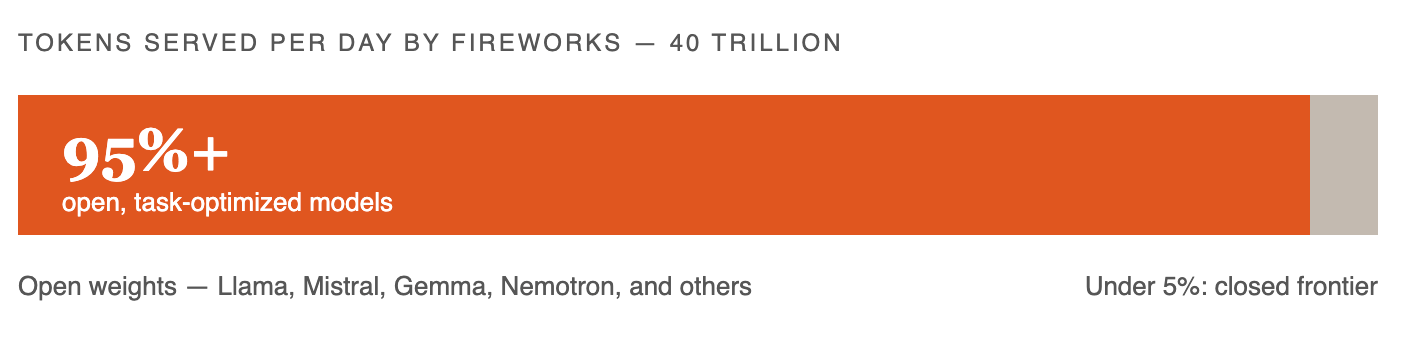
On its Series D, Fireworks AI raised $1.505 billion at a $17.5 billion valuation. Nvidia, Lightspeed, Index Ventures, TCV, Bessemer, and Menlo were all in the round. The business has passed $1 billion in annualized revenue run rate and now serves more than 40 trillion tokens a day.
Watch where the capital went. That roster is not speculative money chasing a research milestone. It is the investor class that funds infrastructure once a market is proven, and it just underwrote the layer between the model and the customer. The smart money is betting on the middle, where practical business applications actually ship.
One number in that announcement matters more than the valuation. More than 95% of those 40 trillion daily tokens come from open models specialized on customers’ proprietary data, not from closed frontier models. Fireworks does not sit at the frontier and does not sell sovereignty. It helps companies take an open model, tune it on their own data, and run it cheaply at scale. Cursor built its coding models this way. Harvey built its legal AI this way.
Read that token mix against the frontier camp’s central worry. The argument that open models are too capable to spread freely is running headlong into a company monetizing exactly that spread, at a billion-dollar run rate, on real products people pay for. The market is not waiting for the safety debate to resolve. It has already priced open, specialized models as the default.
Consider who the fear helps. Brand open-weight models too dangerous to release, and the cost falls on the companies that depend on them to compete — the challengers, not the leaders already selling closed models. Limiting openness protects the incumbents. Anthropic is an incumbent. A warning that open models are too dangerous is not a neutral position, whatever the motive behind it.
The warning also mixes up two different risks. One is misuse. A capable open model can have its safety training stripped, and once the weights are out they cannot be pulled back. That risk is real and grows with capability. The other is data security, and there the logic flips. A model run fully inside your own walls, or through a partner that retains nothing, never sends your data anywhere it can be kept. Self-hosted that way, an open model can be as secure as a closed API, or more secure, because your data never leaves your control.
The open-weight field is broader than the headlines suggest. Chinese models lead the cheap end, and they carry real security questions of their own. They are not the only option. Meta’s Llama, Mistral, Google’s Gemma, and Nvidia’s Nemotron are all open-weight, and the smaller foundation models among them are built to run inside a company’s own walls. Restrict the category and you do not stop this. You mostly slow down the firms that follow the rules.
Fireworks does not land on either side of the Karp-Amodei split. It answers both with the same move.
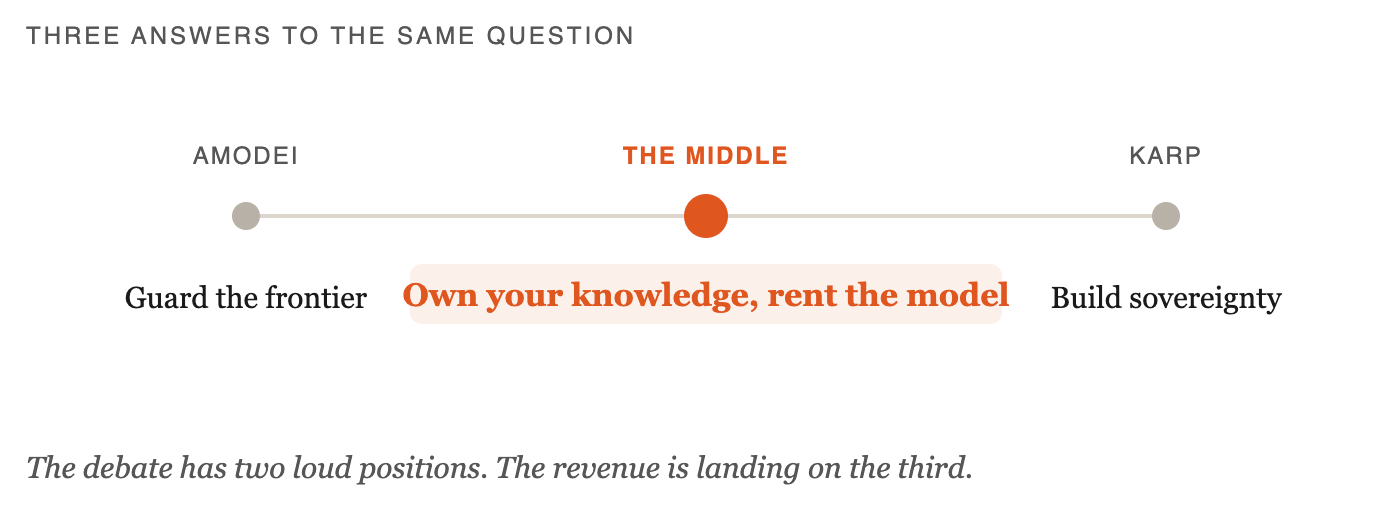
Amodei says rent capability from the frontier and treat it as scarce. Karp says own your stack and build sovereignty. Fireworks says own your intelligence without building the lab — take an accessible open model, specialize it on the proprietary data only you have, and rent the inference. You get close to frontier quality, at a fraction of the cost, and you own it.
That is the position the revenue is backing. Not the frontier, and not a stack you build yourself. The middle, where a company’s edge comes from its own knowledge, applied through a model it can swap, and the heavy infrastructure belongs to a vendor whose only job is running it.
This is not theory for us. At SignalFlare we use both, and the agents route each task themselves: a frontier model when the task calls for one, and task-optimized foundation models on Amazon Bedrock or open-weight models hosted on Fireworks when those do the job for less. That puts our infrastructure closer to Karp’s version of the future than Amodei’s, with one correction. Most businesses cannot afford to build a fully sovereign model and data stack, and most do not have the data to make one work. They do not need to. What every business does need is to protect the knowledge it is building. When we build for a client, that knowledge stays theirs, and the economic model is set up to work on their behalf. That is the long-term value, and it is why we build in the middle rather than at either edge.
This is not a new pattern. In every prior platform shift, the winners were the companies that made the new technology usable and stayed free to swap the parts underneath as better ones arrived. What is new is how fast the money showed up this time.
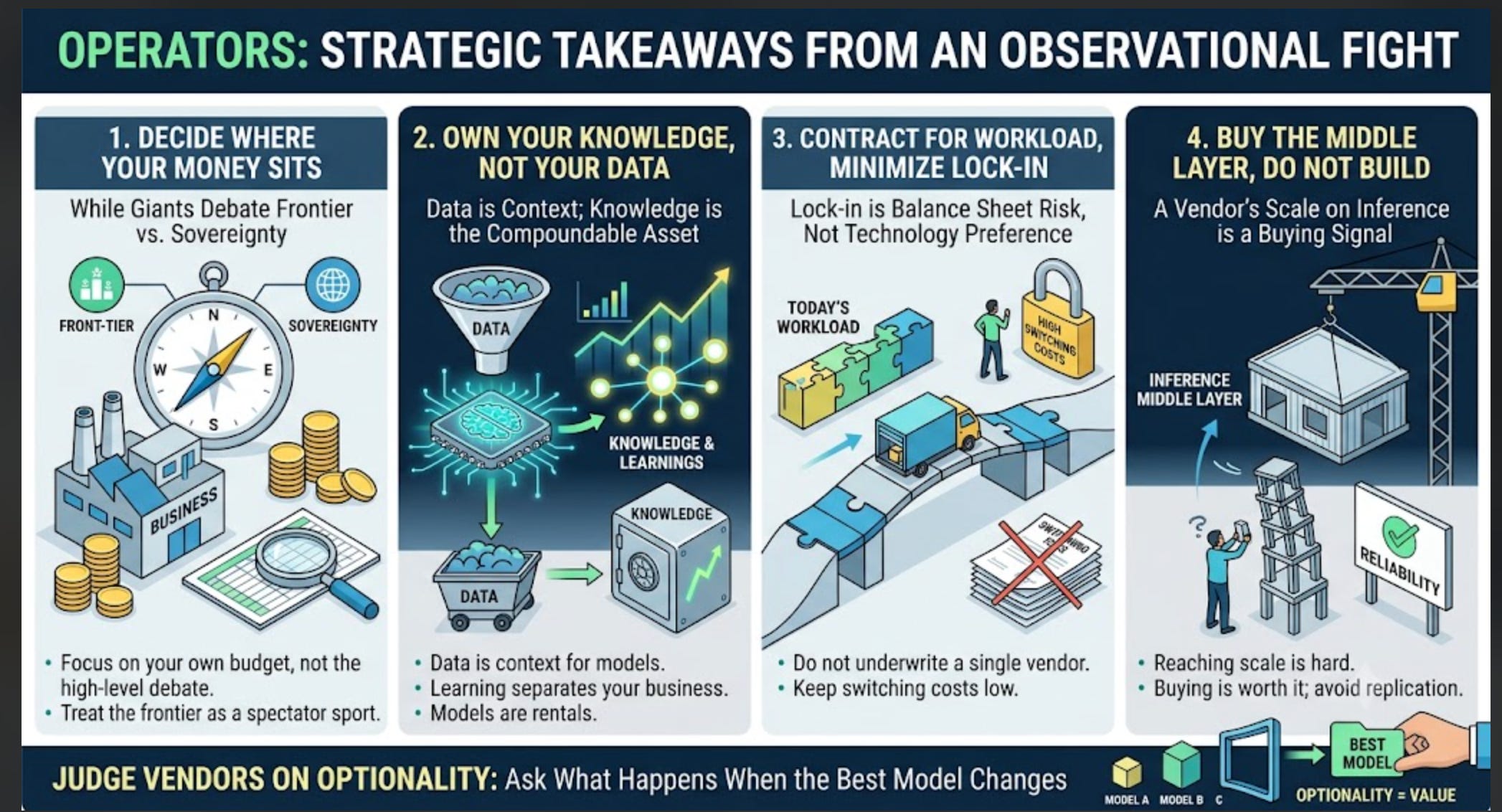
The Karp-versus-labs debate is a real one, and for most businesses it is also a spectator sport. You will not resolve whether the frontier or sovereignty wins. You do not need to. You need to decide where your own money sits while the giants argue.
Own your knowledge, not just your data. The data-lake era treated stored data as the asset. It is not, anymore — everyone has data. What separates you is what happens after the data becomes context a model can use: the knowledge and learning that compound as the system runs. That is the asset worth owning. The model is a rental.
Do not underwrite a single frontier vendor. Contract for the workload you have today and keep switching costs low. Lock-in is a balance-sheet risk, not a technology preference.
Do not try to build the middle layer yourself. A company reaching that scale on inference is a signal the layer is hard and worth buying, not replicating.
Judge vendors on optionality. Ask what happens when the best model changes. If the honest answer is a contract renegotiation, that is the wrong vendor.
Amodei may be right about the frontier. Karp may be right about sovereignty. Neither changes where the work is happening. The middle is where everyday businesses are already using AI to solve specific problems and deliver value their customers can feel. That is how AI makes an impact. Build there.
Sources: Fireworks AI Series D announcement (funding, valuation, $1B+ annualized revenue run rate, 40T daily tokens, 95%-plus specialized-open-model token share, Cursor and Harvey references). Positions attributed to Dario Amodei and Alex Karp reflect public statements and writing. Multi-model routing framing reflects SignalFlare Navigator architecture.
Comments
Nothing yet. Say the first thing.
Sign in to join the conversation.