
Mike Lukianoff · Signal Flare — Data Driven Insights
_________________________________________________
In my last article I stepped into the argument dominating AI right now: Alex Karp making the case for sovereign AI on one side, the frontier labs making the case for model supremacy on the other, with Dario Amodei warning that open models are too dangerous to spread. My read was that both poles are wrong for most operators. You cannot afford to build a fully sovereign stack, and you should not hand your future to a single frontier vendor. The value sits in the middle — own your knowledge, rent the model, and route each task to the one that fits it.
That leaves an obvious question unanswered. Route based on what?
Most routing is crude. It picks a model by cost, or by how long the prompt is, or by which vendor is cheapest that month. That already beats sending everything to one frontier model and paying frontier prices for a database lookup. But it still leaves most of the value on the table.
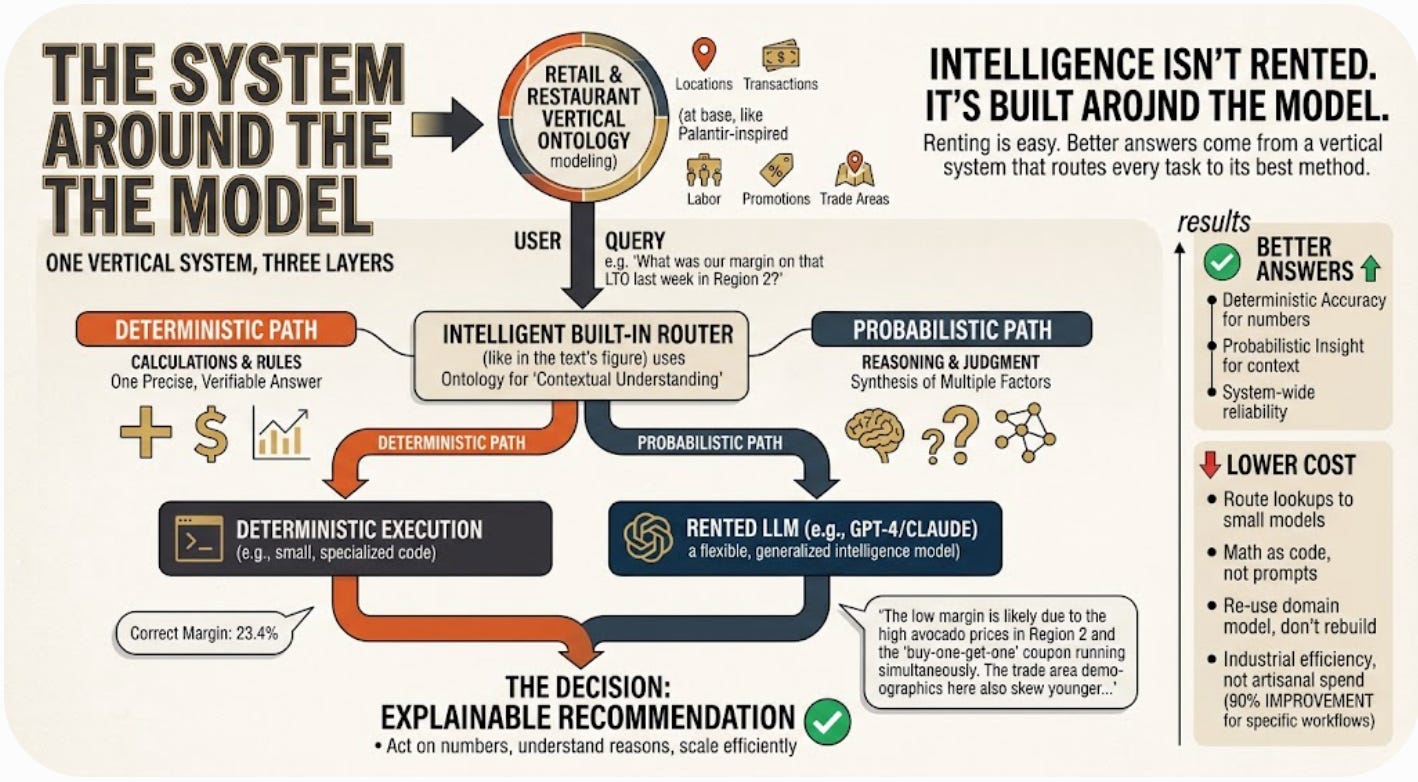
A router is only as smart as the system it lives in. Drop one into a general chatbot and it routes blind. Build it into a system made for one industry, and it can route on the two things that actually decide the answer: what the question needs, and what the data means.
Enterprise work is not one kind of task. Some questions have exactly one correct answer. Units sold last week. The blended labor rate at a store. What a 3% price increase does to a modeled contribution margin. These are calculations. They need to be right, not creative. Hand one to a language model and you have invited a hallucination into a number that has to reconcile.
Other questions need judgment. What is driving the traffic decline in this trade area. Which of three explanations fits the pattern in the data. These reward reasoning and synthesis, and a capable model earns its cost.
A router built for the work sends the first kind to deterministic execution: one question, one verifiable answer, no probability distribution and no room to hallucinate. It sends the second kind to probabilistic model reasoning. Most platforms treat every step the same way. The gap this opens is the difference between running a correlation in a spreadsheet and producing an attribution model from a Bayesian neural net. Those are not the same tool, and they should not be treated as one.
Knowing which method a task needs is half of it. The other half is knowing the domain.
A general system sees a table of numbers. A vertical one sees a business. At SignalFlare we maintain one shared model of the restaurant industry — locations, transactions, labor, promotions, trade areas, and the relationships among them — and we keep it current as the industry moves. Every operator plugs into that same standard instead of commissioning a bespoke model of their own. The system already knows that a sales decline in one region can trace to a supply disruption in another, and that a price increase reads differently in a high-income trade area than in a stretched one.
That semantic layer is what makes the router intelligent. It sends the right context to the right model at the right moment, instead of spending tokens teaching a general model what a trade area is on every query. Time to value goes up. Cost per answer comes down.
This is why the router has to be part of the system, not wrapped around it. A bolt-on router sees prompts. A built-in router sees the whole chain: data coming in, which has to be reliable; processing, which needs the right tool; analysis, which mixes precise math with human-style judgment; and the last mile, which has to be explainable to someone who did not build it.
Palantir proved the value of modeling a business as an ontology. It builds that ontology per enterprise — worth the cost for a government or an industrial giant, and far too expensive for a fragmented industry of thousands of operators. (Full disclosure: I run SignalFlare, and we take that page from Palantir’s playbook and apply it differently.) Instead of a bespoke build for each customer, we maintain one industry-standard model and update it continuously. Eighty to ninety percent of the heavy modeling is shared across every operator; the rest is local. The standard does not sit still — each new deployment and each shift in the industry feeds back into it — so results compound and the cost curve bends down as we go.
Two things come out of this that a generic stack cannot match.
Better answers. When calculations run deterministically and judgment runs probabilistically, the output is accurate where it must be and reasoned where it should be. In practice, Navigator’s recommendations pass muster with seasoned analysts, and it surfaces local market and store-menu dynamics those analysts would not have had the time to find.
Lower cost. Route a lookup to a small model instead of a frontier one. Run math as code instead of as a prompt. Reuse a domain model instead of rebuilding it. Each of those takes cost out, and together they move the economics of analysis from artisanal to industrial. In early release, that has shown up as a 90% efficiency improvement in targeted analytical workflows — work that once took months of expert time and millions in spend becomes continuous.
For an operator, this is the whole point. You do not want a chatbot that sounds confident about your P&L. You want a system that gets the numbers exactly right, reasons well about what they mean, and tells you what to do next in language you can act on — continuously, at a cost that scales.
The model you rent is a commodity. The router, the domain it understands, and the decisions it produces are not. That is where the results come from, and it is why we built the router into the system rather than around it. Computers should do the computer work. The judgment stays with you.
Sources: SignalFlare Navigator architecture and early-release performance (90% efficiency improvement cited for targeted analytical workflows). Ontology and deterministic-versus-probabilistic routing framing as described in Building AI Infrastructure That Lasts and The Intelligence Gap. Follows Own Your Knowledge, Rent the Model.
Comments
Nothing yet. Say the first thing.
Sign in to join the conversation.