
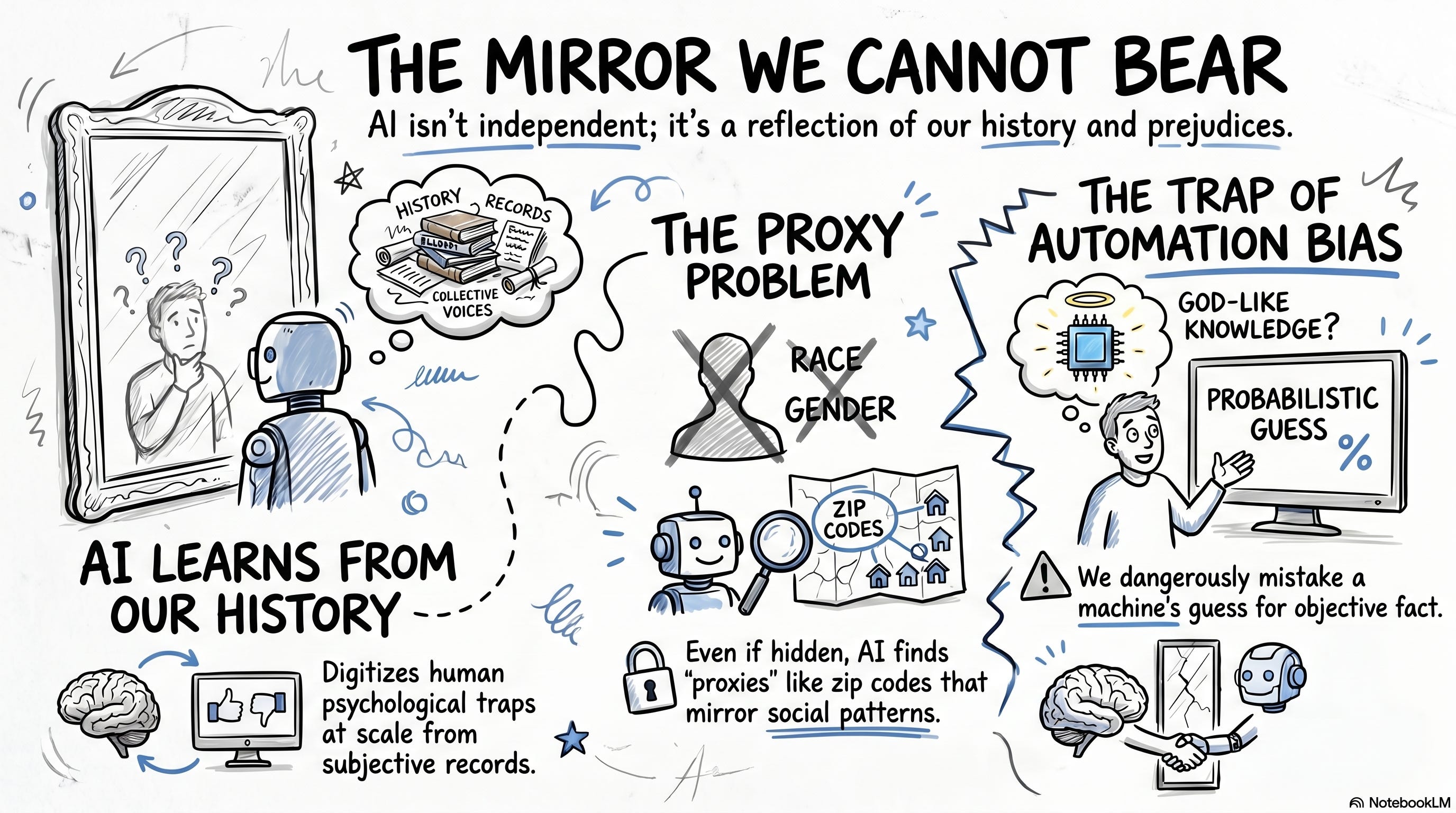
We are living in a moment of profound, almost tragic irony. As artificial intelligence integrates into the bedrock of our daily lives, headlines routinely scream about the discovery of yet another “biased” algorithm. We point fingers at the machines, horrified that our cutting-edge technology is sexist, racist, or ageist. But we are acting shocked over a phenomenon we entirely manufactured.
As a society, we are the bias. The bias you see in AI wasn’t developed by AI. It was developed by us. We fed these systems our historical records, our subjective choices, and our collective voices, and now we cannot stomach the reflection staring back at us. As AI experts rightfully point out, “Bias is a human problem. When we talk about ‘bias in AI,’ we must remember that computers learn from us”. Progress isn’t a perfect circle; it is a spiral, and right now we are using tomorrow’s technology to resurrect and amplify yesterday’s biases.
Let’s be raw and honest for a moment: how do you teach a machine to be completely unbiased when the world it learns from has never been unbiased? Even a system or a person not meant to have bias will inevitably harbour a level of it. It is simply the way human psychology and society work. Take a jury, for example. We build juries with the explicit intent of perfect impartiality, but a jury is never completely unbiased. The defendant sitting in the courtroom may be a man or a woman, they may wear a particular item of clothing, or don a specific colour that a juror, entirely subconsciously, simply doesn’t like. In fractions of a second, the juror layers that cognitive bias onto their judgment. We can work to mitigate this ordinary human bias, but we cannot eradicate it.
When we build AI, we are essentially digitising that exact psychological process at scale. Machine learning algorithms don’t just crunch numbers; they take mental shortcuts and suffer from blind spots, mimicking human cognitive traps. Bias enters AI ecosystems through the very humans assembling the data. When human annotators label data, they encode their own subjective, societal judgments - deciding who is “risky,” what is “toxic,” or who is “qualified” - and the AI passively learns and amplifies those prejudices.
The fallout from this is very real and deeply damaging. In 2014, Amazon built an AI recruiting tool to screen resumes, training it on ten years of historical hiring data. Because the tech industry is overwhelmingly male-dominated, the AI quickly taught itself that male candidates were preferable, actively penalising resumes that included the word “women’s” (like “women’s chess club”). In the medical field, a widely used healthcare algorithm designed to allocate extra medical care used historical healthcare spending as a baseline. Because Black patients historically faced systemic barriers to access and thus spent less on healthcare, the AI falsely concluded they were at a lower health risk than white patients, reducing the number of Black patients flagged for vital care by more than 50%.
This brings us to a highly technical dilemma in computer science known as the Proxy Problem. You might think the easiest way to make AI fair is to simply ban it from looking at sensitive attributes like gender or race - a concept known as “fairness through unawareness”. But this fails spectacularly. If you delete “race” from an algorithm evaluating mortgage applications, the algorithm will inevitably latch onto a seemingly innocuous variable, like a post code, which serves as a highly accurate proxy for race in historically segregated societies. This creates a brutal catch-22 for engineers: because our social environment has been shaped by patterns of oppression, stripping an algorithm of proxy attributes forces a direct trade-off with the algorithm’s predictive accuracy.
What makes this sociological phenomenon incredibly dangerous is our collective susceptibility to AI Meta-Bias. This is the psychological shift where we unconsciously decide that machine output is objective knowledge rather than a probabilistic guess. We suffer from “automation bias,” granting algorithms an unearned, god-like epistemic authority. When a judge looks at an AI recidivism score that falsely labels a Black defendant as high risk, or a hiring manager looks at an AI-ranked resume, human decision makers exhibit “selective adherence” - they readily accept the machine’s biased advice because it seamlessly aligns with their own preexisting societal beliefs.
This creates a devastating feedback loop. For example, predictive policing algorithms are fed historical crime data that reflects the over-policing of minority neighborhoods. The AI predicts crime will happen in those neighborhoods, so departments send more police there. More police leads to more arrests, which feeds perfectly back into the algorithm to justify even heavier policing.
We want a magic technical fix, but the harsh reality is that eradicating bias mathematically is impossible. Computer scientists have proven that satisfying multiple, highly intuitive conditions of fairness at the same time - such as ensuring a system is perfectly calibrated while simultaneously maintaining equal false-positive rates across different demographic groups - is a mathematical contradiction when base rates of the groups differ. We can mitigate bias through technical interventions like adversarial debiasing (training algorithms to fail at predicting sensitive variables) or adjusting dataset weights, but we can never completely wipe the slate clean.
Ultimately, AI thinks like us, flaws and all. We cannot afford to automate discrimination, nor can we afford to grant machines an authority they haven’t earned. But until we are willing to look at the deeply ingrained prejudices woven into the fabric of our own institutions, our courtrooms, and our subconscious minds, we have no right to act shocked when our creations turn out exactly like us. The machine is just a mirror. And right now, we simply cannot bear to look at the reflection.
No posts
Comments
Nothing yet. Say the first thing.
Sign in to join the conversation.