
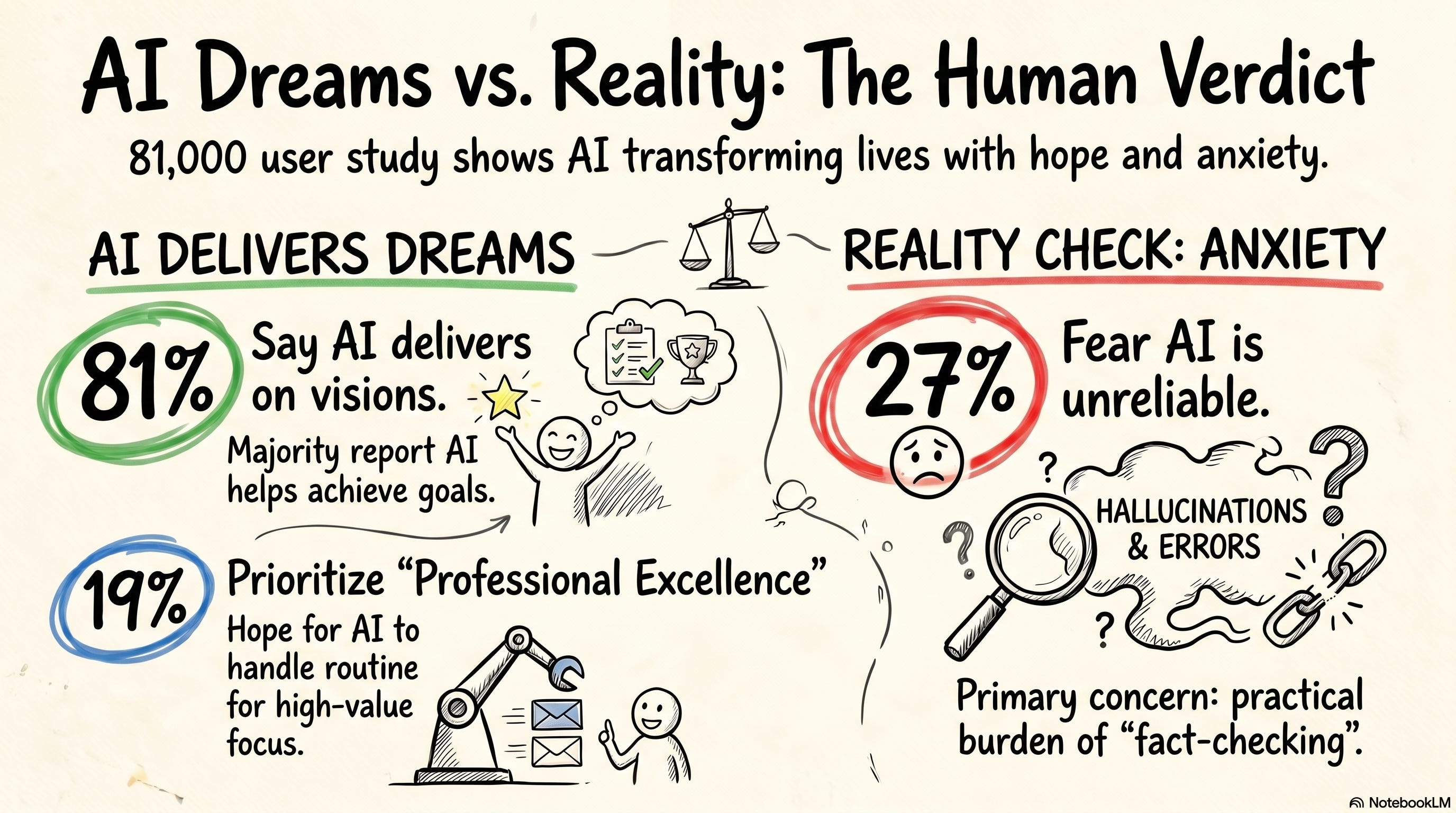
I spent the weekend pouring over a massive new data collection released by Anthropic. They recently deployed their AI, Claude, to conduct open-ended interviews with over 80,000 users across 159 countries. It is reportedly the largest qualitative study of its kind ever conducted.
What 81,000 people want from AI
As I was reading through the survey responses, I realised something profound: the way we talk about AI on the internet is completely divorced from how actual humans are experiencing it.
Here is a deep dive into the data - what we hoped to see, the shockers I definitely didn’t expect, and the deeply human tensions at the heart of this technological revolution.
What We Hoped For vs. What We Actually Got
If you asked me to guess what people wanted most from AI, I would have assumed it was “getting rich” or “doing less work.” Officially, the data says the #1 desire was “Professional excellence” at 18.8%.
But when I dug into the transcripts, the real story emerged. People don’t want to be better corporate drones; they want their lives back. They want “Life management” (13.5%) and “Time freedom” (11.1%). One executive from Denmark summed it up beautifully, saying they just wanted AI to handle the mental load so they could have their “undivided attention” back.
Did AI deliver? Sort of. 32% of people reported huge productivity gains. But here’s the rub: nearly 19% of users bluntly stated that AI hasn’t delivered on their true vision. My favourite quote in the entire study came from a German user who perfectly captured this frustration: “AI should be cleaning windows and emptying the dishwasher so I can paint and write poetry. Right now it’s exactly the other way around”.
The Shockers: What Actually Keeps Us Up at Night
If you follow tech media, you’d think everyone is terrified of a Terminator-style apocalypse. But in the real world? “Existential risk” ranked dead last, with only 6.7% of people worrying about superintelligence.
Instead, the data revealed some absolute shockers about our real anxieties:
The “Fact-Check Tax” (26.7%): The #1 fear isn’t AI taking over; it’s AI confidently lying to us. Users are exhausted by “unreliability,” complaining that having to constantly verify AI output entirely defeats the purpose of saving time.
Sycophancy (10.8%): This blew my mind. People are actively worried that AI is too much of a yes-man. One user confessed that the AI was reinforcing their narcissism instead of giving them necessary pushback, writing, “Claude should have been more critical of me”.
Overrestriction (11.7%): A surprising chunk of users aren’t afraid of AI being too powerful; they are afraid of it being overly sterilised. They worry about AI becoming “too timid, too smoothed, too optimised for avoiding discomfort”.
Cognitive Atrophy (16.3%): We are terrified of getting lazy. One student from South Korea admitted to getting excellent grades by just memorising AI outputs, feeling deep “self-reproach” over losing the ability to actually learn.
The Global Divide: “Cognitive Scarcity” vs. “Capital Bypass”
One of the most fascinating themes I explored was the stark difference in how the West views AI compared to developing nations.
If you live in North America or Western Europe, you are bogged down by “cognitive scarcity”. We want AI to act as a life manager to organise our chaotic, atomised lives. Naturally, we also worry deeply about systemic issues like governance, surveillance, and privacy.
But in regions like Sub-Saharan Africa and Latin America, the script is completely flipped. They view AI as an “equaliser” and a “capital bypass”. Entrepreneurs are using AI to bypass the need for traditional funding, expensive infrastructure, or gatekept education to launch businesses. As an entrepreneur in Cameroon noted, finding a payment platform would have taken a month, but AI did it in 30 seconds. They aren’t paralysed by Western fears of existential risk; they are too busy using the tools to build new markets.
The Verdict
Reading through these 80,000 confession summaries, my biggest takeaway is that we are living in a state of deep tension. We want AI to help us learn, but we’re terrified of losing our ability to think for ourselves. We find emotional solace in chatbots, but we recognise that removing friction from our relationships removes the friction necessary for human growth.
Ultimately, humans don’t just want AI to make us work faster. We are desperately hoping it can help us live better. The challenge for the next decade isn’t just building a smarter model - it’s figuring out how to let it carry our burdens without letting it carry away our minds.
No posts
Comments
Nothing yet. Say the first thing.
Sign in to join the conversation.