
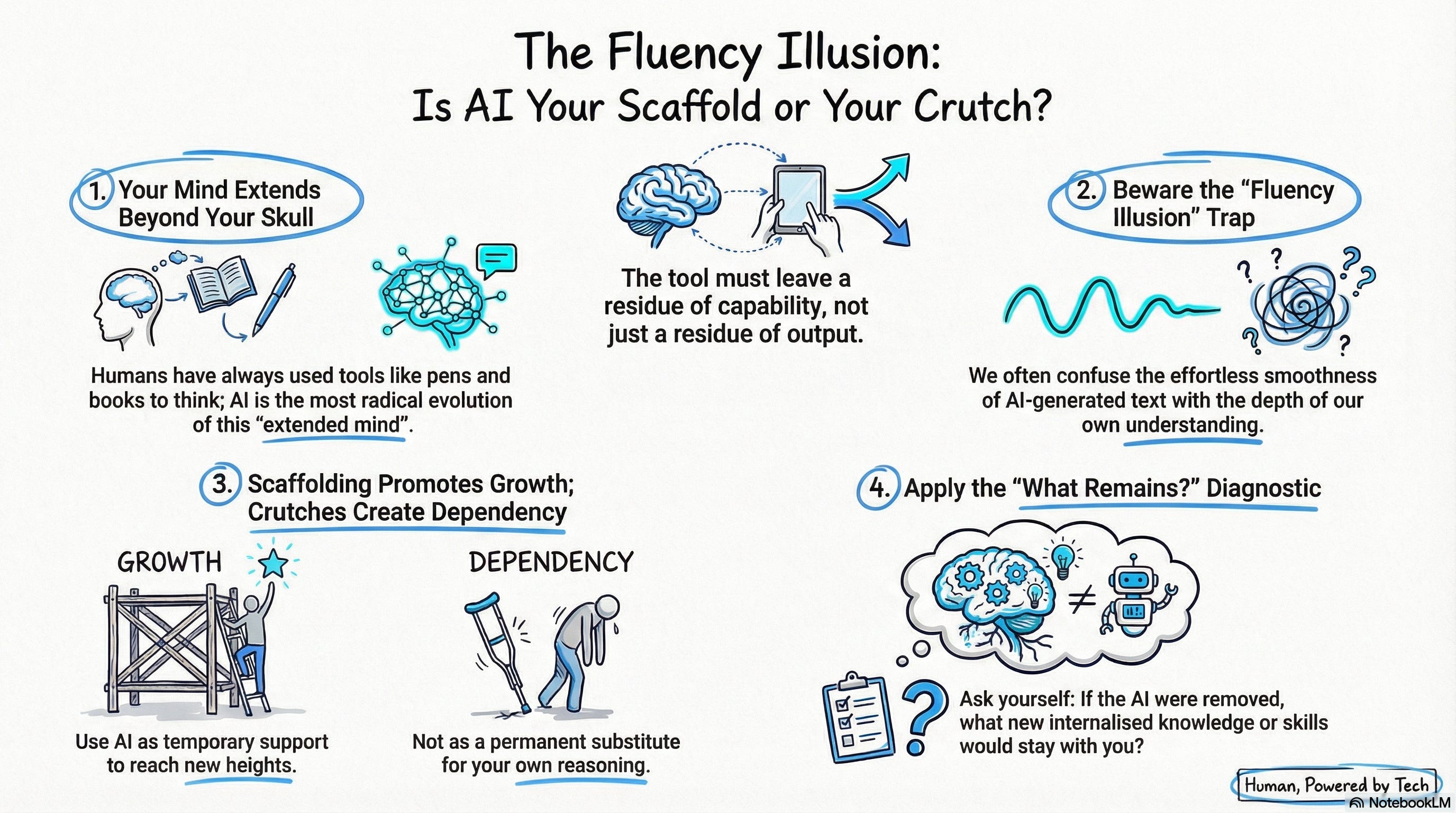
There is a moment, familiar to anyone who has used a capable AI for long enough, where you read back something you prompted into existence and feel a flicker of pride. That is good. And you thought of it. Didn’t you?
That flicker is worth examining carefully, because it sits right at the fault line of one of the most important questions the current wave of AI tools has produced: are we becoming more capable, or are we becoming more comfortable with the illusion of capability? These are not the same thing. And the gap between them may be widening faster than we realise.
The question isn’t whether AI amplifies your thinking. It clearly does. The question is whether amplified output is the same thing as amplified intelligence.
To answer that properly, we need to be honest about what intelligence actually is, and why it has proven so stubbornly difficult to define, let alone measure, for the better part of a century.
The psychologist Charles Spearman noticed in 1904 that people who performed well on one cognitive task tended to perform well across all cognitive tasks. He called this shared underlying factor g, or general intelligence, and for decades it became the dominant model: intelligence as a kind of cognitive horsepower, fixed, largely heritable, distributed unevenly across the population.
This view was contested almost immediately. Howard Gardner argued in 1983 that intelligence was not one thing but many: linguistic, logical-mathematical, spatial, musical, bodily-kinaesthetic, interpersonal, and intrapersonal. Robert Sternberg proposed a triarchic theory: analytical, creative, and practical intelligence. Lev Vygotsky had earlier introduced the idea of a “zone of proximal development,” the cognitive space between what a person can do alone and what they can do with the right kind of support. Intelligence, in this framing, was always partly relational. Always partly borrowed.
What unified these competing models, despite their differences, was an assumption that intelligence was something that happened inside a person. Cognitive science has spent the last thirty years quietly dismantling that assumption.
The philosopher Andy Clark, in his 1997 book Being There and later in Supersizing the Mind, made a case that the mind does not stop at the skull. We think with our hands, our notebooks, our calculators, our cities. Cognition is extended. It leaks outward into the environment. A blind person navigating with a cane is not compensating for lost perception; the cane has become part of their perceptual apparatus. The pen, Clark argued, is not a tool the writer uses; it is a component of the thinking itself.
If cognition was always extended, always borrowed from tools and environments, then AI is not a departure from how human intelligence works. It is its most radical elaboration yet.
This is where the philosophy becomes genuinely uncomfortable. Because if Clark is right, and there is good reason to think he is, then the question of whether AI is “your” intelligence or not may be the wrong question entirely.
And yet something nags. Because there is a specific cognitive hazard that AI introduces that a pen, or even a calculator, simply does not. And it has to do with fluency.
In cognitive psychology, fluency refers to the ease with which information is processed or produced. High fluency feels like understanding. When something comes to mind easily, we tend to rate it as true, familiar, and known. This is sometimes called the “fluency heuristic,” and it is a well-documented source of systematic error in human judgement. We confuse the feeling of smoothness with the presence of knowledge.
AI, and large language models in particular, are fluency machines. They produce text that is coherent, well-structured, confident, and grammatically immaculate, regardless of whether the underlying content is accurate, original, or deeply considered. When you read back an AI-generated response to a question you asked, the fluency of that response activates the same neural signature as genuine understanding. Your brain, in a real and measurable sense, mistakes the smoothness of the output for the depth of your own insight.
This is not speculation. A growing body of research on what cognitive scientists call “cognitive offloading” suggests that when we delegate thinking to external systems, our metacognitive accuracy degrades: we become less reliable judges of what we actually know. A 2021 study published in Cognition found that people who used internet search to answer questions rated their general knowledge as higher, even on topics they had not searched. The tool’s capability became annexed to the self-concept. The border collapsed.
With AI, that collapse is more complete, more seductive, and harder to detect. A calculator cannot convince you that you understand calculus. A language model absolutely can.
There is a distinction in educational psychology between scaffolding and dependency, and it is crucial here. Scaffolding, in Vygotsky’s original sense, refers to temporary support that enables a learner to perform at the edge of their current ability, with the expectation that the support is gradually withdrawn as capability internalises. Dependency is when the scaffold becomes permanent, when the support substitutes for development rather than enabling it.
The honest question about AI is which of these it produces. And the honest answer is: we do not yet know. We are in the early chapters of a natural experiment being run on hundreds of millions of people simultaneously, with no control group and no agreed outcome measure.
What we do have are some suggestive early signals. Studies of students using AI for writing tasks have shown mixed results: in some conditions, AI assistance improves final output quality but reduces the learning that the writing task was designed to produce. The product gets better. The person does not. This is not a condemnation of AI, but it is a reminder that output quality is not the same thing as cognitive development, and we would do well not to conflate them.
There are countervailing signals too. Research into expert performance in domains where AI assistance is available, such as software engineering, legal analysis, and medical diagnosis, suggests that experienced practitioners can use AI to push genuinely beyond their previous cognitive limits. They use the tool to challenge their assumptions, surface blind spots, and stress-test reasoning they would otherwise leave unexamined. In these cases, the AI is functioning more like a Socratic interlocutor than a ghostwriter. The difference lies almost entirely in how the human engages with it.
The tool does not determine the outcome. The quality of attention brought to the tool does.
There is a third possibility that tends to get lost in this debate, and it may be the most intellectually honest position available. It goes something like this: we have always overestimated the degree to which intelligence is individual, internal, and original. The great intellectual achievements of human history, the scientific revolutions, the philosophical traditions, the artistic movements, were never produced by isolated minds. They were produced by minds in conversation with accumulated tools, texts, institutions, and other minds. The myth of the lone genius is a relatively recent invention, and a culturally specific one. Most human cognitive achievement has always been, in some meaningful sense, distributed and borrowed.
What AI does is make that borrowing more visible, more efficient, and more troubling to our ego. When you look something up in a library, you do not feel that the book is thinking for you. When an AI synthesises the contents of ten thousand books and returns a lucid answer in seconds, the cognitive intimacy of the exchange is different enough to provoke anxiety about authorship and authenticity. But the underlying dynamic may not be as new as it feels.
Where it becomes genuinely new is in the feedback loop. Books do not adapt to you. They do not follow the contours of your thinking, surface your assumptions, or generate novel recombinations of your half-formed ideas at speed. AI does all of these things, and that creates a qualitatively different cognitive environment: one where the boundary between your thinking and the tool’s output becomes genuinely difficult to locate.
Whether that is alarming or exhilarating depends almost entirely on what you think intelligence is for. If intelligence is for arriving at correct beliefs and making good decisions, then an extended cognitive system that dramatically improves your accuracy and range is straightforwardly a good thing. If intelligence is for something else, for developing as a person, for the discipline of sustained attention, for the particular kind of understanding that only comes through struggle and failure, then the calculus is less clear, and the risks are more personal.
Here is the question that sits underneath all of this, the one that tends to make people uncomfortable when it is put plainly: if you removed the AI, what would remain?
Not as a gotcha. Not as a purist provocation. But as a genuine diagnostic. When you use AI well, as scaffolding rather than substitute, the answer should be: more than there was before. You should be able to point to positions you now hold more rigorously, to connections you have genuinely internalised, to questions you would not have thought to ask without the encounter. The tool should leave a residue of capability, not just a residue of output.
When you use it poorly, as a fluency prosthetic, as a way to feel articulate without the effort of becoming so, the answer to that question is quieter and more honest: not much. A smoother voice saying roughly the same things. A higher word count. A slight warmth of satisfaction that dissolves when examined.
The technology is not the variable. You are. And that is either the most empowering or the most demanding thing about this moment, depending on the kind of person you are choosing to be.
AI holds up a mirror to your relationship with your own mind. What you see there is the real question.
We are at the beginning of something that will reshape not just what humans can do, but what we believe about what we are doing when we think. That deserves more than productivity metrics and hot takes. It deserves the kind of careful, honest self-examination that, for now, remains stubbornly, necessarily, human.
No posts
Comments
Nothing yet. Say the first thing.
Sign in to join the conversation.