
Remember the mid-2000s? We were absolutely obsessed with “brain training.” We spent hours hunched over Sudoku puzzles, downloading apps like Lumosity, and playing Nintendo’s Brain Age because we were terrified of losing our cognitive edge. The mantra of the era was simple: use it or lose it. Fast forward to today, and we are practically throwing our cognitive labor at the nearest chatbot. We spent years desperately trying to build up our mental muscles, and now we’re eagerly hiring algorithms to do our push-ups for us.
I want to be incredibly clear right out of the gate: this isn’t a discouragement to use AI. It is an absolutely fantastic tool that is massively boosting our productivity. AI can handle menial tasks, improve worker efficiency, and even act as a tireless, 24/7 tutor when you’re stuck on a late-night assignment. Economists even estimate that generative AI could eventually boost global GDP by a staggering 7%. But while we enjoy these massive productivity gains, we must be careful not to let it damage our brain strength in the meantime.
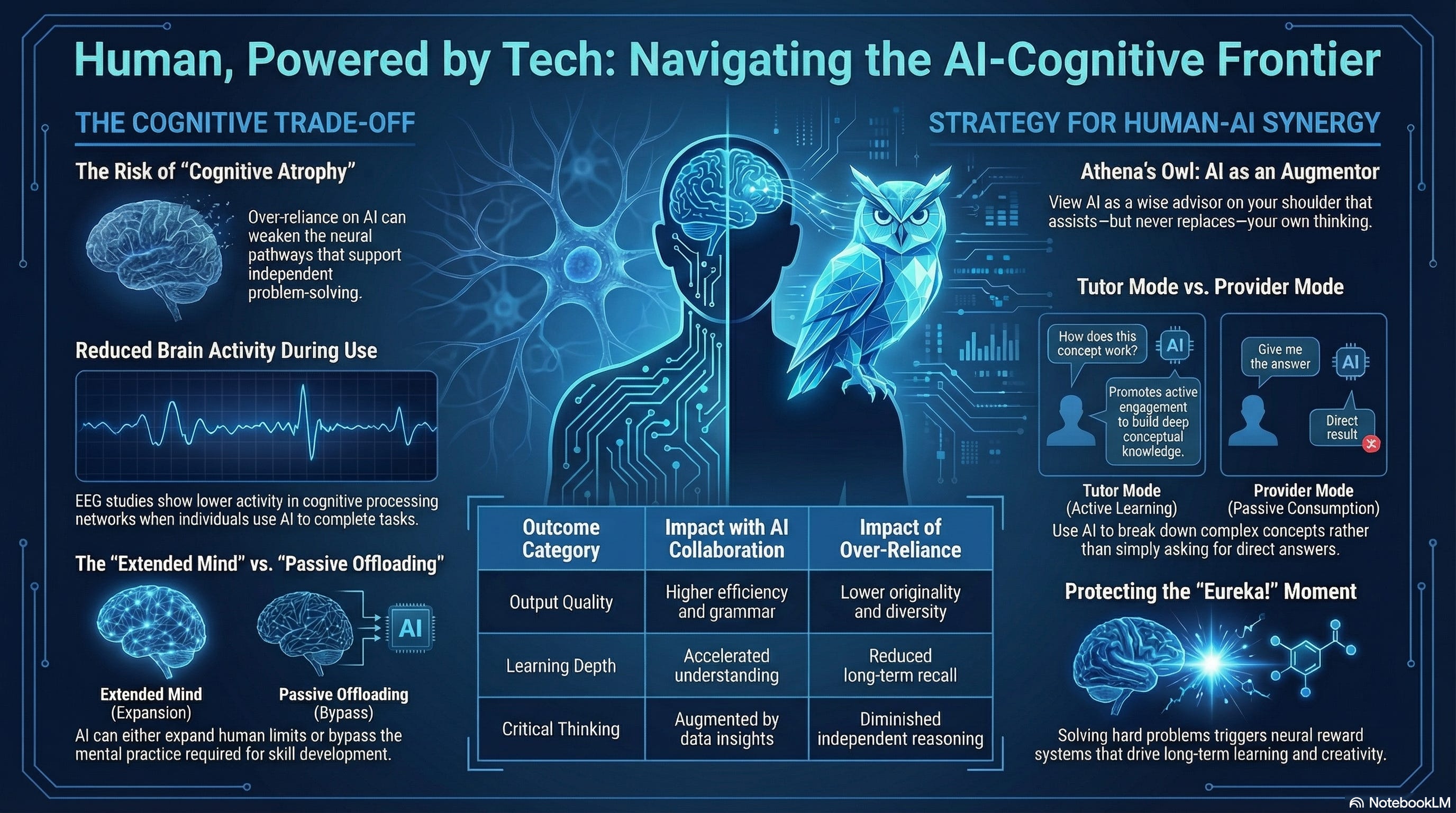
The fear of “cognitive atrophy” in the age of AI is very real. To understand what is happening, think about the last time you used a physical map. Just as turn-by-turn GPS navigation systems have caused our natural, intuitive sense of direction to fade over the years, offloading our thinking to large language models threatens to quietly erode our critical thinking skills. Just like skipping the gym leads to muscle deterioration, consistently outsourcing our mental effort causes the neural pathways that support independent problem-solving to weaken.
We are already seeing this cognitive shift in the lab. In a recent study, MIT researchers hooked participants up to EEG machines and found that those who used generative AI to write essays actually showed less activity in the brain networks associated with cognitive processing. Similarly, another study found a direct correlation between frequent AI use and lower critical thinking skills, particularly among younger users who depend heavily on these tools. When we blindly trust a tool to do the heavy lifting for us, we put in noticeably less critical thinking effort ourselves.
Beyond just dulling our critical thinking, relying too heavily on AI might actually be stealing our joy of discovery. Cognitive neuroscientists point out that when we solve a hard problem ourselves, our brain’s neural reward system gives us a massive, pleasurable buzz - a “Eureka!” moment. This chemical reward doesn’t just feel good; it modifies our behavior, makes us less risk-averse, and drives our future learning and creativity. When we just let a chatbot hand us the answer, we bypass this crucial developmental reward mechanism entirely. Furthermore, while AI might help you brainstorm faster on an individual level, researchers are finding that across the broader population, AI-generated ideas are actually less diverse. By outsourcing our creativity, we are trading paradigm-breaking human innovation for average, replicated thoughts.
So how do we fix this and protect our brains? Christopher Dede, a researcher at Harvard, suggests a brilliant way to reframe our relationship with tech: think of AI like the mythical owl that sat on the shoulder of Athena, the Greek goddess of wisdom. The owl is there to augment your thinking and help you be wiser, but you must never let the owl do your thinking for you. If you use AI just to churn out easy answers without engaging your own brain, your outputs might look better on paper, but your actual learning is significantly worse.
We have to stop asking what AI can do for us, and start asking what it is doing to us.
The next time you are faced with a blank page or a difficult problem, let yourself grapple with it for a minute before reaching for the prompt window. Build that mental muscle. Human challenges require human insight, empathy, and moral reasoning - things a machine simply does not possess. AI might be the ultimate co-pilot, but the second you let it do all the thinking, you become a mere passenger in your own life.
Let’s Chat in the Comments! 👇
I’d love to hear how you are all navigating this in your own lives. Drop your thoughts below:
Have you noticed a difference in your own memory or problem-solving skills since you started using AI tools like ChatGPT?
Where do you draw the personal line between “using AI for a productivity boost” and “letting AI do the thinking for me”?
Do you think the next generation, who is growing up with these tools, will have fundamentally different critical thinking skills than we do?
No posts
Comments
Nothing yet. Say the first thing.
Sign in to join the conversation.