
Democrats Need a Different Economic Strategy
Democrats have traditionally seen themselves as the party of workers vs capital, have nots vs haves. Yet many working-class voters believe they were better off under Donald Trump than under Joe Biden and voted accordingly. This isn’t just a messaging problem. It reflects something deeper: under the current neoliberal regime, meaningful working class economic gains are rare, unpredictable, and largely outside political control. As long as Democrats operate within that system, they will struggle to win working-class support.
The real issue: wages
When voters say they are concerned about “the economy,” they are not speaking in abstract terms. They are asking a simple question: are their wages keeping up with the cost of living? Over short periods, a good way to capture this experience is through real wages (earnings adjusted for price inflation). If real wages are rising, people feel progress. If they are flat or falling, they feel stuck or left behind.
In my work I focus on real wages defined as unskilled wages1 adjusted for inflation using the CPI. Because unskilled, or entry-level, wages have no barriers to entry, they should be the most responsive to market forces, making them a natural choice to assess policy effects on wages. Not only that, but this wage level forms the base off which all higher-level working-class wages are built. When they go up this exerts pressure on the next wage level to rise, which will eventually ripple through the entire wage structure.
By this measure, Trump’s first term stood out (see Figure 1). Real wages for entry-level workers rose significantly over 2017-2020, and not over 2021-24, which I suggest led to a perception of “good times under Trump policy” by working-class voters.
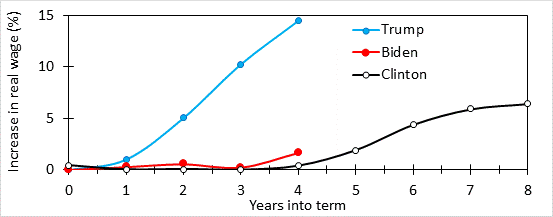
Figure 1. Change in unskilled real wages during various presidential terms
This interpretation is misleading. The “Trump wage boom” was real, but it was not the result of policy; it was a timing artifact. Figure 2 compares real wage growth during the business cycle expansions of the 1990s and 2010s. The trajectories are initially similar but diverge around year 9, when the 1990’s expansion ended, while the one in the 2010’s continued. The late-cycle wage growth happened to occur on Trump’s watch. In in today’s economy, unskilled wage growth only happens late in a prolonged economic expansion.
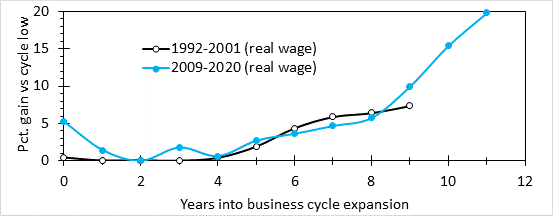
Figure 2. Real wage rise during the 1990’s and 2010’s economic expansion
This does not explain what happened over 2021-24, during which unemployment was as low as it had been under Trump, but without wage growth. In lieu of wages, corporate profits grew from 9.0% of GDP under Trump to 12.4% under Biden. Business was good, increased revenue was there to pay higher wages and maintain profits, but it was used to grow profit instead. The inflation over 2021-23 conferred pricing power2 to companies, who used it to raise prices by more than the amount necessary to cover higher costs, enabling them to boost profit margins.
The problem is the SP economy created under neoliberalism
This pattern is a feature of the “SP economy” created by the neoliberal policy regime that has prevailed since 1980. When pricing power exists, firms can use it to boost profits, or they can take advantage of competitors’ price increases to grow their sales by sacrificing margin to maintain the same price, undercutting their competitors. Under the SP economy firms seek to maximize shareholder value, so they choose to focus on profit growth over sales growth. The situation is reversed under the SC economy; firms seek sales growth, leading to higher demand for labor and higher wages. Under SP, wage growth is possible only late in the business cycle, when fully valued financial markets push investment into business expansion, leading to rising wages.
The political consequences of neoliberalism for Democrats are dire
When conditions favorable to rising wages only appear sporadically, working-class voters experience a general decline in their ability to buy the same share of stuff produced by a growing economy. That is, they experience a declining standard of living relative to the norm, an abrogation of the American Dream. I measure this with the unskilled wage index adjusted for economic growth using GDP per capita (GDPpc). This measure shows a declining trend in working class living standards beginning in the late 1970’s. Also shown in the linked figure is a parallel decline in working-class support for Democrats. Figure 3 shows the same political effects using a different measure, the peak Democratic share of House seats over time. The data show a post-1980 decline in the strength of the Democratic brand that leads to permanent minority status in a dozen years.
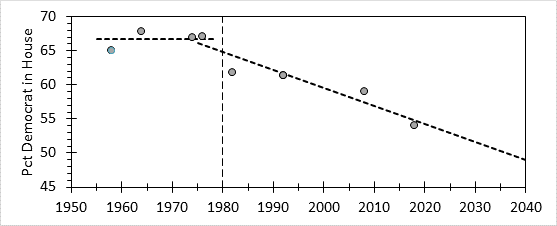
Figure 3. Peak Democratic strength in the House since 1950
Why messaging isn’t enough
Centrist critiques often focus on messaging—arguing that Democrats should deemphasize progressive identity politics and offer a more unified economic vision. There is some truth to this. Democrats can and should avoid alienating voters unnecessarily. But messaging alone cannot solve the underlying problem. If real wage growth is structurally limited, rhetorical flourishes will not convince voters that Democrats are willing and able to improve their economic fortunes. The core issue is not how Democrats talk about the economy, but what sort of economy they deliver.
The take home message is clear, Democrats need to enable a pro-wage growth economy, and that means ending the neoliberal economic regime. The necessary policies will shift income share from capital/management to labor to create conditions for more consistent wage growth. Such changes are politically feasible only in the wake of a major economic disruption, particularly one that discredits the opposing party’s management of the economy.
Lessons from past crises
The response to the 1929 and 2008 economic crises provides a clear example of do’s and don’ts. Figure 4 shows that policy under Obama quickly restored employment to previous levels, while FDR did not. Yet FDR implemented policy leading to the post-war “SC economy” featuring strong growth and rising wages 61% of the time. This yielded strong support for Democrats undergirding a Democratic dispensation. Obama failed to do either of these things. The key difference, I argue, is in the trajectory in real wages, a strong rising trend under FDR compared to a flat trend under Obama shown in Figure 4.
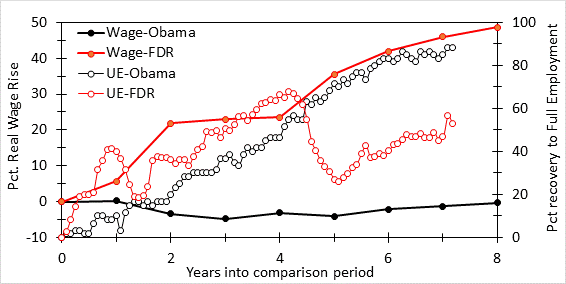
Figure 4. Post-crisis wage and unemployment trends under Obama and FDR
What Democrats must do if they ever again get the opportunity Obama had
Unlike what they did in 2008, Democrats facing a future financial crisis on the Republican watch should categorically oppose any form of Wall Street bailout or QE-type action on the part of the Fed—unless it is accompanied by tax increases on investors that pay for the bailout. If QE is implemented without any offsetting tax increase, Democrats must hammer home how Republicans are willing to print money to benefit Wall Street but not ordinary Americans. They should issue their own “contract with America” vowing to enact the tax increases they called for if voters put them back into power, and to implement a paid-for rescue package for ordinary Americans.
Once in power, Democrats must propose a stimulus much larger than the puny one used in 2008 that would include other policy changes along with large tax rate increases to pay for it, which should prevent inflation like what happened after the pandemic stimulus (which was not paid for). Additionally, once Democrats are in power, they would urge the Fed chairman to support their fiscal stimulus program by buying government bonds at auction as necessary to achieve low rates on long-term governmental debt—as was done in the 1940’s.
Basic economic theory correctly predicts that the short-term effect of the tax increases called for with this program would be to slow the economic recovery—as it did in the 1930’s. The large stimulus would initially mask these effects while the rapid reduction of the deficit as the economy recovers would suppress post-recovery inflationary forces. But the economic recovery would still be sluggish, fueling a “thermostatic” reaction against Democrats in subsequent elections.
Figure 4 shows that the New Dealers achieved strong wage growth despite high unemployment by use of non-market economic interventions. The New Dealers artificially engineered increases in hourly wages and encouraged labor unions to strike for higher wages. Later, as part of wage and price controls during WW II, they engineered a compression in wage levels, resulting in reduced income inequality. Something extra is needed besides the economic policy outlined above. It could be economic, a four-day workweek for example, some visionary project like the space program, or a national response to an external threat such as WW II.
Thanks for reading America in Crisis! This post is public so feel free to share it.
Measuring Worth provides an index of annual unskilled wages from 1774 to 1940 and I start with that. Another component is the BLS series median usual weekly earnings of full-time wages for high school dropouts. To bridge the gap between 1940 and 2000 I use two measures of hourly wages for non-managerial workers: the Fed average hourly earnings of production and nonsupervisory employees over 1964-2000 and the Measuring Worth manufacturing wage series.
The ability to raise prices without reducing sales.
No posts
Comments
Nothing yet. Say the first thing.
Sign in to join the conversation.