
If I do my job correctly here, you will have language for some of the most transformative times in your life, and that language will allow you to experience more of them and maybe even explain them to the people in your life who have never understood why you keep going back.
Imagine a time when you finished something that scared you, a race you were not sure you could complete, a workout that took you to a place you had never been, a day when your body did something that your mind had spent weeks telling you was not possible. Think about the feeling afterward: did you feel a shift? It may not have been sudden, but it was substantial, and something about you was different. It was not just a different type of sore or fatigue but something deeper that gave you the strength to cut through your own bullshit. You made decisions quicker, stopped tolerating the things you used to tolerate, and started carrying yourself like a person who was forged by something difficult.
This type of confidence is earned, no purchase, title or external status symbol can produce it. You had to train for it, sacrifice, and earn it with your body and mind. You could not read a book or listen to a podcast about it, you had to show up, try very hard, and become a stronger version of yourself.
If you have ever finished a workout and driven home in silence because something inside you was still trying to catch up to what you did, or sat in your car after a Hyrox competition and felt a strange satisfaction that had nothing to do with the result, or crossed a finish line after many miles and realized that the person who signed up for this race no longer exists in the same way, then you already have the experience this essay is about.
What you might not have is the explanation, the mechanisms, or the reasons why you keep wanting to come back. That is exactly what I went looking for, and I want to tell you what I found.
I have always used my body to create meaning and connection in my life. My mom says I never met a ball I didn’t like, and I would find my fullest expression as a human while playing. Now, as an adult, I am creating my own ways to explore myself through my body. I still love sports but I miss the daily practice of physicality I had playing football in college. Instead of competing in sports, I am taking on adventure. A few of my favorite adventures include running across the Grand Canyon and back multiple times, paddleboarding eighty miles of open ocean from the Bahamas to Florida, finishing multiple hundred-mile ultra marathons, and most recently breaking the Guinness World Record for the heaviest ever Turkish get-up at 261 pounds, an exercise said to be one of the most difficult in existence because of the mobility, coordination, and strength it requires.
I do not mention these to brag but to share how I have always been involved in the culture of physicality and still search it out today. Over time, I thought it was a personality trait or a product of my environment, and sure, those are true, but what I have come to realize is that taking on physical adventures is only odd in today’s world. Challenging yourself physically is one of the most human things we can do.
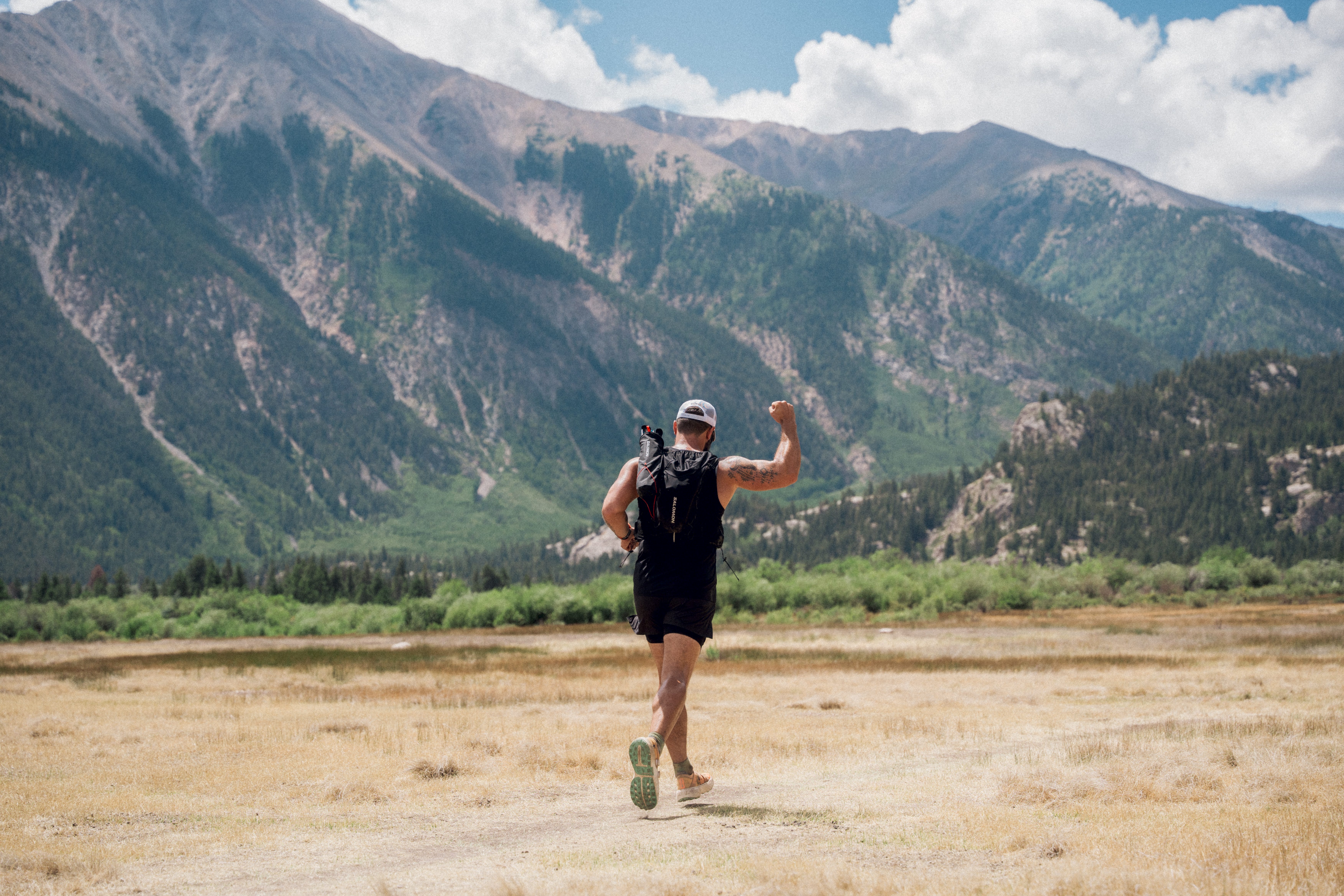
Every one of those experiences changed me in ways I could feel but struggled to explain. Each finish line, start line, and commitment, something had been revised at a level deeper than thought, and the revision stuck in a way that insights from the classroom or affirmations never did. I vividly remember signing up for the Leadville 100 Trail Run, a 100-mile foot race mostly above 10,000 feet and cresting nearly 13,000 feet in the rugged mountains of Colorado. After making the financial deposit, I got queasy thinking, oh shit, it’s real; maybe I bit off more than I can chew, but I then spent the next six months becoming a version of someone who could complete the run. I did not finish that year, but the person who came home from those mountains was not the same person who signed up. I have been going back to Leadville ever since.
For years I carried this question: Why does a hard thing, freely chosen and survived, change a person so durably? Why does the change feel like it happens in the body first and reaches the mind second? And why have human cultures, independently and across thousands of years, built these ordeals on purpose?
I enrolled in the Master of Applied Positive Psychology program at the University of Pennsylvania to find out. Penn is where positive psychology was founded, and the field studies what makes life go well, not just what repairs it when it breaks. The program was created by Martin Seligman, the founder of the field, and he still teaches in it today.
I came in very curious about the body’s relationship with the mind, not about fitness or confidence in the motivational-poster sense but about meaning as the research defines it: a life that makes sense, that points somewhere, and that feels worth living. I wanted to know whether the body could build that, and if so, how.
Positive psychology has spent its first quarter-century building tools for the mind, things like gratitude journals, strengths assessments, and cognitive reframing. These are real science-driven tools for well-being that work, but the body has often been treated as the place where well-being shows up rather than the place where it is made, and the body turns out to be one of the most powerful instruments of psychological change we have. The research I found points to four reasons why, and I want to walk through each of them here. The full published paper goes deeper if you want it.
Self-efficacy is the belief in your own capability, and the psychologist Albert Bandura found that the strongest source of this belief is what he called mastery experience: the direct evidence of having done a hard thing yourself, not being told you can but actually doing it. Physical challenge manufactures this evidence with a bluntness nothing else matches. A finished race is not an interpretation, and a weight lifted is not an argument. It is a fact that the old self-image cannot absorb without changing. If you have ever come home from a hard event and noticed that problems at work or in your relationships suddenly felt more manageable, this is part of why, because the hard thing recalibrated your internal estimate of what you can handle across the board.
Flow is the state of complete absorption where time disappears and the voice in your head goes quiet. It arrives most reliably when the challenge matches your skill right at the upper edge of what you can handle, and physical effort is one of the most consistent doors into it, because the feedback is honest and immediate. You can either hold the pace or you cannot, and the barbell either moves or it does not, and there is no room for self-deception in either case. One theory suggests that sustained physical effort temporarily quiets the parts of the brain responsible for self-monitoring and second-guessing, and that quieting is not emptiness. It is the condition under which real change can land, because the part of your mind that normally defends the existing version of you has stepped aside. You have been in this state on the rower when the monitor said you were redlining and you did not care, and on mile eighteen when the math stopped mattering and there was nothing left but to run.
Awe is the emotion that arrives when you encounter something vast enough to exceed your ordinary frame of reference. Deep in a hard effort, the boundaries of the ordinary self thin out, and you stop narrating your experience and become part of it. That moment in a long race when you realize you are one small body moving through something enormous, and the thing you were so worried about last Tuesday has quietly ceased to matter. The research shows that awe expands the sense of connection to something larger, and people who experience it regularly report more satisfaction with their lives and less preoccupation with the concerns that usually fill a day.
Narrative identity is the ongoing story you tell about who you are. The psychologist Dan McAdams found that people do not simply accumulate experiences but instead select certain episodes as defining scenes and arrange them into a story with direction and theme. Physical challenges make unusually good defining scenes, because they carry effort, real stakes, and a clear beginning and end. Think about the stories you tell when you need to remember what you are made of, and notice how few of them involve something easy. Research on what are called redemption sequences, stories that move from difficulty to positive resolution, found that people whose life stories contain more of those turns report higher well-being. It is not that the people doing best have the easiest lives but rather it is that their stories contain the most turns from hard to good.
These four mechanisms are well-established individually. But for months I studied them as separate literatures. They lived in different journals and used different methods, until I saw a connecting thread.
Underneath all four runs an operation that the psychologist Jean Piaget gave a name decades ago: accommodation. Piaget used the term to describe what happens when existing mental frameworks have to change to incorporate information they cannot otherwise hold. My proposal is that something similar happens to the self through physical challenge.
The opposite of accommodation is assimilation, where the mind bends new information to fit what it already believes so that nothing has to change. Assimilation is the default, because it is easier, faster, and it protects the current version of you. Accommodation is what happens when assimilation fails, when the evidence is so direct that the old frame cannot hold it.
Each of the four mechanisms is a different door into the same revision. In self-efficacy, the old estimate of what you can do is overwhelmed by evidence it cannot contain. In flow, the self-monitoring that would normally resist the revision goes quiet. In awe, the existing frame is exceeded by something larger. In narrative identity, the old story is rewritten to include a scene it was not built for. Four doors into one room, and in most cases the self is changed.
The reason physical challenge is so effective at producing this change is that the body deals in evidence the mind cannot argue away. You can talk yourself out of a compliment, and you can reframe a setback as someone else’s fault, and you can assimilate almost any experience if you try hard enough. However, you cannot tell yourself you are not a person who does hard things after your body has just done one. The body is where assimilation runs out, and accommodation has to take over.
This is why I believe the hard thing changes you in a way that thinking about the hard thing never could. Your body produced evidence your mind could not dismiss, and the person you were before had to be revised to hold it.
I want to be mindful here, because I am not claiming to prove anything. The capstone I completed at Penn is a theoretical framework built on established research, not an experiment, and the claim that these four mechanisms converge through accommodation into a single pathway to meaning is a proposal that needs to be tested directly.
I believe the framework is true, not just because the citations line up, but because I have lived it and watched it happen in the people I coach. The client who bought a bike, rode it around his neighborhood, and loved it. When I mentioned the Triple Bypass in Colorado, 120 miles over three mountain passes and 10,000 feet of climbing, he thought it sounded incredible and said he wanted to talk to his brother, who was into ultra endurance racing. His brother told him it was too hard for someone who had just started cycling. So partly to prove it to himself and partly to prove it to his brother, he signed up and put in the training. His brother eventually wanted to join, and they ended up riding much of the race together. It brought them closer than they had been in years, and now they are looking at their next adventure. The founder who signed up for a wilderness challenge and came back making decisions he had been avoiding for years. My friend who used to weigh over 500 lbs and is now half that weight and about to toe the line at his first 100-mile ultra marathon.
Human cultures have understood something like this for thousands of years. Across the world, cultures built rites of passage around physical ordeals, a fast, a vigil, a long walk, a trial of endurance, because the transformation came through the body before it ever reached the mind. They did not leave people to figure it out alone. They built the reflection into the passage, they witnessed the return, and they asked the questions that turned the ordeal into a story the rest of a life could be organized around. Somewhere along the way, perhaps as our lives became more virtual and industrialized, we stopped doing that. But the mechanism never left. Every time you choose something hard with your body, you are walking through the same door those cultures built thousands of years ago.
The challenge changes the body, the evidence changes the mind’s story, and the story changes what you believe is possible next.
The full capstone paper, “Meaning in Motion: Embodied Challenge as a Pathway to Meaning, Agency, and Human Flourishing,” was completed through the Master of Applied Positive Psychology program at the University of Pennsylvania, advised by Dr. Gloria Park. Read it HERE
No posts
Comments
Nothing yet. Say the first thing.
Sign in to join the conversation.