
The water at the base of the falls was the color of coffee with too much milk in it, thick with mud and sediment from the storms that had rolled through all week. Remi was standing on a wet ledge maybe fifteen to twenty feet up, and I was treading water below him. The problem was simple: we could not see the bottom. Somewhere under that surface there might be a boulder waiting a few feet down, or there might be twenty feet of open water, and the only way to find out was to get in and look. I had been to this spot before, and it was safe for jumping, but I never wanted to take a chance. Waterfalls change, storms move rocks, and familiarity is not the same thing as certainty.
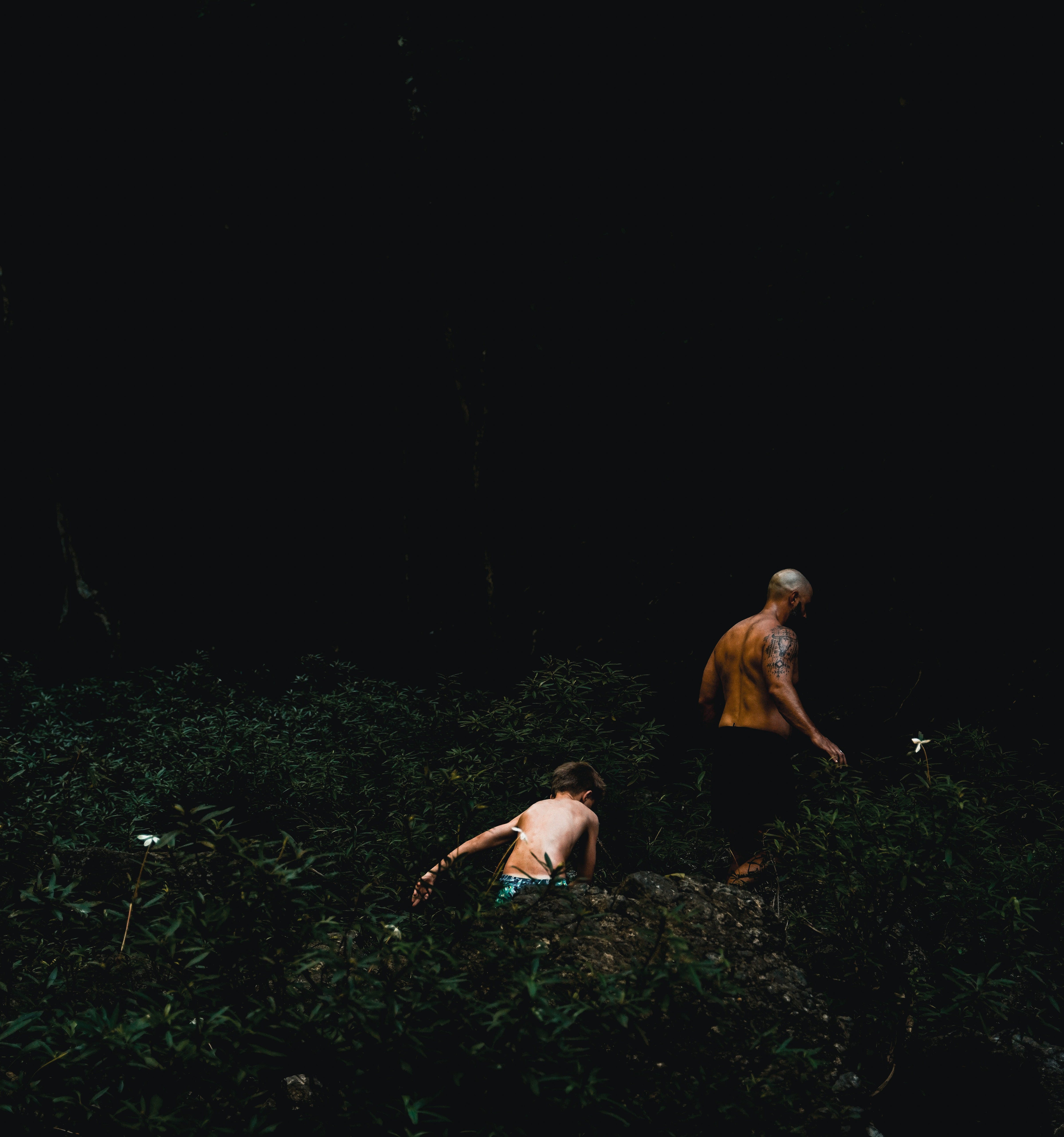
Remi, Kelly, and I had taken an ATV close to thirty miles through the jungle to get here, up and down inclines steep enough that he had to lean into me and trust the vehicle, his arms wrapped around my ribs while he coached me as ten-year-olds do. When we got to the waterfall, we hiked a stream full of roots and slick rock, swam across the pool in front of the waterfall, and climbed the wet stone up the side of the falls.
Before jumping in, I swam the landing zone with my feet down, mapping where the water actually ran deep. Remi stood above me watching the entire time as I threw my arms overhead and penciled down. It was all clear, but I wanted to be the first to test it, so I swam back out, climbed up the rock, and jumped. All systems go. Our first jumps were lower, 10 feet or so, but we eventually made our way to 20 feet. Then, after a few jumps, I saw a route even higher, close to the rushing water. I kept asking myself a private question the entire way up, which was how high I honestly wanted to go. Remi watched all of it. He saw that the excitement and the caution were not enemies... that you can feel your heart slamming in your chest and make a careful decision inside that very same minute. I did a few from the higher spot.
( zoom in … our faces tell the story )
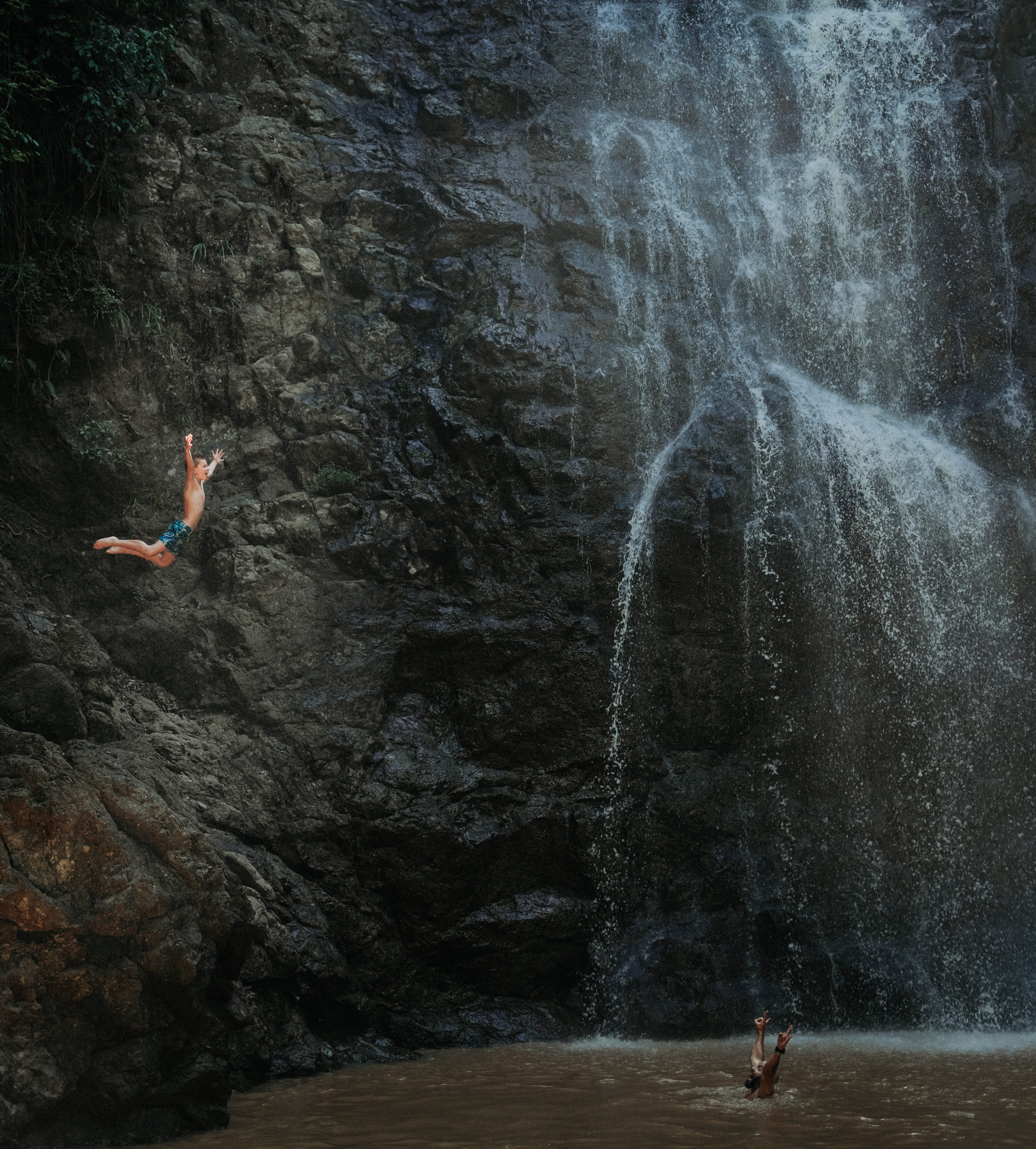
There is a Norwegian researcher I read about last year named Ellen Sandseter who has spent her career studying what she calls risky play, and her work names exactly what I was watching happen on those rocks. She found that children are naturally drawn toward several forms of risk in play. Three of them were present at the waterfall: height, speed, and deep water. That pull is not a defect we need to manage out of them. She argues that this is how a young nervous system learns to read danger and eventually build a healthy relationship with it. She and her colleague Leif Kennair describe what they call an anti-phobic effect, the idea that a child who meets a feared thing... a high ledge, a dark pool... while flooded with the thrill of play will slowly stop being ruled by that fear, and the thrill is what helps them learn. Take it away, and the fear tends to harden into something that can calcify inside of them for the rest of their life, making it harder to trust themselves and take risks as an adult. Safetyism often has parents thinking they are helping keep their child safe, but if not managed well, it can be a psychological risk.
That finding lands hard for me, because I spend most of my working life talking with grown adults who either never got that education, or who got it once and then spent decades unlearning it. The armor a person shows up in was usually built young, and a surprising amount of it traces back to a moment when the thrilling thing got labeled only as the dangerous thing, and the door closed.
This year, while studying at Penn, I sat in a class Jonathan Haidt was teaching, and one line of his has stayed lodged in me since. We have inverted our instincts as a culture, he argued, overprotecting kids in the physical world while underprotecting them in the virtual one, wrapping them in rules of “safety” on the playground and then handing them a phone or screen that opens onto everything. The waterfall lives on the first half of that equation. His deeper claim is that children are antifragile, which means they don’t merely tolerate real-world risk, they often need it in order to grow, similarly to the way a young tree needs wind to build a strong root system.
Haidt made sure to mention that you need to pair the thrill with what he calls a secure base, a trusted adult close enough to make the danger survivable. Treading water in that murky pool with Remi on the ledge above me, I understood the pairing in a primal way. The risk is what has the capacity to teach him, and my being in the water is what makes the lesson safe enough to learn. Kids don’t learn courage from being told to be brave. They learn it by watching someone they trust go first. Albert Bandura built an entire theory of learning around this. Children acquire their deepest behaviors from observation not instruction. They watch what the adults in their life actually do when things are uncertain, and that becomes their template. I was not teaching Remi a lesson about jumping. I was showing him what it looks like to be scared and careful and committed all at once.
Right before his biggest jump, Remi looked down at me with a pensive look on his face and said, “You got me?” It was the kind of question a kid asks when he is trying to hand his fear to someone else. I told him I got him. But more importantly, I told him he has himself, that he can trust himself, commit one hundred percent, and go. He jumped.
Our culture tends to hand a kid two scripts at a moment like the one on that ledge, and I am not the biggest fan of either. The first is protection, the voice that says the jump is dangerous and a good parent keeps a child well away from it. The second is bravado, the voice that says a real man simply sends it and finds the bottom on the way down. What the waterfall teaches, and what Sandseter’s research supports, is a third thing that never got a slogan. Get in the water first, gather your own internal wisdom of the situation based on what your body can tell you, test from a height you can afford to be wrong about, and then trust your gut. Maybe courage and good judgment are not opposing forces. Maybe they are the same skill practiced at the same time.
What I want Remi to carry out of that jungle has nothing to do with a taste for danger. It has to do with a method of adventure he can use for the rest of his life, and the memory that a man in his life didn’t stand on the shore and tell him it was safe. He got in the water, jumped with him, and showed him.
It was the emotional trifecta for me. His face of pensive trust before, the full commitment smile mid jump, and when he surfaced from his own jump a few feet from me, the look on his face is one I will never forget. Pure, uncomplicated joy, the kind that only shows up on the far side of something that scared you a little. I think that joy is the receipt for a lesson the body just learned, and the mind will spend years catching up to.
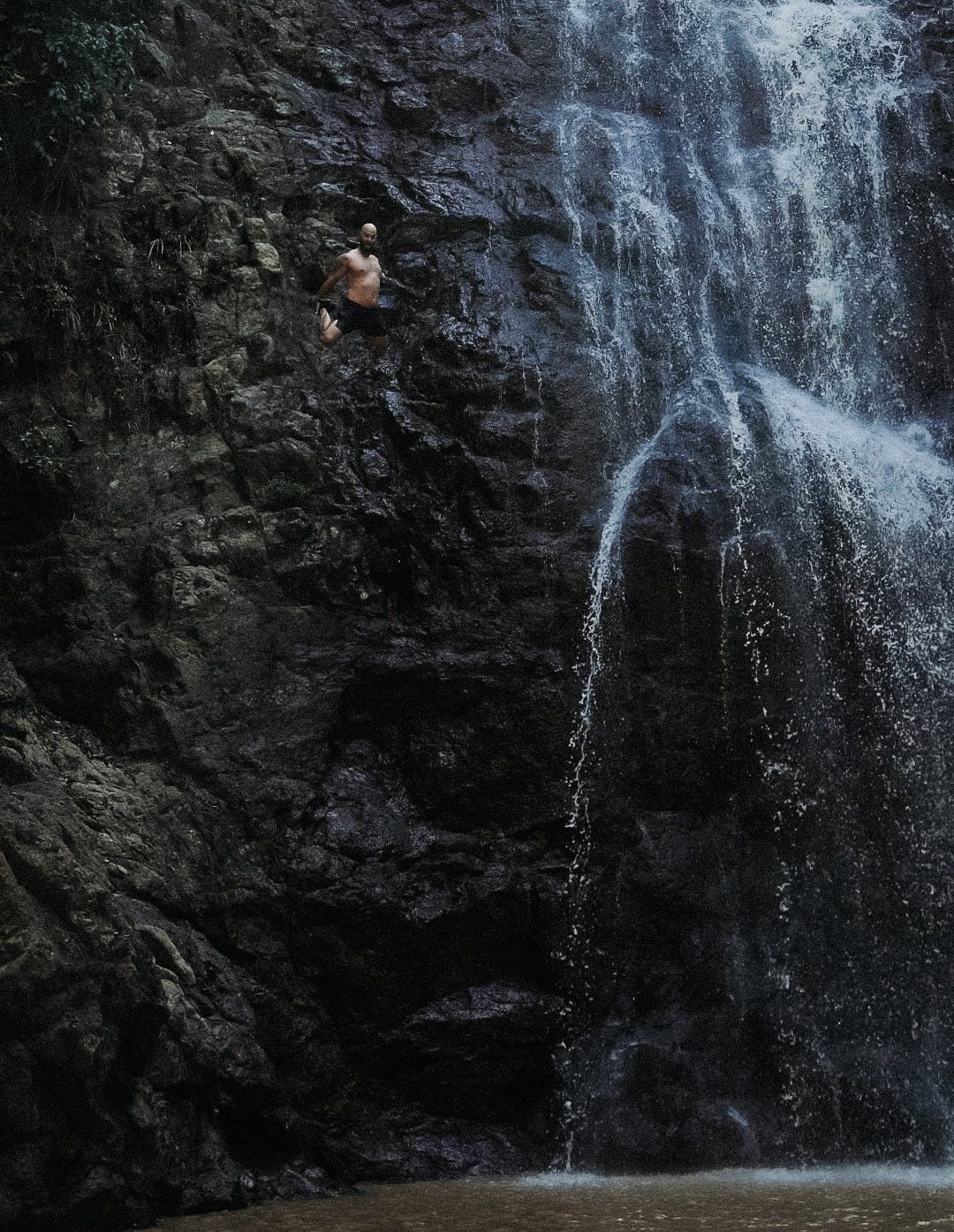
Thanks for reading. If someone came to mind while you were reading this, I’d love it if you passed it along.
I write every Tuesday about where adventure, psychology, and movement intersect. If you want to go deeper, here’s Field Guide No. 1: Meaning, a practical companion designed to help you start building meaning through action.
No posts
Comments
Nothing yet. Say the first thing.
Sign in to join the conversation.