
As an immigrant to America and a proud naturalized citizen, I will never stop being grateful for America’s gifts and promises — its radical premise that all people are created equal, its founding promise of liberty and the pursuit of happiness, its constant, slow but steady move toward greater justice.
Most people in the world would give anything to be able to be Americans, and we should continue to celebrate that.
We should also ready ourselves to fight for our country. There are too many forces pushing us to question the value of America and seeking to weaken it from within. It is our responsibility as Jews and as Americans to do everything in our power to preserve this magnificent republic.
On this note, I want to share an article my father, Rabbi Yosef Bitton, published in Tablet, called “The Rabbis Who Gave America the Weekend.” The article chronicles the efforts of two rabbis to create a two-day weekend in America, and shows how their refusal to give up Jewish distinctiveness and the holiness of the Sabbath helped shape the way we think about work, labor laws, and rest today. This article shows that Jewish difference is a gift we Jews bring with us — one we use to contribute to America.
Wishing you all a happy 4th of July and Shabbat Shalom from Jerusalem,
Mijal
Joshua Hoffman recently wrote about American Jews’ new reality: a world where support for Israel is no longer automatic. His answer was neither panic nor retreat, but to deepen our relationship to Israel and to each other.
As an educator and a parent, I keep coming back to that phrase: deepen the relationship. What does that actually look like in this difficult new reality?
I think it begins by teaching our children not simply to love Israel, but to yearn for it, deliberately, as a discipline we pass down.
For a long time, American Jewish education gave our children a Disneyland version of Israel. As the historian Jonathan Sarna has observed, Israel became a place that reflected back whatever American Jews needed to see about themselves.
The trouble with Disneyland is that eventually you notice the seams. When fantasy meets reality, disappointment follows. This is, in part, what happened to a generation raised on an Israel presented as a dream already fulfilled rather than a real place.
If we raise our children to relate to Israel as a finished dream, we set them up to be disappointed by it. We need to raise them differently, not toward fantasy, and not toward the disillusionment that follows it, but toward yearning. Yearning does not require perfection. It reaches toward something unfinished, knowing that it is still unfolding.
I’m writing this in Jerusalem as the Three Weeks begin, the annual period of mourning that starts with the breach of Jerusalem’s walls. At their heart, the Three Weeks are an education in yearning. They train us to keep longing for something we may never fully possess.
Can that kind of yearning be taught? This week’s parasha suggests that it can.
In the portion of Pinchas, the land of Israel is already being divided in the wilderness, tribe by tribe, family by family, though no one has yet set foot in it.
Five sisters, the daughters of a man named Tzelofechad, come to Moses with a claim. Their father died without sons, and under the current law, they would receive no portion in the land.
They ask for one anyway.
There is much one could say about their legal reasoning, their leadership, or their place as women in the history of inheritance law. But what has captured my attention this year is a different question: where did their yearning come from?
These are daughters of the generation that left Egypt and then refused to enter the land — the generation that wept at the report of the spies and asked to go back to Egypt. And here are these women, raised in that same wilderness on stories of a land they had never seen, fighting for a portion in it.
Where did their intense yearning come from? Commentators note that their family line traces back to Joseph, through his son Menashe. Before he died in Egypt, Joseph made his brothers swear that they would carry his bones back to a land he himself never returned to. Joseph’s longing did not die with him. It became a story passed from generation to generation until it reached five sisters in the wilderness.
This is a portrait of yearning: not as something you simply feel, but as something you are taught. Someone has to tell you the story, make the land real to you before you have ever stood in it, and pass on to you a longing they themselves may not have fulfilled.
Tzelofechad’s daughters did not invent their love for Israel. They received it, the way you receive an heirloom, and then they had the audacity to act on it. God tells Moses that the daughters speak rightly, and the law is changed to grant their claim.
I’ve found myself thinking about these daughters and the ancestors who taught them yearning. One moment in Jerusalem helped me better imagine what that looks like.
We came to Israel this summer for my nephew’s bar mitzvah, but mostly because my husband and I decided we needed to try making it here as a family once a year.
Since October 7th, we’ve realized that if we want our children to develop a deep relationship with Israel, it has to be built intentionally.
Last Shabbat afternoon, my brother and I took twelve of our children, nephews, and nieces on an impromptu tour of the Old City, tag-teaming based on whatever each of us knew.
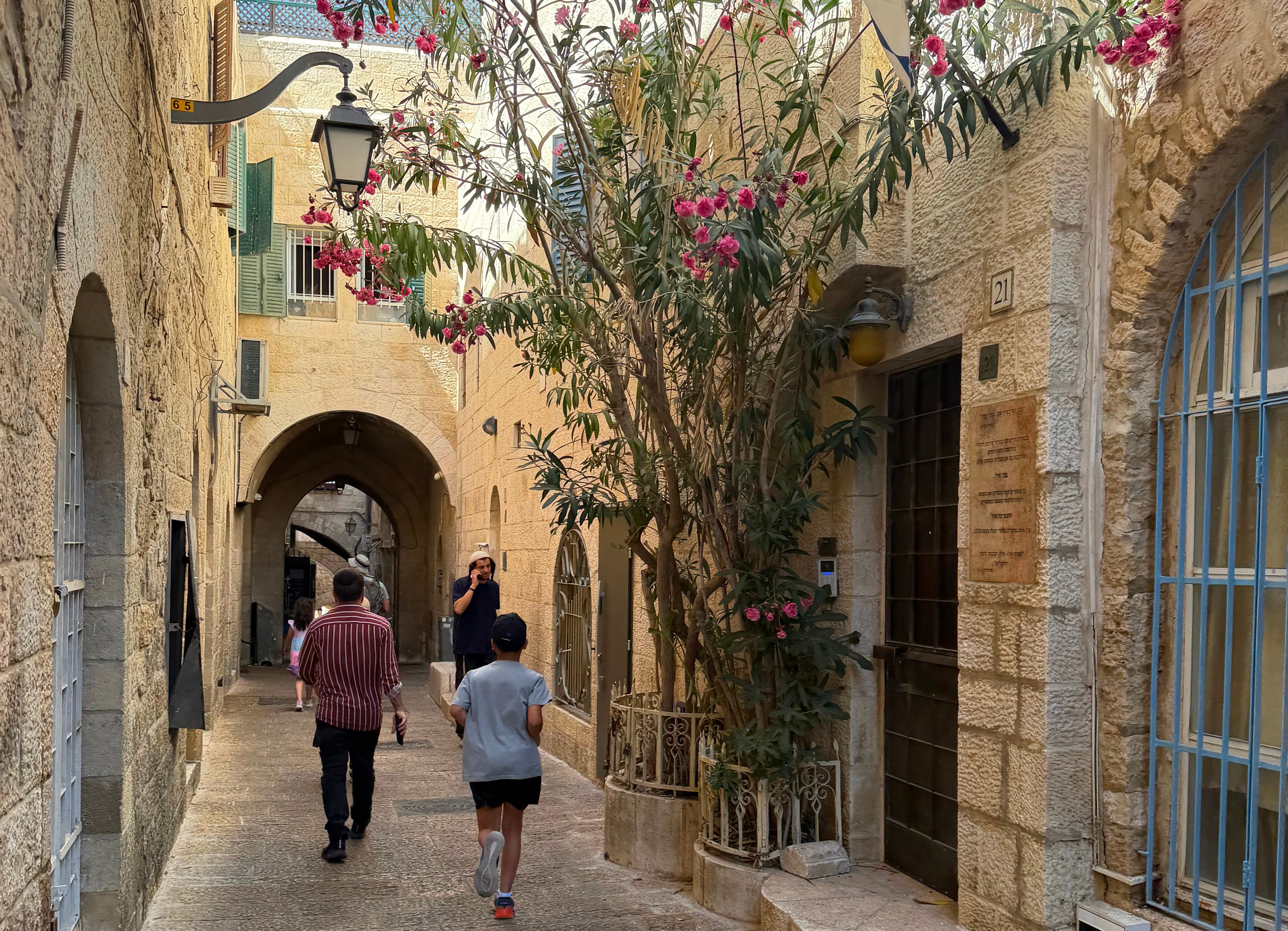
We wandered through centuries of Jewish history. We pointed out the Ottoman walls, the Roman Cardo beneath our feet, a wall from the days of Hezekiah, and the synagogue where my parents were married. We stood before a memorial to those killed defending the Jewish Quarter in 1948. In one afternoon, we walked through thousands of years of Jewish history.
My brother had been promising the kids a rooftop nearby with an incredible view, and with every mention they grew more excited. But as we walked, we realized we were running out of time.
I pulled him aside.
“What do we need to cut to make the rooftop work?”
“Let’s not take them,” he said. “I want them to leave wanting more. It’ll make them want this place even more.”
We ended our walk in a square in the Jewish Quarter, beside a playground and a school. On its wall is Zechariah’s prophetic vision of Jerusalem: elderly men and women sitting peacefully in its streets while children fill its squares with play.
That vision captures what yearning for Jerusalem looks like.
It is elders teaching children to love Jerusalem with their feet. It is learning to celebrate the miracles we have witnessed without pretending the story is complete. It is committing ourselves never to stop yearning.
Jerusalem is not finished, and it is not our job to make our children believe otherwise.
This, I think, is also an answer to Hoffman’s challenge, even if he didn’t put it in these terms. Relationship that is based on assuming the project of Israel or Zionism is finished is fragile and can easily turn brittle.
Yearning is different. It is, by definition, a form of not-yet-having — a way of staying in relationship with something that is always in a state of becoming.
If we want the next generation to stay in relationship with Israel through hard days, the deepest gift we can give them isn’t a finished dream to defend. It is an unfinished Jerusalem to love, to build, and to leave a little more whole than they found it.
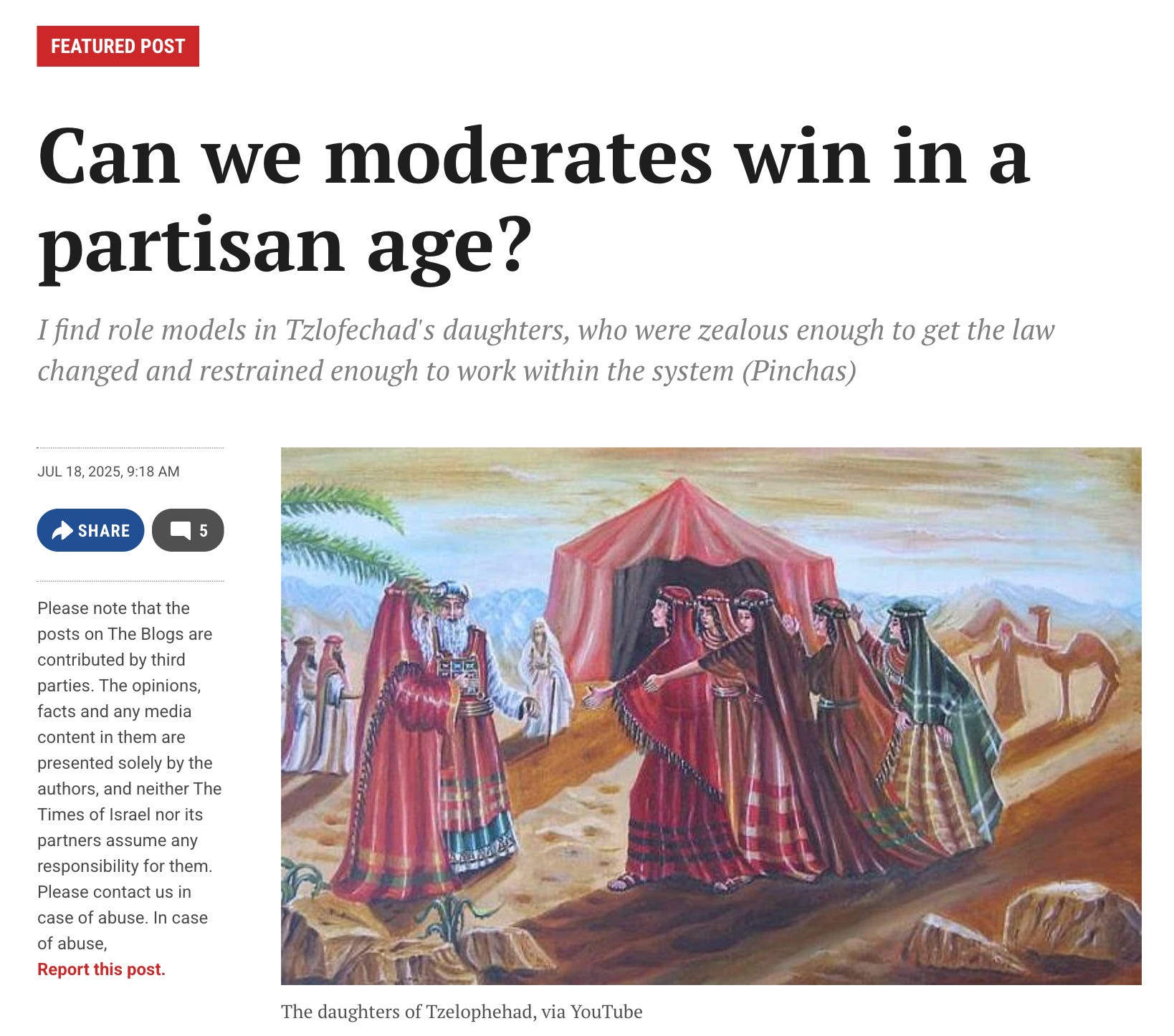
📖 Check out my Committed essay from last year, featured in the Times of Israel, on why the daughters of Tzelophechad offer a powerful model of moderate leadership in times when extremists flourish.
No posts
Comments
Nothing yet. Say the first thing.
Sign in to join the conversation.