
By Aníbal Yariel López Correa, EdD, Senior Manager of Evaluation, Research, and Monitoring, Migrant Clinicians Network
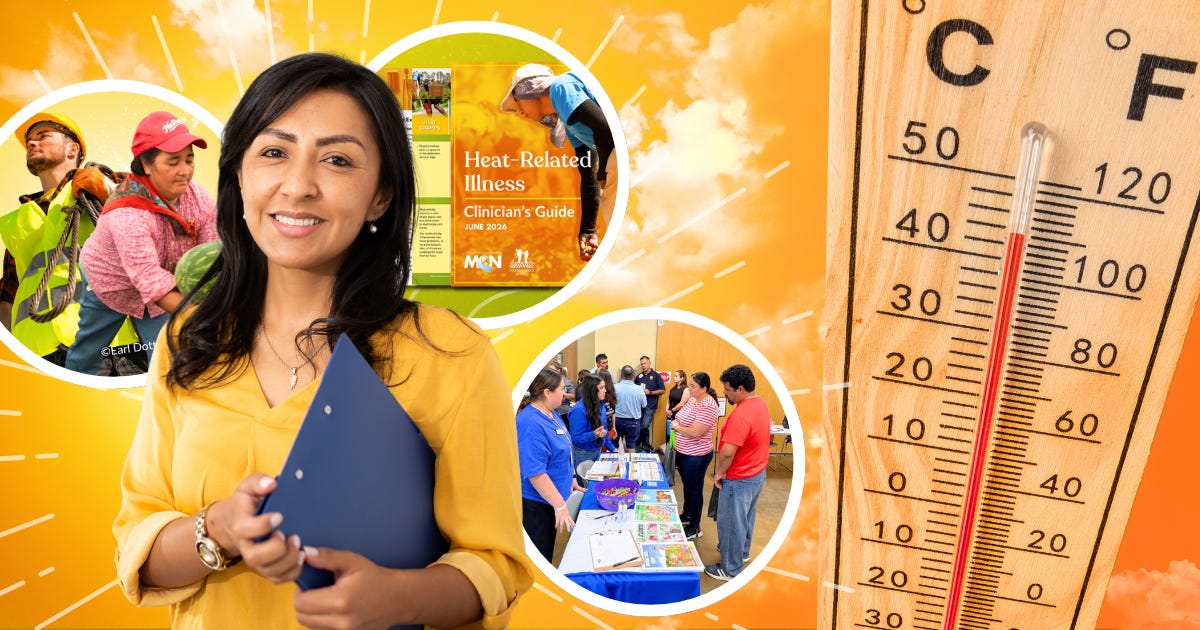
July 2026 was the hottest month on record in the contiguous United States, breaking the previous record from 1936’s Dust Bowl. In the middle of this broiling heat, community health workers/promotoras, community outreach workers, health educators, and other professionals committed to community well-being gathered virtually with Migrant Clinicians Network (MCN) to discuss heat – and how it influences or complicates access to health services in migrant communities and other populations facing barriers to medical care. Participants, from across California, Texas, New Mexico, and Arizona, shared experiences, lessons learned, and strategies for addressing the unique challenges faced by communities in their particular region, as well as the strategies these communities are using to respond to extreme heat. The session was particularly unusual in that it was conducted entirely in Spanish, opening up peer connection and access to experts to Spanish-speaking, US-based health professionals who often lack opportunities for this form of connection and learning.

Heat was top-of-mind. Participants opened up about the 100-plus-degree temperatures that families are facing this summer in some of their communities, and the effects of extreme heat on many community members, including farmworkers, construction workers, community outreach staff at health centers, and others who work outdoors or in indoor spaces that lack air conditioning. The heat had already affected people participants know; more than one participant had to call 911 for assistance related to heat. Others shared how heat is in the news, including this useful comic from NPR.
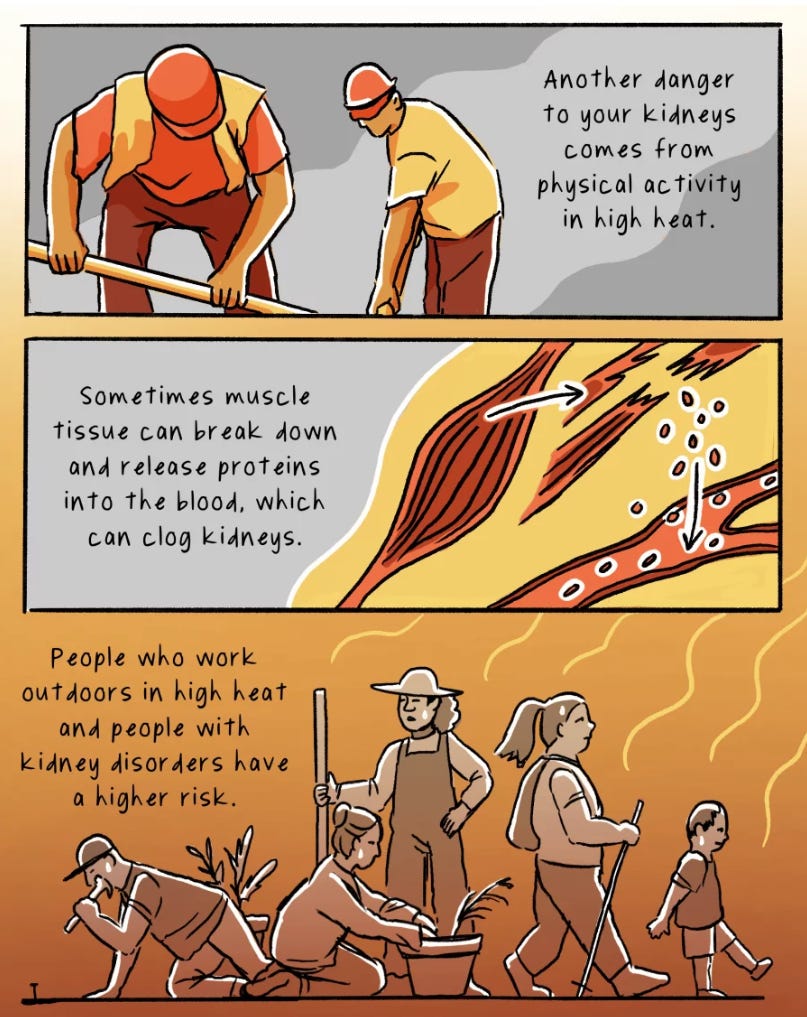
The conversation highlighted that the risks associated with extreme heat are affecting a wide variety of workers and families, beyond those traditionally associated with heat exposure. Similarly, the participants shared that, while some people have options to seek shelter from the heat during their workday, many others continue to work outdoors in extreme temperatures. This exchange highlighted the importance of strengthening community education and health literacy so that more people can learn simple and effective ways to prevent heat-related illnesses and take care of their health.
MCN shared educational resources available in Spanish and English on the health effects of extreme heat and on preventing heat-related illnesses on our Heat page. Similarly, the Pacific Northwest Agricultural Safety and Health Center’s heat resources were shared, featuring a toolkit to educate communities about heat and risk factors.
Text within this block will maintain its original spacing when published
Participants exchanged practical recommendations for preventing heat-related illnesses and protecting the most vulnerable people:
Stay hydrated throughout the day.
Take frequent breaks in cool places.
Seek shade whenever possible.
Wear light, cool, light-colored clothing.
Use sunscreen.
Carry electrolytes to help replenish fluids and minerals.
Recognize the early signs and symptoms of heat-related illnesses.
Stay attentive to the well-being of family members, friends, neighbors, and coworkers.
During the conversation, we covered how to identify symptoms such as rashes, cramps, dizziness, heat exhaustion, and heatstroke, as well as the steps to take when someone shows symptoms indicating an emergency. One of the most important messages was the importance of mutual care. The participants emphasized that protecting one’s health during extreme heat events depends not only on individual decisions but also on communities’ ability to support one another.
MCN shared educational materials on the prevention of heat-related illnesses, including resources based on OSHA recommendations that explain how to identify symptoms such as rashes, muscle cramps, dizziness, heat exhaustion, and emergency situations requiring immediate attention, as well as workplace guidelines. MCN’s most recently released resource, an updated version of the Heat-Related Illness Clinician’s Guide, is available in English and Spanish as well, which includes one page that can be printed out and handed to community members on signs and symptoms. The conversation also dove into community education initiatives. One participant shared a Facebook reel she uses on social media to raise awareness in her community about the effects of heat and strategies for staying safe on days with high temperatures.

Community care is an essential strategy to stay safe during periods of intense heat, participants noted. The Listos California website was referenced for its multilingual resource hub.
In many communities, not everyone has consistent access to air conditioning or suitable spaces to stay cool. As a result, various locally used strategies were shared, including:
Opening windows early in the morning to take advantage of cooler temperatures before the heat rises.
Spending time in libraries, community centers, shopping malls, or other air-conditioned public spaces.
Identifying and using shelters or cooling centers when they are available.
Sharing information about local resources to respond to extreme heat events.
These practical solutions can, at times, help protect health and support those at higher risk.
Text within this block will maintain its original spacing when published
In addition to the discussion on extreme heat, participants learned more about Health Network, a program of MCN that helps ensure continuity of care for people who are on the move or face difficulties accessing health services. MCN staff shared that Health Network works to ensure that people feel supported, safe, and confident in taking care of their health. The program offers support to help navigate the health care system, connect people with community resources, and facilitate access to medical care.
Examples were shared of situations in which the program can provide support, including:
People who are moving and need to transfer their medical records.
Agricultural workers and their families.
Construction workers who relocate for work.
Pregnant women who need continuity of care at their new destination.
Children with health conditions who have recently moved.
People with tuberculosis (TB) who need continuity of treatment while moving.
People who need guidance to understand and navigate available health services.
The presentation highlighted that Health Network’s goal is to help eliminate barriers and make it easier for people to receive the care they need, no matter where they are. It was also noted that MCN offers patient navigation services free of charge and helps patients connect with a health care provider. Patients are responsible for the costs of medical services, although MCN does its best to identify providers that offer affordable care.
Text within this block will maintain its original spacing when published
As part of the discussion, a digital form currently under development was also presented; it will allow community organizations to make referrals to Health Network more efficiently. Participants provided comments and suggestions regarding the form’s content, including questions that could be clarified, simplified, or supplemented with new answer options. This feedback will contribute to the development of a more accessible and useful tool for organizations that support people with health needs.
Text within this block will maintain its original spacing when published
The community discussion served as a space to share resources, suggestions, and experiences that are similar despite participants working in different counties or states. Unlike a workshop or webinar, the discussion serves as a space to hear real-life experiences, identify common challenges, and learn from the strategies being used in different places to cope with extreme heat. This session was unusual in that it provided a space, in Spanish, where community health workers/promotoras could explore methods of community preparedness to extreme heat and gain access to tools like Health Network.
MCN invites community health workers/promotoras, community outreach workers, and community organizations to participate in the next installment of our virtual community talk series, which will take place on August 18, 2026. This time, the conversation will focus on vaccines as students return to school and on how Health Network can support people and families who are on the move to stay connected to health care. It will also be an opportunity to exchange experiences, share resources, and discuss strategies to help strengthen access to and continuity of care for communities with limited access to health services.
The discussion will be held in Spanish and enrollment is at no cost to participants:
1:00–2:30 p.m. PT / 2:00–3:30 p.m. MT / 3:00–4:30 p.m. CT
Note: The resources included in this summary reflect materials shared during the conversation by participants and by MCN. They are included for informational purposes to facilitate access to information related to the topics discussed during the talk.
About this initiative: This community discussion is part of the series “Community Discussion! Let’s Share Ideas to Strengthen Access to Health Services in Our Communities on the Move,” developed under the project Health Network: Bringing the Most Vulnerable to Care (OT2OD035845), funded by the National Institutes of Health (NIH).
No posts
Comments
Nothing yet. Say the first thing.
Sign in to join the conversation.