
👋 Hey, it’s Teija, back with another edition of The Midnight Text, Forum Ventures’ bi-weekly newsletter answering the questions that keep founders up at night.
I’m the Head of Product Design at Forum Ventures’ AI Studio, where I work with founders to turn AI ideas into products people actually want. Over the last decade I’ve led product and design teams across AI, Web3, B2B, and B2C SaaS, helping startups go from early ideas to products that are ready for market.
A few weeks ago I led a virtual session with the team at Make.com about the practical reality of AI agents for founders and startup product teams. Rather than talking about tools, I walked through a framework I use to decide where AI should own the work, where it should simply make humans faster, and where it shouldn’t be making decisions at all.
Interestingly, the other presenter had a pretty different perspective.
It caught me off guard enough that I spent the rest of the afternoon second guessing my own framework.
Was I thinking about this the right way? Was my take too conservative? Had I become a bit jaded after watching enough startups build things nobody wanted? Or was I underestimating what these models can actually do?
So I did what I usually do.
I shared the presentation with a few colleagues, called a couple of product leaders I trust, and Slacked a handful of Forum portfolio founders to see how they were thinking about it too.
At the same time, founders who had attended the session started reaching out with almost the exact same question:
“How much of this should I actually hand over to AI?”
After a few dozen conversations over the following weeks, I actually came away feeling more confident in the framework than I did walking into the presentation.
AI has made execution dramatically faster, and I genuinely think that’s exciting. If anything, I think we’re still only scratching the surface of what these tools will eventually be capable of.
But when I look at why startups still fail, the reasons haven’t really changed.
- We still misunderstand customers.
- We still build features nobody asked for.
- We still optimize the wrong workflows.
- We still solve problems that aren’t actually worth solving.
AI hasn’t changed those problems. It’s just made it possible to get to them much faster.
Which led me back to one question that I now use almost every time I’m deciding how AI should fit into a product process:
Where does the understanding actually come from?
After enough conversations, I realized the disagreement wasn’t actually about AI.
It was about where understanding comes from.
That’s now the question I ask myself whenever I’m deciding whether AI should own a piece of work.
Not:
Can AI do this?
Instead:
Where does the understanding actually come from?
Where does the context come from?
Where does the judgment come from?
At least today, answering those questions has become the simplest way I’ve found to decide where AI belongs in the product process.
The understanding that leads to product-market fit doesn’t come from prompting AI.
It comes from spending time with customers. Talking to them. Watching how they work. Seeing where they hesitate, where they create workarounds, where they complain about something you didn’t even think to ask.
AI is incredible at helping organize and synthesize what you learn (and yes, I’m a huge fan of AI note takers). But it can’t replace building that understanding in the first place.
From there, almost every product decision falls into one of three buckets:
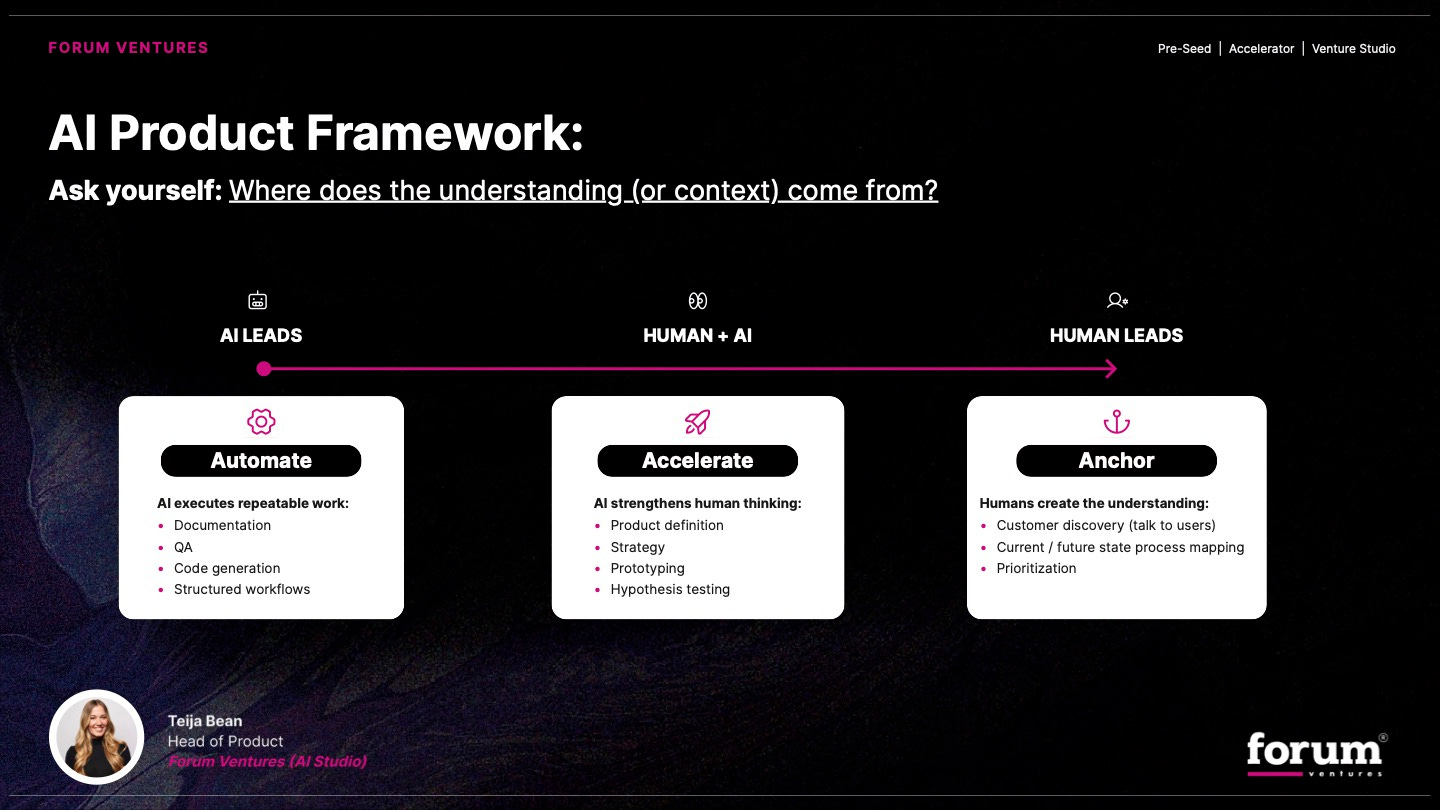
When you’ve already figured something out and the work has become repetitive, automate it.
The important distinction is that the understanding already exists. You’re not asking AI to figure out the process. You’ve already done that work.
If you can clearly explain:
- The workflow
- The tradeoffs
- What good looks like
- Examples of successful outputs
...AI is fantastic at taking repetitive execution off your plate.
This is where agents shine. They don’t need to discover the process. They simply execute it consistently and at scale.
This is where I think AI is at its best.
Human thinking is still driving. AI just gives that thinking leverage.
I lean on AI constantly for things like:
- Product strategy
- Product definition
- Research synthesis
- Prototyping
- Hypothesis generation
- Brainstorming
- Writing and communication
AI can challenge assumptions, summarize patterns, generate alternatives, or help explore ideas much faster than working alone.
But you’re still the one deciding what to build and why.
Today, I think AI is at its best when it amplifies product thinking, not replaces it.
That may change over time. But right now, I’ve found the highest leverage comes from combining human judgment with AI’s speed, not choosing one over the other.
This is where I think founders get themselves into trouble.
Some work is valuable because it produces an output.
Other work is valuable because doing it creates understanding.
That includes work like:
- Customer interviews
- Current-state process mapping
- Future-state workshops
- Prioritization conversations
You’re not just collecting information. You’re building judgment.
Customers tell you things that no model has direct access to, like:
- Internal politics
- Workarounds nobody documented
- Previous implementation failures
- Competing priorities across teams
- Organizational constraints
- The thing they forgot to mention until halfway through the conversation
Those insights fundamentally change products.
AI can absolutely help you prepare for these conversations. It can help synthesize them afterward. It can even suggest patterns you may have missed.
But today, I don’t think it can replace building that understanding yourself.
When founders skip this work, they usually don’t end up with a bad product.
They end up solving the wrong problem.
AI makes it incredibly easy to build, which is a huge advantage.
The downside is that it can create the illusion of progress.
Founders build a polished prototype, get excited by what they’ve made, and start iterating on the solution before they’ve really validated the problem.
Building is no longer the bottleneck.
Understanding whether the problem is actually worth solving still is.
Some work is valuable because it produces an output.
Other work is valuable because doing it changes how you think.
Customer interviews, process mapping, and prioritization conversations all build context and judgment that shape better product decisions. If you hand all of that work to AI, you don’t just lose the output.
You lose the understanding that comes from doing it.
I regularly see founders trying to orchestrate ten AI workflows before they’ve proven one.
Automation amplifies whatever process you already have.
If that process is still changing every week, you’ll spend more time maintaining agents than benefiting from them.
Get one workflow right.
Understand why it works.
Then automate it.
If this sounds overly cautious, look at gstack.
It’s an open-source engineering workflow created by Garry Tan that became well known for using AI agents to dramatically accelerate software development.
On the surface, it sounds like an argument for replacing product teams.
I actually see it as evidence of the opposite.
Gstack creates specialized AI roles across the development process, including:
- CEO
- Product Manager
- Staff Engineer
- Security
- QA
- Technical Writer
Each role has:
- A clearly defined responsibility
- Clear inputs and outputs
- Human oversight at key decision points
The teams furthest along in agentic software development haven’t removed product thinking.
They’ve protected it.
They’ve simply made execution dramatically faster.
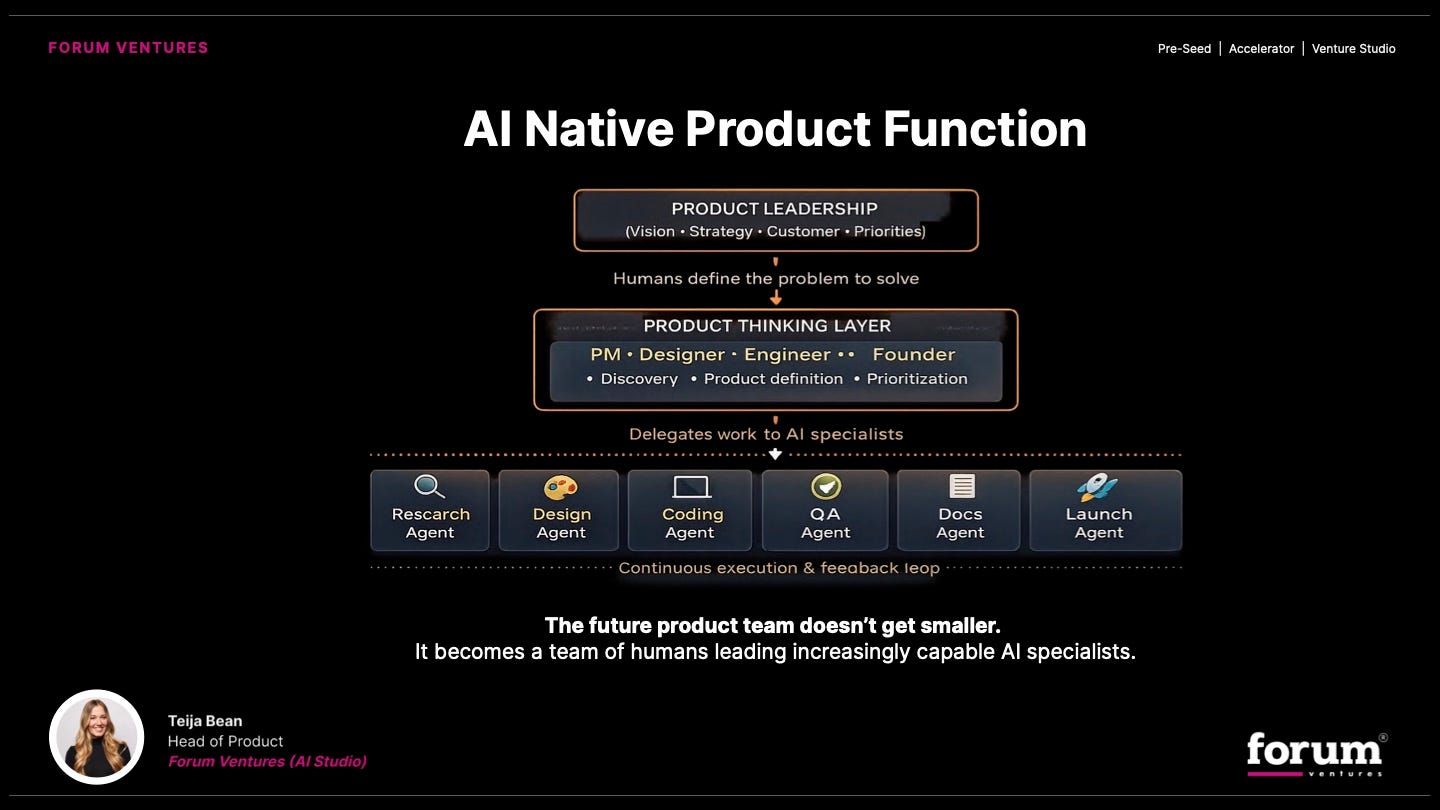
That’s where I think product teams are heading.
Not toward fewer people.
Toward smaller teams leading increasingly capable AI specialists.
Humans will continue deciding what to build and why.
AI will increasingly own more of the how.
I actually built a Claude skill for myself called /beforeyoubuild.
It’s basically an AI product advisor that pressure-tests my thinking before I let myself build anything.
Every new product.
Every feature.
Every major decision.
It forces me to validate the problem before I invest in the solution.
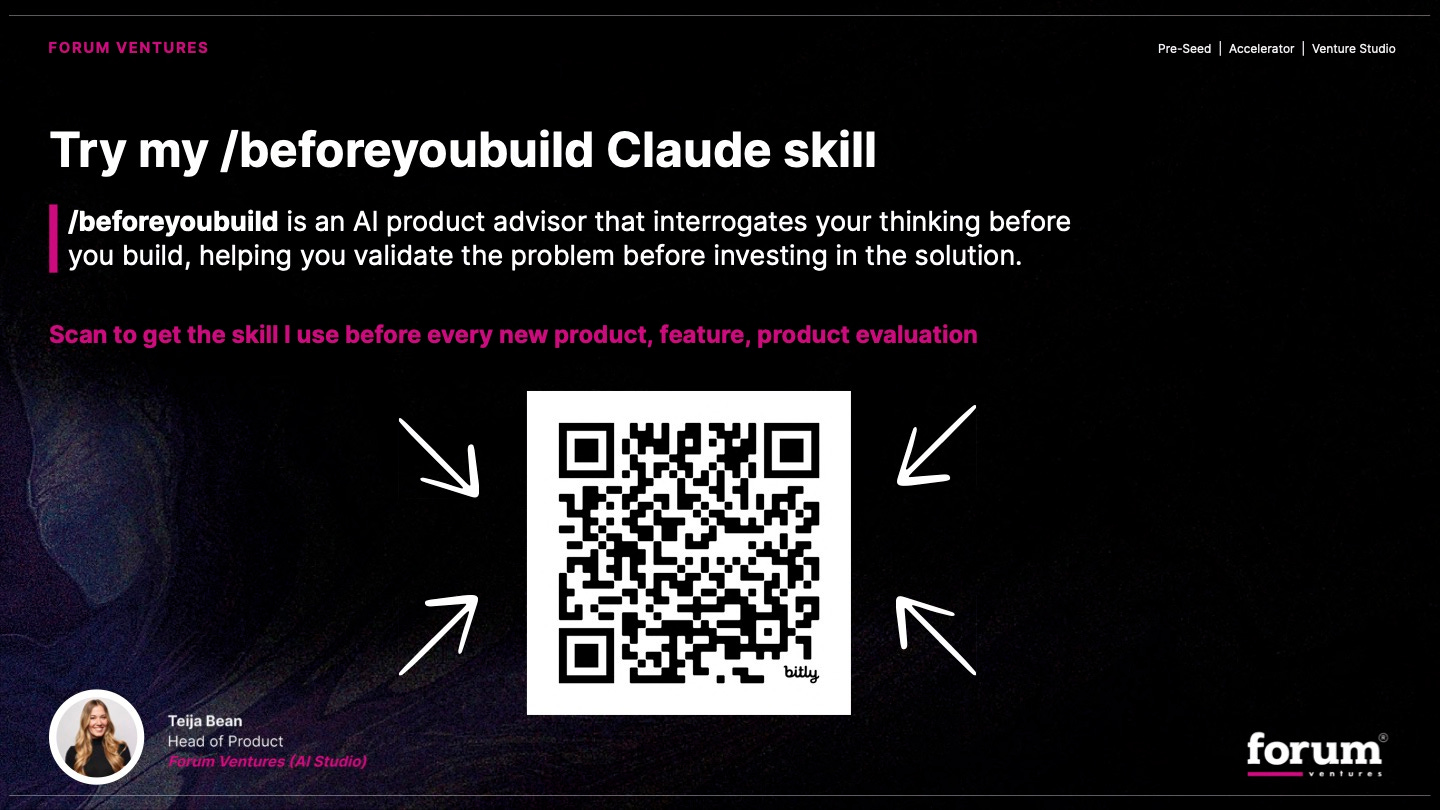
It asks me three simple questions.
1. Is there one repeatable, correct answer? If yes, automate it.
2. Does this require human judgment, but AI could make the thinking faster? If yes, accelerate it, but keep a person accountable for the decision.
3. Does this depend on understanding a customer’s specific context that no model has access to? If yes, anchor it.
Most founders ask:
Can AI do this?
I think the better question is:
Where does the understanding actually come from?
Looking back, I’m actually glad that presentation challenged my thinking.
It forced me to pressure-test the framework instead of assuming I already had the answer.
AI is evolving incredibly quickly, and I’m sure parts of this framework will evolve with it.
But for now, this is the mental model I keep coming back to.
If the understanding already exists, automate it.
If AI can make your thinking faster, accelerate it.
If doing the work is what creates the understanding, stay involved.
That’s the framework I’ve landed on today.
We’ll see where AI takes us next.
You got this,
Teija
If you found this helpful, share The Midnight Text with another founder!
If you’re an early-stage B2B founder looking for your first check and unmatchable support, learn more about our accelerator here.
If you’re an early-stage B2B founder with an idea or insight and deep domain expertise, and haven’t taken the founder leap yet, learn more about our venture studio here.
Comments
Nothing yet. Say the first thing.
Sign in to join the conversation.